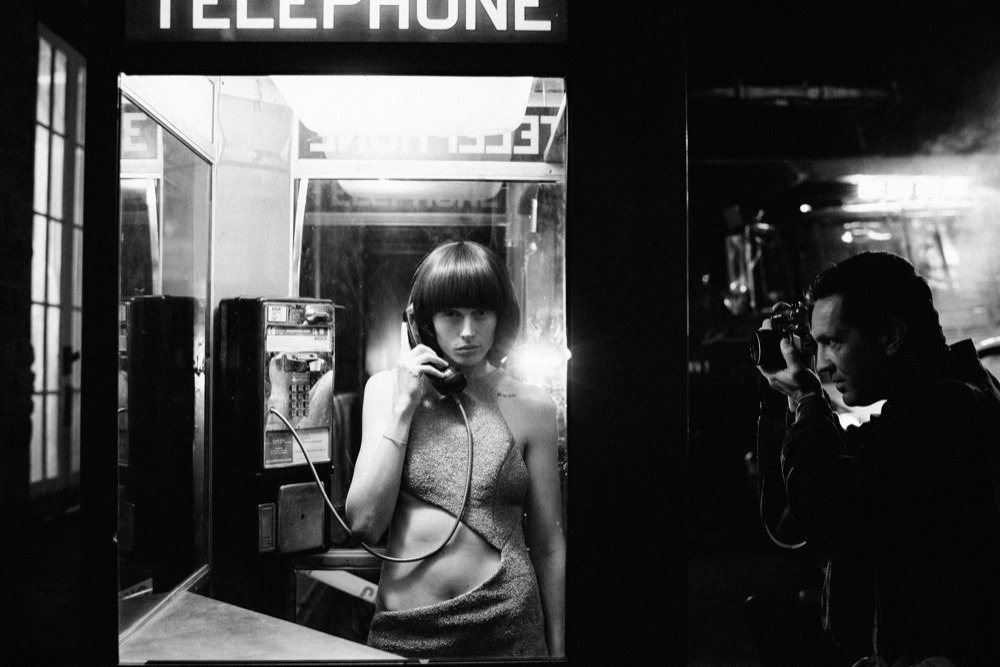
Chadwick TylerAli Michael for P Magazine (2015)

I get a lot of guff from people when it comes to my notions of what constitutes logical framing decisions.

I suppose my two responses to that would be something like:

  1. The received wisdom that one needs to learn the rules before breaking them applies, and
  2. That I am aware that I tend towards dogma with regard to certain aspects of image making–so take what I saw with a big old boulder size grain of salt.

In truth, I don’t really spend a lot of time thinking about it. The proliferation of lens based imaging methods has democratized visual culture only insofar as anyone who can lay hands on the equipment now claims to know what they’re doing. In my experience, however, the predicted increase in vitality of work turned out to be a trumped up pipe dream.

I really don’t like this frame. It’s clearly trying very hard to seem like a shot from the hip, every second of living the hip lifestyle obsession circle jerk is pure fashion poetry waiting to be memorialized by a snapping shutter. (If it was legitimately that, I’d be non-plussed but generally accepting of it.)

I don’t like that this is so carefully posturing as that but it’s difficult to hold the grudge since the Michael’s pose is so spontaneous and clearly unintended. (The fashion/glamour everything that’s not airbrushed must go aesthetic, infuriates me.)

So I find awkward poses like this–when they ever see the light of day–to be endearing. It’s like an admonition to remember that people are beautiful not only when they are trying to be or not succeding at being, they are beautiful because they are people doing the best they can with what they have.

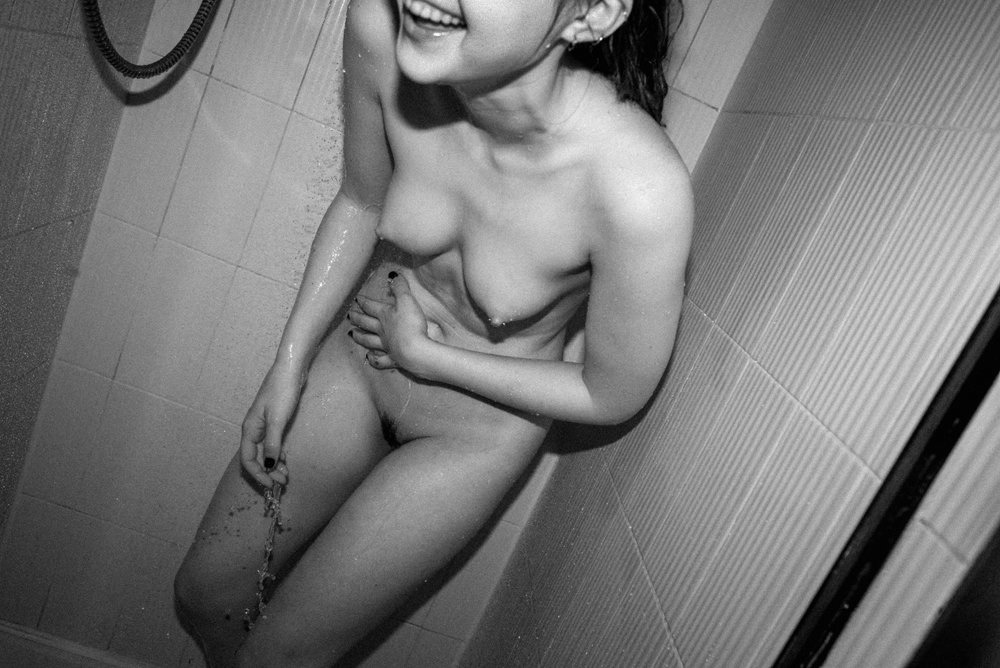
The pose also reminds me of another image I had saved as a draft but I didn’t know how to address.

Source unknown – Title Unknown (19XX)

I could comment on this isn’t necessarily a good picture but at least the depth of field softejs in both the foreground and background.But mostly I have been sleeping like shit for the last week and am not exactly in a frame of mind conducive to critical/analytical writing. So I’m just leaving this here because I think it’s hot as fuck.

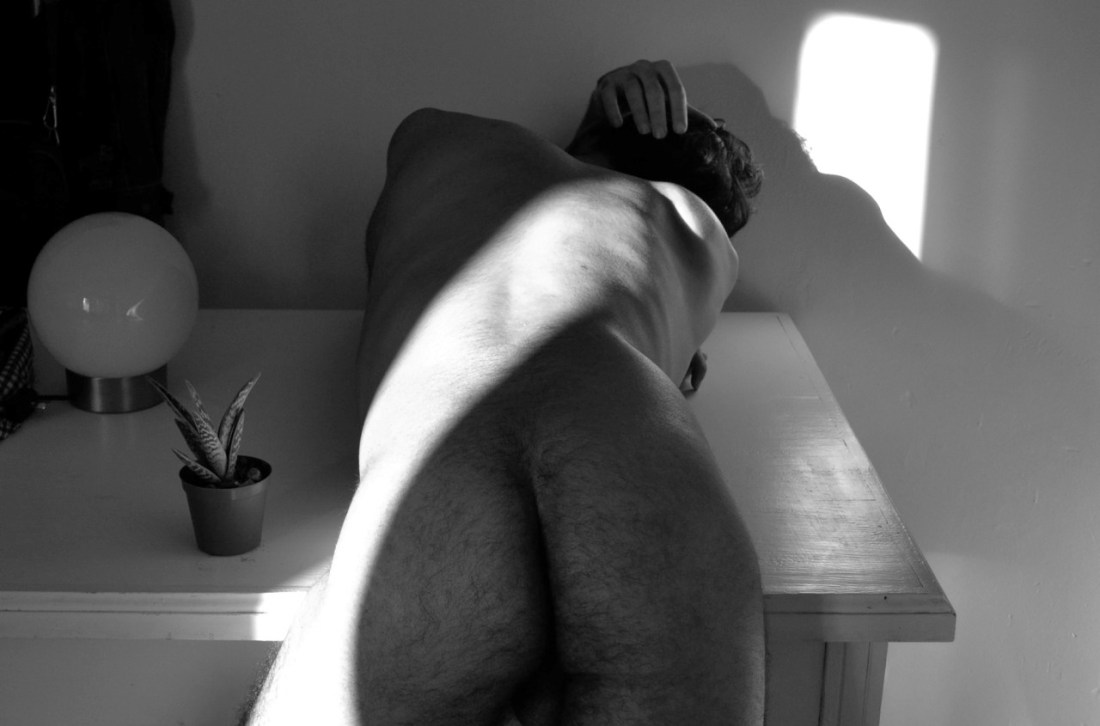
M▲NU

Untitled (2012)

This image doesn’t quite work. The swath of light falling across the back and the hard shadow cast by his hair, shoulder and arched back is freaking gorgeous.

This is digital, so assuming a RAW file (which if you are shooting digital and not shooting RAW, then like why bother), there’s definitely going to be enough detail of the reflection in that globe to pull out details in order to evoke a better picture of the room (a la Escher’s famous self-portrait).

And the lighting is weird. The highlight by his left hip is probably, what 5 stops over. The pool over his right shoulder 3 stops. You’re getting bounce back from that pool onto the surface of the desk and light ostensibly reflecting off the floor is spilling around under the desk.

Further, I really don’t understand the two objects choice–compositionally an odd # of things is almost always preferable; I think the left hand that you can see curled under the right side is supposed to balance this. It doesn’t and wouldn’t even if it was more apparent. It would need to be holding something.

Thus, there either needed to be a third object, the plant needs to move from his left side to his right or that black drape behind the globe light needs to be removed. Actually, any way you slice it that black drape–although it does extend the dynamic range of the image–adds zilch to the proceedings.

mpdrolet:

Cara Robbins

Cara RobbinsAugust Getty SS2016 (2015)

The above image has a very Blow-Up vibe to it.

And the story behind it definitely fits that perception. Interview Magazine hired Robbins to cover Getty’s latest fashion collection “Thread of Man”

I know fuck all about fashion. When I buy clothes I usually wander around the store feeling each garment between thumb and forefinger. If I like the way it feels on my skin, I consider color–I have an unintentional fondness for earth tones, apparently. If I subsequently try the item on and it looks normalish on my frame, then we’re a go.

Thus, I had no idea that Getty is some kind of Fashion world wunderkind. He’s 21 and the above image is taken from his third ever show. For it he hired David LaChapelle. (Full disclosure: when I think of the word ‘garish’ the visual definition that pops into my head is exactly half Amsterdam’s Red Light District and half David LaChapelle.)

Given free reign LaChapelle, as he’s wont to do, built an elaborate installation on a Universal Studios back lot wherein to install the show. (If you care at all, read more about it here.)

Robbins choice to deliver the images in B&W is a bit idiosyncratic to me. LaChappelle’s work is loud and unsubtle and much of how he accomplishes this relies heavily on cacophonous color palates.

On one level, this decision is prescient: diminishing the fanfare in favor of emphasizing the clothing. (The dress and the way it fits is definitely the focus of this image; the rest is lagniappe.)

What strikes me as perhaps disingenuous is that Robbins’ work features flourishes that are frequently straight out of the LaChappelle playbook–especially in her portraits featuring more cluttered backgrounds.

All-in-all this is one of those instances where upon learning the context of the image, my original opinion shifts slightly to the bad. I just can’t shake the feeling that the image maker is hiding something in a fashion that is very nearly if not fully dishonest.

photominimal:

There and Back. With Suspended in Light: Montreal / Polaroid Automatic 100 / Fuji FP3000b

I am absolutely dead-to-rights, head-over-heals for this ‘Polaroid’.

Yes, the tonal variations are effing exquisite. Note the gradual grade from right to left–reversing the convention set by Dutch Golden Age (that’s been more or less continued uninterrupted ever since).

And the light slides into the frame in such a way as to imply a right triangle. There are so many grace notes: the way the sunlight accentuates the curve of the bottle like a hand that can’t quite decide whether to lift the object or merely luxuriate in the cool press against its palm. The two plants–how they are just illuminated enough to separate them from the background, rendering them legible. The way the brightest point in the image is the echoing right angle formed by Suspended In Light’s left forearm the sink edge and the side of her top.

Oh, and the way the light from her left thigh pops against the gloaming darkness. And the second bottle to the left of the mirror with the sprig of something standing at attention. And the light on her reflected face…

Instant film stocks tend to provide an unpredictable softness of focus. It is used to masterful effect here were the paneling, sink pedastal and skin all appear to have visual texture that almost seems as if were you to touch it, it would feel like wood, porcelain and flesh.

But I think what I love most is the washing machine and dryer nudging in along the lower left edge of the frame. Not only does it balance out what would have otherwise between a frame leaning decidedly off balance to the right, the inclusion renders a greater degree of interest in the frame as a whole. There is a timelessness feel to the image but it is clearly anchored in the present.

I especially admire this image because in my own work, I am generally loathe to work indoors. I always tell myself that one day I’ll be able to afford to live in a place like the apartment in Mirror. This image serves as a reminder that even if I had that apartment, I’d still struggle to shoot in it because when you’re working in close confines, at a certain point you have to play it as it lays. I’m too much of a control freak to do that–and I think my work suffers as a result.

Marc Attali [p] / Jacques Delfau [t] – Les érotiques du regard (1968)

I don’t speak a lick of French–so best as I can tell: this image is from a book entitled Les érotiques du regard (trans. Erotic Gaze).

It was published in the late 60s and features Attali’s photos and Delfau’s poems.

What’s online from it looks effing exquisite!

There’s something mysterious about this photo. Has she removed her own undergarment to holding it up like a flag? Does it instead belong to a lover? Is she holding it up to the light the better to see it? The text–again I do not know French–but Google translate seems to suggest something like “dedicated to the unfaithful” as the meaning. (EDIT #1: I’ve been informed by my favorite native French speaker that it means literally: “[v]owed to an unfaithful role” or maybe something like “[d]oomed to be unfaithful”. EDIT #2: After further contextual investigation it seems it means “relegated [as if by societal perception] to be unfaithful”)

Vermeer may be my all-time favorite artist. That’s because many of his works feature what I call a ‘story seed’.

Much the way an acorn contains the oak–a story seed is a single static frame given which the viewer can interpolate much if not all of the events leading up to the moment rendered as well as some notion of what follows given the scene as presented.

It is unlikely that Vermeer ever intended his paintings to bear titles. But what’s interesting to me is that frequently the titles that have come to be historically attached to his work tend to describe as opposed to definitively encapsulate.

One of the many things Joel Sternfeld is up to in his On This Site series is majorly fucking with the conception of the relationship between photographs and their accompanying titles.

With the project, he pairs self-consciously mannered fine art photographs bearing descriptive titles with additional text explaining the broader historical context which motivated him to make the picture–in this case: incidents of stunning violence.

I object to artist’s who hang titles on their work as an attempt to activate a perceived narrative that might otherwise be missed by the viewer. Worse though are the scores of folks who pretentiously intellectualize titles as a way to add a sense of lofty intellectual ambition to straightforward work.

A good title serves as something closer to an ergonomic handle never–and yes, at times knowing a handle is a handle can be instructive if you are questioning how to carry something. But as a rule, if you title your photographs: your title should not function as a instruction manual or explanatory dissertation.

If that’s how you employ titles then you might be better served pursuing something more in keeping with the artists’ books tact of Les érotiques du regard–in that way you’ll have room for didactics instead of bragging about how oh so super smart you are.

Édouard Chimot – Untitled (1930)

This is clearly a sketch. By that I mean the figures are posed for the artist to render them. Yet here, how they are rendered is interesting. The presumable draped dais upon which they are standing is rendered in the drawing in sculptural fashion–the base requiring strategic load bearing functionality to support the figures rising from it. (It bears mentioning that the shading to suggest depth is masterful and I love the simple line and asymmetrical form of the standing woman’s breasts–an incisive application of the classical contrapposto posture to a female figure.)

And although the poses are hardly exact matches, the tone does remind me very much of Gustav Vigeland’s Kneeling Man Embracing a Standing Woman.

Also, I really like the cartoon face in the margin that appears like what I’d imagine the main character would be in a Jean Vigo directed anime.

msjanssen:

lovely backlight!

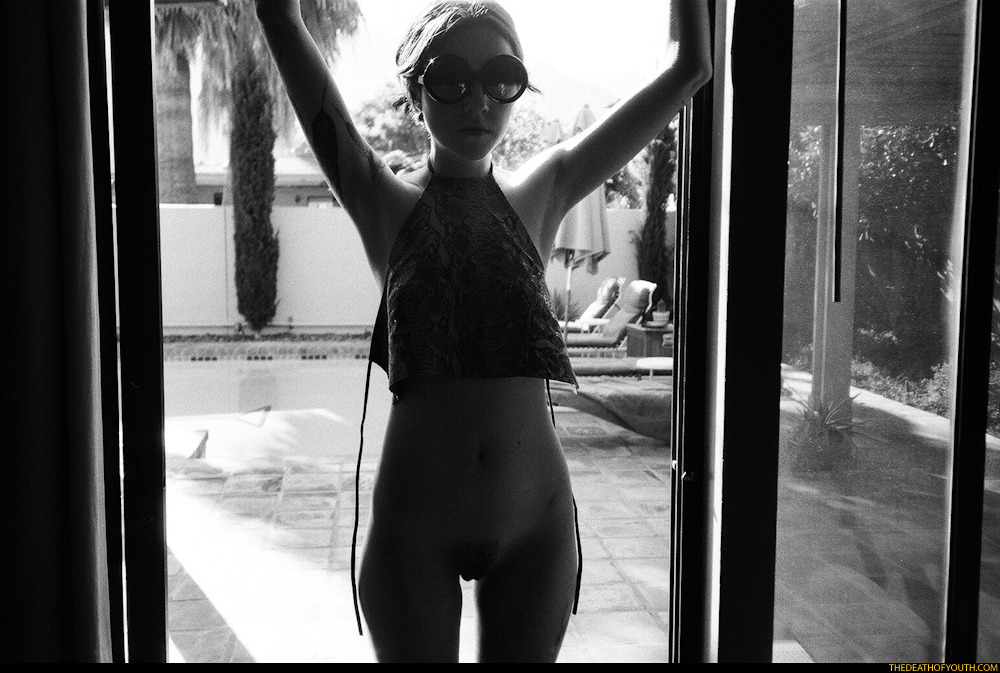
The Death of YouthAlanna (2012)

@msjanssen has already covered ¾ of what’s so arresting about this image.

All I can add is that you also need to consider the angle of the light. Yes, it’s backlit; but while the background is bright and the foreground is dark, the angle of the light is falls in such a way that you can actually make out the general shape of Alanna’s face and unlike the flattening silhouetting effect of backlighting, her body has dimensionality–you can see the shape of her hips and tummy and just make her pubic thatch.

Also, you can gather enough to get a clear notion of the pattern of her top–which is super cute. The loose hanging strings contributing a casually coy hint of eroticism.

I’m generally put off by tDoY’s semi-slick, desert counter culture as new glamour aesthetic ethos. And while I think there’s room for improvement with the above image–Alanna’s left elbow gets lost in the shadowed doorframe and the down tilt of the wide angle lens renders the plumb lines of the door as converging instead of parallel and this encourages a downward cast of the gaze that walks a razor wire line between breathless appreciation and leering; in turn that renders the way both her arms and legs are amputated problematic regardless of which side the viewer tips toward.

Willy KesselsFemale nude from behind (19XX)

I’m too fuzzy on the the epoch to identify the progenitor here but this is reminiscent of both Edward Weston and Man Ray.

I’ve mentioned before that Weston’s enduring reputation is due to the brilliance of his skills as a print maker not especially as a result of his compositions.

And with Man Ray, who referred to images of himself as rayographs, there’s always a feeling I have when I look at his work that he felt the women he photographed were art only because they were fucking him at the time.

Kessels’ photo manages to skip the sentimental nostalgia for heated fumbling adolescent sexual exploration and present something unusually reserved, almost reverent.