Harry CallahanEleanor and Barbara (1954)

onlyoldphotography:

Muses throughout his career, Callahan’s wife and daughter played, posed, and aged before his lens. With their attention to the physicality of light, however, Callahan’s photographs transcend mere family portraiture by calling attention to the simple beauty of life’s fleeting moments. “He just liked to take the pictures of me,” Eleanor recalled in her nineties. “In every pose. Rain or shine. And whatever I was doing. If I was doing the dishes or if I was half asleep. And he knew that I never, never said no. I was always there for him. Because I knew that Harry would only do the right thing.”
Eleanor Callahan died in February 2012 at the age of ninety-five.

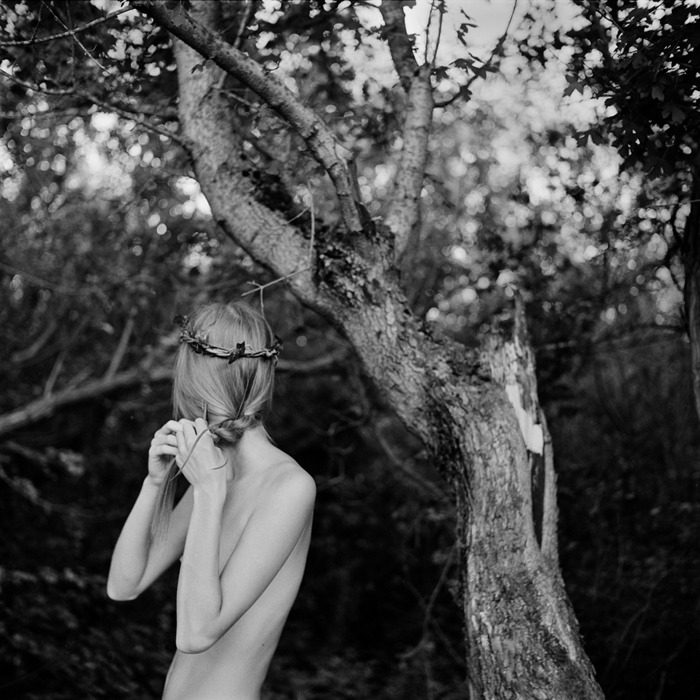
Mariya Kozhanova Untitled from Prussian Brides series (201X)

There are so many things this does well–the tree trunk twists up and stretches away  into the background, the young woman leans every so slightly toward the camera to counterbalance this retreat (it’s rare to see such shallow depth of field used to interesting, thoughtful effect); not to mention the effing lovely cinematic bokeh…

I don’t have any quarrel with this photograph in and of itself. In fact, I’m rather fond of it. The thing that baffles me is the rest of Kozhanova’s Prussian Brides series. I don’t understand the use of eye contact with the camera, POV shots, not to mention her homage to Jock Sturges and startling similar ways her shooting windows is reminiscent of Michelle Arcila.

The statement of purpose accompanying this body of work–contributed by Russian curator Irina Cmyreva– (unfortunately) further muddies the matter. After localizing the work in the history and tradition of Prussia (now Kaliningrad), she connects to work with the ‘original Prussian legend’ where:

[A] dead bride in ancient times whose tomb was opened and it was discovered that she had disappeared. The Prussian Bride is a kind of
film or literary narrative about a girl’s dream of an old house within
an ancient estate in the forests. The month of May is the time when
nature awakes again and is reborn. It is the time of the ancient legends
and the folk celebrations of the “May Bride”. In her re-telling of the
legend of the May Bride, Kozhanova incorporates Prussian culture in the
blond beauty of the girls, the old style of the dresses they wear and
the architecture of the house itself.

It speaks to how much better the above photograph is than the rest of the project that verbal diarrhea such as this actually serves the work. But it detracts a great deal from the rest of the images in the series.

The images are not a stand-in for ‘a kind of film’ or a literary narrative. They might be a bit of a dream–that would alleviate some of my more pressing concerns. However, in point of fact, it’s not. The work is precocious portraiture, edgy editorial or oneiric look book. By trying to be all those things at once, it ends up being none of them.

Kozhanova is still a teenager–a clearly clever and talented teenage. So I’m willing to give her some credit. There’s a chance a 6×6 camera is all she has and another chance that it was less her notion to tie her work together with a pat mythological reference. And even if she was directly responsible for both decisions, her work is sharper than a great bit of what’s out there.

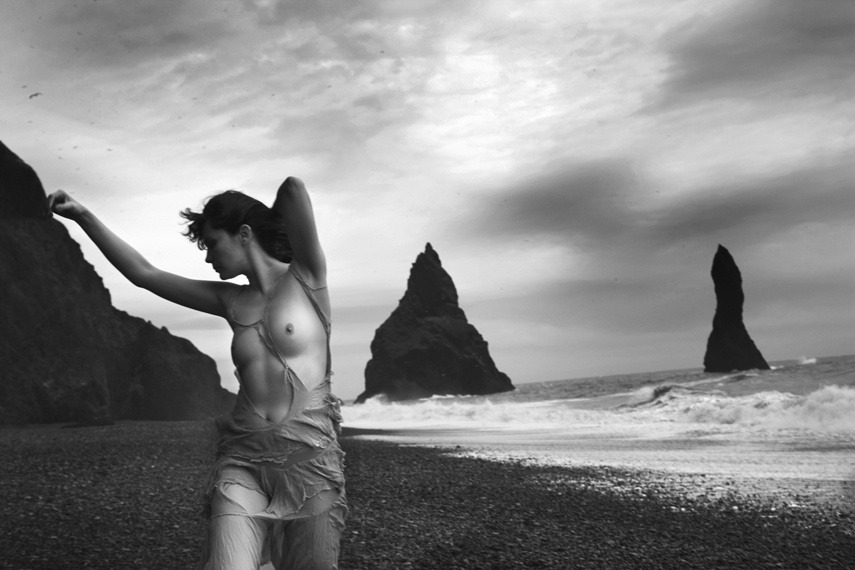
Silja MaggUntitled (201X)

Despite the fact that this sacrifices proper exposure for pushed contrast, I’d post it on the strength of the interplay between the tattered outfit and the gorgeous skin tone highlights.

But, I’m mostly posting it because it was taken on the volcanic black sands of Vík beach in Ísland, or as you’re probably more familiar with seeing it: Iceland.

The way that many of the misogynist literary giants write about how Africa gets under your skin is the way I feel about Iceland.

I’ve dreamed about it on a recurring basis since I was approximately eight. Initially, in these dreams I’d find myself in the middle of a vast expanse of arctic terrain. In the way dream logic works, I just felt that this was Iceland. It was a number of years before someone informed me of the epigraph: Iceland is green and Greenland is ice.

The dreams continued but shifted: I’d be on my way to the airport to fly to Iceland. But there’d be traffic or I’d have forgotten my passport.

Finally, two years ago, despite being unemployed, I through caution into the wind and spent a week there.

I’m not yet to a point where I can articulate the impact of this trip. All I can say is that I’ve booked tickets to visit again at the end of the summer.

I could never live in Iceland. Being as I suffer from severe Season Affective Disorder, the paltry 3 daylight (3 hours in Reykjavik at Solstice) would quite literally kill me. But it’s a place where I feel strangely not at home but in my element.

All that is merely to introduce the fact that as Iceland becomes an increasingly popular vacation destination and more and more photographers tap into the alien beauty of the land, there are sadly fewer and fewer images like this that so effectively encapsulate the feeling of being there that they make my soul ache with the most profound longing.

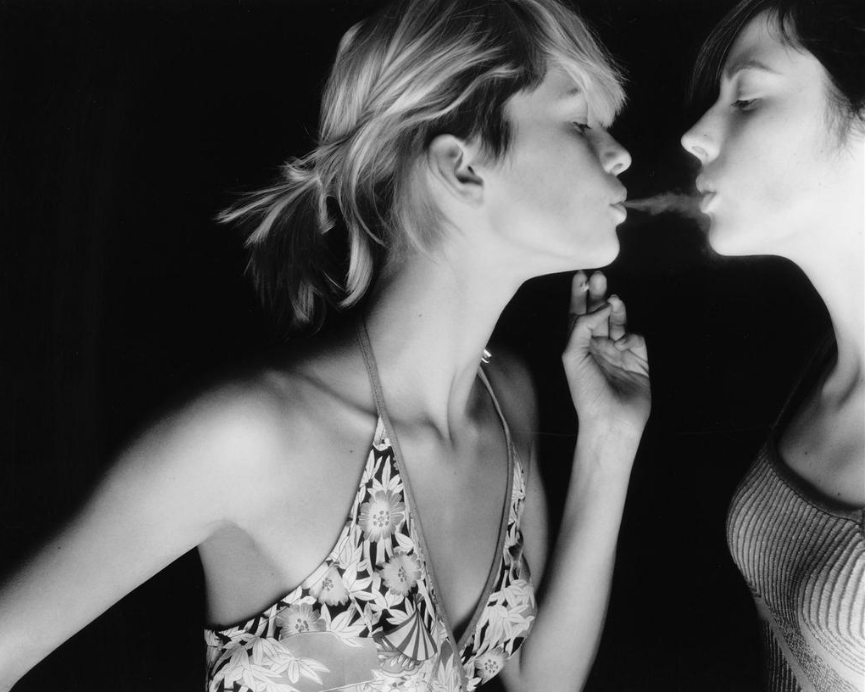
Lula HyersUntitled (2014)

Were you to take the current bumper crop of twenty-something lifestyle/fashion image makers, write their names on slips of paper, fold up those slips and place them into a hat, shake the hat about and pull out a name at random, any name would share some obvious parallel with Hyers’ work.

I am certain that Hyers would be at least passingly familiar with the large majority of names in that hat. She probably even considers many of them influences. The thing is: her work is also frequently better than the work of at least ¾ of those names that might emerge from the hat.

A bold statement: yes; but if you stop and look at her work–I mean engage with it–you can’t dispute the assertion. Add to that, Hyer’s still being a teenager and Jesus Harold and Maude Fucking Christ on Christmas her aptitude is freaking unbelievable.

And while I am of a mind that she’s better than the majority of her peers/influences, what she does better than just about anyone is the way she presents bodies and the sometimes related sometimes unrelated sexual expression of bodies as almost an afterthought–allowing her broad latitude in presented the truth of those in her life without misrepresenting the complexity of the moments she captures or relying on knee jerk shock value.

It’s surprisingly mature work for someone so young. And although comparisons to those aforementioned twenty-something lifestyle photographers are astute (along with correlations to Goldin and McGinley), I feel there’s a closer relationship with the frenzied urge to document life exemplified by one of my favorite photographers Igor Mukhin.

What I see matters little next to  than simple truth that this work is breathtaking; I cannot wait to see where it goes from here.

Source unknown – Title unknown (19XX)

I have a preference for graphic depictions of sexuality focusing on a woman’s pleasure. Thus, although clearly staged–this appeals to me with a particular intensity.

The intensity is amplified by the fact that I also find it alluring where nudity is not presented as a facet of a woman’s sexual expression.

What I am really trying to communicate is the completeness with which this had me from the start.

There are two things it refuses to clarify: is the woman’s thousand yard stare a by product of the obvious staging of the scene or is she fantasizing about another man–perhaps the one rendered as a ghostly presence in the background.

My suspicion this is the intended–as much as authorial intention bears any relationship to the audience’s reading/interpretation (which is to say little if any)–outcome; however, to me the image exudes a sort of aching physical desperation. And that feeling causes me to wander if the ghostly presence is perhaps actually corporeal–a third party waiting to be invited to join the proceedings. The positioning doesn’t really support this interpretation; but wondering about the position caused me to notice the pose and musculature is oddly posed–legs together and touching, abdomen perhaps stretched…

…and I can’t help but thinking if the woman is thinking about the Crucifixion–a notion that would certainly fit with the feeling of seething sexual desperation I get from the image.

It doesn’t have to be that. In all likelihood it isn’t; but the ambiguity within the work that allows such an obscene meditation appeals with glee to the stretching darkness in me.

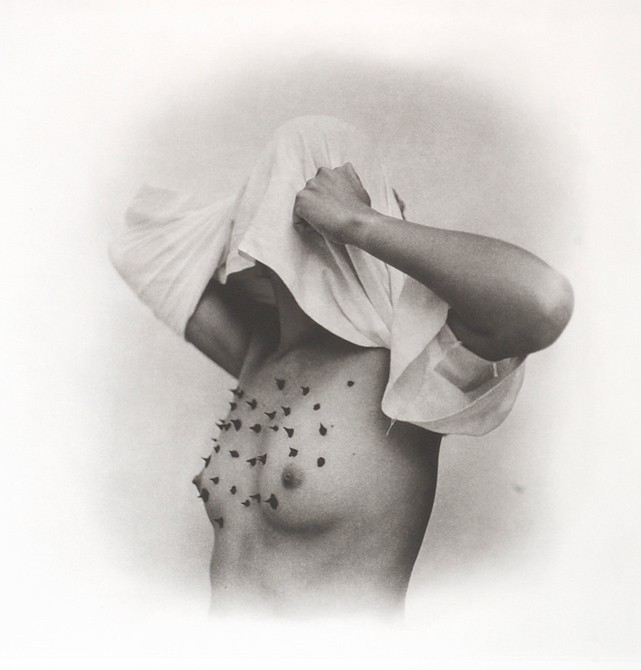
Marta Maria Perez BravoProtection (1990)

You know that class everyone has during their first year of uni that teaches you have to write a paper and use the library for research, etc?

Well, during my first college try, the teacher who taught my orientation course was a curmudgeonly fucker who smoked in class while refusing to let anyone else partake; he told us right off that he only promised to read the first paragraph of our papers and if he wasn’t interested he had five steps from his vestibule up to his living room and he’d stand in the living room and toss the offending papers down rendering the binding final grade based upon where they landed–top step being an A, bottom step an F.

I was one of three students who had every word of every paper read. This was not necessarily a desirable status due to the fact that unlike the other two folks, my tactic wasn’t finding a way to present the material in a direct and pithy manner so much as to present a first paragraph that made the reader ask themselves how the ever loving shit is this fucker going to bring this back around to the assigned topic?

To this day I struggle with directly engaging with material. It’s so much easier for me to indicate overlap and then address things in terms of analyzing things with which I am much more thoroughly familiar. I worry a lot about getting shit wrong and it’s easier not to fuck up when you are dealing with the familiar instead of the foreign.

The benefit to my approach is occasionally, the apt metaphor is the perfect decoder ring. So for every time it works, the nine other times it doesn’t just seem like the price of admission instead of a deficit of diversity in tactics.

Whatever that’s a whole lot about me and very little about this amazing photograph. But part of the reason this photograph appeals to me is that it presents the equivalent of an initial paragraph that is both completely outlandish and also simultaneously tied to a rigorous artistic unity within the work.

For example: when I look at it I notice two things predominately. It provides an oneric as opposed to dream-like consistency. (Perhaps the best way to explain what I mean in juxtaposing ‘oneric’ with ‘dream-like’ is the difference between Maya Deren and David Lynch–the former is interested in replicating the logic, structure and mechanics of dream states on the silver screen whereas the later is interested in borrowing the fragmentation, ruptures and disjunctions familiar from dreams as a means of structuring/sequencing images in a more-or-less narrative fashion.

Thing #2 that I notice is that when researching the additional, non-visual context of the image this distinction broadens and enriches my perception of the images; i.e. there is a reason that this reminds me of an image emerging from a dream instead of being an imitation of a dream–Bravo being deeply immersed in the Afro-Carribean Santería, a belief that “the divine exists in all things, even everyday objects.”

I will be forever fond of work that rewards engagement by unfolding and intensifying. Plus, I pretty much live for those moments when I learn something without any sort of awareness of didactic intentionality. In other words, the engagement is both its own reward and an invitation to deeper levels of resonance and understanding.

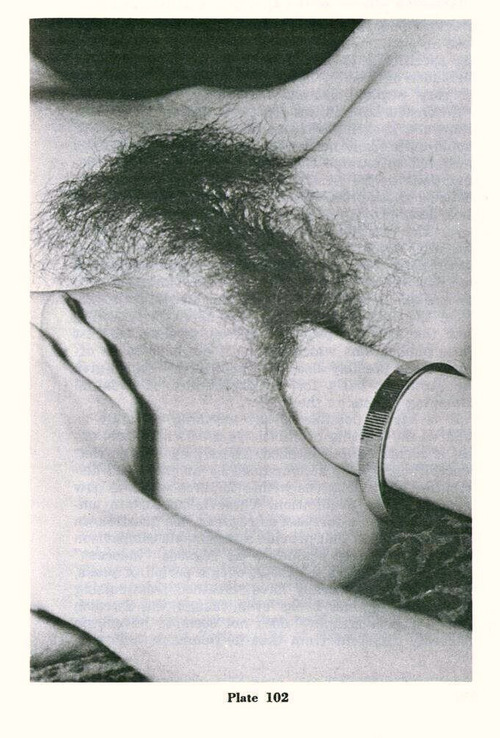
Source unknown – Title Unknown (19XX)

This reminds me of both Man Ray’s pornographic self-portraits with Kiki De Montparnasse and Hans Bellmer’s test photos for the cover of L’histoire de l’oeil.

But it mirrors (along a vertical axis) the infamous Mapplethorpe photograph.

I’m fairly certain this post-dates the first two and predates the latter. As much as I admire Bellmer’s audacity in presenting the extremity of sexuality without ever losing site of the hunger for physical pleasure that motivates it and how much the clean minimial aesthetic of Mapplethorpe’s image speaks to me, I think this may be if not the better image out of the aforementioned cohort, it is the most interesting.

There’s a way in which it contradicts itself. The intimacy of the extreme and extremely graphic close up with the bracelet dangling from the wrist–at once both private (an intimate document) and public (a jewelry advert). There’s the way the hand on the left hand on the leg can be seen bracing with an implicit violence to administer greater force or a calming/reassuring means of facilitating connection through an intense physical experience.

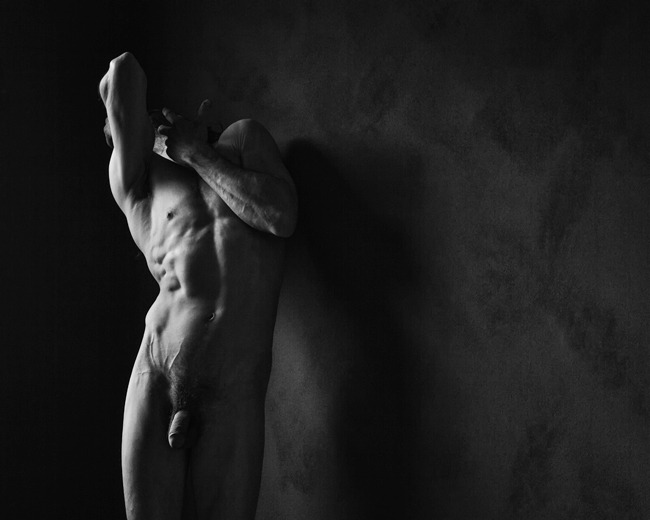
Carter SmithAn Oost (2001)

As fascinated as I am by the transgressive, I’m put off by cultivated hedonism.

It’s not even that I have a problem with pleasure for pleasure’s sake–after all everything in moderation up to an including moderation itself.

But, being an alcohol dependent individual, I’ve learned the middle way is better than the escalating risk/consequence cycle.

Sure, it was great when I was a twenty-something. The strange magic whereby no matter how late I’d been up binge drinking the night before, by noon I was right as rain.

As I’ve gotten older, over-indulging has increasingly long range effects that I simply can’t tolerate. However, I can’t stop drinking. Beyond the fact that I drink as a means of self-medication, I chase this permeability. A sort of running up to edge and dangling as much of my body into the chasm as I can without falling.

Part of the motivation is because I’m damaged goods. Or, a truer way of saying it: so much of what I’ve felt so strongly all my life–contrary to logic or any authentic personal experience–resonates with this image. I drink because every once in a while, if the moon’s in the right house, I remember what it’s like to feel physically present and entirely permeable with another person.

Patricija StepanovicUntitled from Skin series (2011)

As far as creativity goes, I feel as if there’s the person who is unflappably driven. Who sets out in one direction and plows ahead without looking back. The instinct motivating such single-mindedness doesn’t necessarily make someone a good image maker. But it does seem to improve the odds.

Stepanovic is decidedly not one of those single-minded obsessives. She’s more a chameleon–shifting styles and genres on a dime. (The only consistent facet of her work seems to be her favoring the milky texture that comes from soft-focus and underexposure.

I won’t go as far as to say I dislike her work–there’s only a handful of folks whose work I’ll openly call out as bad–but it’s largely uneven, obviously derivative (ex. Stepanovic | Arcila) and maybe even a little sad.

I say sad because the above image was one of her earlier efforts. It demonstrates an eye that although not strong has a certain precociousness for the tenuousness of an ephemeral moment. It’s also extremely creative. Usually blinds like these–besides being annoying–are employed towards a more film noir reminiscent end. This tosses the usual playbook and instead uses them as an innovative backdrop. (This same creativity manifests in much of the rest of the work, only more often than not it skews towards executing something that’s already been done and the result achieves strikingly less effect the the original.)

I’m not interested in self-conscious homage to artistic heroes. But I am interested in Stepanovic’s personal vision. The few times it slips through it outshines the rest of the work like the midday sun next to a candle. Thus, I know it’s in there somewhere. It’s just not all that present in the work. And that’s a crying shame.