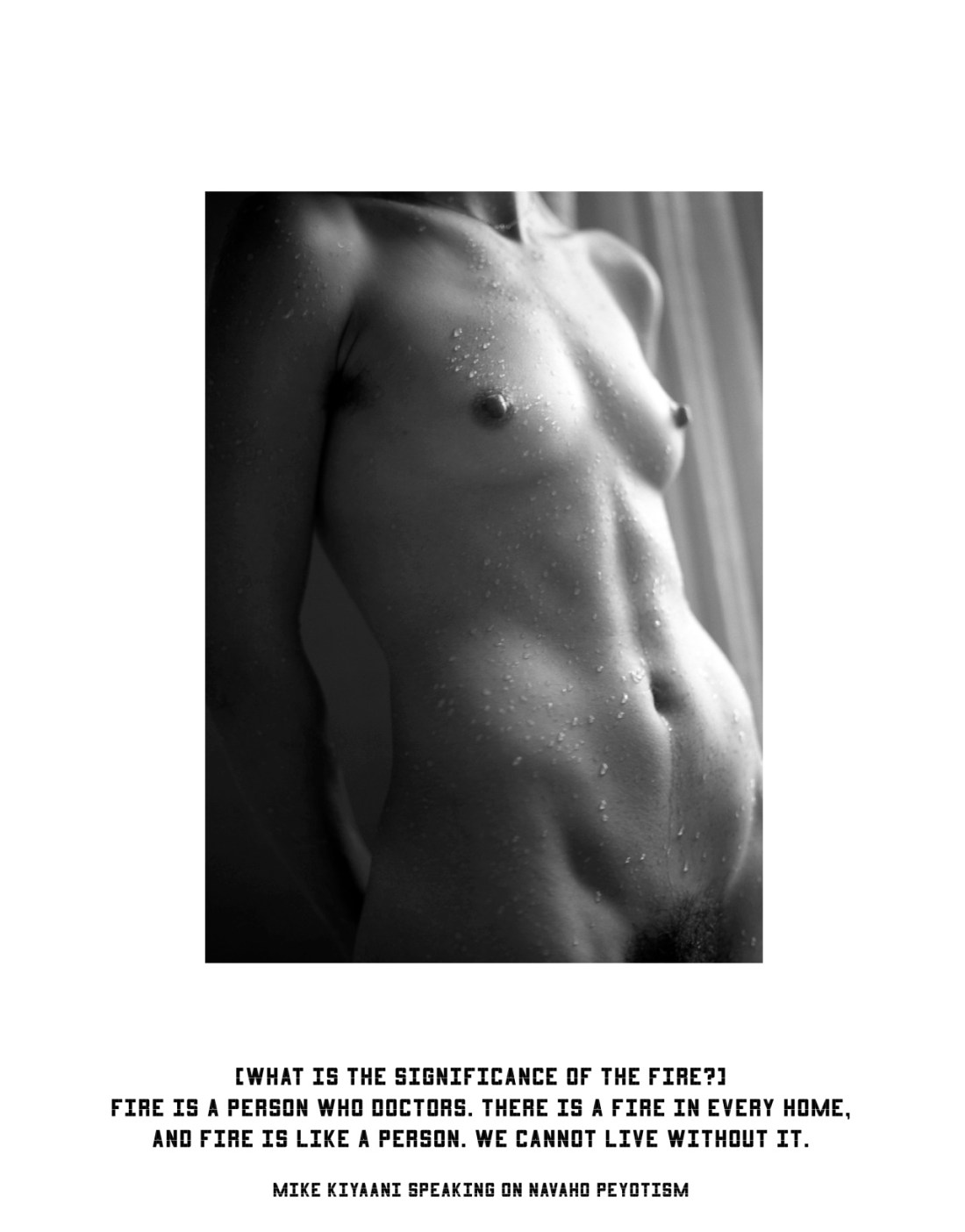
Zsuzsanna Ujj – [←] Untitled (1989); [+] Untitled (1989); [→] Untitled (1989)

There’s not a lot that about Ms. Ujj to be found. She’s Hungarian and began making subversive self-portraits in the 1980s pretty much covers the extent of it.

She’s clearly preoccupied with the relationship between a woman’s body, how the woman sees her body and how society views a woman’s body. However, in this work, given the interactions of shadows (and the probable Jungian implications) and reflections (the resulting bifurcation of physical representation/ sight turned against itself), there’s more going on here than is readily discernible.

The dislocation is interesting and although I want to connect that to Picasso’s frequent mutilation of women’s bodies and while I know there’s an obvious metaphor with the individual vs. collective that relates to communism, my first thought upon seeing these was of the images of shadows burned into walls after the bombing of Hiroshima.

These images go a great deal deeper than most and they offer no ready made solutions or easy answers. In many ways, this reminds me of another work that is ostensibly about reconcile existence and beauty with the horrors of the nuclear age–Inger Christensen’s Alphabet (which is by far the best volume of poetry I’ve ever encountered).

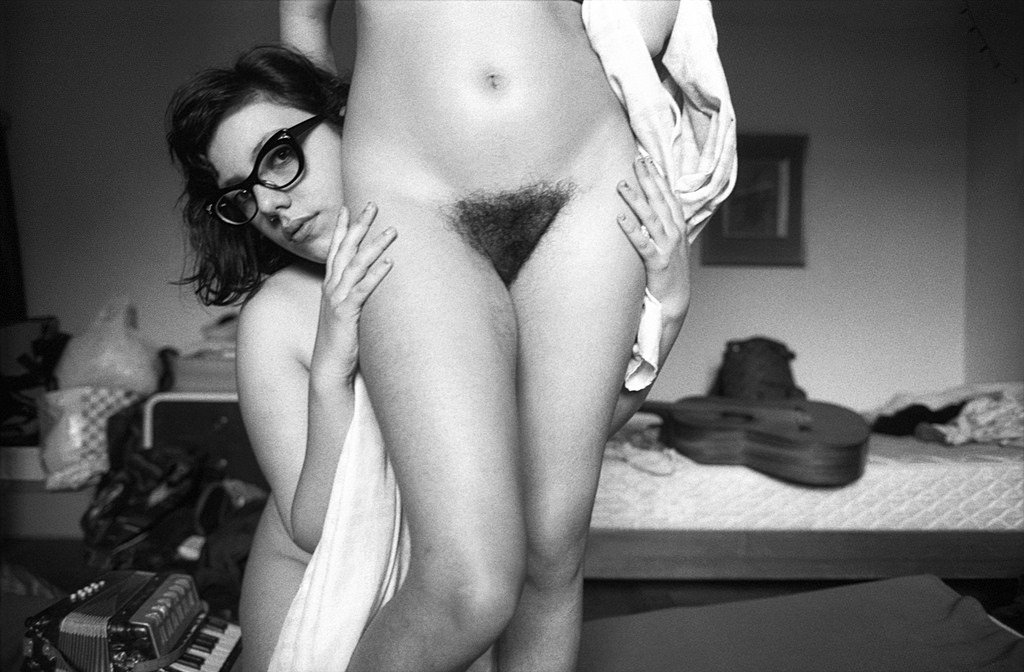
Germaine Krull – Les Amies (1924)

I have two oppoing reactions to Krull’s extremely problematic Wikipedia entry. On the one hand, it’s fucking captivating. Her family was rich and her father was either brilliant or a ne’er-do-well–or as such things usually go: both.

Her father allowed her to do whatever she wanted. She wanted to dress and behave as a boy. So that was that. She never received a formal education and was instead home schooled.

She learned to operate a camera and used that as her ticket to not only travel to far flung locales, she also met and befriended many of the best and brightest as far as 1920s creative luminaries. I mean can you imagine being on a first name basis with Rilke and Cocteau? Not to mention deemed peers with fucking Man Ray and Kertész by Parisian high society?

She was also known for giving fewer than zero fucks about what society felt her place should was and went right ahead and made her own way.

In other words, she’s exactly the sort of person I value most. And perhaps, stupidly, reading about her I can’t help but think she and I might have understood each other a little too well.

My second reaction to the Wikipedia article is that it’s composed much like a junior high research paper. You know when you’re just learning how to write and find some solid information and just change the words and re-arrange the sentence. Yeah, it’s like that and the source it’s cribbing from is an article by Kenneth Baker on the occasion of a Krull retrospective opening at SFMoMA in 2000.

Baker refers to her early nudes–the above is an example of such–as: satires of lesbian pornography.

Glossing over the way the author of the Wikipedia piece completely misreads the context, to Baker my response is: the actual fuck..? Has Old White Dude ever actually watched lesbian pornography?

I mean there are certainly lesbian overtones. But is it a satire because most lesbian porn is made by straight men for straight men and this is lesbian porn made by a wink-wink-nudge-nudge for lesbians? Personally, I don’t see it as anything less than sincere. There’s a feeling that there’s this sort of salon for two, a meeting of minds prior to a meeting of bodies. I don’t think I’ve ever seen anything quite like it before.

However, if anyone other than me saw that, it gets lost in an effort to emphasize the life of the artist at the expense of the work itself. I won’t argue that Kroll’s work is universally brilliant but there are bits of it that simply have no excuse for languishing in semi-obscurity. And I feel that Baker is the main architect of this attempt to shift attention onto the artists life–which yes is fucking intriguing–but the work can and does stand on its own feet.

I guess if it were simply garden variety sexism in popular art criticism, I’d probably just shake my hand at sky and move on. But it rankles me that not only does Baker dismiss this ingenious image, he then continues with some of the most specious art historical claptrap when he insists that Krull belongs to the Pictoralist tradition. Why because Pictorialism ran it’s course more or less concurrent with Krull’s creative maturation? Is this another effort to throw shade on her being derivative?

I’m not by any means a trained art history. But I’m not blind (yet) and I know how to listen to and feel an image. And I am very curious as to why there’s no mention of her within the context of Romanticism. I know art historian’s like to keep things cordoned off and otherwise like-kind with like-kind but:

  1. There’s an extensive history of Romantic painting in Poland;
  2. Kroll was born in what is now Poland;
  3. Her family was wealthy and likely had access to such work;
  4. Romanticism embraces an exceedingly wide range of subject matter, many of which figured prominently in Kroll’s subsequent work.

There’s also definitely some social realism–although to admit that is to demure that she was actually ahead of her time.  I can understand missing it though, it’s a social realism grounded in a stubborn humanism.

Wonderful work which I find in-fucking-furiating that isn’t more widely known and praised. The work still transmits a residual radical charge.

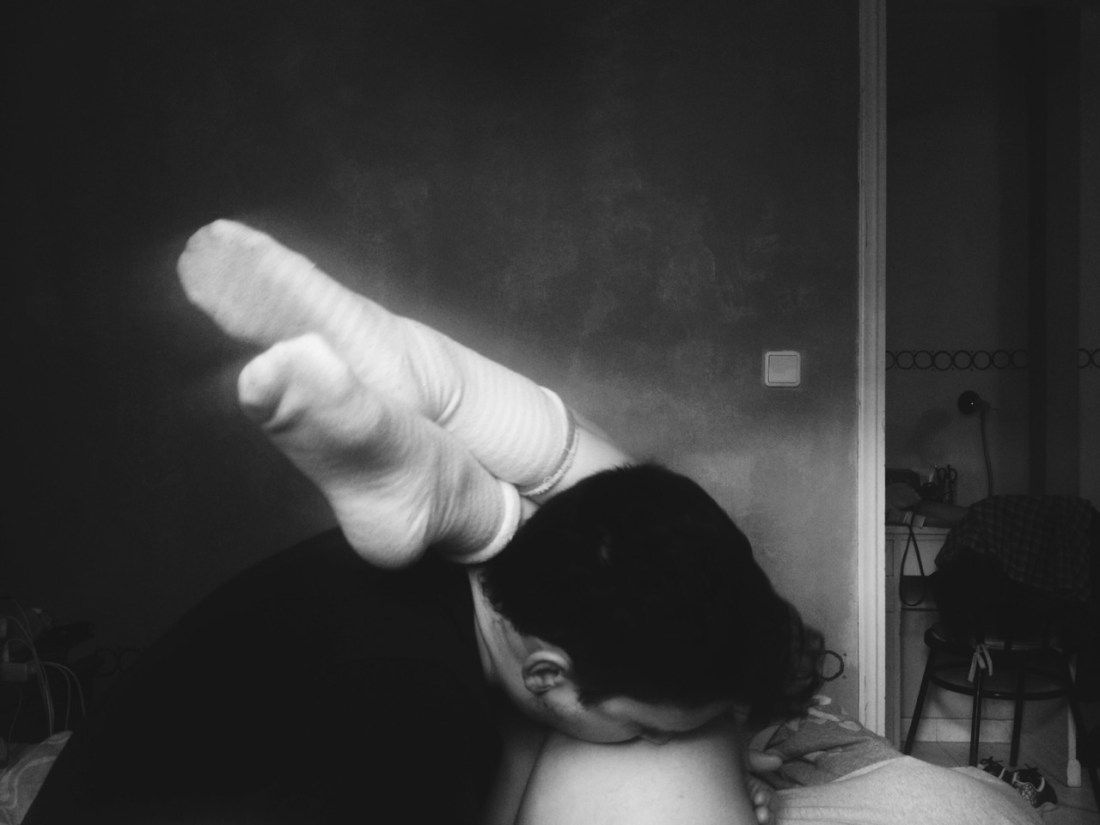
9mouth789 from Menstrual series (2014)

I can’t look at the sprawling mass of mostly messy work on 9mouth’s website without comparing him to Ren Hang–particularly his Instax mini images. The comparison does the former no favors…

Yes: occasionally 9mouth’s work achieves an almost transcendent tenderness. Take the above–the lighting, pose and gesture all balance perfectly to offset what appears to be barrel distortion warping the baseboard. There’s an introspective cast to her expression. It’s really quite lovely.

There are a few other pictures where the image serves to still questions about concept and execution. This one, for example.

Unfortunately, these images are the exceptions that prove an entirely entitled, arrogant and conceptually specious framework. Take his on-going Menstrual series. He says essentially–I’m paraphrasing because the English translation is astonishingly bad: he chose a different woman every month and photographs her life. It’s not intended to be private because like you know he widely shares the pics on the interwebs. By working with them he finds himself falling in love with them but at the end of the month, it’sover. A cycle of melodramatic, manufactured loss he equates with the monthly shedding of the uterine lining.

It’s the sort of thesis that even a shoddy art teacher would render more hole ridden than a slice of Swiss cheese in less than a minute. But, it’s infuriating to me that on top of this he so frequently imposes himself on the frame in an objectifying fashion or worse, touches the models in a way that is unambiguously sexual.

And I don’t mean to suggest that there is something that is inherently off limits as far as process goes. If being an image maker is the only way you can get laid, then at least own that shit upfront. Don’t be all using flimsy conceptual justifications for the shart you use as an occasion to perhaps drop those panties. (That shit is straight up a soft form of predation, btw. And spare me the exploratory creativity justification counter argument…check out mafucker’s Lofter with the outtakes from Menstrual where he takes selfies with each women he shoots.)

What disgusts me with 9mouth is that his work has a fuck load of raw potential that quite frankly seems wasted in 90% of the work he exhibits.

That other 10%, tho… makes you like to say gotdamn!

4201Title unknown (2015)

Believe it or not, I do make an effort not to repeat the same things over and over but although I’ve said it before, I feel it bears repetition in this case: whoever is behind maanavi is righteously kicking ass and taking names.

I am at the stage of crawling on my knees while genuflecting as far as my level of impressed-ness goes.

I’ve reached out to the person(s) posting to the cite in an effort to glean a better understand of where this work originates. I’ll be sure to update this post if I hear anything.

Until then you should definitely check it out. It’s a truly rare occasion where I am this impressed by work where I know fuck all about the artist behind it.

EDIT: I heard back in regards to my inquiry. The manaavi blog is the work of Piotr Debinski (unless otherwise visibly sourced). He’s on Flickr and his photostream represents a mix of incisive studio work (as above) and a sort of hybrid street photography as portraiture/architectural meditation. Of the studio work he states it is representative of his “fascination with human elation.”

Myself NudeUntitled (2015)

Maybe the most inspired use of a mirror in a nude self-portrait since Francesca Woodman.

First, there’s the sense of dimensionality imposed by her hanging hair encroaching upon the upper right corner of the frame and the manner in which the same hair obscures her reflection’s face. All enhanced by the way her pose–which were it a clock might read 6:12:46–splits the the reflection of the ceiling into a mid-tone grey color wheel.

Next, everything in the frame exhibits an awareness of the ninety degree angle formed in the upper right corner by the floor seam. The woman stands on her left tiptoes, twisting her leg in a manner that would appear awkward to an observer looking at her instead of at the mirror; nevertheless, in reflection it creates an exaggerated Seven Year Itch posture. But the reiteration of the leftward skew halts with emphasis due to  the way her right foot is so firmly planted (you can actually see how close the base of her fibula is to the mirrored surface in the reflection).

Of course, there’s the further glorify of the positive and negative contrast between the brightness of her right inner thigh and right shoulder/arm vs the darkness of her left inner thigh and left side/shoulder/arm.

The coup de grace though is how he shadows are permeable enough so her individual fingers each remain distinctly discernible.

The line of her legs, her pose and even those lines between her fingers all guide the eye to the exquisitely rendered cleft of her ass. However, once there, any attempts to dwell and objectify are thwarted by the way the opposition between light and dark draw the eye down the inside of her legs and outward again, recovering the entire frame and thereby reaffirming we are have been graced with a view of a woman both as she sees herself and how she wants to be seen.

Alexander Bergström – Miss L (2014)

There isn’t anyone making fine art nudes about whom I feel more conflicted than Bergström.

Right off, I’m not really all that fond of his color work. The decision as to whether the image is in color or black and white seems less at issue than what film happened to be loaded in the camera at the time. And although he handles color skintone better than many, I just don’t ever feel that color contributes anything except itself to the sense of the image.

That being said, the one thing that is consistent throughout the work is the logic of the frame. I’ve never seen an image made by Bergström where I can find any fault whatsoever with where the edges of the frame have been fixed. (I do not mean to imply I always agree with the composition within those frame, however.)

In my estimation: Bergström is an extremely gifted, sometimes even astute B&W photographer. The problem with his work isn’t something I’d probably notice if it weren’t for a personal paraphilia.

It’s not that body hair is something I fetishize, exactly–although when it comes to women who choose not to shave their underarms, I’m likely to enter a pre-swoon state on site–I’m very much into the personal agency to do whatever the fuck one wants with ones body.

So I totally support Miss L’s decision to go bare. It absolutely suits her. But, then I start scanning back over Bergström’s work and it seems that he holds a definite preference for shaving or model’s who shave.

That’s fine, I guess. But it’s also disconcerting when my several of my friends who have children talk about how their pubescent daughters respond to changes in their body but feeling they are required to begin removing any hair that isn’t on their head. Thirteen year olds shouldn’t have to concern themselves with whether or not they need to shave their pubic area–there’s too much else going on at that time and extra bullshit pressure is the last thing a hormonal teenager needs.

Although in my informal count, the preference for a smooth vulva presents in about 65% of Bergström’s work, it adds a level of sexualization to the work that makes me slightly uncomfortable.

I realize there’s nudity is a bit like identity. Sometimes its just a celebration of physical embodiment, sometimes it’s political. And yes, sometimes its sexual or a veritable grab bag of other consideration. The point is–just like how someone chooses to identify–I don’t get a say in that. It’s ostensibly up to the person whose naked to decide that. Except well, when you aren’t dealing with self-portraiture, there is another person who contributes to the identification: the image maker.

I’d never think of accusing Bergström of not respecting the women he shoots–his images exude an almost religious reverence. But I am never sure if it’s a reverence for the woman as a complete self-realized, autonomous wonder who is also capable of sexual expression or a creature who due to her ability to express herself sexually is a complete, self-realized autonomous wonder.

In the case of this image–with what seems as if it might be a reference to Dorothea Tanning’s Birthday–I’m willing to err on the side of giving the image maker the benefit of the doubt that it’s the former option and not the latter.

Unfortunately, with all the work, I find myself not only confronted with beauty and skilled craft, I also find myself always wondering whether its the former or the latter that held sway in the exchange between being seen and seeing that went led to the creation of the image.

Paula AparicioUntitled (2014)

If there is a single, salient aspect to Aparicio’s work it’s likely the way her photos exude a feeling of post-coital tension between “the waning of ecstatic satiation and the waxing hunger of wanting more.

This tendency is well suited to her style; but, it’s especially noticeable in the way she photographs women.

I’ve lobbed a couple of shots over the bow of the Good Ship Female Gaze previously–namely with regard to Masha Demianova’s claim her work cultivates an equal and opposite response to Berger’s seminal male gaze as presented in Ways of Seeing.

And although I am doubtful, Aparicio would ever invoke the term female gaze to explain her own work, it would almost certainly be more functional applied to her work than anywhere else I’ve witnesses its deployment.

Upon what grounds to a base such an assertion? I am (unfortunately and much to my eternal chagrin) male bodied; therefore what the fuck can I possibly know about a female gaze?

Well, if there is such a thing as the female gaze–unlike the historical male gaze–it’s almost certainly the opposite of monolithic.

I know that growing up seen by others as ostensibly masculine, my experience of attraction, gender identity and sexual desire almost never lined up with my peers.

And I do realize it’s a dangerous assumption to take the braggadocio of hormonal male children as fact based, but I do know that while far ahead of puberty I shared an almost clinical fascination with sexual intercourse and that this fascination was age appropriate within my peer group, it remained a complete abstraction.

Let me try to unpack that a bit more–I feel a very profound need to articulate this correctly. We’d talked about sex, spent hours imagining the mechanics of it and my friends all tended to extend that imagining by connecting it to their sexual response. There was no separation in the expression of attraction and their sexual desire.

What I thought was attraction was actually a need to be understood. The people who listened to me, supported me and shared glimpses of their inner lives were always the people to whom I found myself drawn.

I remember the first time I ever experienced an attraction that linked up with my sexual desire. It was ninth grade. Her name was Michelle. She was my best friend and she’d had a growth spurt over the summer between junior high and high school. She didn’t really notice and I think her family was struggling to make ends meet with private school tuition, so she kept wearing the same clothes she had the previous year. Her favorite pair of pants were these white khakis. They’d been a bit on the tight side the previous year but now they might as well have been skin tight.

I remember walking behind her to class and noticing the visible lines caused by her underwear. I looked away, immediately. Partly because, I felt like I was violating her privacy but also because I found myself stunningly aroused. But my thoughts didn’t proceed from there to a litany of sexual things I’d like to enact with her. Instead, it orbited the notion of wandering if she felt toward me the way I felt towards her in that moment. The thought that there might be a possibility she did was the fantasy I brought myself to orgasm with again and again throughout high school. (Spoiler alert: she didn’t.)

I am hardly so daft as to suggest that what makes me think the notion of a female gaze applies to Aparicio’s work is because I experienced attraction in an unusual fashion. It’s more that the memory of the feeling resonates very strongly with something in her images.

Edward WestonNude [Charis, Santa Monica] (1926)

I have a conflicted relationship with Weston’s photography: on the one hand, his images don’t do much for me; on the other, I consider his print making skills unsurpassed.

Yes, Pepper No. 30 was printed by Weston’s son. And yes, it features the dynamism of a stiletto pressed against your jugular. But the prints made by Weston’s son–although never less than monumental–are good because the exaggerate what the senior Weston was so astute at underscoring in his work: dimensionality conveyed by means of rigorously exacting control of tone and texture.

Perhaps I’ve just worked too long with B&W film but the skin tone in this looks more perfect than I can fit to words. I don’t miss color. In my head, Wilson’s skin looks exactly how I see skin in my head. (And I love, so much, that one of the most iconic images of feminine beauty in the photographic canon features a woman with unshaven legs and pubic hair.)

You can want to be drawn me like one of those French girls all you want. Me? I want to see (and be seen) the way Weston saw Charis.