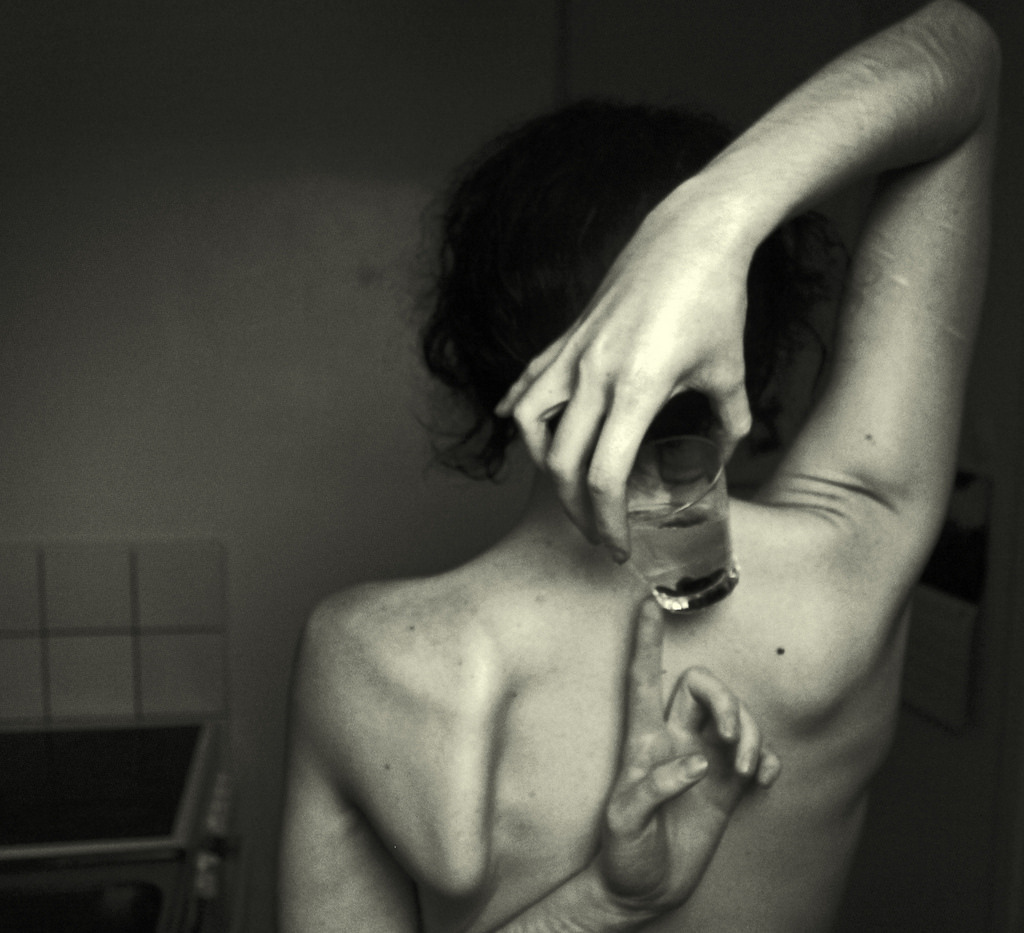
Source unknown – Title unknown (19XX)

I tried to draw attention to this series a few posts back but on the grounds of quality of craft, i.e. adept handling of a diverse tonal range and unimpeachable attention to skin tone/texture.

Yes, some of the framing is awkward but I feel that’s more than counter balanced by the fact that the camera remains at enough of a remove that it remains voyeur instead of becoming an ersatz participant in the liaison.

(And my Wittgensteinian side thrills in the fact that the action–haphazardly framed or not–is firmly grounded in the context of a background equal parts Ostra Studios and anticipating Saudek.

Jacques Biederer Women in Love (1930)

If your thing is top shelf vintage (think 20/30s & not 60/70s) erotica and porn, drop everything and check out The Venusberg. (Note: the URL is mispelled, the ‘u’ and ’s’ are inverted.)

The Venusberg came to my attention due to another breathtaking menage a trois post. It deserves far more attention than its received but the sense in this of unabashed intimacy is something for which I am craving desperately tonight.

Source unknown – Title Unknown (198X)

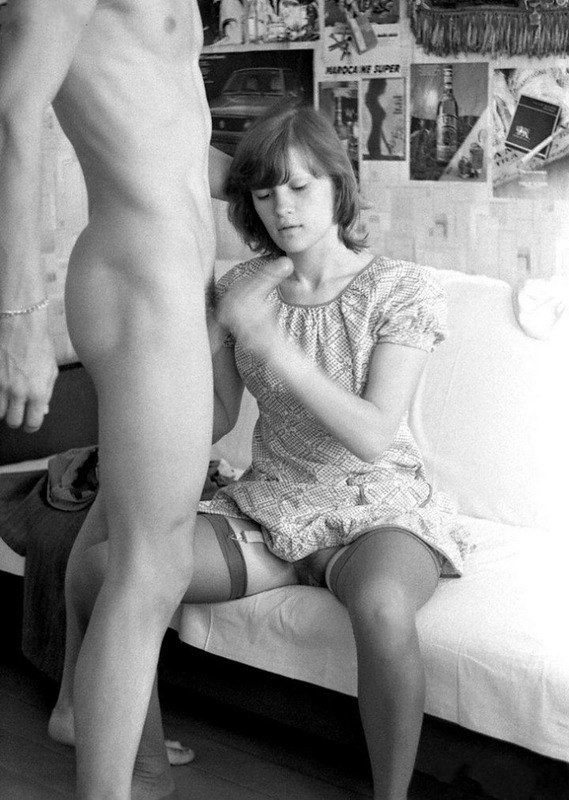
I consider it a damn shame that I can’t trace exact attribution for this image. All I know is that it seems to have been a popular set shot in Russia circa the 1980s.

Its #skinnyframebullshit is so egregious it’s laughable. However, setting that point aside this and the rest of the images from the aforementioned set are disarmingly charming.

I love how he’s naked and she’s clothed. Her exposed labia are a little too dimly lit to comply with porn expectations–instead I read it as reading as the boy going down on her prior to the scene in the above image (which appears to be supported by the set).

I love how he’s stroking her hair and her visual preoccupation to the proceedings in the majority of photos from the set.

Taken together the set suggests a curiosity the mirrors the rapt, passionate explorations of the couples. Nothing about it feels staged, artificial or contrived.

Masha DemianovaUntitled from Badlands series (201X)

By her own admission, Demianova is preoccupied with establishing a female gaze countering Berger vis-a-vis Benjamin’s art historical male gaze.

I won’t argue that her assertion is unfounded–the work does supports it. I just think that perhaps the notion might be more effective applied in analysis of Rita Lino’s work. Further, when she’s asked about the female gaze she trots out flippant non-answers a la I am a female so is my gaze.

In fairness, that half-assed quip comes from a painfully bad interview with DAZED in which they compare Demianova’s images to Petra Collins’. (As an aside: it seems if you want to talk about Collins you’d really be better suited using Arvida Byström or laurencephilomene-photo.)

Demianova’s work–preoccupation with the female gaze, notwithstanding–has far more in common with Igor Mukhin (a fellow Russian who also shoots both B&W and color) or, in an inversion of style, Noah Kalina (who is similarly caught up in fashion/editorial work and who favors skin tone just beyond the edge of overexposure, an equal but opposite effect to the way Demianova often lets her backgrounds edge dark and muddled to render a somewhat sinister Floria Sigismondi/Kubuki effect.)

But I’m not really especially critical of Demianova’s work. It doesn’t all appeal to me but like so many other artists of Russian and/or Eastern European extraction, there is an edge that draws me like a moth to a flame.

I think it has something to do with–and I may be off base her because I know little about Catholicism and even less about Eastern Orthodoxy–but there seems to be a different perspective on physicality. In the West, the body must by brought under rigid control, but I always feel very much as if in Russian and Eastern European work (at least modern work) there is a way in which physical sensuality is a spiritual realm.

So that is the bias which makes me without hesitation think the boy above is posed to recall the Blessed Virgin. The genderfucking undertone is satisfying. But what sells the photo–and (at least in my mind) suggests that even if Demianova hasn’t quite learned how to express it in interviews, she is not being even slightly pretentious when she mentions her aesthetic of a female gaze–is the fact that the way it’s shot with the photographer ostensibly standing over the subject and using a strobe, this feels like it’s also trying to re-appropriate an aesthetic now very nearly ruined by its association with predatory scum bags like Terry Richardson.

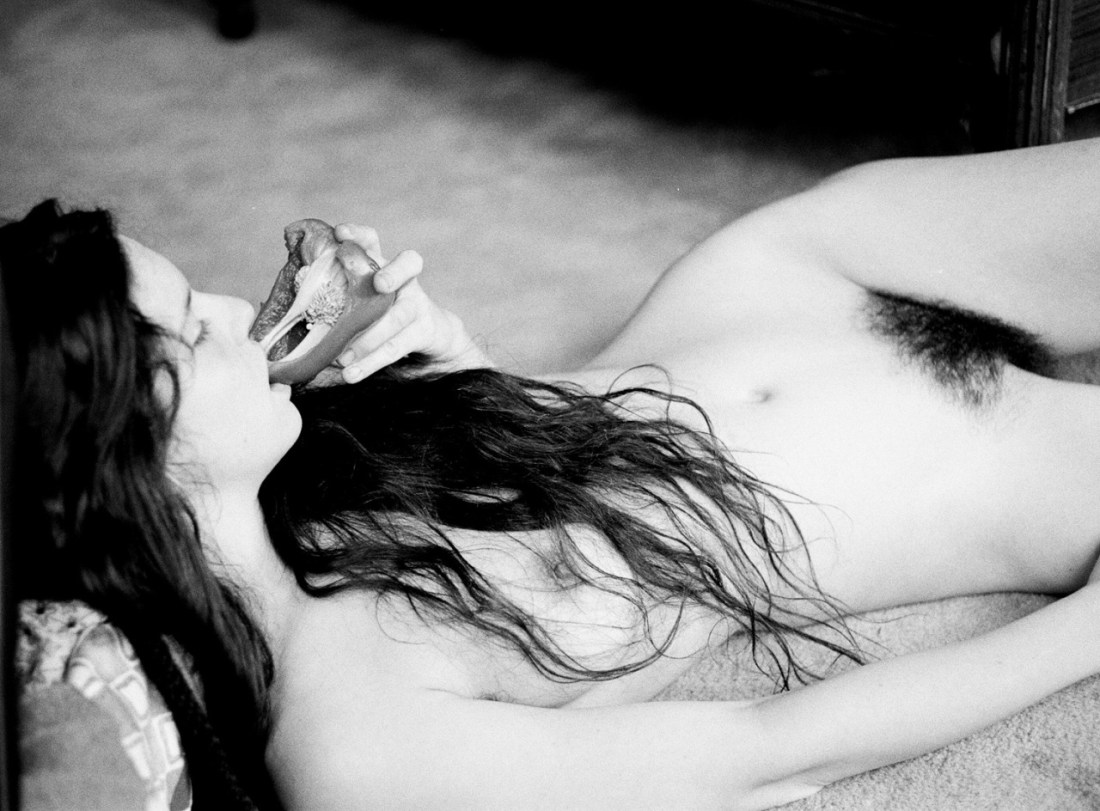
Henry Gaudier-GreeneEdward Weston and the Origin of the World (iii) featuring Kelsey Dylan (2014)

Early this year Gaudier-Greene was asked whether he had any New Year’s resolutions; he announced his desire [t]o develop a better working relationship with midtones.

It struck me as an odd self-deprecating joke–coming from someone virtually unrivaled in the using color photographically to claim controlling B&W midtones to present a challenge after he’s used them to stunning effect (thinking specifically of his collaboration with Tanya Dakin: The Beginning of Mod, emphasis on this gem).

I suspect it is largely just that but it’s also an interesting and probably entirely unconscious framing device. Let me see if I can show my work for that assertion.

Looking at this gorgeous photo oblivious to the title recalls Goya’s La maja desnuda and Modigliani’s Reclining Nude.

Now, when I look at the title I dart in the opposite direction–away from painting as a means of transcending the ephemeral one-to-one nature of sensuality and towards the physicality of father shot/son printed green peppers and graphic nudity, i.e. the visual documentation of explicit bodies as a means of exploring the erotics of metonymy.

I don’t think such misdirection is misplaced. But I also don’t think it’s accidental. I’m not quite sure how to ground a further explanation of what I mean in Gaudier-Greene’s work, so let me take the half-assed route of the intellectually disingenuous: I see a number of parallels between Gaudier-Greene and Edgar Degas. But for the purposes of this explanation, I’ll limit myself to one. Degas set out to be a historical painter, he is now lumped in with the Impressionists–despite wide variance and in some cases outright antagonism to their practices.

In truth he was both a historical painter and an Impressionist; at the same time, he was never truly either. He was more radical and subversive than any category. It seems to me that in an effort to fit within the photographic tradition, Gaudier-Greene tends to point to the less obviously discernible influences he’s pinned to his sleeve while the audience fawns in awe over the calm and stubborn purity of beauty in the work.

Gaudier green is a photographer par excellence and a capital A artist. He has on at least three occasions made me swear to give up photography and on half a dozen others caused me to swear eternal fealty to it.

Yesterday’s PornTitle unknown (2014)

Puritanical responses to nudity and/or sexuality are an enormous pet peeve of mine.

But I have a very special hatred setting reserved for failing to inquiring as to whether the pic was requested or consent was sought and received before it was sent and instead applying the default, knee-jerk response: no one wants to see that.

Um… saying no one wants to see peen is completely fucking untrue. What no one wants is seeing shitty picks that involved little thought beyond having a hard on and a camera nearby.

(Also, while we’re on the topic bear in mind saying no one wants to see that not only implicitly dictates (pun semi intended) an insanely narrow view of sexual propriety but is also hugely problematic as this is entirely disproportionate to the typical response when women who post nudes or have their nudes leaked face a staggering gambit of slut shaming, body shaming and myriads of other forms of harassment, not to mention threats and the long term consequences of losing employment or narrowing future options.)

With that in mind I present this as a sort of gold standard template of what a classy cock shot entail:

  1. A dick pic doesn’t have to be fine art but quality never hurts–this image is effective because it presents a decent tonal range between shadow and highlight while also featuring three distinct, effectively rendered textures, i.e. wall paper, sweater and skin. (Plus, the sweater adds a somewhat feminine note which juxtaposes well with the more phallological content.)
  2. Anytime a frame includes genitalia, the inclusion is already charged. Placing the genitals at the center of your frame isn’t just preaching to the choir, it’s screaming in their face while beating them around the head and shoulders. Here: the left hand directs the cock out of the center of the frame. This dodges the common trap of thinking images magically become 3D when others view them or worse the tendency of treating the aperture as little more than another fuckable orifice.
  3. Avoid the oh my god! look at how huge I am trope. This image is preoccupied with that but I am willing to overlook that due to the sublimation and also because the small triangular sheen of reflected light his corona makes my molars feel all itchy.
  4. Another great strategy is decontextualizing the dick or finding a way to present it in a more mundane and natural setting. This image isn’t concerned with that but this does both interestingly.

Thus before you send/post that shot ask yourself how does it compare to the above. If it pales in comparison, maybe think about hitting delete. If it’s on the same level or better, go forth and conquer.

Source unknown – Title unknown (XXXX)

Here’s an example of a vertical frame that isn’t #skinnyframebullshit.

Why? You ask, Isn’t it just echoing form of the subjects?

Well, it is doing that but in this case a landscape orientation contributes little additional context to the image. As it is we can tell it’s a small bedroom, demonstrating exactly how small it is–if anything–belabors an already clear representation.

The trick that makes a skinny frame work here is the narrow triangular form of the overexposed motion blur adorning his hands and her left side would–in a wider frame–be subject to de-emphasis. Further, the vertical framing draws attention to the discarded clothes piled on the bedside table and likely Russian electrical outlet.

Mathilda EberhardUntitled (2014)

Mathilda EberhardUntitled (2014)

Flickr retains little more than a ghost of its late aughts glory.  In fact, it’s pretty much a completely clusterfuck.

There are some notable outliers whose photostreams’ always showcase bona fide next level shit–looking at you: im_photo, chill and 3cm.

I’d include Eberhard to that list except well although I wouldn’t ever suggest that her work is better than those guys, I am just flat out enamored with her work.

This should surprise no one having followed me for any period of time–after all this is the fifth image of hers I’ve posted.

You’ll notice I tend to favor appending quotes to her images instead of commenting on them–partly because I am so awed by them that my fumbled attempts at expression seem entirely cross juxtaposed with the work and partly because I get self-conscious about the fact that I tend to compare things that move me to the very limited set of work I adore (at least initially) instead of come to terms with them on their own ‘ground’.

For example: for as many image makers as will either claim or accept the critical assignment of overlap with Francesca Woodman’s work, Eberhard is probably the image maker who most completely takes up Woodman’s mantle.

But to state that and consider the matter settle is intellectually dishonest. There’s more to it than that it and leaving it there does a disservice to both image makers.

Unfortunately, it’s not something I can express in the positive–i.e. I can say this is what makes Eberhard’s vision singular. However, it did occur to me that there’s a way I can, for the time being, point in the right direction.

Think of the word ‘desire’. We use it primarily as a noun–to describe a visceral wanting. It’s also a verb. I can say to a friend: I desire a delectable brie.–Although grammatically correct it sounds to the ear unbalanced.

In actuality when we desire, there is a tendency to express desire with metaphor–’craving’, ‘hunger’ or ‘thirst’.

Now, consider the qualifications we add to these metaphors when we use them non-metaphorically. We might say her appetite was ‘insatiable’ but we would be much less likely to say his hunger was insatiable unless we are using ‘hunger’ in some metaphorical sense. One eat until one’s hunger is sated.

I’m not sure if it’s just my pushing the point to reach a satisfactory conclusion, but it seems that we speak of thirst differently. Thirst isn’t sated, it is ‘slaked’–implying satisfaction. The space between ‘hunger’ and ‘being sated’–when measured in time–is less ephemeral than the space between ‘thirst’ and ‘slaked’.

I think when you extend this realization of the tendency in the literal to the metaphorical–desire when expressed via a thirst metaphor is more insistent than desire as expressed via a hunger metaphor.

What makes Eberhard’s work so singularly compelling is the way it methodically charts the terrain of thirst as a metaphor for desire.

Libby Edwardsthere are no boundaries anymore/just purity/just us (2012)

You know that smart ass quip that there are two types of people in the world: normal folks and then those who separate the world up into two types.

Yes, there’s certainly a kernel of truth there–things in the desert of the real rarely divide cleanly or suggest such neat polarity with easily navigable spectra between.

However, as long as either/or dichotomies are invoked as a genesis point (a means to an end instead of an end in and of themselves), I think they can be useful.

Take this image. It’s crossed my dash probably several dozen times in the nearly two years I’ve run this blog. Technically, it has a heavenly choir of problems: the camera’s slight up tilt combined with counter top reinforcing the lower frame edge draws attention to the asymmetry of the corners where the walls meet on either side; I would wager this was taken with some sort of matrix metering setting–resulting in the skin tone being what I’d call a Zone IV instead of halfway between Zone VI & VII.

In other words, it’s technically flawed.

Now, I’ll be the first to admit that the technical interests me. I would even go so far as to say I consider quality of craft a major turn on. Still though all the technical know how in the world doesn’t count for fuck all if there’s no mojo.

What do I mean by the oh so technical term ‘mojo’; heart, honesty, integrity. For example: I can’t fucking stand Monet but you’ll never hear me question the importance of his work. Just because it doesn’t appeal to me doesn’t mean I can’t be convinced through and through that the way he painted was a painstaking effort to share the wonder he say in the world.

But back to my original notion–for the sake of argument: let’s say that there are two sides of the image making equation; namely, the technical and the spiritual.

This image is off-the-goddamn charts in terms of presenting the truth of a discrete moment. It’s technique could be improved but there’s enough merit to it as it is that it sort of diminishes any potential criticism that can be leveled here.

Paweł Pawlikowski – screen capture from Ida (2013)

Over the last three weeks, I have been geeking out over the im-fucking-peccable Every Frame a Painting series. (Seriously, Tony Zhou has forgotten more about film form than I’ll ever know.)

I’m curious what he’d make of Ida–mostly because I don’t know what to make of it.

For such an ‘uncomplicated’ movie, there are a metric fuck ton of unresolved contradictions.

Also, the compositions are just straight up weird. Not in a bad way–there is a rigorous logic informing them.

  • Pay close attention to how characters are isolated within the frame,
  • In the rare instance where characters are presented together in the same frame, observe how they relate to each other in space?
  • Why do feet appear within the frame so rarely?

In other words: there is clearly a pervasive authorial design to the more outlandish decisions. But to me it reads as an effort to unnecessarily ‘artify’ the proceedings. I adore Ida’s vacillation between her vows as a nun and the carnality of the world inherent in Coltrane’s Naima far too much to hold Pawlikowski’s failings against the film, but still I can’t help wondering what could’ve been if he’d simply played it straight.