[Source: REDACTED]Title Unknown (201X)

I’m less than convinced posting this isn’t an ill-advised misstep: it’s irredeemably pornographic. produced by a pay-porn site whose ethos aren’t exactly in line with my own (or this blog) and it’s desaturated from the original (an marked improvement, actually).

Also, I am sure if I bothered to watch the video of which this is a part, odds are I would be repulsed.

Yet, this scratches entirely too many itches I’m feeling right now for any decision to exclude it not to smack of a certain degree of dis-ingenuousness. 

Frankly:  it really fucking turns me on.

Why?

I’ve noted previously my affection for and belief in the artistic potential in the visual dynamism of the ejaculatory act.

And although I am not every going to be first in line on ass play day, depictions of pegging appeal to me insofar as they implicitly flip the gender stereotypical, heteronormative script.

From what is glimpsed in this two second clip, my guess is this video flips the scripts but then amplifies the staged physical and verbal abuse to a level that would result in castigation were the gender roles not so clearly inverted.

What gets me about this clip–and I think it would’ve been enhanced in a wider shot–are the muscle tremors playing over his stomach. After all, he’s been brought to orgasm with an enormous dildo compressing his prostrate. His ability to exercise autonomous control over his body is effectively short-circuited; he is completely at the mercy of his partners.

It’s that feeling of being at the mercy of someone I trust completely is what I miss most about sex. Being pushed up against a wall and told in a whisper almost too soft to hear: you’re boundaries are bullshit. If you say ‘no’, I’ll stop. But you won’t say ‘no’.

And my desire to share that experience–to know the give and take of mutual needing–makes me thing this isn’t a two second clip but a much longer one. Where the woman continues to stimulate the man, reminding him there’s no such thing as too sensitive

the-secretpervertsubmission to porn4ladies (2014)

Although these lack fully differentiated tonal range and the content/ composition announces them as cockshotus vulgaris, there is at least something charming about them.

I am probably being disingenuous–it being unwise to project the subconscious internal on the manifest external and label the result: interpretation–but this reminds me of Peter Hujar’s breathtaking portrait of David Wojnarowicz.

Whether or not that free associative jump stands up under interrogation, I think the common denominator–both depict male bodied individuals masturbating–is applicable here.

Adding masturbation by no means ameliorates concerns over presumptive entitlement associated with male-bodied exhibitionism but in this case the image reads less like look-at-what-I’m-doing-doesn’t-it-make-you-horny and more what-I’m-doing-makes-me-horny-and-I’m-curious-as-to-the-visual-mechanics-of-the-action.

Interestingly enough that does actually lead right up to what attracts me to these images: a very dear friend once confessed to me that although she masturbated frequently, she had only ever made herself come perhaps three times.

One of those times, she hadn’t intended to masturbate, she’d just been curious about her own genitals and employed a hand mirror to ease closer examination.

In her retelling, she didn’t realize she was going to come until it was too late to stop. Fifteen some years later, she still claimed it as one of the three best orgasms in her life.

For me, this image invokes the same feeling of someone explaining their sexuality to me not in an effort to invoke arousal–although if that happens as a side effect, so be it; but to instead share something true about themselves without fear of judgment or reprisal.

I can’t help but find that attitude incredibly sexy.

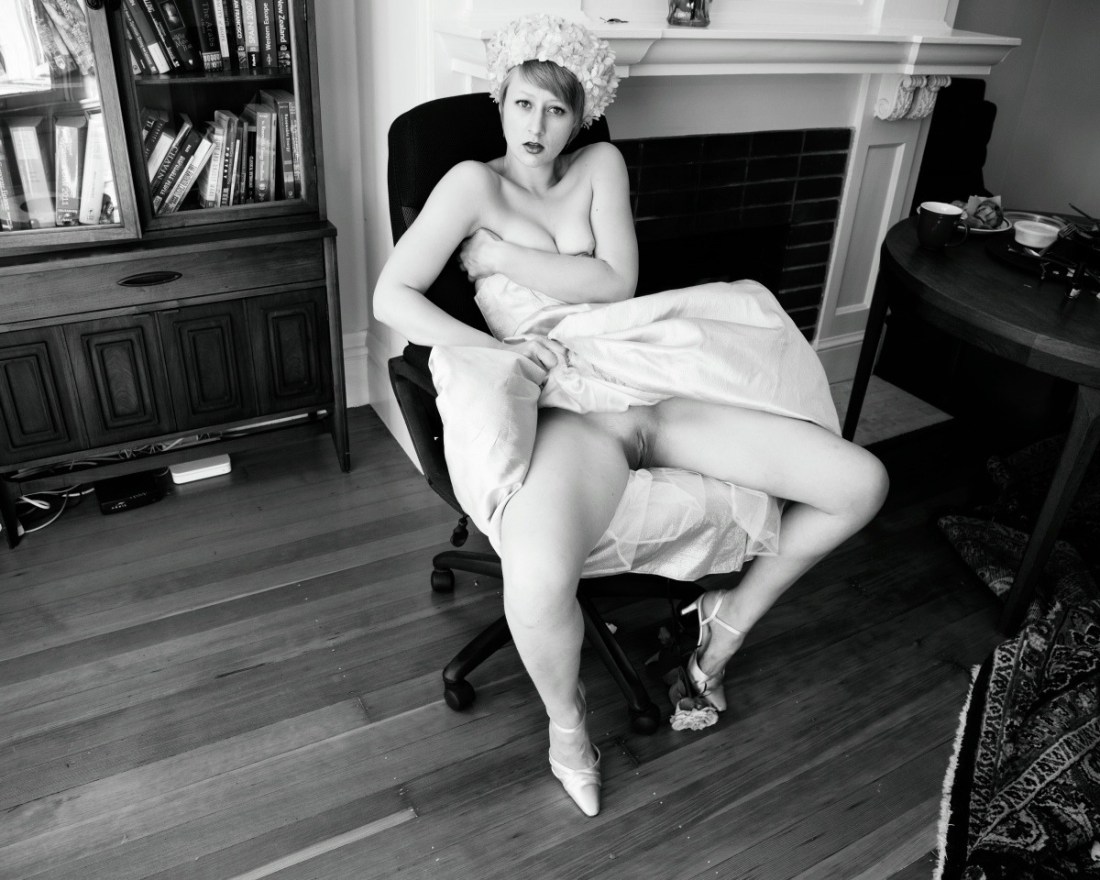
Katherine TurczanAnya and Carolina from Brezhnev’s Daughters series (201X)

In the indispensable Ways of Seeing, John Berger shows us the same painting–specifically, Van Gogh’s Wheatfield with Crows–twice.

With the first instance he presents it much as it would be encountered in a gallery, with the title and artist. However, the second time he merely labels it something to the effect of the last painting Van Gogh made before killing himself.

Criticism has been leveled against this scene. Chronologically, Wheatfield with Crows is only known to be one of the final paintings.

In my mind the criticism misses the point and by doing so goes a great distance towards proving the contention: context of presentation shapes the way a work is approached and subsequently understood.

Katherine Turczan’s work–to coin a phrase–really cultivates my pearl by representing both why fine art photography matters as well as why it’s–in the same breath–an intolerable, insufferably pretentious circle jerk.

Consider the ’essay’ which accompanies Brezhnev’s Daughters:

Brezhnev’s Daughters, the title of this project refers to what women call themselves in Dneprodzerzhinsk, Ukraine, the birthplace of Leonid Brezhnev and the industrial heartland of Ukraine.  The women say that they are Brezhnev’s children because they have inherited the future of the failing land and their father has abandoned them.

Dneprodzerzhinsk, Ukraine is about 8 hours from Kiev along the Dnepro River the heart of Ukraine’s mining and manufacturing production.  This area is like many cities in the east, an industrial wasteland with factory stacks ablaze filling the skyline.  The landscape takes on the quality of a bad Hollywood movie about the apocalypse. The industry in these towns is a double edge sword; one that contaminates and sickens yet employs most of its people.  This is where Ukraine’s working poor live.

In these parts of Ukraine it is very prestigious to work in the sex industry.  The industry offers economic opportunity to many women other than what the factories can provide. Their sexuality is their strength and they use it as a form of emancipation to support their families.  They are very proud of this.  Many young women work as welders during the day for pay that is not sufficient to feed their families, while at night they pole dance. Brezhnev’s Daughters is a portrait of these and other women in the industrial south who are faced with these complex choices. 

These photographs are made with an 8×10 camera and printed on Gelatin Silver Paper.

As far as such things go, it’s all but flawless. And without a doubt it enlivens/amplifies the resonance of the photographs. The trouble is: it also muddles them.

That which is distinct in Turczan’s work is not what makes the work’good’.

Katja, Mariya and Liana resemble thousands of other candid model shots produced by the internet hordes. (Admittedly, these were shot with a large format 8×10 analog camera.)

Karolina could very well be a reclaimed Jock Sturges’ discard; Yulia is a straight-up Atget heist.

What is distinct about Turczan’s work is where it doesn’t bother to sweep it’s shoddiness under the rug. Sasha is #skinnyframebullshit; Oksana avoids the same mistake (the difference for anyone who cares, is mentally reconsidering the shot given the opposite orientation and comparing and contrasting) but as with the previous image just isn’t an especially technically astute image even if both are alive in a way few of the other images are.

I do like the photograph I’ve posted here. It one of maybe three in keeping with the explanatory essay. But not only is it in keeping with the essay, there’s a dialogue between the contextualization and the work that sharpens both.

And it occurs to me that academnified fine art photography operates from the premise of creating work that clearly indicates both what it is and what it is not. Popular image making on the other hand starts and more often than not ends with the assertion this is interesting. Such taxonomical considerations are vital to my own process, but I think at a certain point you have to focus on what is instead of what isn’t. Too much work tries to be everything to everyone and ends up nothing to no one. But it’s interesting that the work which insisted clearly in its own specificity somehow manages to transcend that specificity more often than not.

Our Naughty AdventuresSubmission to Let Me Do This To You (201X)

There’s this essay that’s been bouncing around in my head for more than a year. It has to do with the junctions, disjunctions and ruptures in the terms ‘erotica’, ‘sexual explicit imagery’, ‘pornography’ and ‘Art’.

I have some 30 pages of notes but sitting down to write in earnest is a real struggle for me.

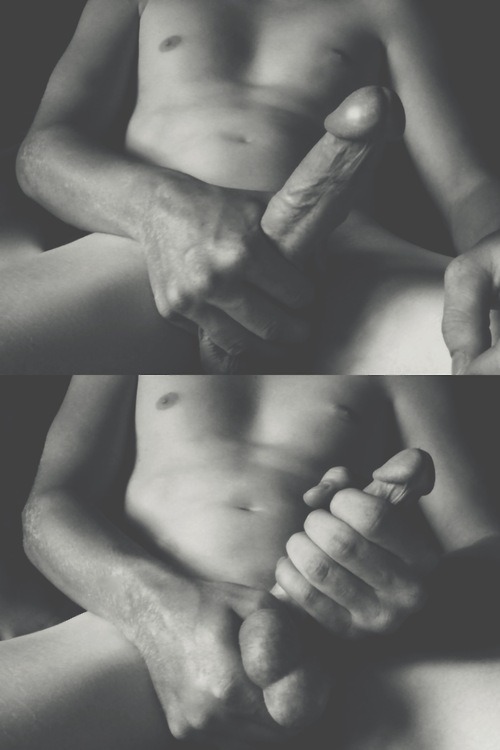
It’s a shame, really–being able to call on such an essay in the analysis of this image would pay rich dividends in the case of this image, especially given that I’d be inclined to label this as both ‘erotica’ and ‘pornography’ but less willing to attribute any strong artistic merit or suggest that depicting and erect penis precludes sexual explicitness.

What’s sexual here is the position of the female body in relationship to the male. The image clearly captures a moment prior to the commencement of sexual congress; in other words, the image titillates through implication.

There is a sense of artistic pretense–high contrast, black and white, shot with a strobe there’s also the feeling that what is presented is a crop from a larger image; or, what should have been a composition centering on a wider angle of view.

Artistic shortcomings aside I do find this image to be highly erotic as it includes a number of things that dampen my undies: the fact that although not wearing a stitch, the female bodied participant is presented in such a way that her nakedness is hidden at the same time the male bodied participant is visible for all the world to see. (In this case I also really dig the acute angle of his erection and way the flash draws attention to the texture and tone of his foreskin.)

There’s also something intangible about the image that conveys for me  a sense of craving a lover’s body so much it causes physical pain. And with that aching transforms the carnal union into not only an approaching of ecstatic bliss but a drowning of pain in pleasure.

Ida OppenPale Afternoon from The Wicked Innocent series (201X)

Ida Oppen is an early twenty-something freelance image maker hailing from the suburbs of Oslo.

Her work transcends the perfunctory reproaches I customarily present. Honestly, I am profoundly impressed with her sophisticated compositions, precocious attention to scale and use of color.

Thus, the bifurcation into two mutually exclusive bodies of work–the editorial/‘fine art’ and the sexually explicit–really fucking baffles me.

From the standpoint of commerical viability, this is understandable: ‘professional’ clients are unlikely to appreciate graphic presentations of genitalia, intercourse and sexual effluvia.

What fails to track is the degree to which Oppen’s approach varies between disparate oeuvres.

The painstaking craft of the editorial work loosens in favor of a grittier immediacy. Not that craft is by any means lacking–pay attention to the precision of the framing (especially in the multiple image assemblages reminiscent of analog contact sheets), the manufactured multiple exposures and the–admittedly less astute–digital chromatic interventions.

Oppen admits this is what she’s after in her artist’s statement for The Wicked Innocent series. And there really isn’t much room for argument. She knows what she’s doing as well as how it is going to be read by an audience.

But as a member of that ostensible audience I would like to be pushed outside of my comfort zone and confronted a little more directly. Honestly, I mean that less as a criticism and more as a misguided compliment because although I know Oppen does not conceptualize this work as pornography, it offers me everything I look for–but rarely find–there. It’s partly that there seems to be a great deal of overlap between the kinds of sex with which Oppen is preoccupied and my own interests. But that is only intensified by the fact that vulnerability and trust factor so prominently into the process of making the images.

Viewing the work there is an unshakeable sense that the openness is equally if not more arousing than that which is explicitly depicted; the feeling that I am seeing what I am seeing not because there’s any expectation that it will turn me on but that it is a record of what gets someone else overwhelmingly aroused.

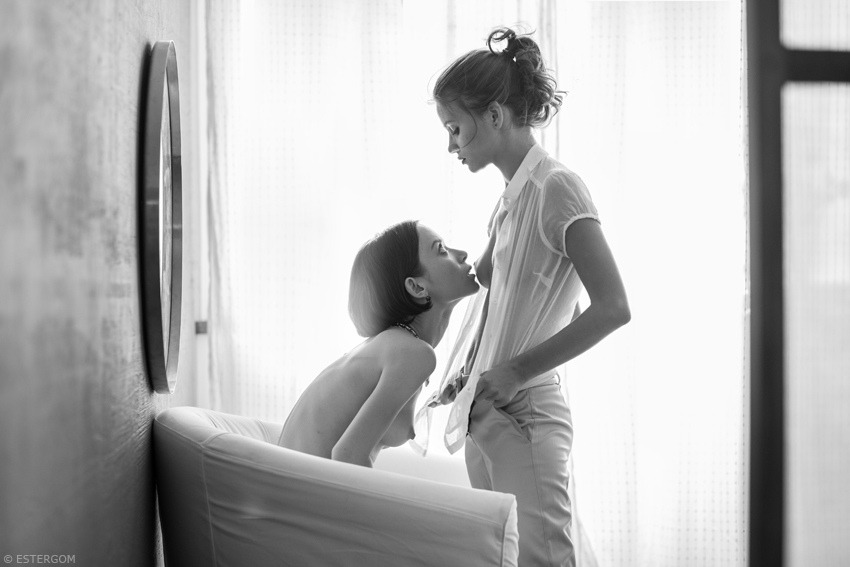
Anastasiy Mikhaylov [AKA Estergom] – *** (2013)

Mikhaylov’s images look as good as digital B&W can be expected to look–awful when compared with analog B&W–and are ordered according to crisp compositional logic.

I nearly had a heart attack and died from not-surprised when I learned Mikhaylov was trained as a cinematographer.

If photography is English, then cinematography would be English spoken with a nearly impenetrable Scottish inflection.

Seeing Mikhaylov’s work is like running into someone who speaks with the same accent. Someone whose words you understand in a nearly prelinguistic fashion.

In other words, the familar pretty-pretty and consistent evocation of scale attracting my eyes like ball bearings to a magnet.

Cinematographers are as a group less than astute when it comes to the nuances of conceptual art. (Two prominent exceptions that spring most readily to mind are Sven Nykvist and Harris Savides.)

Yes, echoes absolutely exist in relation to matters of visual storytelling and figuring out how to inveigle unruly images to sit politely side-by-side around the table like some many birthday party kids cracked out on sugar rushes. But I think there’s an inherent notion of what a photographer does that gets instilled in us; it transitions a bit too easily into an explanation of what photography entails.

For everything Mikhaylov does well, there’s always a corresponding deficiency. The most obvious is his inconsistency in including/eschewing eye contact. There’s no rhyme or reason to it unless you step outside any critical space and instead start from an acritical exposure to visual culture. In other words, don’t ask why does this look the way it does; begin instead by insisting this is what an image should look like.

There’s some overlap with an Matt Singer penned op-ed over at The Dissolve earlier this week in which he compares and contrasts the visual indelibility of the latest Spider-man blockbuster and Jonathan Glazer’s gorgeous and incomprehensible Under the Skin.

Referring to yet another essay by HitFix’s Drew Mcweeny, Singer notes:

McWeeny concludes his essay by imploring Hollywood to “make the stakes more personal” while “telling good stories that also happen to be amazing to look at.”

Pretty-pretty is all well and good but it is ultimately not enough. Something more is needed. In the above image, for example: it’s a matter of tone–a cishet male positing lipstick lesbian schtick as same-sex attraction.

Ultimately, despite it speaking my language convincingly, I feel like this is an image that is comparable to a seedling needing partial shade that was planted in direct sunlight. It’ll grown, but it’ll need extra attention.

Technical merit isn’t enough. And it irks me that the extra care it requires needs hinges equally on the artist’s ego and the irrigation of lusting arousal as the only viable means of fully intoxicating the viewer.

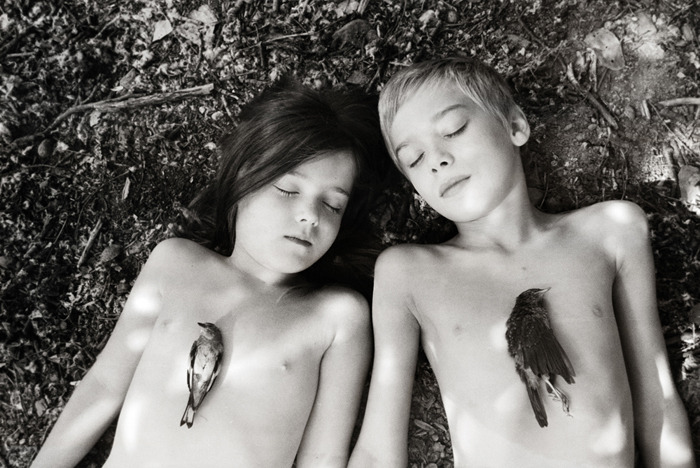
Sally MannThe Last Time Emmett Modeled Nude (1987)

In my admittedly short lived travels in fine art photographic circles, Sally Mann tends to be merely tolerated in public while she is derided and/or dismissed for her ‘excessive sentimentality’ behind closed doors.

So it’s not surprising to witness her wondering aloud in HBO’s excellent documentary What Remains: The Life and Work of Sally Mann whether or not she’ll be ‘pilloried’ by the critics when she exhibits her new project.

It’s a telling scene. Mann’s observation demonstrates a keen understanding of the disparity in her reputation between consumers of culture and the cultural gatekeepers/overlords.

The accusation of ‘excessive sentimentality’ is a palpable hit. The sentimental lies at the foundation of virtually everything she’s ever made. (Except maybe the cibochromes–which if you haven’t witnessed, you are truly missing out on some of the most staggering color work since Eggleston.) 

The cultural gatekeepers/overlords aren’t so patient with sentimentality given their unquestioning adherence to the syllogism dictating that the sentimental is to art as Kryptonite is to Superman.

It all strikes me as too convenient. Yes, Mann’s chosen medium is photography. But that doesn’t mean her lineage can only be traced back through Gowin to Callahan and the Bauhaus movement. Mann belongs equally to the tradition of Walt Whitman and Henry David Thoreau both of whom are comparable sentimental and adored for the fact.

A better criticism might be to draw attention to her blemished, unnecessarily dark printmaking.

Or better yet, acknowledge that–as the aforementioned scene illustrates-even when anxiously doubting herself and her work, she plays the conceptual art shell game masterfully.

What makes her work great is she always predicts criticisms that will arise from the work and uses the work to refute them in advance.

What makes Immediate Family the greatest work she’s ever likely to produce, is its naive, unblinking curiosity that didn’t manage to see the snake until it had already stepped on it and still somehow avoided getting bitten.

It’s impossible for me to narrow that work down to a single favorite image. But this image of Emmett is easily one of the top five.

Vlad Kenner [aka VK Photography] – Lady Sensuality (2014)

I don’t feel connected enough to the Tumblr model community to offer pronouncements on it. But based on the relentless quality of work from Cam Damage, Jacs Fishburne, Katlyn Lacoste and Johanna Stickland, it seems to this total outsider that nude modeling demands not only dedication and hustle but impeccable curatorial acumen when it comes to identity/brand/persona.

I’m pretty sure I had seen things Lady Sensuality had done prior to this .gif hitting my dash. Even now, her smile transforms me into a great big old pile of bashful turtles.

But what really grabs me by the throat is her work. She’s direct and unapologetic about her body/sexuality. At the same time, there’s a sense her work necessarily exists outside any predetermined personal comfort zone.

Lady Sensuality’s work isn’t that much more objectively explicit than say: Rayne Tupelo’s (who I adored and dearly, dearly wish was still making work). She embodies an edgy transgressing of ‘socially appropriate’ boundaries. To me, looking at her work feels liberating.

In fact, I am so thoroughly impressed that as much as I am terrified by the prospect of interacting with–let along photographing–strangers, I would do just about anything for the opportunity to collaborate with her on something in the very near future.