[

Normal
0

false
false
false

EN-US
X-NONE
X-NONE

/* Style Definitions */
table.MsoNormalTable
{mso-style-name:”Table Normal”;
mso-tstyle-rowband-size:0;
mso-tstyle-colband-size:0;
mso-style-noshow:yes;
mso-style-priority:99;
mso-style-parent:””;
mso-padding-alt:0in 5.4pt 0in 5.4pt;
mso-para-margin-top:0in;
mso-para-margin-right:0in;
mso-para-margin-bottom:10.0pt;
mso-para-margin-left:0in;
line-height:115%;
mso-pagination:widow-orphan;
font-size:12.0pt;
mso-bidi-font-size:11.0pt;
font-family:”Garamond”,”serif”;}

↑] Les KrimsFall, Fargo Avenue, Facing the West Side Armory, Buffalo, New York (1969)

[

Normal
0

false
false
false

EN-US
X-NONE
X-NONE

/* Style Definitions */
table.MsoNormalTable
{mso-style-name:”Table Normal”;
mso-tstyle-rowband-size:0;
mso-tstyle-colband-size:0;
mso-style-noshow:yes;
mso-style-priority:99;
mso-style-parent:””;
mso-padding-alt:0in 5.4pt 0in 5.4pt;
mso-para-margin-top:0in;
mso-para-margin-right:0in;
mso-para-margin-bottom:10.0pt;
mso-para-margin-left:0in;
line-height:115%;
mso-pagination:widow-orphan;
font-size:12.0pt;
mso-bidi-font-size:11.0pt;
font-family:”Garamond”,”serif”;}

↓] Masha Sardari – The Ashen Heart (2013)

Juxtaposition as commentary.
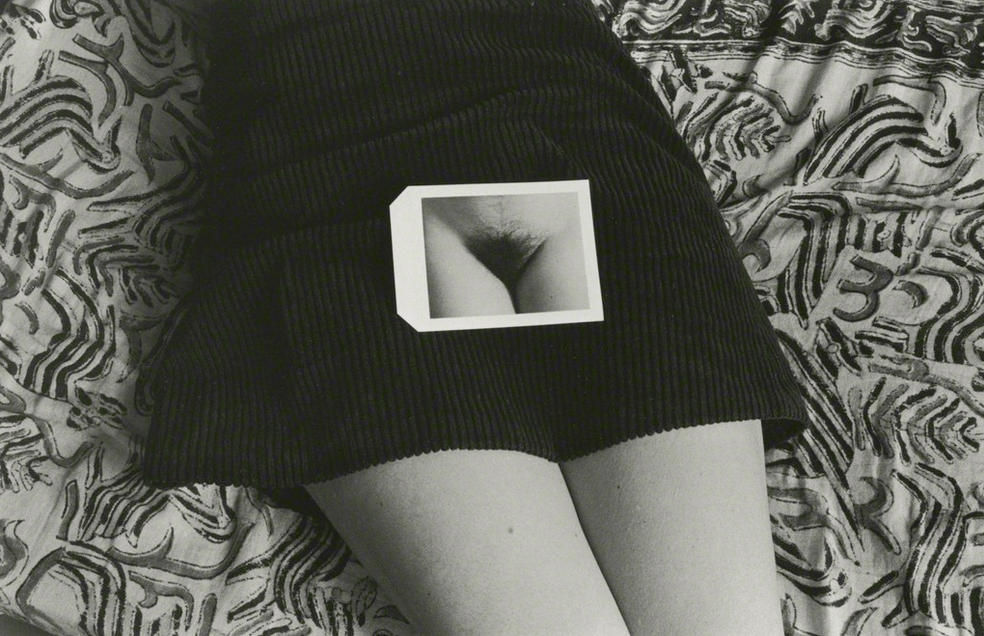
Kenneth JosephsonPolapan (1973)

First things first: I have gotten flack for the wordiness of my posts. I post what I post because I believe in contribution as a prerequisite for participation in a community. I don’t have much in the way of original content, so I offer what I can: commentary.

I realize that most of you couldn’t give less of a fuck what I think about images. I don’t give fuck one if you discard what I’ve written when you reblog shit from me. That’s cool. No offense taken.

What I can’t abide is deleting attribution. Don’t do it. If you do, you suck shit through a fucking tube.

Case in point, this image was properly credited in the original post. Somewhere along the line, credit was removed.

It may seem like a small thing. But this has come across my dash several times. Seeing it, i’ve thought to myself: self, the blacks look kinda shallow so this is probably an image created through digital means. It has a bit of the picture-in-picture thing happening, maybe a touch of the album-cover-instead-of-a-face trend. In other words, due to my lack of pre-extant familiarity with the work, I end up mistaking it for a copy cat instead of an instigator.

Further, knowing that this was made in 1973 immediately connects it with Duane Michals Things are Queer and sharpens my ‘inspired picture-in-picture’ formulation toward an insinuation of mise en abyme.

And what is particularly interesting to me about mise en abyme and what Michals focuses on is that you can not only travel inward in such images, it is equally possible–and I would argue more interesting–to travel outward.

Garry WinograndNew York 1969

I would never dispute Al Pacino’s skill as an actor; I just don’t really ever respond to his performances– perhaps that’s the virtue. (Bear with me; I promise this comes back around to the image.)

Pacino is one of those actor’s actors–a notion I find intolerably snobbish, as if someone were saying you need to know something about what it takes to be an actor in order to understand.

Something not unlike being a photographer’s photographer–minus the snobbery–is true of Winogrand.

Saying I was initially nonplussed by his work would be putting it nicely. It seemed too random, chaotic and unpolished. I remember thinking anyone could have shot these.

For nothing else than my perpetual tossing around of that famous Picasso quote in defense of the modernists, this sentiment should have set off alarms.

Alas, I remained off put by Winogrand until a dear friend showed me this image recently.

I’d never delved deeply enough to have encountered it. The precise composition– the couple kissing, the smoldering cigarette pinched between fingers, the Tortilla Factory sign, the what-are-you-looking-at-motherfucker glare and the go-ahead-and-watch-you-motherfucker glance–made my head explode a little. The image appears almost accidental, unmediated.

You know that moment when you glance at something and look away without really seeing it? And suddenly, the scene registers and you have to do a double take to make sure you saw what you thought you did. This photo is a photographic approximation of that first seeing but unseeing glance. It inspires an instinct to look back at the image again to see if what you think you saw is what you really saw. 

That is really what makes this image so extraordinary. The skill of the photographer is on display only to the extent that the camera is no longer an extension of the eye but the eye itself. It’s all so vital, so gleefully transgressive.

Clearly, my initial estimation of Winogrand was wrong. I don’t necessarily like all his work. But I can appreciate it and I do get what all the fuss is about now.

I don’t like being wrong. But the wonderful thing about admitting your mistakes is that little else motivates learning and growth quite as effectively.

Igor Mukhin

Normal
0

false
false
false

EN-US
X-NONE
X-NONE

/* Style Definitions */
table.MsoNormalTable
{mso-style-name:”Table Normal”;
mso-tstyle-rowband-size:0;
mso-tstyle-colband-size:0;
mso-style-noshow:yes;
mso-style-priority:99;
mso-style-parent:””;
mso-padding-alt:0in 5.4pt 0in 5.4pt;
mso-para-margin-top:0in;
mso-para-margin-right:0in;
mso-para-margin-bottom:10.0pt;
mso-para-margin-left:0in;
line-height:115%;
mso-pagination:widow-orphan;
font-size:12.0pt;
mso-bidi-font-size:11.0pt;
font-family:”Garamond”,”serif”;}

If it moves, Igor Mukhin likely shoots it; if it doesn’t, he’ll still take aim.

With nearly 5000 images—split between B&W film scans and Leica AG M9 captures, amassed over 6.5 years—perusing his photostream is like mainlining a hyper-distilled, chaotic mélange of interesting, occasionally ingenious work.

My head doesn’t wrap around such profligate excess easily—limitation is too central a feature in my own process. (Read: I am poor.) But I can let that slide. What I fail to fathom is how Mukhin’s haphazard, throw-it-at-the-wall-to-see-what-sticks curatorial approach works at all, let alone results in such jaw-dropping examples of all that photography should embody.

(To avoid unnecessary disappointment, skip his staid personal website.)

Kim Eliot FungPhenomenon of Being 2006

Normal
0

false
false
false

EN-US
X-NONE
X-NONE

/* Style Definitions */
table.MsoNormalTable
{mso-style-name:”Table Normal”;
mso-tstyle-rowband-size:0;
mso-tstyle-colband-size:0;
mso-style-noshow:yes;
mso-style-priority:99;
mso-style-parent:””;
mso-padding-alt:0in 5.4pt 0in 5.4pt;
mso-para-margin-top:0in;
mso-para-margin-right:0in;
mso-para-margin-bottom:10.0pt;
mso-para-margin-left:0in;
line-height:115%;
mso-pagination:widow-orphan;
font-size:12.0pt;
mso-bidi-font-size:11.0pt;
font-family:”Garamond”,”serif”;}

It’s like returning to a location that filled the child-mind with its enormity only to find it suddenly shrunk, like music that once moved you, moving on now without you.

A rule to which there are precious few exceptions.

The disparity between perception and reality has to burn away over time, like morning fog. Perhaps this is what Baudelaire was about when he advised poets to burn anything written before the age of twenty-five if they wanted to be taken seriously.

If you take the idea of poetry literally: what of Rimbaud—who wrote everything he would ever write prior to turning twenty?

What if you define poetry as did Emily Dickinson—and I do—what does this mean for the photo poetry of Francesca Woodman?

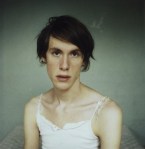
What about Kim Eliot Fung who was a teenager when she made this photograph?

I mean there are certainly criticisms that can be made here—adolescent angst, sentimentality. I might even add question with regard to why the model’s head is cut off—though I think the effort of the image has something to do with the spectators gaze and how an awareness of that implication inverts and skews notions of anonymity, gender perception/performance and the politics of visual representation of identity.

Criticisms that the work lacks refinement or is unaccomplished are completely off base. In other words, it suggests a precocious understanding of what maturity entails even if it has not yet fully reached maturation.

This is one of my favorite photographs. Unlike so many things that I return to in time, this does not seem smaller than my memory of it. If anything, the opposite is true: the image itself seems larger, richer and fuller when measured against my memory of it.

It’s my hope that Ms. Fung will return to photography at some point. Until then she makes aprons and curates the always impressive Editor’s Index.

toutdroitaller:

Irina Zadorozhnaja

Whether she is shooting street-travel hybrid images, landscapes or portraits, Ирина Задорожная demonstrates a precocious formal consistency.

Her images feel symmetrical. Yet, upon closer inspection they instead employ an objects implicit extension beyond the frame edge to balance out an equal amount of negative space on the opposite side.

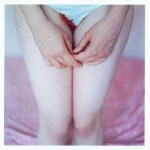
For example: the lower frame edge cuts awkwardly below the model’s wrist + mons pubis. Notice though how this is balanced by the negative space above the model’s head at the limit of the upper frame edge.

It’s a sophisticated, compelling tactic.

I really like this image. The expression in tandem with the pose is both aloof and fragile; the visible texture of the sweater expertly counters the otherwise problematic flatness. The light is probably too harsh but I can forgive that.

#skinnyframebullshit still needs to be called, however. It baffles me how the same artist responsible for this image showcasing how portrait orientation ought to be used, resorted to the typically knee-jerk, portrait-orientation-for-portraits in an otherwise nearly impeccable image.

passius:

porn4ladies:            passius:

Olga Karasik404 2013

The use of the mirror here is goddamn inspired– obscuring both women’s faces within the frame. (See!! There’s no reason to decapitate yourself in your images to maintain your anonymity. A little creativity goes a long way and makes for better pictures.)

It’s obviously beholden to Francesca Woodman; but it wisely cribs a page from the rock and roll rule book for performing cover songs: make it better than or do it different.

Karasik filters Woodman’s concerns through her own aesthetic sensibility in a way that marks it as reinterpretation instead of a rearranging of elements in a template.

Sadly, it’s either some #skinnyframebullshit; or, :::shudders::: cropped. (I loathe a we’ll-just-fix-it-in-post attitude. Do it right the first time or go the fuck home. Post-production is a safety net in the unlikely chance it becomes necessary; the entire fucking point is not to need it.)

I guess at least evinces some thought went into the decision to opt for the skinny frame.