

[↑] Source unknown – Title unknown {desaturated} (2010); [↓] Source unknown – Title unknown (201X)
Juxtaposition as commentary.
[↑] Source unknown – Title unknown {desaturated} (2010); [↓] Source unknown – Title unknown (201X)
Juxtaposition as commentary.


[↑] Source unknown – Title Unknown (201X); [↓] Source unknown – Title Unknown (201X)
As much as I’m utterly fascinated by depictions of ejaculation, I’m really super not into facials.
I’ve already written about this once before–and while it was from way back when I was a baby blogger: my opinion hasn’t really changed.
These two posts are not really an exception that proves the rule so much as a proof of concept that whether or not I dig facials, they can be depicted in at least a somewhat artful fashion.
In the top .gif there’s a focus on palate–namely, a monochromatic scale from a pale through peach skin-tone, to the shadowed masturbating hand to the burnt umber background. (I do worry here because it looks like the stud probably jizzed in the woman’s eye–and seriously getting semen in your eye is an awful experience.)
In the lower .gif, the staging from left to right, uses the natural motion of the eye’s tendency to instinctive scan left to right actually adds to the dynamism of the trajectory. I love that her hands are covering his and that she appears rapturously in the moment.
I also really love how if you look in the background you can see his hand open and pull back, as if he’s a magician conjuring a magic trick.
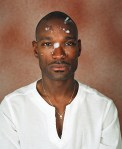








Ashkan Sahihi – [ ↖] O; [ ↑] S; [↗] C; [←] C; [+] N; [→] J; [↙] C; [↓] T; [↘] K (2003)
Taken together, the nine images above constitute Sahihi’s series Cum.
On the surface, what they are is obvious: carefully crafted head and shoulders portraits featuring an assortment of men and women with semen on their faces.
I am admittedly exactly the opposite of a fan of facial cumshots in pornography; however, the immediacy in the confrontation of the viewer by the subjects’ gaze is compelling in a manner reminiscent the obviously exposed nerve as raison d’etre that contributes such vitality to the cinema–birth by poetry–that became the Iranian New Wave.
However, upon researching Sahihi’s work, I find his conceptual framing frequently emerges from both sides of his mouth. For example, to make the images in the Cum series, he “asked his male and female sitters to bring along a male partner to ejaculate on their face just before the photo was taken.”¹ Whereas, when it comes time to courting the art world, he refers to his impetus as addressing the “pornification of everyday culture;” and just in case that isn’t specific enough:
I wanted to do a series on how I feel popular culture is getting more and more saturated with pornographic imagery whenever something needs to be sold — any product, any TV program. The pimp-and-whore look is everyday fashion. But as people get more and more sexed up, they don’t necessarily have a happier or healthier sex life. They don’t have a better relationship with their sexuality. My point was not to claim that pornography or sexual self-empowerment were “bad” or “immoral,” just to say it’s everywhere, and our acceptance of it is a pose. If you told some of the same people who wore pimp-and-ho clothing that you support gay marriages or gay adoption, they’d be up in arms.²
In other words it seems doubtful that Sahihi informed his sitters of the aim of his project beyond him wanting to take classy photos of folks with jizz covering their faces. But in subsequently packaging this as a critique of consumerist culture, he enacts the same sort of transaction he claims to be criticizing.
The additional art speak rationalization is fucking patently unnecessary–analogous to seeing a monkey sitting in a recliner in a room and having the narrator explain that you are seeing a monkey sitting in recliner in a room.
And as much as I like these images, seeing the way Sahihi uses people as props in so much of his work, is as deeply problematic as it is disturbing.
Ultimately, he does share in the provocateur tradition of the Iranian New Wave. Unlike it–the Iranian New Wave was provocative because of the perspective it espoused, Sahihi seeks to suggest provocation as a means of selling his work.
 Acetylene Eyes