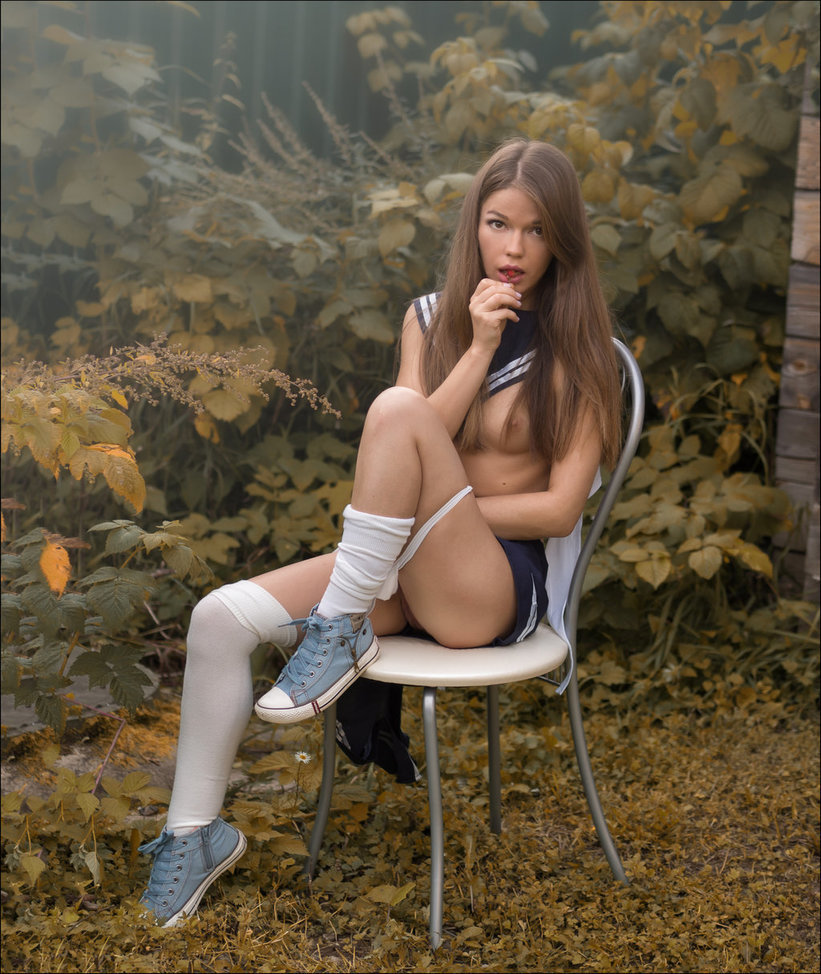
Pavel Kiselev – Kate (2017)
If you’ve spent any time plumbing the depths of :::air quotes::: fine art nude photography/image making on the Interwebz, you’ll be familiar with Kiselev: he made a bunch of images of women lounging around in various stages of undress inside a cabin on a sleeper car aboard a train. He eventually edited these images down and released them as a photo book called Railway novel.
His work has always been interesting in a knee-jerk, voyeuristic fashion–he’s clearly most comfortable when his work pursues a measured but by no means reserved eroticism.
This portrait of Kate (above) is surprising for a number of reasons. The eroticism is understated. Yes: there’s the cherry pinched between her teeth, hair partially obscuring her left nipple and her knickers pulled down and up draw attention to the shadowed cleft between her thighs.
The way she meets the gaze of the camera though suggests–to me at least–that it’s all a carefully constructed ruse to command attention. I mean: leaving the eroticism and voyeuristic impetus for a minute–the use of color is actually effing fantastic; the dark navy of her sailors collar, the matching skirt (darker for less lights reflecting off it) and the darker blue of her denim shoes.
And the blue is perfectly balanced by the green brown to yellow motif of the autumnal leaves. (Hell, the attention to texture is even hitting and sticking: the brushed chrome of the legs on the bistro chair, the vinyl of the white seat cushion–even the texture of her stockings registers.
I am not 100% sure what the haze in the upper left corner is exactly. I’m guessing it’s supposed to look like fog–or, what in painting is termed: sfumato. It’s not evenly applied across the area, however; and my gut says it’s that thing you see often in documenting products for commercial campaigns where you reflected light directly into the lens. (You can do this with a white sheet of paper or the blade of a knife held at an angle just on the periphery of the lens’ angle of view.)
I’m bothering to point this out for a number of reasons but mainly to demonstrate that if you keep making pictures–merely the act of continuously creating will improve your work.
However, those who both consistently create work and consume work will always progress faster and more organically than others. Like I’d put money on the fact that Kiselev knows the work of the Ninja Turtles namesakes. But, looking at this, I suspect he’s also familiar with Otto Dix. (This portrait of Kate reminds me of Dix’s 1926 Portrait of Sylvia von Harden–I suspect that’s not an accident.)






 Acetylene Eyes