Source unknown – Title Unknown (201X)

There are definitely essayists who are more formal, more critical, more highfalutin–but very few people approach writing with Rebecca Solnit’s firm belief in the potential of the marriage of words to ideas as a means of sparking curiosity, that most tantalizing precursor to wonderment.

In other words, she doesn’t treat her reader as if they are an empty vessel she is intended to fill with her great and varied knowledge. She suggests revelatory parallels, indulges lapses, digressions and exists fascinatingly somewhere between narrative and a sort of liberal arts whirligig. She’s dazzling to read; often bordering on transcendent. (She’s the sort of writer I dream of being.)

I can’t help but look at this image in the context of her most recent collection of essays The Encyclopedia of Troubles and Spaciousness–specifically Journey to the Center.

It’s the second piece she’s written about Icelandic artist Elín Hansdóttir‘s PATH installation–which is a pitch dark labyrinth setup in a gallery that one person enters to explore at a time.

On the matter of light and dark, Solnit observes that generally we are afraid of darkness and that one of the many things Elín Hansdóttir is interrogating is the notion of darkness as generative instead of detrimental–much as those spaces where piles of snow are last to melt, is also where the grass comes in greener and faster than anywhere else.

Of light, she notes:

Darkness is amorous, the darkness of passion, of your unknowns
rising to the surface, the darkness of interiors, and perhaps part of what
makes pornography so pornographic is the glaring light in which it
transpires, that and the lack of touch, the substitution of eyes for
skin, of seeing for touching.

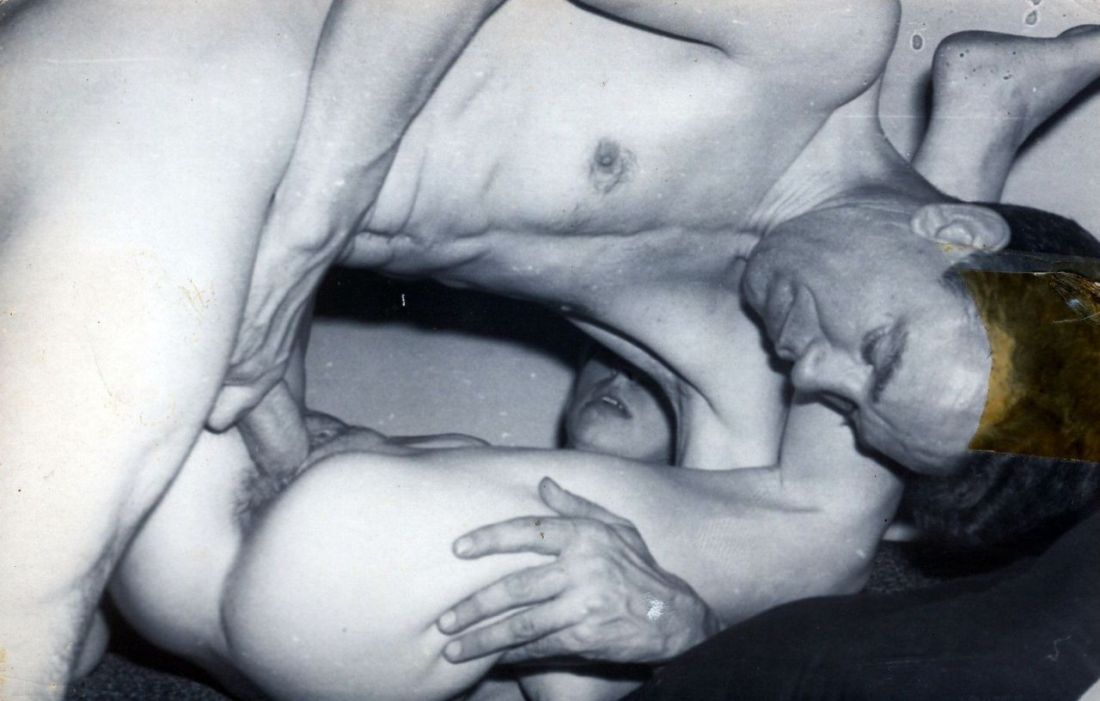
This is not a good image. It’s somewhere between what I’d term a medium shot and a close-up. And while you can ascertain what’s going on–a fairly blase, heteronormative FFM scene–it manages to neither focus on the impending penetration nor provides any sort of coherent check-in with what’s going on in the broader scene. (In other words, the camera needs to be either two feet closer or two feet further back for this scene to make sense as a still image; whether or not it was intended as a still image is immaterial–whether they are moving or still the general stipulations with regard to the grammar of an image  are analogous, respectively, to writing a speech versus public oratory.)

So if It’s not a good image why are you posting it. Well, simply because if you only consider selective parts of the frame, the light really is sort of gorgeous. The way the oblique light kisses the engorged corona of his cock is effing breath-taking. The delightful illumination rendering the lower woman’s rump with a supple dimensionality; the gorgeous skin tone it brings out along her back.

In other words, the frame improves as the contrivance of the glaring light source diminishes across a distance and is blocked by objects which diffuse it, introduce shadows and texture.


Laurent BenaimTitle unknown (2015)

I do not believe home
is where we’re born, or the place we grew up, not a birthright or an
inheritance, not a name, or blood or country. It is not even the soft
part that hurts when touched, that defines our loneliness the way a bowl
defines water. It will not be located in a smell or taste or talisman
or a word…

Home is our first real mistake. It is the one error that changes
everything, the one lesson you could let destroy you. It is from this
moment that we begin to build our home in the world. It is this place
that we furnish with smell, taste, a talisman, a name.

                   —Anne Michaels, The Winter Vault

Source unknown – Title unknown (201X)

One of my favorite things about sex with others is gap between orgasms, the space where everything is intensely sensitive. (It’s something with which I’m completely preoccupied with, if I’m honest.)

The way a-trusted-nother can guide you beyond any boundary you thought you knew yourself to have and to hold.

Pleasure is amplified–a river escaping its banks, flooding the levees. Senses sharpen–the smell, of sweat slick bed sheets, eucalyptus tinged summer breath through the screened window. The dewy drops dotting pubic fur–pearls and diamonds caught in a spider’s nest.

Saliva, sweat and orgasmic fluids layered, intermingled on the lips, skin, tongues and genitals of lovers. The holy taste of the holiest of communions.

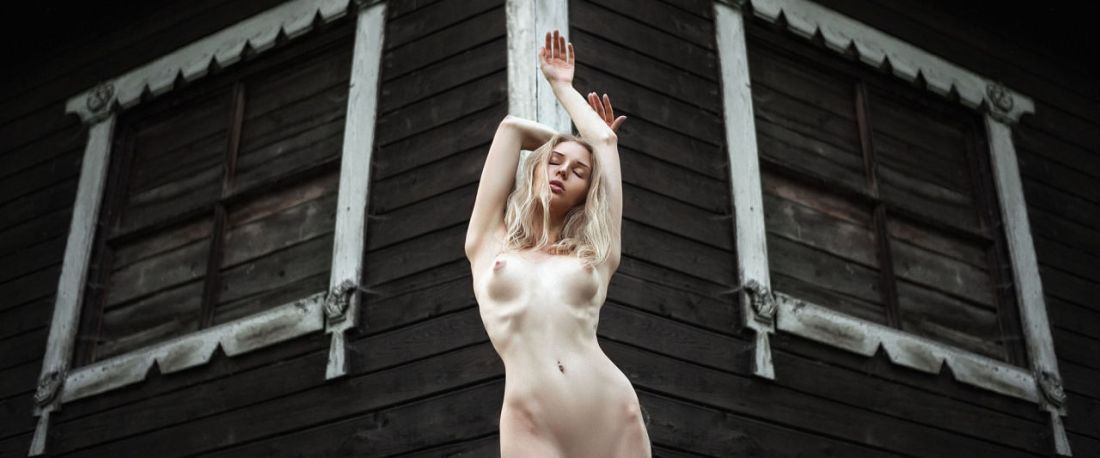
Elias HotNatalia (2016)

Given that the corner of the building is ostensibly a 90° angle, that leaves 270° from the side of the building at frame left to the side of the building on frame right.

Were everything perfectly symmetrical–and spoiler alert: it’s admirably close, but alas no cigar–looking at this from overhead and drawing a circle around the corner of the building, the building would represent a quarter of the circle. You’d divide the remaining circumference in half, in other words: 135°.

With the camera perfectly centered on the corner of the building the camera would align perfect with the 45° bisection of the 90° building edge.

This does not do that. If you measure the 270° of the circumference that isn’t occupied by the building, then Hot has situated his camera at about 138° (It’s more on a plane with the side of the building at frame right than the other.

That shouldn’t really be a big deal. Unfortunately, it is. One thing you learn working with a camera on a tripod for long enough is that rigorous symmetry in composition is extremely goddamn difficult to achieve. Lens distortion and the fact that there’s almost no SLR viewfinder that allows you to see 100% of the frame. Add to that that things that appear symmetrical, rarely are exactly symmetrical. (Also, the up-title and that this has been cropped in post complicates things even further.)

Still, I think it’s an audacious image. I don’t think it entirely works–but there’s something dynamic about it. If it weren’t in color, it could almost be a lost photo of Edith by Emmet Gowin.

Sophie Harris-TaylorFrances (2016)

Like most of the rest of Tumblr, I just finished Stranger Things. (I have mixed feelings about it; I never really felt that it ever came together in any kind of totality. The mid-to-late 80s nostalgia comes across as heavy-handed and seems more designed to fuel a sort of instant-geek connection to the show than to actually provide any sort of substantive immersive world building. It’s saved by unusually committed acting and surprisingly dexterous attention to consistent application of visual form and spatial continuity.

When I saw the above image, the mussed dark hair and the shape of the model’s face reminded me rather strongly of Natalia Dyer’s character Nancy.

Like the show, I have mixed feelings about this image. The color is nice–a very rigidly circumscribed magenta spectrum from skin tone highlight to the ribbed peach top to the pink-red lipstick.

However, the pose is odd. Does anyone else wonder what in the hell is going on with her right arm? And the pose–the tentatively uncertain hovering of her hands near her neckline–almost like she’s fingering a beloved pendant. But it’s designed for her to stylistically pull the top up to reveal her breasts. Why? For whom? Things are a bit a-muddle with this as far as questions of voyeurism.

It reminds me of this image of Génia by PeterVR. Both feature awkward/odd, self-conscious poses. Harris-Taylor’s is technically superior. But I feel like PeterVR actually provides enough context where the self-consciousness actually dovetails nicely with a more consistent application of the conceptual underpinnings of the image–i.e. his image takes a definitive stand on whether or not the work is voyeuristic.

Alfred StieglitzGeorgia O’Keefe (1919)

I don’t especially care for Stieglitz.

I mean I recognize his contribution to the advancement of photography as an art form both within the US as well as around the world; yet his work–although frequently very beautiful–feels not flat, but affectless in a way that comes across as contrived. (It’s like he spent way too long reading Thoreau in his teens and latched on to the pretentious naturalism more than the admonishment to ‘live purposefully’.

His work with O’Keefe is a little different. Or, the better way to say it might be: what I don’t like about his work actually serves the work instead of undercutting it.

Take the image above: there are similarities in her pose to depictions of Eve in oil paintings throughout the western canon; a ruse meant to preemptively short circuit Puritanical objections to the more sensual facets of the composition. (Eve for example is unlikely to be depicted hold her breast in such an ambiguous fashion, but even that can be traced back to something in-line with the asp biting Cleopatra’s breast.)

I don’t think there’s any way you can wrap your head fully around the Steiglitz and O’Keefe collaborations without acknowledging that they were ravenous with carnal desire for one another.

I know the prevailing wisdom is that an artist should remain aloof and not become entangled with their subjects. But I don’t think you can deny that when a photographer is consensually involved with their subject, it absolutely complicates the work–usually in interesting and unpredictable ways. (Thinking here of Corwin Prescott and Nicole Vaunt as another sterling example.)