The Death of Youth – Guetcha (2016)

As I’ve noted several times already: a cliche is a cliche because it allows one a reasonable handle on something that is otherwise unwieldy and fraught with complications.

The adage against cliches emerges from the fact that by using them, one is refusing to re-engage with and analyze a concept that isn’t necessarily one-size-fits-all anew. In other words, the advice against cliches isn’t that cliches are inherently bad so much as their ready made-ness presents an obstacle to independent thinking.

The elements of this image are cliche to the point of ubiquity: luminous lighting kissing the skin of a nude model standing before a milk white background.

Here though, the cliche serves as a foil–drawing attention away from the elements; instead, highlight the compositional attention to shape, line and tonal form.

I’d argue it’s too dark–and I don’t think that’s a matter of opinion given that the underexposure results in lose of shadow detail in Guetcha’s hair and along the right side of her face. But it’s easy to let that sort of teensy mistake slide when the result is this dynamically eye-catching.

Hannes Caspar* (2013)

I’m always yammering on about the role color plays in lens based image making.

And I’m nowhere near a place where I can coherently articulate my thoughts on the subject but in general when we’re talking about fine art photography and the question of the purpose of color, the conversation will (rightly, in my mind) revolve around masters such as: William Eggleston, Harry Gruyaert, Stephen Shore, Joel Sternfeld and Jeff Wall.

If we are to point to unifying themes with regard to the work of these artists and what it tells us about the nature of color in image making, I think there are two principles that bear mentioning:

  1. Color in a fine art image is never the point of the image but is indispensible in rendering the point of the image with unequivocal clarity.
  2. A heightened sensitivity to the interplay between conceptual foundations of the work, composition and form.

A better way of putting it would the pictures would absolutely work whether they were in color or black and white but the color is what ‘activates’ them.

There aren’t many people producing work today that I feel are making work that adheres to these criteria. (I’ll consider @thebodyasconduit as an exception, to this point.)

Conversely, there are artists doing visionary things with color that insist upon color as a the singular unifying point. (In other words: the desaturated work would realize a diminished impact.)

For example: @pru-e‘s work would be almost banal sans color. And although she doesn’t fit the above formula for color in fine art image making, she’s right up there with Eggleston when it comes to incomparably brilliant practitioners of color work.

But as much as I dig Ms. Stent’s work, her strobe heavy, co-option of a glossy fashion aesthetic, isn’t something that I can apply to my own work.

Hannes Caspar–on the other hand–is more applicable. And yes, I think he absolutely needs to be mentioned when the discussion turns to photographers doing radical things with color in their work.

In the case of the above, you have the vivid red, with no bleed whatsoever. (This effect is absolutely assisted by the off-blue color of the painted, scuff mottled floor planks. There’s an intense dynamic range but the mid-tones are almost entirely reserved for the skin and the wall/radiator in the background. Given such dynamic range, the skin tone is exquisitely perfect in its rendering.

In tone and form, this image actually reminds me of an image by the enigmatic Pole STOTYM.

There’s the accepted wisdom that B&W images, through their abstraction, allow us to bear witness to the foreign in the familiar. The historical struggle of color lens based images makers–if you accept my presumptions–is to render the mundane, somehow both mundane and transcendent at the same moment.

It feels like both Stent and Caspar are in their respective ways, calling bullshit on the notion that it has to be both or neither.

Art ShaySimone de Beauvoir in Chicago (1952)

Shay, on how the image came into being:

“I knew someone in advertising who said she would be happy to open her
apartment to her,” Shay recalled. “I took her there. She was about 41,
still a very attractive lady. I was a ballsy 28- or 29-year-old. She
took a shower and left the bathroom door open. I always carried a Leica
(camera) around my neck. There she was at the mirror doing her hair. I
went click, click click. She turned around and said, ‘Oh, you naughty man.’”

As much as I’m thrilled that there’s an actual honest to goodness nude of de Beauvoir, I’m a little skived by the explanation of how it came about.

If you are going to take nudes of someone, you absolutely must have their consent before you click the shutter.

I know, I know–they’ll invariably be someone who says, well she left the door open and he was a photographer who had a Leica around his neck, she had to expect that might happen. LOUD BUZZER SOUND & a ‘nope.’

–But, but… if she’s really been upset, she could’ve just told Shay to never promise never to publish it or to demand he remove the film and give it to her. That she didn’t proves she’s fine with it.

Again, no. She probably was fine with it. But the point is in a situation like this, what would it have hurt for him to ask. She would’ve said sure and then been self-conscious for a bit and then gotten caught up in what she was doing again and the picture would’ve been much the same except it would’ve been consensual.

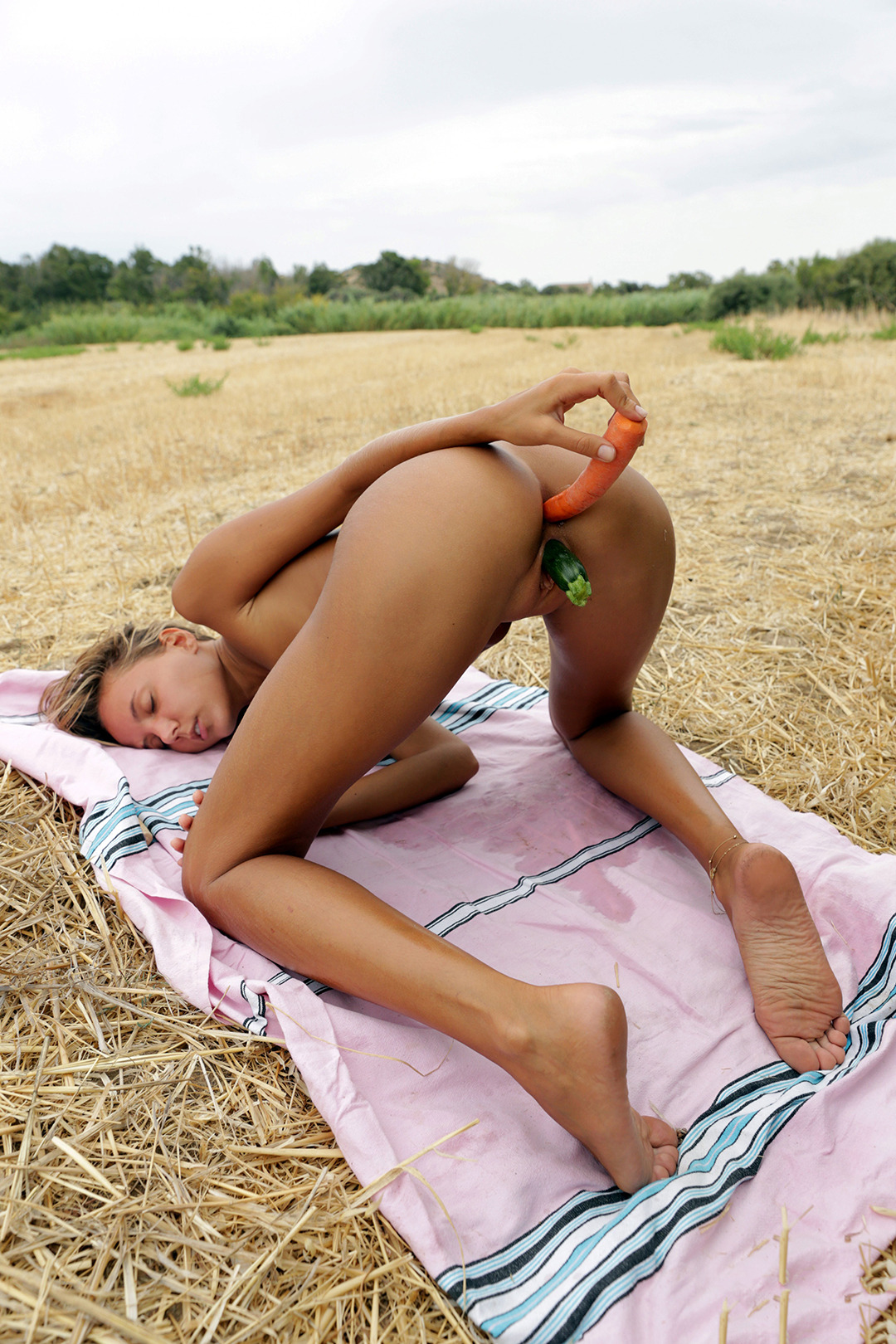
Katya CloverTitle Unknown (2016)

I’m of two minds about this image. It gets me painfully hot and bothered. So it at least has that going for it. The trouble is it’s a garbage image.

There’s no sort of compositional logic. It’s #skinnyframebullshit. There’s no rule of thirds, no golden mean; it’s merely the camera turned on its side as a means of most easily fitting the most information pertaining to Clover into the frame and (also the slimming effect that a vertical frame can impose.)

What makes the image attention grabbing is the super saturated skin tone, magental of the blanket and organ of the carrot against the bland straw and blah sky. (This is about as first rate an example I’ve ever seen of how faithful rendition of color does not guarantee a good image.)

I do like the concept–quite a lot, in fact. I’ve never seen anything like it.

Further, I love the giant wet spot on the blanket. If we knew a bit more about where she was, the image might be improved. Is she near a garden? Is that where the zucchini and the carrot came from? But there’s not enough of an indication to go anywhere with these questions. (Another short coming of the image.)

I’m not sure her pose works. It’s a little awkward but it does at least seam to be in service of what she’s doing. (I adore her expression.) Even though it is interesting, in that I feel most images like this would go for an angle more aligned with a straight on view of her vulva and anus. I always tell people that one can absolutely include graphic depictions of vulvas in one’s work, but if one want to know a general real for what’s objectifying vs what’s depiction, imagine the vulva is an eye lid, if the eye opens and is looking straight ahead is it making eye contact with the viewer? If so, there’s a good chance the image will end up being objectifying unless a good bit of other work is put in to avoid it.

Looking at this I’ve realized another thing about the difficult in using masturbation as a subject for art. It’s really a question of visual depiction of an experience versus staging the experience for a voyeur and by extension–due to the unfortunate white cishet male history of art–the male gaze.

If I can find someone interested in posing for it, I would actually very much like to reinterpret this concept as a fine art photograph–’cause I think there’s that sort of potential to the concept.

Inside FleshTitle Unknown (2016)

If you’re at all familiar with music criticism, you know that generally there are three templates for artists with long careers of making continual relevant, ground breaking work:

  1. Do the same thing you did before–except this time around do more of it and do what you do bigger;
  2. Apply your essential voice to something completely different in scope and execution (generally referred to as ‘making a left turn’);
  3. Burn everything to the ground, then burn the ashes and only then reinvent everything again from the beginning (think: David Bowie).

If Inside Flesh can be said to be following any of the above trajectories, it would be #1.

To me, that’s not just interesting–it’s surprising. Let me attempt to explain what I mean…

I’ve always appreciated IF’s aesthetic. But I’ve always worried that it’s a little too rigidly circumscribed–the whole glitching, industrial hell thing seemed to me that it would become cloying at a rather quick clip.

Quite the opposite, in fact: it feels like someone exploring the interstices between art and pornography could do worse than to immerse themselves in IFs oeuvre.

What I’ve noticed is a degree of conceptual recursion in their work. The limitations of their aesthetic are frequently mirrored in a certain heteronormative predisposition in their work. For example: they have a lot of scenes like this, where the viewer sees an nearly disembodied phallus vaginally penetrating a definitely embodied woman. (I really like that their frames tend to include the entirety of the woman’s body within the frame.)

However, there are two things that distinguish IF from most straight porn:

  1. Running counter to the strict aesthetic limitation (or perhaps, because of them), IF’s work possesses a profound sense of animalistic desire–the limitation of the form presents itself as artifice (or, you might say: the pornographic fantasy of it all is a set dressing intended to be seen as a set dressing which contributes an ambiguity to whether the form isn’t merely a means of helping to illustrate the strange beauty of two people who would be fucking in which the same way with or without the production design, props, costumes and cameras rolling.)
  2. As unsettling as some of it is, there’s never a sense that what the viewer sees is in any way divorced from a legitimate experience of interpersonal intimacy.

In their artist statements IF refers to their ongoing preoccupation with “human carnality in all its aspects.”

I know they are based in Poland. But I can’t help seeing what their doing as a sort of radical fuck you to on going policing of sex workers by ‘well-intending’ fuckwits–I’m thinking specifically of the AIDS Healthcare Foundations utterly ridiculous ballot initiative that would empower private citizens to personally sue adult performers not wearing a condom in adult media.

I am about as against the contrived Puritanical prudery that suggests sex is a sin in the eyes of some deity as a means of dodging unwanted pregnancy, disease, eternal damnation, etc., as one person can possibly be. When it comes to sex positivity, I err on the side of over-the-top. I think people who enjoy sex should have more and better sex.

By the same token, I find the sort of heteronormative no risks/all reward notion of sex perpetuated by most mainstream pornography to be only a bit less repugnant. I mean how many times have you watched a scene where a cable guy or plumber shows up to fix something and upon finding the person with the troubles is scantily clad and horny, things progress to sex with little if any flirting, communication or foreplay. It’s pure simulacrum.

But although it’s fantasy, and part of the fantasy is the randomness and availability, the context indicates that there should be behavior in place that pays attention to safer sex. (I say ‘safer ‘specifically because I don’t think there is any such thing as 100% safe sex–at least if your doing it right by recognizing that risk is an intrinsic feature to anything in life truly worth doing–and vulnerability, connection and giving expression to unfiltered desire are all risks; plus, the queer milieu in which I maneuver, I don’t know a single person who uses dental dams or condoms when performing oral sex.

My point is you choose your level of risk and accept the consequences. It’s not really anyone else’s call to make.

Yet, I feel like whereas most porn would argue against condoms for being elements that pull the viewer out of the fantasy, their absence in feels like a radical decision to experience the extremity of human carnality.

And it’s true: safe sex is good sex. But there’s something about unsafe sex that is completely immersive. (It’s like the difference between the hallucinations associated with mushrooms vs LSD–when I’m shrooming, I always remember I’m shrooming, when I’m tripping on acid, I sometimes lose site of the fact that I’m hallucinating–interestingly, I don’t especially like LSD.)

Like you can feel the smallest changes in engorged rigidity, changes in the viscosity of vaginal mucus, the slow build up of clenching and unclenching micro contractions, the warm surge of unrestrained ejaculation.

Really, I think it’s exactly these sorts of intangibles that IF is trying to convey in their work.

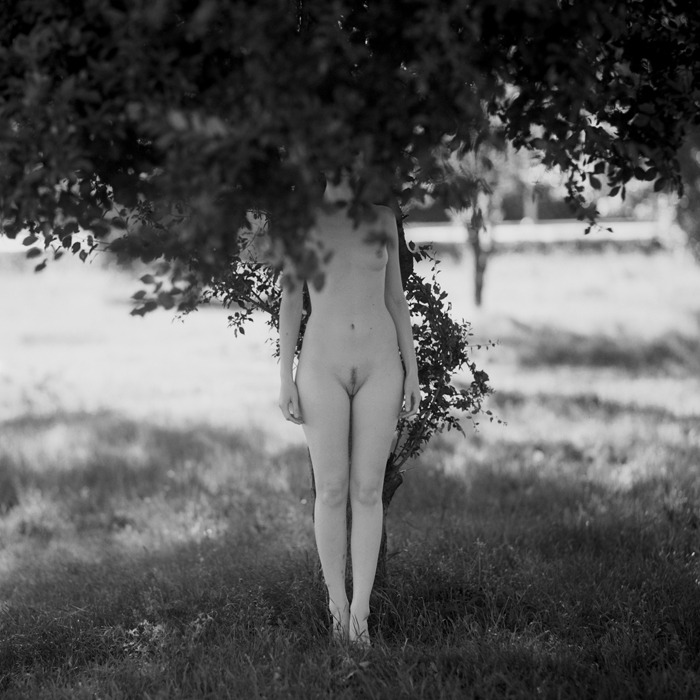
Michal Buddabar – Paula Lyily (2016)

Geez Louise, what are they putting in the water in Poland? The concentration of fucking fantastic image makers active there is just effing breath-taking.

Buddabar is putting out some interesting work. You can easily pinpoint specific influences. For example: if you take any artist featured multiple times by The Quiet Front, you’re going to find traces of those folks work in Buddabar’s.

I don’t want to belabor that point by cross-referencing specific examples but I do think the it’s useful to compare and contrast with Alexander Bergström.

There’s a huge degree of overlap between their two respective bodies of work: an unapologetic voyeurism, similar form and tone, etc. Bergström‘s use of color is superior, further I think he’s arguably the better technician.

However, where Bergström seemingly tries to sublimate his more perverse (I’m employing my preferred value-neutral connotation w/r/t this term), Buddabar is more unflinching–also, although this perhaps wasn’t the case two years ago, he seems to be a much better editor than Bergström.

But what I also love about this image is it’s yet another wonderful example of how using the frame lines to crop out someone’s face in service of preserving anonymity is just a garbage decision. There are so many other ways to go about it and even the worst, most ill-advised face blocking device will be infinitely better than figurative decapitation.

Either way, definitely check out Buddabar’s work–it’s pretty great, especially the more recent stuff.

Erotic BeautiesDaniela in Casual Orgasm (2014)

While I certainly appreciate the various elements here:

  • the window and its inviting of public vs private notions;
  • questions over the implications of voyeurism (experiential, i.e. masturbation vs mediated documentation of experience, watching someone masturbate as if they were unaware they were being watched even though they most certainly are very aware of that fact);
  • the crocheted décolletage, the fruited branches decorating the dress’ fabric and sparse floral on white pattern of her knickers present a stylized-without-being-kitchy, cutesy-femme bearing.

It’s definitely some #skinnyframebullshit and I think the way the frame amputates her legs just above the knee brings in issues of restricting autonomous mobility of the subject and rapidly pushes things down a slippery slope towards knee-jerk male gaze objectification.

When I started this project a bit over four and a half years ago, I was extremely unhappy with my life. There were a lot of things that informed my decision—but it was primarily driven by two factors:

  1. every creative outlet open to me felt stagnant, and;
  2. I am obsessed with the potential confluence of the subjects typically relegated to ‘pornography’ being recognized as viable subjects for consideration by capital A Art.

It was actually an inspired decision. They say write about what you know and considering I was spending two hours every day viewing the same sort of material I post on this blog, there was an elegance to the proposition.

Also—as I came to realize—my creative stagnation all started when I stopped writing. (Although ‘stopped’ made it sound like I gave up instead of spending several years staring at the blink-blink-blink of a mocking cursor on a blank page.)

I still struggle with writing. I’ve been working to get a novel off-the-ground for months—to little avail.And although I still don’t feel a renewed sense of momentum, there is at least movement now.

Surprisingly this blog has taken off more than I ever expected. I mean: I only started it out of abject desperation. So if some time traveller had told me that in January of 2013 that by the summer of 2016, I’d be averaging a post per day and have followers totaling into four figures, I’d not have believed them.

The ‘success’ of this project—if you can even call it that—has unfortunately changed some things. I definitely put more time and energy into posts than I did when I first began. However, as I have—for whatever reason—gotten attention for what I’m doing, I do worry that I have lost several things I wish I hadn’t; namely: I spend more time worrying about the more academic aspects (after anon advising me to top myself, the most common nasty messages I get accuse me of being ‘uneducated’ and/or ‘pretentious’) and how I’ve lost the more deeply personal, confessional tone of the first nine months or so I was doing this.

Amadine and I had just finished a hike.

We’d driven back to my AirBnB—a quaint cottage situated in a large chaotic garden. The two of us were seated at the heavy bistro table adjacent to the cottage. She’s an insanely talented illustrator and our conversation centered around our motivations for art-making. (We both agreed that the primary drive was a feeling of profound responsibility to share and/or draw attention to the moments of transcendent wonderment we experience. Subsequently, she talked about how her chronic health issues so frequently derail her creative practice and how societal pressures cause her to veer away from dealing with physicality, nudity, intimacy, vulnerability and sexuality in her own work.)

I found myself talking to her with a degree of guileless intensity I’ve never managed with another human being about my own work. Pornography serving as my intensely problematic/myopic introduction to human sexuality; and my simultaneously fascination with explicit documentation of sex vs my alienation from the rampant objectification and misogyny of porn.

I told her:

I started masturbating before I even knew masturbation was a thing. I’d rub my genitals against my pillow and I learned that if I did it long enough, it would make me feel warm and tingly for a bit.

By the time I learned that what I was doing was called masturbation, I was already hooked on the endorphin rush. It was the way I’d manage to deal with how insanely fucked and abusive my environment was growing up.

I ejaculated for the first time when I was twelve. I didn’t enjoy it. As a matter of fact, I remember it was painful.

As fate would have it, that same week, we had been told that masturbation was a mortal sin. (Remember I was raised by fundamentalist Xtians…) I remember the teacher telling us that if we had such urges we should pray that Jesus would take them away and that he would. It was identical to my mom telling my brother and I that my father really did love us deep down, he just didn’t know how to show it and that we should pray for Jesus to help him not be angry and to instead love…

I prayed but my prayers felt as if they never went higher than the ceiling above my bed.

I paused. Half expecting her to be appalled and fumbling for a way to make a polite exit. Instead, she offered: I’ve never been much of a masturbator. My mom says I used to touch myself constantly when I was young. But that was more curiosity. I had this intriguing body and I wanted to know everything about it. But as it became less about exploration and more about maybe not masturbating, but self-pleasure… it just made me feel weird and I stopped doing it.

Honestly, the raw material in the image above is first rate. Given the same elements, I firmly believe that someone could make a jaw-on-the-floor work of capital A Art. The problem is: the focus here is on the a mediated fantasy. This sort of ideal type—what the male gaze imagines female masturbation to entail. I’m not interested in that—that isn’t what arouses me, what captures my imagination, what makes my heart race and my brain crackle.

I am transfixed by the experience of unselfconscious pleasure—because it’s not that much different from transcendent experience when you get right down to it. And I’m singling out this image here because I think it has a great deal more potential than most images—but sadly it’s squandered as a result of preconditions and a lack of empathy.

I don’t want to see what you think I think pleasure looks like. I want to see the flush of your face, the shiver of your body, the breathless surrender as pleasure takes you. That, to me, is the fundamental essence of what makes something Art.

Amadine isn’t her real name. And I doubt she’ll ever happen upon this. But in the interest of full disclosure, the 48 hours I spent with her are among the three best experiences of my life. Only once in my life have I felt as connected/understood/seen by another person.

I am absolutely head-over-heals in love with her. It’s impossible though—for reasons I can’t even begin to go into here.

But: if there was something I could say to her it would be this line from poet Mahmoud Darwish:

قالوا: تموت بها حبـاًً؟
قلـت:  ألا آذكروها علـى قبـري لتحيينـي
they asked “do you love her to death?”
i said “speak of her over my grave and watch how she brings me back to life

wonderlust photoworks in collaboration with Kathleen Truffaut – [↑] Atelier (2016); [+] Redolent (2016); [↓] Cauterwaul (2016)

My last trip out to L.A. was pretty much a cluster fuck of truly epic proportions. The highlight of the trip though was meeting and making photos with the angelic and thoroughly intriguing Kathleen Truffaut.

(An extra special shout out to @jacsfishburne–without whom the above would not have happened.)

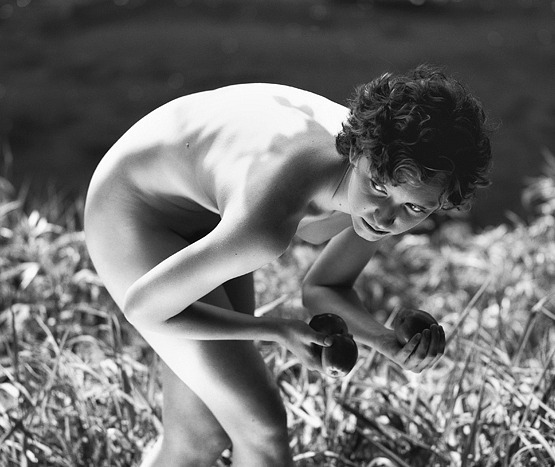
Tono StanoGift (1999)

Like much of Stano’s work, I am, at first, not certain how to engage with this photograph: it’s stunning–both in the sense of the reflection of sunlight off a moving vehicle that unexpectedly blinds you as well as incurring a coup de grace.

That’s probably not such a bad starting point, actually. (First idea, best idea–and all that.) There is something impossible about the light in the above: the over exposure along the ridge of your back, the flattering dynamic range of gradients on her face. (There’s almost certainly some sort of wizard-like chicanery with bounce boards going on just beyond the frame edge.)

After the initial wow-ness of seeing it, I naturally think woman with apples and start running with the biblical Eve mythos. On the surface, I feel that’s a super hackneyed premise. I’m inclined to accuse the artist of a lack of subtlety, when I should probably equally blame myself for the ease with which I trot down that well-worn path.

However, I don’t think it’s the wrong path. Here the woman is looking at something on the ground with both gravity and curiosity. The viewer might very much be intended to make this sort of subconscious connection. The three apples (instead of the usual one associated with the trope), suggests a fascination with the potential of knowing of good and evil (and from a theological standpoint: embracing of sin).

The more I look at this the more I’ve convinced that the allusions to Eve actually serve a recursive purpose, to present the surrender to temptation with nothing more than an implicit tempter.

Everything else points to a rapturous celebration of the sensuous pleasure of being human, alive and therefore physically embodied. (Also, from the standpoint of compositional form: not how the parabola of her rounded back opposes the inverse parabola of the grass behind her and how her shape and order contrast with the blurry chaos of vegetation; and how the dark background in the upper 40% of the frame makes her stand out more–conceptually suggesting that between chaos and nothing, there is humanity and it’s potential of sensuous experience.)