
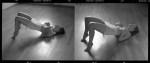
[↑] Grant Beecher – Vex Voir Lounging (2015); [↓] Niccolò Barone – Half Moon with frame glitch (2011)
[↑] Grant Beecher – Vex Voir Lounging (2015); [↓] Niccolò Barone – Half Moon with frame glitch (2011)
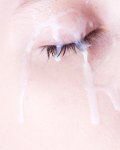


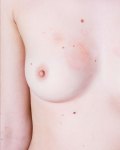

Amandine Kuhlmann – Cinq Sens [Five Senses] (2015)
The adage talent burrows, genius steals–most often attributed to Oscar Wilde–actually originates from T. S. Eliot:
Immature poets imitate; mature poets steal;
bad poets deface what they take, and good poets make it into something
better, or at least something different.
There’s zero question that Kuhlmann is stealing with this series. The color palate, poses and timing might as well be verbatim visual quotes from the posters for master provocateur Lars von Trier’s Nymphomaniac.
I won’t argue that these images are better than the posters. If nothing else, the posters almost certainly required a team of creatives and tens of thousands of dollars to produce. They are more dynamic, dimensional and artfully constructed.
But Eliot doesn’t imply that the only justification for theft is that you make something better–making something that is at least different is also an option.
Kuhlmann succeeds admirably in that regard by focusing on little tics–scratches, broken blood vessels under the skin, a silvered thread of spit suspending bubble of saliva above a mouth open in an orgasmic gasp, hair clinging to sweat slick skin.
Looking at these makes me realize that although the Nymphomaniac posters are technically superior–they could have been much more impactful if those responsible for creating them had been more attentive to such seemingly mundane details.

Source unknown – Title Unknown (201X)
People speak to me about boundaries.
This is work. That is play. This is public. That is private.
This is for friends. That is for lovers.
I don’t understand imaginary lines in the sand.
I want to know the ones like me. Daughters whose mothers
Left them to wolves, trusting the tutelage would
Lead–one day–to understanding the words
tattooed over their shivering hearts:
There are no lines. There are no boundaries.
A horse will run until it dies.
And death, death is better than dreaming about
what it might’ve been to run free.


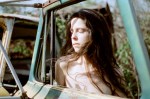
wonderlust photoworks in collaboration with Kelsey Dylan– [←] if-then-else (2016) ; [→] Che La Mia Ferita Sia mortale (2016); [↓] Samson’s Riddle (2016)
I had the pleasure of making the acquaintance of and collaborating with the fabulous Kelsey Dylan while in Atlanta last month.
Here’s the best photos from our session at the Atlanta Goat Farm.
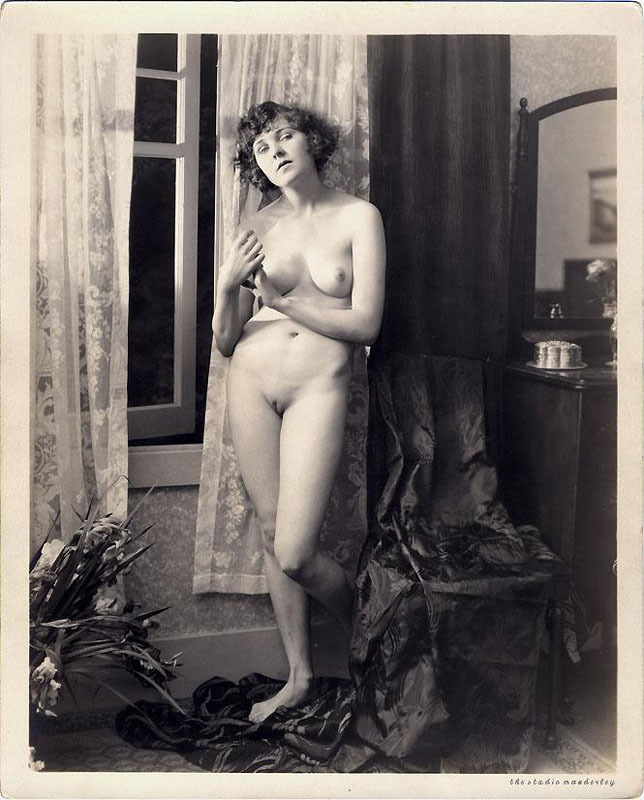
Albert Arthur Allen – Untitled (192X)
Excluding the border, sepia tinge and interior design, this could from a modern image maker who took this last year and only got around to uploading it to Tumblr last week.
But this was made sometime during the 1920s by a man born in Massachusetts, who moved to the Bay Area and started shooting nudes.
In this way he was singular in focus and profligate in output.
…
The work is a bit of a chimera; words like ‘camp’ and ‘contrived’ pop up whenever Allen’s work is discussed–sadly the former obscures a more important feature, the latter perhaps misses a pertinent point.
Take the above, for example. At first, it strikes one as charmingly intimate and unselfconscious. Upon further examination: the composition mostly works. The relationship of the lens to the mise en scene is studied, carefully composed–the half of the plant in the lower left corner is great as is the reflection of the room in the mirror.
Yet, as one gazes, inconsistencies take on a sharper focus: why in the hell is her ankle hooked behind the leg of the chair; did the shutter fire mid-blink or is she half asleep? That’s entirely too much fabric to be a robe and why is it draped on the chair like that–is it an effort to rubber stamp Classical Ideal ™ bonafides?
And now, almost a century after the images were made–despite their sometimes clumsy habituation, they are still better than 95% of the stuff made by so-called Tumblr famous image makers who shoot nudes and nothing by nudes.
In fact: I think there’s an argument to be made that Allen is perhaps a better photographer than someone like David Hamilton–if for no other reason than at least Allen is honest and straight-forward and owns (for better or worse) his rote repetitions and foibles.
But the interesting question here is: by seeking to document a subject which has been tested–tried and true across the ages–as perennially of interest as a subject addressed by art, to what extent does surviving 100 years render a photograph less document and more art?
I’d argue that the continued interest in Allen’s work has less to do with the work itself and more to do with what the viewer might interpolate about the longevity of fine art nudes as a photographic genre based upon the work.
We want the work to be Capital-A Art because it suggests a degree of merit to the undertaking and in so doing we subtly fixate upon the charm to the diminution of the awkward.
And really, Allen’s work is better than 95% of the work by this or that Tumblr famous image maker–I mean at least he is compellingly conversant in art history and its considerations.
But I’m not sure that which makes his work enduring is something that should in any way be seen as a voice from beyond the grave legitimating these our most earnest of efforts.

Malerie Marder – Untitled from Carnal Knowledge series (1998)
When I first stumbled onto Marder’s work a little more than a year ago, I had mixed feelings about it.
As I’ve subsequently encountered the work and reengaged with it, my estimation has shifted dramatically. The work has grown and I’ve discovered nuance and sensitivities I had previously overlooked.
Yes, I would still very much like to see her make something that is simultaneously capital-A Art and pornography. However, I’m not much less inclined to believe that not making that sort of thing the focus of her work is any sort of detriment or side-step of intrinsic potential and more I suspect if she did make art porn it would immediately clarify a number of stubborn questions I have about how to approach such an endeavor.
Really though, what I’ve learned by spending more time with the work is there’s actually less in the work that relates to pornography or Art. As the title of the series from which these images emanate suggests, these are more documentations of sexual arousal. They are less concerned with any sort of fantasy or sensuality; all but completely disregard any pretense of eroticism and focus simply on the space between tension and distension in physical desire.
The images are about sex. But in being about sex they aren’t intentionally arousing or explicit, that’s merely a natural outcropping of their laser-like focus on presenting the material with honesty, immediacy and intensity of feeling.
Another way to put it might be like this: how do you describe the taste of coffee to someone who has never tasted it? It’s a trick question: you don’t/can’t. You pass them a mug and say here this is hot and strong, try it.
The corollary here is that in a similar fashion, you cannot explain to someone who hasn’t had sex with another person, what it’s like. You can say it’s different than masturbating; but as to how it’s different… yeah, good luck with that. Because there’s the way the sensation is fundamentally different.
To be crass: being so horny you need to get yourself off to alleviate the tension is not unlike hunger but desire to share a connection with someone is much closer to thirst.
I believe Marder’s work is seeking to address something of the mechanism of such thirst. And the extraordinariness of that cannot be overstated.


Mario Zanaria – [←] Frances (2015); [→] Lynsey (2015)
I’m not really on board with the way Zanaria contextualizes his work but that’s not to say I dislike it.
Quite the opposite, in fact–for as many people who toss around the notion of ‘fine art nudes’ as a genre within lens-based media practice, I actually quite like his work.
I can’t help but thinking of the above images as an implied critique of Duane Michals’ Naked Nude.
In addition to that critique there’s an impressive synergy of structure, form, content and style. I love the novel poses–Frances’ dynamic confidence, Lynsey’s seeming reservations coming so close to passing as casual nonchalance.
There’s a sense of interplay with the photography that shines through but also a sense of personal agency in engaging in considerations of the politics of visual representation and identity.
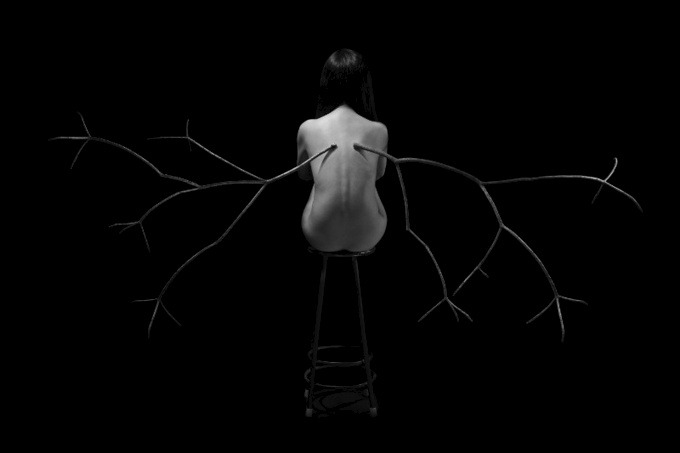
Peng Yun – I also have a pair of wings (2013)
Typically, I’m not fond of excessive pitch dark negative space for the same reason I’m skeptical of close-ups–both tend to diminish context. And, if you haven’t already figured it out: I’m all about that context, ‘bout that context, ‘bout that context. No vagaries.
This though, this I like.
I think what renders it especially resonate for me is that I rarely dream anymore; or, if I do, I do not remember my dreams upon awakening. It’s probably partly that I don’t ever sleep especially well–which is almost certainly exacerbated by my dependence on self-medicated with a variety of substances.
That’s not really the point. One of two dreams I’ve remembered in the last six months or so, involved these gargoyle like creatures. They appeared more or less human–except on a slightly larger scale; like a short one would be about 7 feet tall.
What made them resemble gargoyles was they had tree branches grafted to their backs. Walking around and interacting normally, they looked like two Groot arms trailing down their backs. But when expanded, they revealed green leaved branches that could be flapped like wings and allowed for limited flight.
I wanted to do something with the idea since I had the dream but I’ve been struggling to figure out what fits. Thus, it’s unnerving to see someone a world away with a stunningly similar notion.
One other note: while I hardly dig all Yun’s work–a lot of it is a little two reminiscent of lazy liberal arts students who easily invent compelling concepts and then execute them in a half-assed, haphazard fashion to a Radiohead track. But, I do absolutely love the way there’s also an explicitly erotic tinge to her work. For example: this is an image of which I am murderously jealous I can’t claim ownership.)

Miriam Valle – Parasite (2014)
The forest will answer you in the way you call to it.
—Finnish proverb
 Acetylene Eyes