Christine Godden – [↑] Light Touch #009 (197X); [←] Light Touch #008 (1970); [→] Light Touch #019 (197X); [↓] Light Touch #016 (1970)

In an interview with LENS Escuela de Artes Visuales in Madrid, Mark Steinmetz comments on the difference between B&W and color photography by saying something to the effect of if you’re shooting B&W you want to be on the blindingly bright side of the street; whereas if you’re shooting color you want to walk to the other side of the street and work in the shade.

Therefore–given the time when these images were created and given their ostensible fixation with capturing the interaction between bodies and light–it’s understandable that these were shot B&W.

Given the premise, these images were not necessarily destined for greatness. After all, ‘photography’ literally means ‘drawing with light’. And no one needs to look further than the parade of images on Instagram that serve no other purpose than to document the fall or angle of a certain precocious shaft of light.

To my mind what makes these images exquisite is their intimacy. However, instead of making that observation and then leaving it at that as I normally do–usually because I struggle so much with the unruly beast that is language and don’t know how to convey my thoughts clearly; I think it’s worthwhile to dig a bit deeper here.

Godden’s eye is unusually disciplined. The one thing that I believe holds true across her body of work is that through it’s revealings, it actually manages to conceal far more than it presents–the hiked up skirt hem, one erect nipple/the other concealed, a shift lifted to reveal allow a bare tummy to luxuriate in light and a nude body stretched out beside a pool.

Nothing is explicit; yet the photos are organized to point–seemingly incidentally–towards what remains unseen.

All of the above images are what I would term close-ups. I typically don’t like the close-up because I feel it tends to highlight a part of the whole instead of the part within the context of a whole. These images have a context–albeit a purposefully limited one.

What’s interesting is these images remind me quite a lot of glossy ads for luxury items from the late 80s/early 90s that I see beginning to bleed in around the edges in emerging ads that go over the top to commodify sexuality by aggressively conflating it with whaat ever the fuck is being sold–the pairing of several discrete elements that read as surreal juxtapositions.

In the case of such ads, it’s the product that unifies the disparate elements. But with Godden’s work, these carefully constructed images allow for the viewer to experience a sort of mirrored relationship between the photographer and her subjects. There’s very much something of seeing the world through someone elses eyes.

Source unknown – Title Unknown (19XX)

Narrative this image is not. In fact it’s pretty goddamn contrived–a cishet male photographer appropriating lesbianism for erotic effect.

But that realization serves as a narrative spark and I can’t help but think that as these two women were leaving post-session and one of them–probably the one on top (the woman on the bottom with the protruding tongue is a little too lipstick lesbian for me to believe she has any personal experience with cunnilingus) works as a prostitute but is a lesbian. She accepts these photo gigs because they pay the same as sex work and she doesn’t have to deal with men.

Yet the sessions themselves are the closest she gets to tracing the outline of her true desire and as such she frequently jokes with other woman with whom she is photographed about how ridiculous the way heterosexual men think about lesbian sex is and hoping that the other model will just once nod a little too knowingly and one thing will lead to another.

Source unknown – Title Unknown (20XX)

A couple of posts back I mentioned about how in unselfconscious moments, no one really gives a second thought to accepted notions of public decorum. We pick our noses, scratch our asses and just generally give in to the entropy of personal comfort.

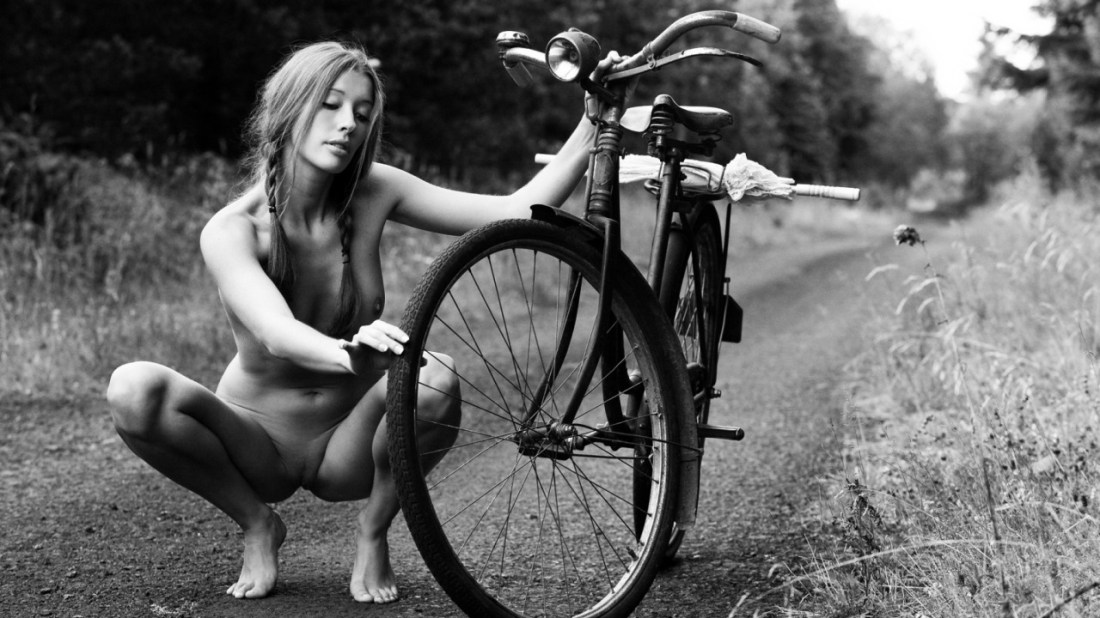
As such, this is clever insofar as the pose–although leaving little to the imagination–is actually not salacious. I mean, if a young woman riding her bike nude down a picturesque country road were to question whether or not she had a flat-tire, it might look something like this.

Yes, the camera is positioned ever so carefully to offer the audience the best view. But I do like the sense of scale, perspective and other than the dead flowering weed that just seems to float in the foreground, it’s actually a pretty damn decent composition.

(And, yes, anyone who was a seasoned bike rider would probably stop, straddle the bike and lean over the handle bars to check the tire–but that would be far less coy.)

With these type of images I always encourage people to ask: why is the subject naked? In this case, that’s not a question I think to ask. (I may not have ever had a chance to go skinny dipping in my life but I’ve damn well ridden a bike naked on dozens of occasions.)

But what I don’t understand is the damn umbrella strapped to the back of the bike? I mean, she doesn’t appear to need to wear glasses, she’s rocking the bedhead straight to braids look so it’s not like impending showers are going to muss her look and it’s warm enough for her to be riding her bike naked down a deserted country road…it seems to me an umbrella just doesn’t make a goddamn lick of sense.

Because riding a bike naked is great and all but running around without a stitch in the summer rain is bloody transcendent.

Barahona PossoloSweet (2013)

I love this.

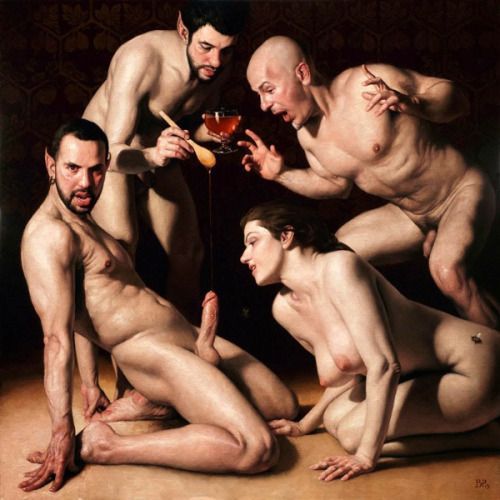
Stylistically, it wouldn’t be out of pace displayed side-by-side with any of Caravaggio’s biblical paintings. (In fact, there would be a reasonably interesting paper comparing/contrasting the influence of both Caravaggio (with a distinction between his biblical vs mythological work) and Klimt‘s paintings after 1900 in Possolo’s work.)

Granted, such explicitly suggestive depictions don’t really exist in the Western Art Historical Canon. There certainly aren’t rigidly errect penii in Caravaggio–however, I believe there may be a few lurking in Klimt’s criminally under-appreciated sketches.

But my point here (as well as with this blog) is there is no reason there couldn’t be/shouldn’t be graphic depictions of sex in art.

And that’s not to say this completely works. Ostensibly, the fellow on the top left is ladling honey out of one of wide mouth wine glass with a wooden spoon and letting it drip onto the engorged glans of the man on the lower left. (Note: the wine glass bears more than a passing resemblance reminds me to a similar object in Vermeer’s The Wine Glass.)

On the right half of the frame, you have the exuberantly performative excitement/delight of the guy on the top and the transfixed and lets be honest clearly thirsty AF woman on the lower right.

Some of the other facets are much more difficult to decode. Like–there’s a feeling that all the men in the image are aware of each other but the woman seems oblivious to everything except the honey marinated hard-on. (Let’s be honest, that is the locus here.) This conjecture is at least supported by the strange elf like ears all the men have.

I’m not really sure what the bumble bee on the woman’s flank indicates either–given the context of the image it seems it could speak to her sexuality and contrast that against the seeming ambiguity of the elf-eared ones; yet if that’s the case there are potential ways in which it could be interpreted that the image erases gay, lesbian and bisexual women. (And that’s not ever cool.)

But what really strikes me about this image–and like so much of the way my brain works this isn’t an association I would have made if I hadn’t read this article several days ago–the way he of the honey slicked dick breaks the fourth wall reminds me of the way Robert Mapplethorpe performs a similar action in (arguably) his most notorious image. It’s as if both are saying: this is who I am. But in the case of this painting there’s an insouciance and arrogance in contrast to Mapplethorpe’s studied gravitas.

June CanedoVarious Untitled (201X)

I shouldn’t be as completely over the moon about Canedo’s work as I am–almost without exception she composes vertically, she’s all about Kodak Portra and she’s exploring the currently trendy no man’s land between portraiture, fashion/editorial and so-called lifestyle photography.

But, contrary to everyone else hanging out in that space–her sensibility comes across as generally curious and engaged instead of being just another cookie cutter hipster affectation.

The above photos are my favorite and they fit the theme of this blog. However, I do feel a little conflicted for focusing solely on photos featuring nudity to the exclusion of some of the other work.

For example: Canedo has a bunch of what appear to be medium format film portraits of people in Wal-Mart parking lots. That these images are luminous and enduring is one thing; but as someone who frequently feels a desperate urge to make something against the odds and my own personal stagnation–I can’t tell you how many times I’ve thought about doing something similar in order to run some film through the camera. It’s never something I do–because I’m convinced that there’s no way the ends will justify the means. It works for Canedo, though. And the results are noteworthy.

She also does fashion/editorial work.Yet, although it fits the expected mold for that sort of thing, her work always features a distinctive personal style–low angles re-envisioning the customary tropes into towering and statue-esque abstractions, rendering a cool and detached view of something that is fundamentally unreachable; or a stunningly humane flicker between subject and photography, the splendor of which the viewer sees without ever being fully able to decode the entirety of the context surrounding what they’re seeing.

Adi PutraOnce in a Blue Moon (2014)

This is an impressive image. Not so much based on its virtues as its success in the face of ubiquity.

By that, I mean: I’m pretty sure everyone who has ever tried to make images of nudes in situ, has tried to produce an image like this and found the eventual product to be far less compelling than the impetus that spurred the act of creation.

This succeeds partly because of perspective (the horizon divides the visual field into constituent parts: 40% water and 60% sky–a result of the camera being positioned several feet lower than the usual human POV, which would’ve rendered the horizon bisecting the model’s waistline), allusion (pretty sure this pose in this environment is intended to recall The Colossus of Rhodes), ambiguity (the object in the sky is the sun, but with the weird effect of the strobe it’s difficult to tell whether or not its the moon, which is after all in keeping with the title) and the blue hair (which always commands attention).

Also, I really like how if you look closely you can see that she’s wearing sandals–a necessity if you’re going to walk on volcanic rock like that without cutting your feet to ribbons, the subtle reflection of her legs along with the sparkling glitter of the sunlight on the water’s surface and the fact that if you zoom in you can actually distinguish her shadowed labial cleft (not that it is a sexual image but to merely convey that whether or not nudity is sexual has nothing to do with nudity and everything to do with intent and consent.

Karel Temny**** (2015)

There is something curious about Temny’s work.

Skimming through it’s easy to latch onto an essential Russian-ness to his aesthetic; from there, to pick apart various apparent influences, & etc.

Such actions ultimately impune the images as both derivative and internally redundant.

However, there are some interesting things to be gleaned if you squint a bit and think outside the box. In other words: Temny does literally thousands of things wrong but at the very least he does them consistently–and in that consistency there is something not unlike a recalcitrant artfulness.

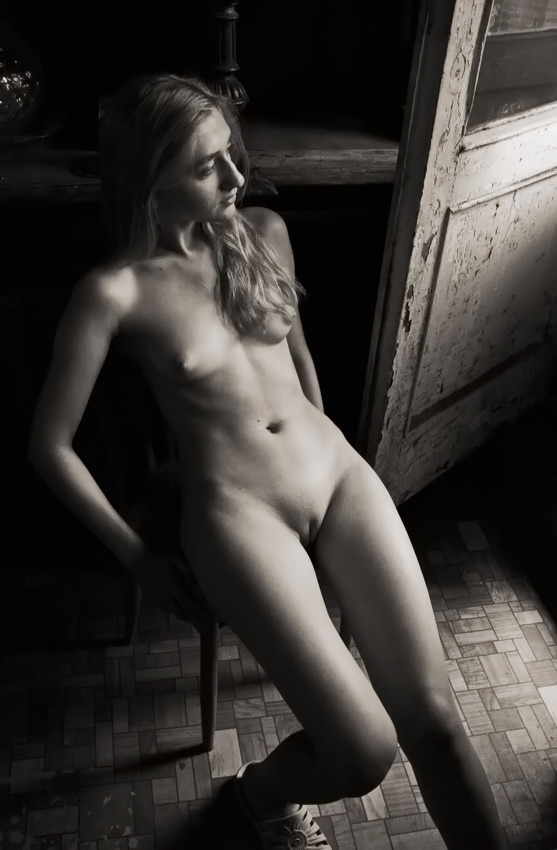
To start with: the above is a shining example of #skinnyframebullshit. The vertical orientation serves no other purpose other than to–given a tight space–include as much of the young woman’s body as possible; even though the frame runs contrary to the logic of the lines of the door and oblique angle of the light which push the eye leftward. (The way the lower frame edge amputates the bottom third of her right food and her left leg mid-calf is also unappealing. Also, a wider frame would’ve diminished the distraction of light falling from a window onto the floor that can be seen in the background between her face and the edge of the door.)

Yet, in this botching of composition, there is something instinctive that should be celebrated. Given this scene the light is hardly ideal. Given the bright spot on the door and the reflected spill onto the floor, this image was made at or very near to mid-day.

A ‘better’ image maker would’ve waited for more diffuse illumination but there is something to be said for the way the light accentuates the texture of the flaking paint on the door, the pattern of tile floor (further enhanced by the fact that the hyper focal point of the image is actually mid-way between the model and the floor), and the arabesques of her sandals.

Also, the pose doesn’t work. Her upper body seems transfixed on something playing out just beyond the edge of the frame; whereas her knees press together in a slightly demure self-consciousness. (Contrast with these MetArt images of Brionie W or this still of Laney from an Abby Winters masturbation video; both are made with a voyeur clearly in mind but although stylized they present a realistic unself-consciousness that is designed to de-emphasize the voyeuristic imperative.)

There is at least one other thing of interest to note–despite the inherent Russian-ness of the image, there’s also a way in which the muddy mid-tones invoke a Francesca Woodman-esque tone; a tone that neither exactly fits nor doesn’t fit the image but strikes me as intentional. If so, whether or not it work, it’s an audacious inclusion and I hope Temny is better able to address the extensive technical flaws with his work because I get the feeling he’s got some truly bad ass ideas he just hasn’t quite figured out how to accomplish yet.

Apollonia SaintclarL’archipel du plaisir [Liquid joy II] (2016)

During my undergrad stint, I flirted with layout and design..

There was something heady about pre-CS Photoshop image manipulation that appealed to me. I could take existing pictures and turn them into reasonably compelling posters for campus events.

I called what I did graphic design. And for the most part, I never said it loud enough or in the company of anyone who was a legit graphic designer until after I graduated.

But as I came into contact with folks who paid their bills doing design related stuff. I quickly learned that being able to layout out a flyer was only a fraction of what graphic design entailed.

Pros were always obsessed with the pedigree of typefaces, serifs vs sans serifs, integration of content and form.

Generally, I found such people intolerable. The work they made was thoroughly accomplished in a utilitarian sense but lacked passion and flair. (It would take me a full five years to realize that although I wasn’t really interested in graphic design, I am very interested in the underlying notions of UX/UI in regards to design.)

Anyway, I mention all that because two terms that design folks toss around a lot are ‘minimal’ and ‘clean lines’. And those are two terms I would use to describe Saintclar’s work.

As far as terminology goes: ‘minimal’ with ‘clean lines’ might as well be pointless in their ubiquity. However, given a visual context, they can be useful when it comes to orientation.

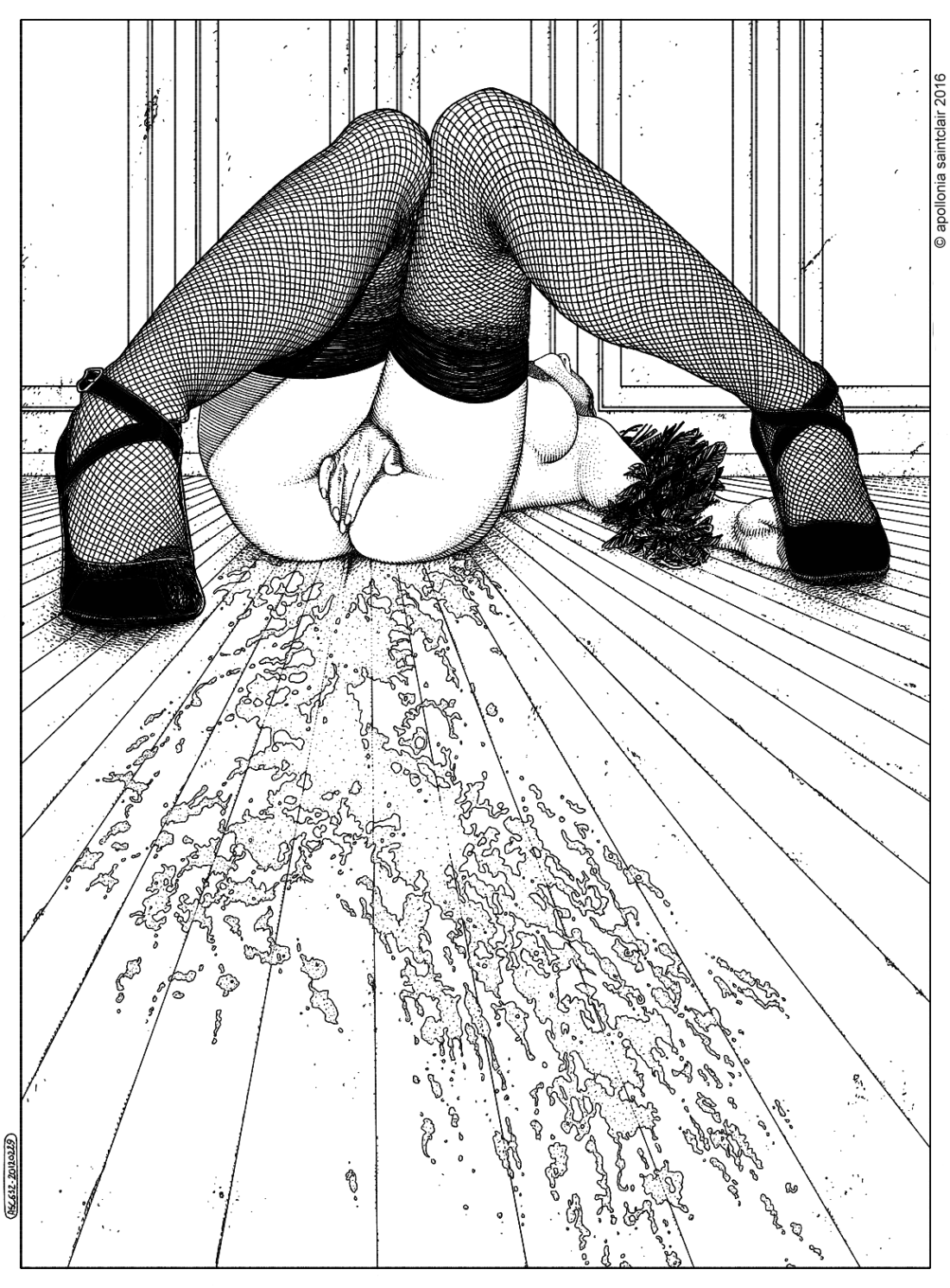
For example: Saintclar’s work always reminds me of Dürer. But it’s an association in negative–by that I mean, although Dürer’s work is maximal, he uses space and line in a very similar fashion to Saintclar.

Yet, what I also appreciate about Saintclar is that the artist uses lines in a surprisingly varied manner. They can imply shape, give form to negative space or–as above–emphasize dimenstionality.

What’s more: the framing is actually ingenious. A lesser artist would’ve inched the frame back enough to include the full swath of the messy on the floor. By allowing that to trail out of frame, the viewer is given a sense of continuity of space beyond the frame edge. Combined with the fact that the perspective is render in such a way so that vanishing point of the image is hidden behind the woman’s hand, it presents an image that is both erotically charged and artfully composed. (This is definitely not some #skinnyframebullshit due to its internally consistent use of composition and the fact that it is mindful of the fact that the viewer’s eye is meant to wander up and down instead of side to side.)