I’m here to suggest a similar relationship between white cis men who identify as ‘fashion & nude photographers’ and shitty, quasi-exploitative imagery.
Talyuka is a sterling example.
However, much like the infinite monkey theorem suggests, even a douche-y bro can sometimes stumble upon a good picture–consider the above.
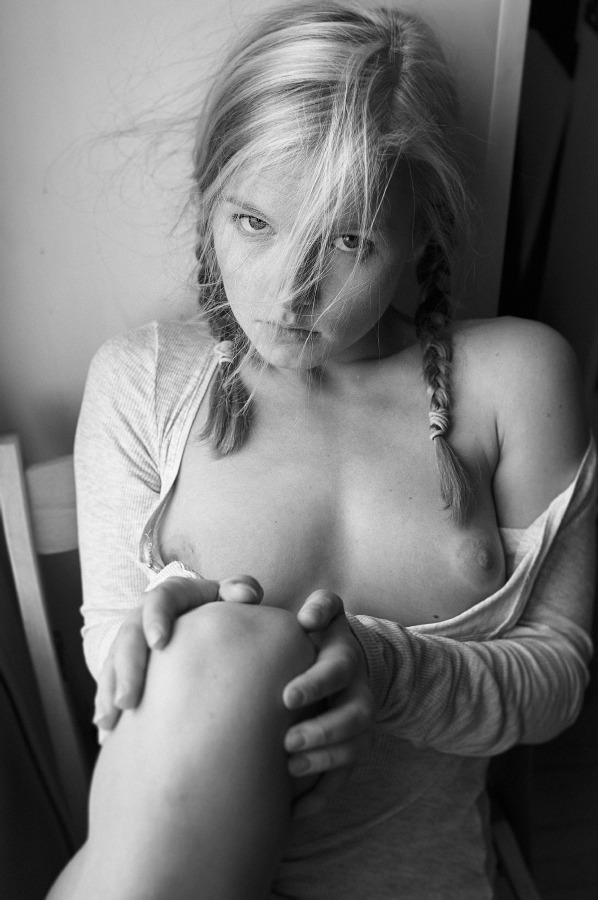
And it’s not even necessarily good. First and foremost, there is no compelling reason for this to be a vertical composition. Second, I’m going to take a wild stab and suggest that it was shot on some sort of full manual, setting. This would’ve been an image that would’ve benefited from an extremely shallow depth of field as her knees and hands contribute decidedly towards creating a foreground and the wall behind her is an obvious background. Rendering both bokehlicious, could have accentuated her expression–somewhere between coy and perhaps deflective of unwanted insinuation.
But really, I’m all about the mussed hair. It’s like she just pulled a wool jumper over her head and her hair is all wild with static electricity. It flies in the face of the prerogative for perfection in fashion moded work and her it at a cute, down-to-earthness to the image that renders it palatable.
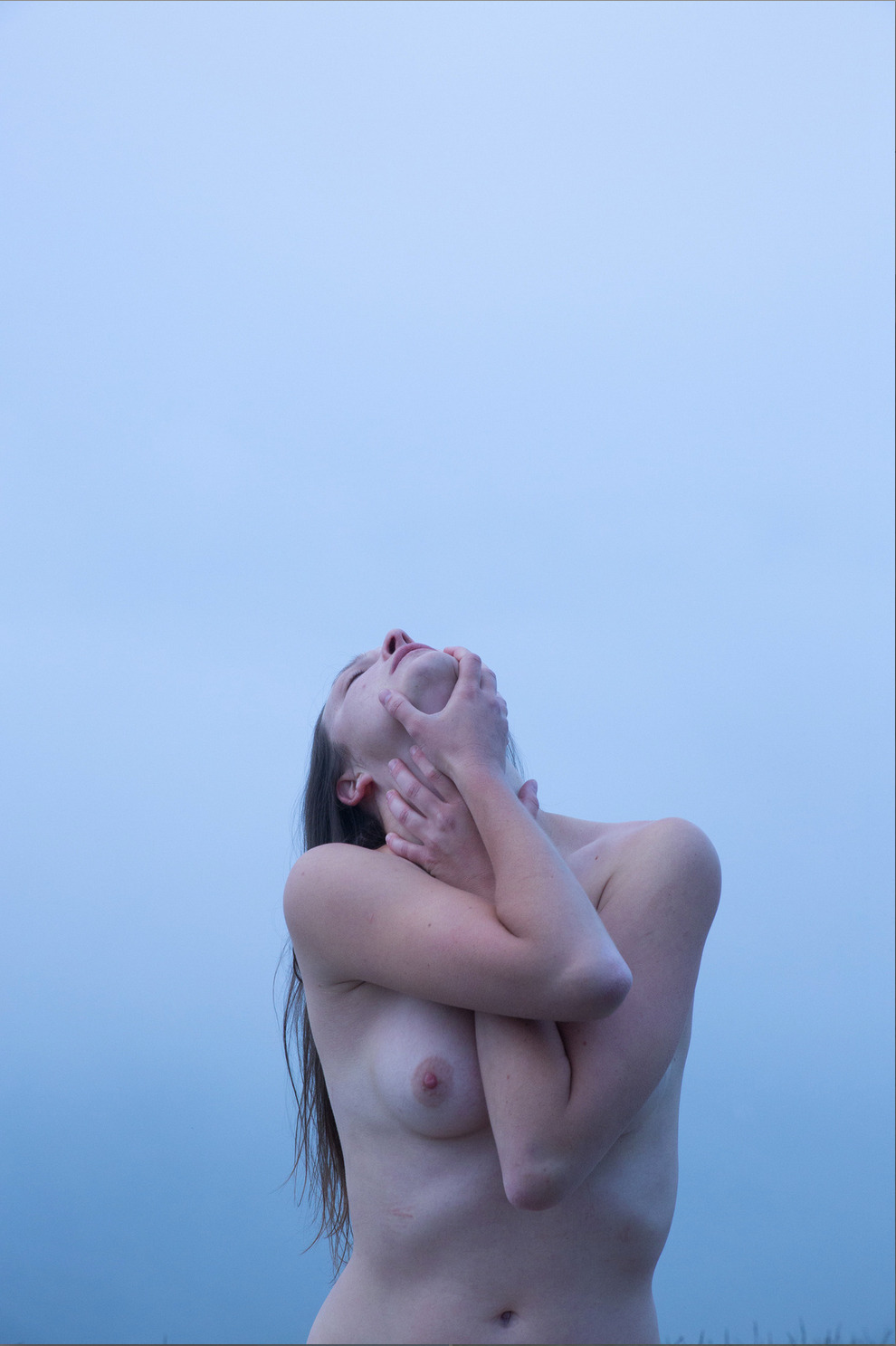
I LOVE the way it’s both flat–the subject in the foreground and the blue-white gradient of sky in the background–at the same time there is this weird dimensionality to it. (I mean look at her right elbow blocking her left forearm and how that suggests spatial cues that contribute a palpable sense of her right nipple, right breast and upper body all offset by the hair trailing down her back behind her.
It’s the same thing with her overlapping hands-right over left (and oh god look at her left thumb against her neck!) Her lips nostrils and earlobes backed again by her trailing hair.
And the way the tippy tops of beach grass stalks at the lower right frame edge render the space between her body and the right edge of the frame a sort of neither positive nor negative space that perfectly balances the extensive negative space within the frame.
Also, the composition moves the eye downward and subsequently pushes it up again.
As an image maker, Ruiz is all over the place. She studies fashion but pursues interests in practices as diverse as 3D printing, video, graphic design and illustration.
It’s easy to see the influence of Lina Scheynius and Traci Matlock on her work. (Interestingly: I always see correlations with Benoit Paile–as far as scale and perspective go; and Matthieu Soudet as far as scene manipulation is concerned.)
And as much as these are sort of secondary influences (from an art history snob standpoint), I don’t hold it against Ruiz because her work is interesting and she knows how and way to employ vertical frames that are not #skinnyframebullshit.
As far as that goes: she’s already better than ¾ of the image makers out there today.
I like the fact that when Kuklin photographs nudes, he mixes up it–featuring both men and women.
On top of nudes, he works with landscapes and more traditional portraits.
His work is all mostly middling–except for this, which is so effing exquisite it manages to transcend its many flaws.
Coming from me that’s saying a lot as I am normally prone to throwing up a little in my mouth when middling image makers embrace alternative process–in this case: cyanotype–in an effort to attribute some sense of distinction to otherwise mediocre work.
In Kuklin’s case the cyanotype gambit pays off–not due to luck so much as a result of working squarely within the confines and expectations established by art historical tradition, i.e. he’s intimately familiar with the history of portraiture and landscape as themes for visual depiction.
To me: it’s obvious that he lack formal training. The above, for example: if you squint and tune out everything that makes it so compelling you’ll not that the way you can’t see her right arm is super awkward and distracting, the way she’s sitting perpendicular to the bridge is also not entirely compositionally effective given the disbursed negative space. (In addition: you can argue that her right leg is distracting, too–but I thought it was trailing off the bridge into dark water at first. Clearly that’s the effect Kuklin’s going for but there’s no way the water would be higher than the bridge given her position.)
However, the expression and the over-exposure of her left shoulder separates her from the background, this is counter-intuitive given the other lighting cues but actually serves to balance the highlights in the foreground–her skin and underwear, the shoes in the mid-ground and the rhizomatic grasses and their mid-tones in the background.
It’s also charming that she has and seems completely oblivious too the hole in the crotch of her knickers.
Wer mit Ungeheuern kämpft, mag zusehn, dass er nicht dabei zum
Ungeheuer wird. Und wenn du lange in einen Abgrund blickst, blickt der
Abgrund auch in dich hinein. [He who fights with monsters should look to it that he himself does
not become a monster. And when you gaze long into an abyss the abyss
also gazes into you.]
It’s the second bit about gazing into the abyss which seems to me to be applicable to Ocaña’s photos.
This was the first image of hers I stumbled upon.
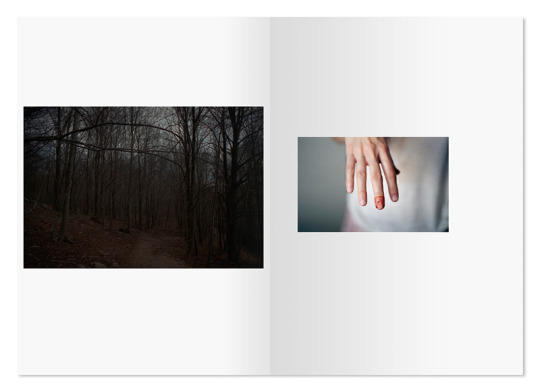
The photo on the left reminds me of the stuff Sally Mann was doing between Deep South and Proud Flesh–too dark to determine whether its twilight pastoral or turgid nightmare.
Yet paired with the second photo of a bloody finger–which might have been taken by any number of internet famous photographers–any sense of sinister menace resolves into something closer to the slow ache of an unrequited longing; as if the beauty as well as desperation of existing in a desolate space transform one into something that mirrors similar beauty entwined with desperation.
Ocaña is doing revelatory work in exploring the interplay of images. (I especially admire the way she’s employing text, mixing B&W and color–something I’ve struggled with how to pull off in my own work–and so openly demonstrating her process.
But here we should return to the images with which this post opens from the series Don’t break.
My Spanish is godawful but here’s what I’ve got as far as an ultra literal translation of the artist statement:
This project is about delicate-ness; where absence, the unattainable and loneliness form the central conceptions. Nudity is de-emphasized and employed as a means of establishing an intimate, relateable frame for the work.
Each photo/diptch presents an anonymous protagonist. The relationship between photos morphs across the series and establishes a larger context given the work taken as a whole.
Assuming I got even a fraction of that right, I would deem the work highly successful.
However, heading back now in the direction of the quote with which I opened this post: I read this article recently in the NYTimes about a newly discovered ‘music center’ in the brain. I was fascinated and appalled in equal measure.
See: I’m a disciple of Wittgenstein. And one of the most salient facets of Wittgenstein’s work is the notion that contrary to the accepted Cartesian model, meaning does not derive from internal mental processes. As W. puts it: if every time I understand how to solve a problem I experience a white flash as if a light bulb is suddenly illuminated above my own head, the white flash is not ‘understanding’. I am justified in saying I understand only when I am able to correctly solve the problem.
Thus, if we say that music activates a certain area of the brain that language and aleatoric sound do not–how much further is it to test if something is music or not by strapping someone into an MRI and playing them a sample and then judging by how they react deeming music or not?
One of the great sadnesses of my life is that I possess no talent for playing music–although I am more sensitive to music than any other form of art. (I’ve gotten higher off songs than I’ve ever managed with any illicit substance.) To me there’s something musical about walking through a snowy forest with no one around for miles and you can actually hear real silence for once or the way the calack-calack of trains always ends with a half-measure rest instead of the expected completion of the rhythmic expectation. Hell, right now I’m listening to Tim Hecker…
Is what Ocaña does photography or collage. I’d argue it’s both. And to me that both is incredibly important.
Imagine I’m standing listening to you tell a story. You’re back is to the ocean and I’m facing you. We’re standing on a hill and the sun falling toward the ocean. And then something between your story and the orange-mauve color of the sky sets my brain on fire. I point and you turn and look. Either you’ll see it or you won’t. By the time I find the words to indicate that to which I am pointing, it’s spell on me will have ended. But by pointing there is a chance that you might catch the tail end of the same spell. That I might share it with you. That you might know too.
I like Jump’s work but I have no idea what to do with it.
She mentions her conceptualization revolves around ideas of ‘memory’, ‘belonging’ and ‘home.’
It’s not that I think she’s misjudging her own work. It’s that if those are her primary considerations–then they are not readily apparently in the work (at least not without enough mental squinting to prompt a migraine).
I’d venture that the work is about those things insofar as each of those notions involve some degree of fragmentation. Memory–I remember it like this, you remember it like that but the truth was likely somewhere between contradictory accounts. Belonging–do you accept me for who I am, who you think me to be, who you want me to become? ‘Home’–as a very wise person once told me: home is the place you can’t leave fast enough but once you’re gone all you do is count the days until you come back.
It’s as if she’s trying to produce work that matches the vision in her head but in doggedly pursuing that vision, she loses sight of subtle course corrections suggested by the ways product contradicts process.
Like she makes wonderful self-contained images that are visually dynamic (1, 2) yet convey a strong sense of temporal-spacial distension–as if the viewer is a voyeur watching a dreamer experience their dream.
But such cohesive and clear photos are placed side-by-side with the above–which is lovely, yes; but there’s something languid, informal and uncertain to it.
Interestingly, as dynamic as some of the other work is, I get caught up wondering what I’m missing with the image above. And I can’t help think that if whatever is absent was at least pointed to by the photo, I would probably prefer this to the more compelling but distant considerations.
Still, I think Jump is talented and she clearly has a solid enough foundation that if she continues to make work, I have no doubt her work will become more focused and incisive.
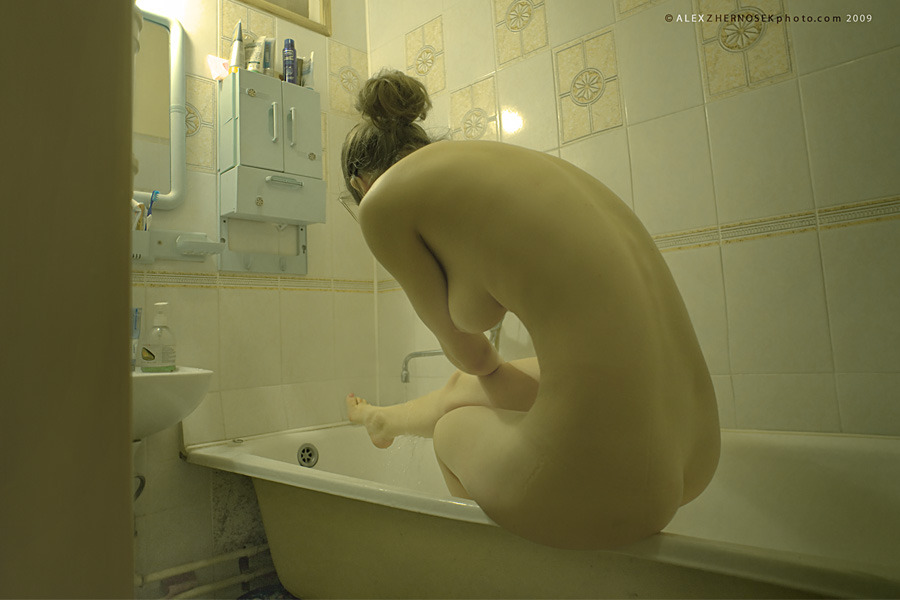
When I first encountered this my thought was along the lines of wow, that’s very nearly perfect.
Spending a bit more time with it has caused me to question my initial reaction. Yes, there’s a very strong sense of mood. And it’s actually rather unlike the rest of Zhenosek’s work–which reeks of objectified sexualization of bodies/run-of-the-mill straight/white/cishet misogyny.
But there’s something interesting about the documenting of a sensuous moment here (warm water splashing over her ankle) and how that pushes up against the sense of imposed voyeurism (the visible door jamb and the uncertainty as to whether or not this woman knows she’s being viewed).
And as much as the focus is the curve of her back, Shifting her several inches toward frame right would’ve better balanced the door jamb, as well as blocked the reflected hot spot on the tile with the models head, creating better separation from the background and also underscoring the fact that the water is splashing over her foot.
So-called ‘lifestyle photography’ can be a huge drag. It tends to be folks performing cool in ironically coded ways that only their fellow hipsters shits are going to ‘get’.
Reinoso doesn’t seem to give a single fuck about ‘cool’. Instead, her work seems precociously fixated on the virtue of a panoply of experiences.Another way of putting it: sex, drugs and rock and roll are less the entry fee and more the perfectly curated opening act that whets appetites for the headlining band.
Consider the juxtaposition between this more formal photograph (which could be a reference to Clare Laude) and this more grungy strobe variation.
And this one where a pants-less, high-as-fuck guy pisses on a couch.
Or this one. No description. You just need to click on it. (Also, full disclosure: have done, would do again.)
I just can’t shake the feeling that much of the work features people who sexually aroused and are either about to fuck or are thinking about fucking.
I’m not saying it’s all great. But insofar as all of it is interesting, it’s at least good and there are glimpses of simple, candid greatness both in the more erotic work as well as in the quieter, more candid portraiture.






 Acetylene Eyes