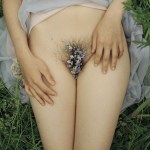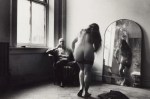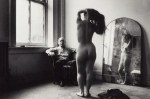
Alexandra SophieSecret Garden (2014)

I have no idea which came first this project or Natalie Fressel’s Forbidden Fruit but there is absolutely overlap between them.

Fressel is all about color and blunt synecdoche; Sophie is more subdued but she also presents a coy playfulness.

I’d be willing to give both the benefit of the doubt and tout them as promising up-and-comers. Except, well, when you get down to the nitty gritty, Sophie’s work is actually categorically better.

No, it doesn’t have to florid color. The skin tone is a little flat and the grass doesn’t quite pop the way you’d maybe hope from an artist working in color. What is exceptional about these are the positing of the hands.

Now before you start lecturing me about how you didn’t even notice the hands, so why am I banging on about them. Well, that’s my point. Look closer–remembering the oft repeated frustration people express about being in a photograph: I never know what to do with my hands.

The hand positions in this are very obviously staged but not in a way that stands out. (The hint of the fingers in the third frame from the top is freaking ingenious.)

I’m super hesitant to impose meaning on work by artists with which I am only passingly familiar, but the way this is about touch and so much of the dynamic effect depends on the hands, I think under the darlingness of these pretty pictures is a very intense effort to develop a visual language to address representation of a woman’s sexuality. Specifically, I’d be pretty willing to be this project is actually about the relationship between young women and masturbation.

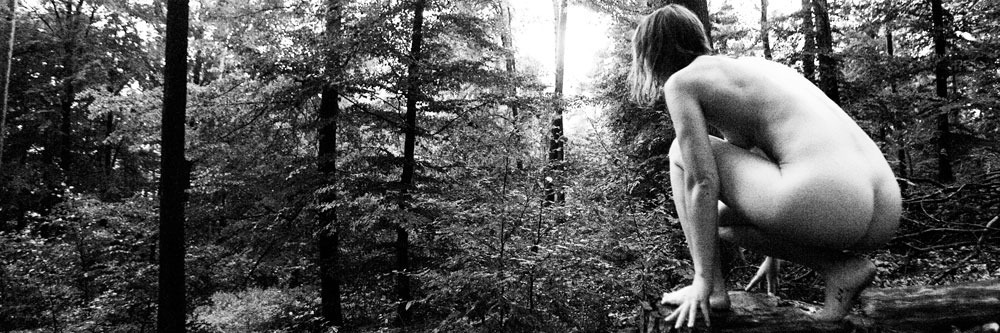
Christian Schnalzger Untitled (201X)

I’m posting this less as an endorsement of the artist–alright not as an endorsement of the artist at all (I mean he has some okay ideas, but his technique just is not anywhere near where it needs to be)–but more because this isn’t cropped. The image is actually that wide.

I’m verklimt–talk amongst yourselves. Here’s a topic: the Holy Roman Empire was neither ‘holy’, ‘Roman’ or an ‘empire’. Discuss.

Seriously though, I found out about this format on Wednesday. It’s depending on where the camera originated either the Hasselblad Xpan i/ii or the Fuji TX-1. It uses regular 35mm film and fits 21 shots per roll and features an aspect ratio equivalent to Ultra Panavision 70mm. (Think Ben-Hur or Tarantino’s forthcoming The Hateful Eight.)

The cameras are extremely rare and exorbitantly priced. It would also solve a half dozen different problems I’ve been struggling with in my own work for the last three years.

Really, someone out there has to love my blog enough to get me one. You don’t understand. I need this camera like woah…I can’t even.

WowPornSize Matters! featuring Bella Baby (2013)

Despite what tend to be better than the run-of-the-mill online porn outlet production values, I object to the over-the-top heteronormative tropes in which WowPorn traffics.

And as much as this video is emblematic of everything I detest about the company, this shot actually has a great deal of inherent potential–I mean I’ve never seen framing quiet like it before.

Granted, the camera probably needs to pull back about two feet and perhaps angle up slightly. Cover that too hot key light source–probably a west facing window–with a couple layers of frost; gel what ever is casting that godawful purple sodium vapor tinge that’s working as the fill here (I’d say CTB but then I like everything to match and correct via a grade in post, CTO could work too.)

Also, production design dropped the ball. Sure the wood floor is nice, but how about some sort of rug to add some color. And the difference between the color of the wall and that cabinet needs either color or at least two stops greyer.

Lastly, this is one of those situations, where the default 16:9 aspect ratio isn’t quite as wide as you’d want. Ideally, this scene would’ve benefited from the abbreviated depth of field an anamorphic adapter would’ve brought to the table. However, given that those tend to be expensive, they camera guy could’ve opted for a wider lens and then letterboxed during editing. (Something I’m discovering is that the more rectangular your image, the more it invites a narrative reading–which is not to saw every movie made needs to be shot in 2.35:1 but there are cases where it is appropriate; this is one, IMO.)

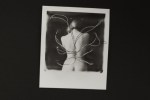
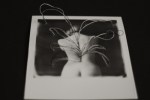
Anna MalinaUntitled (2013)

My first thought is that knitphilia would love this. And I’m sure she’d have all sorts of intriguing things to say about the interrogation of the notion that work made by women has been historically discounted as not ‘art’ and instead labeled ‘craft’.

As fascinating as I think that angle would be I’m just barely conversant on that topic. So we’ll have to settle for what I know a bit more about–in this case: possible influences.

The tones are reminiscent of Selina Mayer and the surrealist feel is definitely in keeping with ellie-lane-imagery (less the above image and more bearing in mind the dark, vaguely nightmarish effect of Malina’s broader scope of work).

Really, what gets me is for all the inane repetition of adorning photographs with needle work, the thread here actually functions as a legitimate sculptural element.

It’s probably short-sighted but I can’t think of thread as a media of visual representation without thinking of Russell Mills album artwork for nine inch nails The Downward Spiral.

And I can’t think about that cover without tying it into the tradition of Joseph Cornell’s pissing all over the distinctions between sculpture and collage.

But whereas I have mixed feelings about both Mills and Cornell, it feels like Malina’s work has managed to find itself in the interstices between what those two artists considered the limit of their own work and the outer boundary suggested by that limit. But it’s not just dwelling quietly, it’s wildly clawing at the very outer limits in a way that very few artists ever manage.

Ayaka YamamotoEvita Goze from Portraits of Girls in Latvia and Estonia series (2013)

Earlier this week I reblogged a quote from Reverend Bobby Anger:

There is more than finding the right light to shoot it. You must find
the people with the right light in them.

I couldn’t agree more with the sentiment. In fact, although I realize it’s meant as  a poetic metaphor–likely riffing off the line that may or may not really be Hemingway and is at least half Leonard Cohen:

We are all broken—that’s how the light gets in.

But as someone who on occasion experiences people with a glow about them–and I say experience because it’s typically something you feel for a time before you actually see anything and the seeing is rarely more than like the last question on those how many colors can you distinguish tests where you can’t actually see the difference so much as one of the samples feels slightly different.

Photographer and Model Evita Goze is an example of someone who possesses a similar quality. Only to call it light perhaps mischaracterizes it–it’s the thread stitching both her personal photographic work and her modeling together, a stillness both resigned and expectant.

I’m not sure how else to explain it other than to refer to Plotinus. Now forgive me if I don’t get this 100% correct–it’s been more than a decade since I studied this–but as I remember Plotinus’ trip was he had this absolutely earth-shattering transcendent experience. Post-experience, he was distraught and depressed… I mean after mystical union with The One, day-to-day exigencies here in the desert of the real positively pale in comparison.

It wasn’t a singular experience. He reconnected with it several more times and his notion with regard to the meaning of life took shape accordingly. He maintained that the purpose of human life is to wait expectantly for those moments of self-transcendence so that we are prepared to receive them when they present themselves.

There is absolutely something of that waiting in-between-ness to Goze’s interactions with the world of concrete visual representation. She is definitely near the top of a very short list of people I would do just about anything to work with.

Cem Edisboylu – [↑] FRG3519 from Flash of Light series (2015); [←] KOW3207 from Fräulein Kowalski series (2014); [+] ALG2968 from Alessa Ghoulish series (2014); [→] KAD2723 from Sofie seires (2014)

I’m not prepared to endorse Edisboylu’s wholesale. I’m pretty sure it’s digital–and let’s be real there is no reason an image maker with fine art aspiration would ever bother shooting non-analogue B&W.

Further, the nudes-for-nudity’s-sake work reads as both awkward and clunky.

Not to say it’s all bad–I think the above images are all actually brilliant; the central image of Fräulein Kowalski is, in fact, goddamn fucking breathtaking.

And how good the three portraits are–where the focus is on immediacy, intimacy and a sort of Buber-ian relationship, where any nudity serves in an ancillary capacity–is part of why the other work seems so godawfully boring by comparison. If the image maker can do so much with so little, it would follow that with more the viewer would be reasonable in expecting expanded and not diminished returns.

But what I really appreciate about Edisboylu is a feature of his presentation you’ll probably miss if you don’t have fat fingers and aren’t clumsy as fuck like I am. All the images in his portfolio–so long as you open into a new tab–lead to a more in-depth selection of images from the same shoot. This is a badass feature for two reasons.

  1. It shines a light on the darker corridors of individual process and in this case it’s easy to understand why the image maker has chosen the images he has to represent the shoot. (I’m always talking about editing. This is what I’m referring to–the process whereby you pare down the multitude of images to the best and brightest. Given the sampling of other shots, it’s easy to follow the shown work on why each image was chosen.
  2. You can actually interpolate even more about the shoot. For example: Edisboylu clearly shoots a lot during his sessions. The cross section of the shoot with Fräulein Kowalski, for example, seems to suggest that he tends to adopt the loathsome spray-and-pray approach that digital imaging facilitates. Yet, as much as I detest that approach, there does appear to be at least some respect for the audience. Consider the handful of Tumblr famous photographers who go to great lengths to post several new images every single day. I want to see and appreciate an artist’s best work, not experience a continual watering down of quality in an effort to build a sense of brand constancy. I’ll always take two marshmallows later over one marshmallow right now. It’s appealing that Ebisboylu seems to understand that. His work is definitely better for his reserve.

Evgeny Mokhorev – Girls from Teenagers of St. Petersburg series (1996)

This is edgy in all the ways I crave for photography to be edgy.

Beyond that I’m not sure what else I can say about it. Except, except… OMFG, it reminds me of Myroslav Slaboshpytskiy’s The Tribe. (TRIGGER WARNING: if you are a person with any sort of trigger, this film will unquestionably be a problem for you; proceed with caution.)

If you haven’t heard of it’s the story of the seedy underbelly of a Ukrainian boarding school for deaf teens. There is zero spoken dialogue; everything is in sign language and subtitles are intentionally withheld.

It’s riveting and brilliant and unconscionably brutal.

It’s also ballsy as fuck–almost every scene occurs in a single uninterrupted long take, which if not up to the standards of someone like Béla Tarr you are pretty much required to overlook the sometimes less than perfect framing by virtue of the fact of how completely batshit fucking crazy camera tai chi several of the scenes are.

Masao YamamotoTitle Unknown (19XX)

When I learned about the haiku form in like 7th grade or some shit, what I took from the lesson was the whole 5-7-5 syllable patterning and that they all seemed to be meditative on nature.

For probably a good decade, my approach to the form was on par with South Park.

But what gets glossed over is the connection between the first 12 and the disjunction/rupture inherent in the final 5 syllables.

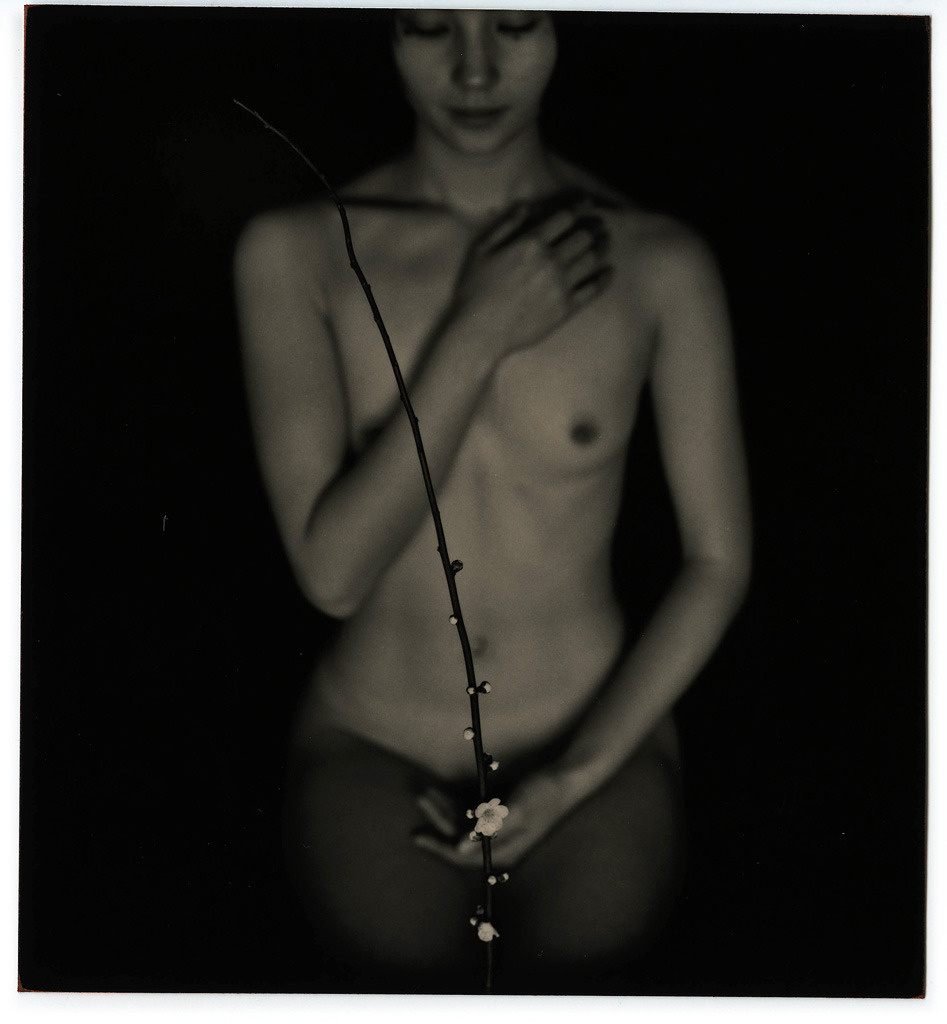
In effect, the above image is a photographic approximation of a haiku. There are two distinct planes in the frame–differentiated by depth of field; the blossoming cherry branch in the foreground, the young woman in the mid-ground.

This was almost certainly shot with a telephoto lens–which has the effect of magnifying the subject. However, telephoto lenses also compressed the distance between objects. Thus although there may be twenty feet between the subject and a wall, it appears as if the subject is relatively close to the wall. (The famous cinematographic example of this is that famous scene in the Coen Brothers’ Raising Arizona with the baby in the car seat in the middle of the road with a station wagon barreling down on it.)

Given that the background in this print is so pitch dark that it seems like an Edward Weston wet dream and that the blossoming branch in the foreground is so dark–only remaining visible due to the body separating it from the background, what originally appeared as discrete planes, interpenetrate.

Bonus factoid: Apparently, Yamamoto isfond of employing tea to stain his prints.

Pixoom PhotographieTitle Unknown (2015)

If you’ve followed this blog for any time, you are most likely painfully aware of my aversion to portrait orientation in lens based image making.

I refer to it–with profound contempt–as #skinnyframebullshit.

It’s a term I use a lot and I’m always linking to the same article I wrote more than two years ago. So–with the notion in mind that someone seeking to determine counterfeit from legitimate currency always studies the real item instead of the fake–it occurred to me that being as this image is not only stunningly gorgeous but also in no way shape or form #skinnyframebullshit, that it might be time for me to create a positive reference instead of a negative one.

It’s maybe not the best place to start but one of the things that doesn’t directly relate to my hatred for portrait orientation but does inform it is the increasing ubiquity of digital imaging technology. (Again, if you’ve followed me for any time you’ll know that I am obsessively anal about differentiating between digital and analog processes. Yes, they are built off the same chassis but their respective functions are vastly different in practice.)

By now, you all are familiar with shitty Youtube videos wherein due to the shape of and interface of our smart phones you get a preponderance of video with vertical frames. It’s ugly, sloppy and I would maintain a poor reflection of the author’s basic intelligence.

I’ve been pretty active in Internet photo communities since 2006. Back then, folks making work were basing it off the history of lens based image making up to that point. Yeah, you had vertical oriented images but whether or not there was a reason for them to be vertical (i.e. an internally consistent compositional logic) they were the distinct minority.

Of that minority, a plurality featured this sort of self-conscious flipping the physical camera body on its side makes me look more like a photographer. When you do it, you feel a little rebellious.

Now, if you’re a person shooting on film, then you drop what you shot at your lab (or better yet, process yourself); and then you pop your slides or negs down on a light table and have a look-see. The thing you note immediately is that your vertically oriented frames break the flow of your reading your slides. You end up having to flip the filmstrip, contact sheets or whatever. Invariably, this causes you to favor either the landscape or portrait images due to the fact that it’s easier to read images that are in line with however you have the page currently oriented.

I learned quickly that there really needs to be a compelling reason for a shot to be vertically oriented. And with my reluctance to deal with vertical oriented shots, I realized that almost categorically, image makers opt for vertical orientation as a compositional shortcut. Like: oh, hey…what I want to shoot won’t fit this way, I’ll just flip the camera and that’ll fix it. Makes sense. Except one small thing and I’ll state it as a truism–you will always get a better shot by moving your body in relationship to the object or by using a different focal length lens. It’s just a fact.

And if you apply that to the history of photography, it’s interesting to note that most images with vertical orientation are–wouldn’t you know it–within the architectural genre. Why might that be? Well, in relationship to an edifice there are few options with regard to moving in order to achieve the framing you want.

Thus, I maintain rather rigidly that in general, if you aren’t shooting architecture, you can go ahead and shoot that vertical but then maybe move around and shoot the same thing landscape from different positions. I’m confident that all things being equal, you’re going to find you prefer the landscape frames.

One of the first things a beginning photography student hears about is the sacred rule of thirds. As a rule of thumb, it serves–and ensures photography instructors cut down substantially on the godawful wawker-jawed, indecipherable images. But like any rule, it’s nothing more than a general guideline that you really have to understand before you’re allowed to start ignoring it as you please.

Yes, the rule of thirds is an abstraction of the Golden Ratio. And with the tendency to frame the subject at one vertical third line and then leave a great deal of negative space to the left or the right, it does produce appealing images. (Note: how images that are perfectly balanced within the framework of the rule of thirds tend to have the effect of leaving you confused about what you’re supposed to be looking at.)

My theory is that with vertical compositions, the rule of thirds is less useful as a guideline; the expectation of the eye is something more in-line with the golden ratio.

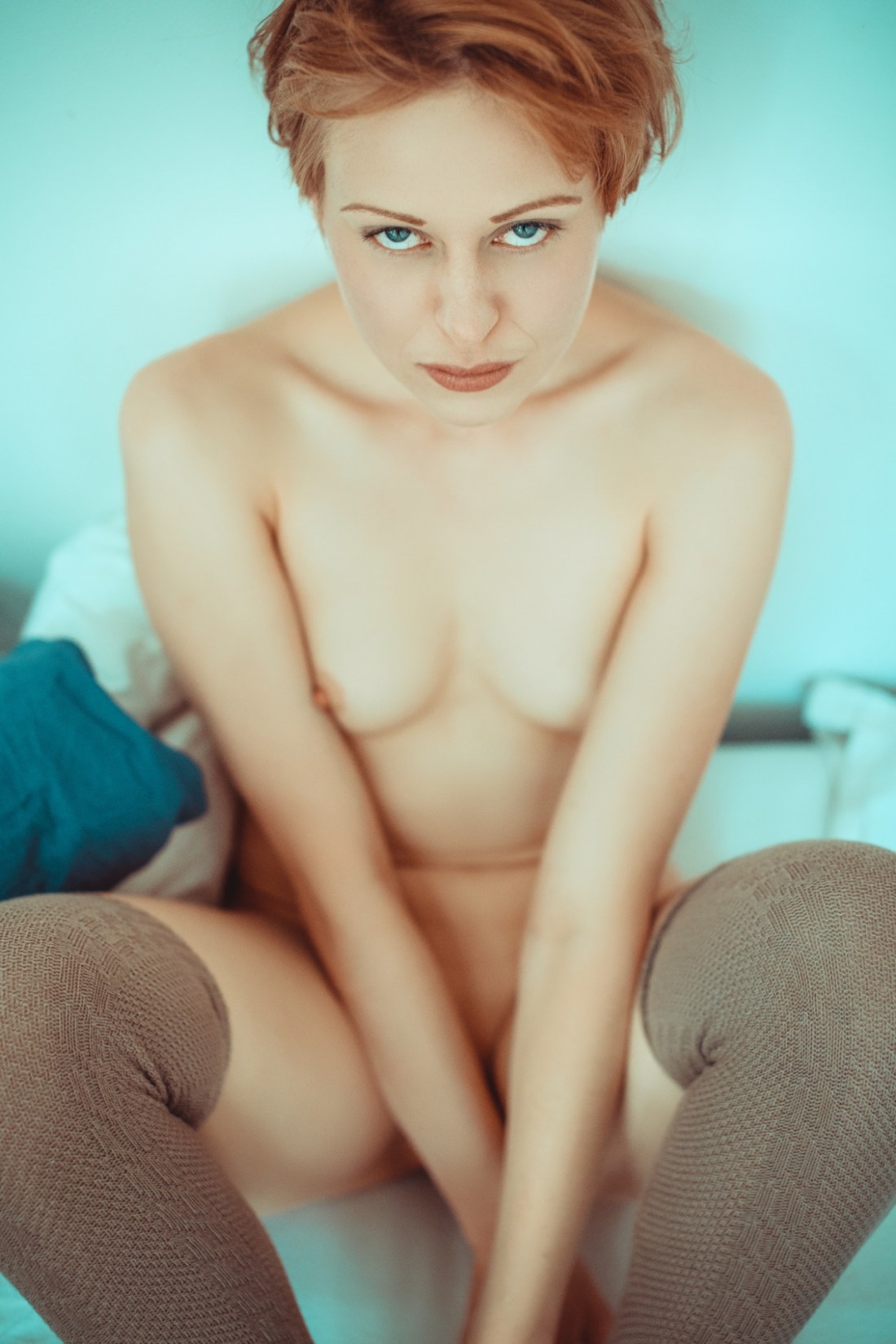
There is only one horizontal line in the above image–dividing the frame top-to-bottom roughly 60/40. Katjuschenka is ever so slightly off-center (consider the mid-line of her face)–balanced expertly by her right knee opening what would’ve otherwise been a repetition of the angle of her arms.

There’s essentially only two colors in the frame–red (hair, skin tone) and blue. Everything falls in line with those tonal hues. Focus is sharpest on her eyes. (And as a dizzying bonus, check out the texture in her stockings. Dayum.)

A creepier photographer would’ve focused on the nipple or at least increased the depth of field so that it would remain in focus. But the decision to do that makes this image about the color and framing. The eye contact is neither coy nor pouting. It’s not flirtatious but it does convey a sense of knowing a great deal that the viewer does not.

This image is breathtakingly exquisite. If you’ve got to go vertical, this is the baseline. Either make it clear that the composition was the only thing that would’ve communicated the magic of that moment or go home with your weak ass #skinnyframebullshit.