Darren AnkenmanDora Yoder (2013)

During the year I studied fine art photography at an MFA level, I was one of the few people in my class who only shot B&W.

My classmates who shot in color always digressed into these long conversations about the purpose of color in photography.

Unfortunately, I had no point of reference to participate in these discussions. So I tuned them out.

Now, some 7 years later, bits and pieces of their lines of reasoning are coming back to me.

The main contention was that while a photograph (or image) could be in B&W or color that color had to be used in such a fashion that the sense of the photograph/image would be lost without it. In other words: from the standpoint of fine art photography a B&W image was either fine art photography or not but when you dealt with color the decision for it to be in color must be debated prior to any comment on whether or not it could be classed as art.

In hindsight, I realize this discourse was based on the tendency for the monolithic art world to not accept work that was in color unless the fact that it was in color was conceptually unified with the work itself. The great color photographers–Eggleston, Shore, Sternfeld and Wall made work immersed in questions of the roll of color in photography.

(In order to further drive the point home: I say Cindy Sherman; you say Film Stills–but why not Centerfolds or Sex Pictures. I say Sally Mann; you think Immediate Family–but Mann has some extraordinary cibachromes that you’ve probably never seen…)

The above is an example of an image wherein the use of color is foundational to it’s legibility.

Furka Ishchuk-PaltsevaHen Party (2009)

If you’ve followed this project for a while, you’ll be well versed in my own personal bias against digital in favor of good, old-fashioned film.

I’m not a Luddite–hell, my day job is as Systems Admin. It’s not that I’m incapable of working digitally–I have digital gear and I possess a general mastery of working with it.

Why do I prefer analog? Well, there’s the obvious reasons: film’s vastly superior resolution coupled with the feel that an organic grain structure contributes the image. It is those things but it’s also about process.

One of the first things you learn when you begin to study cinematography is that not all light is created equal. By ‘equal’, I mean that the temperature at which a source of illumination burns determines the color of the light.

For example: although we think of the sun as yellow, we think of sunlight as white when, in fact, daylight is blue in color and burn at approximately 5600K. (Interesting note: daylight is bluer in winter, more yellow in summer.) A standard incandescent bulb–not these new-fangled CFL bulbs which you can buy in any number of color temperatures but always seem to make everything look like a pile of shit under restaurant heating lamps–or tungsten illumination burns at about 3200K.

Thus when you are shooting something you have to consider in advance what your light sources will be. Are you shooting in Midtown Manhattan at high noon? Well, then you’re probably going to want Daylight balanced stock. Shooting a family dinner scene that happens at night? Tungsten balanced stock is probably gonna be the way to fly. (Of course, you can shoot whatever stock and either adjust your lighting to match it or slap a filter on the lens to correct. The last time I shot 16mm stock, I shot everything on daylight balanced stock and made sure to shoot color bars at the head of each reel and then had the lab color correct the telecine.)

From a process standpoint, I prefer having the decision about color balance made in advance. It’s one less thing to measure. (And really that’s probably the thing I hate most about digital. The workflow is fussier to me than analog where I find my frame and the camera becomes a reference instead of a distraction. With digital, I have to white balance. I have to judge exposure using the histogram. (Honestly, fuck histograms. Give me a Sekonic L-398A any day of the week and twice on Sunday. That way I’m interacting with the scene instead of evaluating it on some shitty, small ass LED camera back or worse a $10K HDMI monitor.)

With digital, I am intensely suspicious of the instant gratification. You snap a shot, you record the scene and you can playback everything immediately. It foments this WYSIWYG approach to art-making that strikes me as repugnant.

It’s like the Stanford marshmallow experiment, wherein researchers offered children one marshmallow now or two later on. There’s no way around it, digital is the child who insists on instant gratification.

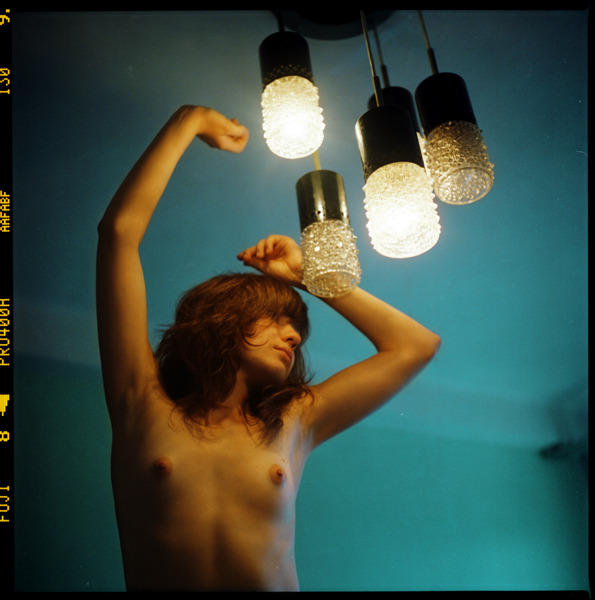
That’s what I love about this image. Fuji Pro 400H is a daylight balanced color negative stock. But the primary source of illumination comes from Tungsten bulbs in the overhead fixtures. This pushes the daylight on the ceiling and wall blue-green, while tinging the young woman’s skin orange.

In fact, it’s the color that ‘sells’ this image. The composition is interesting but not really inspired. The languid lazy dancing would seem contrived if not for the way the color functions to separate the body from the background.

Ultimately, that’s what I appreciate most about this image. Triggering the shutter on a scene like this is always a risk–no matter your degree of expertise. You can only intuit that it’ll turn out readable.

Yes, the more you do it the better your instincts become… but there’s always an leap of faith required on the part of the camera operator. You can’t just check the LED screen to make sure you’ve got it.

And that’s what I love this so much because I know what it’s like to re-experience the wonder that drove you to memorialize the image in the first place–without knowing whether or not it would turn out. And the extreme wonder when it does and the moment you see on the film is like a glinting spark in amber, that when it hits the light just right, puts you nearly out-of-body back into the feeling you wanted to hold onto so you clicked the shutter and prayed it would work out.

That ability is the reason I bother with this photography thing.

Vivienne MokZhuzhu (2015)

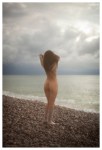
I can’t say I’m fond of Mok’s quasi-Pictorialist tendency towards downy soft-focus.

At least it makes sense in the case of these two images–accentuating the dawn kissed skin and rendering clouds nearly worth of an El Greco.

What’s more: it’s a fabulous example of how to avoid #skinnyframebullshit. (Although, I think the first pose would be better suited to the second frame and the second pose to the first frame, but I admit that’s being so knit-picking as to be splitting hairs.)

Chip WillisNathalia Rhodes (2015)

As someone fluent in only one language (English); and who therefore is in the habit of reading left to right, this image caters to my expectations.

I wish I had the time to super impose angled rule of thirds indicator markings similar to what I did with this photograph by Igor Mukin. It would be immediately clear that what I’m guessing is an out-of-focus towel rack in the lower left foreground, the inside edge of the tub and the mildewy grout-line between the tub and the wall separate the image into thirds diagonally.

As a westerner who’s first language is English, I read left-to-right. thus I scan this image starting from the top left. The repetition of the diagonal draws my eye down and right, along the outside edge of the tub.

What’s interesting here is that unlike the Mukhin image, the diagonal of the top of the diagonals of the top and bottom of the mirror and the front and back of the toilet lid don’t align with thirds–but they do represent the most dense range of contrast with in the image.

In the absence of the second set of guiding third indicators, The angle of Rhodes legs functions as the compositional element that redirects the eye from right to left. (Notice: that the angle of her legs forms the base of an acute triangle of which the reflection of her face is the vertex.)

I’m not ready to attribute to this a status of some next level visual shit. It is inspired though. The pose and boots all scream tired porn tropes. However, the effort to include the face–anytime you shoot with mirrors you’re introducing seven different flavors of hell to the process–subverts the seeming unmitigated sexualization of the body as object. (In other words, even though Rhodes is effectively chopped in two by the frame edge, her holistic totality is at least illustrated.

The more I look at this the less I see it as gratuitously graphic. There are details that command attention: the black bobby pins against the white porcelain toilet lid, the strategic placement of the the rear hem of her dress and her gaze focused on the photographer instead of the camera are all inspired touches.

This is the first of Willis’ images I’ve seen where I’m convinced that my suspicion he uses porn tropes in a critical instead of incidental fashion is on the right track. And the fact the above is maybe a little heavy handed in its efforts to conflate fashion editorial work with pornography; however, the criticism is too stunningly on-point/fiendishly executed for me to even thing of docking points.

Joe TrainaKelsey Dylan (2013)

The so-suffused-it-appears-smoky backlighting here is just sumptuous–not unlike sfumato steeped in the implicit neo-paganism of the Hudson River School and then heartily infused with the sensibilities of Gerhard Richter’s landscape paintings.

And Dylan’s pose reminds me of a Venus born without a societal imposed sense of bodily shame.

I’m extremely fond of this image but I do have to take issue with a facet of its presentation. I’m personally against watermarking images. Yeah, yeah.. I understand people regularly steal stuff. But if you as the image maker have done your work, it bears your distinctive finger print with or without a water mark.

I admit that’s a personal peccadillo. However, if you’re an image maker who insists on using a watermark–be mindful of the fact that you are an image maker and therefore, ostensibly, a visual art. This tendency for visual arts to employ typographic watermarks is fucking inexcusably lame. (This is perhaps the only accolade I’ll ever offer SingleChair: he gets it and his watermark might as well be considered the gold standard–ahead of literally thousands of superior image makers who slap together a 75% transparency text logo. Mad unsat.)

Mercedes EsquivelSarah Vōx (201X)

At first glance, there was some thing about this image that flustered me–not flustered as in frustrated, more unconventional; as in the way the profound is often masked by it’s commonplace-ness.

It’s been saved as a draft for several months now. I keep  traipsing back to it, spending an hour hear and there trying (and ultimately failing) to give expression to an inarticulate gut reaction.

As with so much of my intellectual life, I have this tendency to believe only that which is so difficult as to be functionally impossible has merit. It’s a mentality that in the absence of intellectual heavy lifting, creates unnecessary work.

But that’s super abstract. Let’s keep it concrete and focus on this image: from square fucking one this image has been about the effortless, lack of contrivance to the pose. It is as if posing for an image were to be separated into a continuum of 1. ) preparing to pose, 2.) the mindful tension of holding the pose and 3.) the subsequent dissolution of mindful tension, then this image would represent the moment after 3 but also before 1.

This fit with my limited familiarity with Esquivel’s work; thus, most of my initial efforts to explain my reaction centered on the notion of pose. The trouble is that when you’re looking for something so specific, there is a tendency to miss the forest for the trees. By focusing on pose, I drunkenly lopped down long dark alleys of considering odd framing decisions; and instead of taking a step back, trying to justify my initial theory by suggest that kind of like counterpoint in musical compositions, the frame was an effort to highlight poses intended to exemplify the Golden Ratio.

However, after spending some time with Esquivel’s work, I’m realizing that there just isn’t that consistency in her use of pose. For as natural as the above is, her work is also rich with unnatural, highly stylized poses. In fact, her use of scale and angle of view differ enormously over her body of work. That which remains consistent is how she frames things.

And the framing is extremely interesting; it features an internal logic–while not immune to #skinnyframebullshit, she mostly avoids it–as well as an external consistency across her work. Moreover, there is a sense less of an image maker creating an image and more that the work exists as an exercise in assisted self-portraiture.If you spend any time with the images, there is a feeling that the impetus for the frame being what it is has more to do with it being something the image maker might have set up a tripod and posed for the picture herself without access to willing models.

April-Lea HutchinsonUntitled (2012)

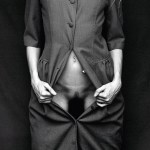
Underlying Hutchinson’s work is a visual equivalent of the restless energy which motivates a lion to pace back and forth behind the bars.

There’s a sense that she shares a strong connection with those she photographs. I don’t know anyone who manages to capture Tanya Dakin in such an assured and sultry state– bearing in mind that by the word ‘sultry’ I mean it in much the fashion as my dear friend who was born and raised in the deep south and always tells me that southern ladies never sweat, the merely become increasingly sultry. (Of course, she said this as she was visible sweating through her linen dress…but her point was well taken.)

She also manages to summon an affected coyness from Johanna Stickland that you never see anywhere else in either of their respective work.

It’s interesting that she happens to be close friends with both. As if the history of mutual understanding that fostered the relationship, provides a basis wherein either party is comfortable trying on and shedding whatever roles or perception of self seem to fit in the moment without judgment or consequences.

And that freedom in the moment, seems to be an effective tool in work that is consistently and unapologetically erotic.

Source unknown – Title Unknown (20XX)

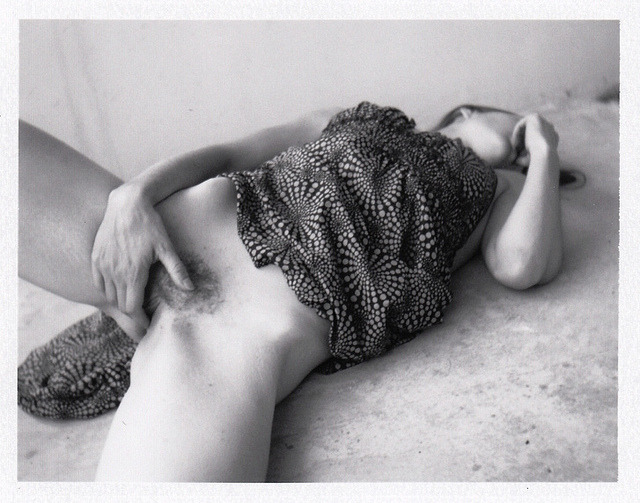
Most folks would instinctively term this ‘porn’.

Given the content and the manner in which depth of field is deployed to focus on her genitalia while blurring her face, it’s hard to argue that the purpose of this image isn’t primarily as a masturbatory aide.

To my reading, there’s more to it. Yes, the framing is problematic as it amputates limbs–not to mention offering a textbook example of #skinnyframebullshit; but the sense of immediate intimacy it presents is unusual.

I’m really super aroused by it; also overwhelmingly concerned about it’s genesis given the rare vulnerability it depicts and this the era of leaking nudes and revenge porn, I worry whether this individual has consented to these images being published. (Google Image search and TinEye both return zero results–doing nothing to alleviate my concern.)

And my worries aren’t necessarily tamped down as a result of noticing the texture of the couch and the pillow seem anachronistic enough to suggest the sort of set dressing favored by authors of Internet smut–if that’s the case I’d have to retreat momentarily to amend my knee-jerk finger wagging w/r/t the depth of field to a vociferous objection.

Ultimately, the reason I’m posting this is although it’s hardly a good image as is, its various elements are valuable and I’m convinced that benefiting from more logical composition, increased depth of field and a more nuanced approach to lighting design it could be mistaken for fine art.

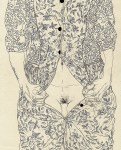
Source unknown – Title Unknown (197X)

Although this seems–initially–highly staged/contrived in an effort to balance the composition, there’s also something profoundly compelling about it.

I knew from square one that I fucking adored it. Putting my finger on the why of it took some time. But, last week I stumbled upon an article about a photo snapped during one of the many brawls in the Ukrainian Parliament and how it has garnered a great deal of attention because its composition resembles the Golden Ratio governing composition of Renaissance masterpieces.

It’s really the first time the how of the Rule of Thirds derivation from the Golden Ratio has made sense to me. But it triggered another correlation that’s generally overlooked in most work governed by the rule of thirds–the reliance on an increasingly dense deployment of negative space as thing spirals outward.

This realization reminds me of the wonderful–as per usual–analysis Every Frame a Painting presented of Nicolas Winding Refn’s grossly under-appreciated Drive and it’s use of a so-called Quadrant System of composition.

Granted Refn’s use of quadrants isn’t exactly in line with the Golden Ratio; however, I suspect if one had the time and energy one could demonstrate that the reason some of the unexpected cuts he uses work so well is actually due to an overall respect for the Golden Ratio across connecting scenes… the point is if you overlay quadrants over the rule of thirds and recall that one quadrant needs to be predominantly negative space, then the logic of the rule of thirds suddenly clarifies itself. (At least for me it does.)

I strongly suspect that the above image was originally composed according to the Golden Ratio and subsequently cropped prior to publication. It’s interesting to note that if something is rigorously composed according the Golden Ratio, then any thoughtful crop retains a logical consistency in composition.

Yet, what especially fascinates me  is that although my first thought is stylized contrivance–looking at this now, I view it more as a lie about a lie that manages to tell something not unlike the truth.

I love her introspective expression, the way it conflicts with the obvious catering to the voyeur suggested by her pose and it now strikes me as disarmingly intimate and beautiful.