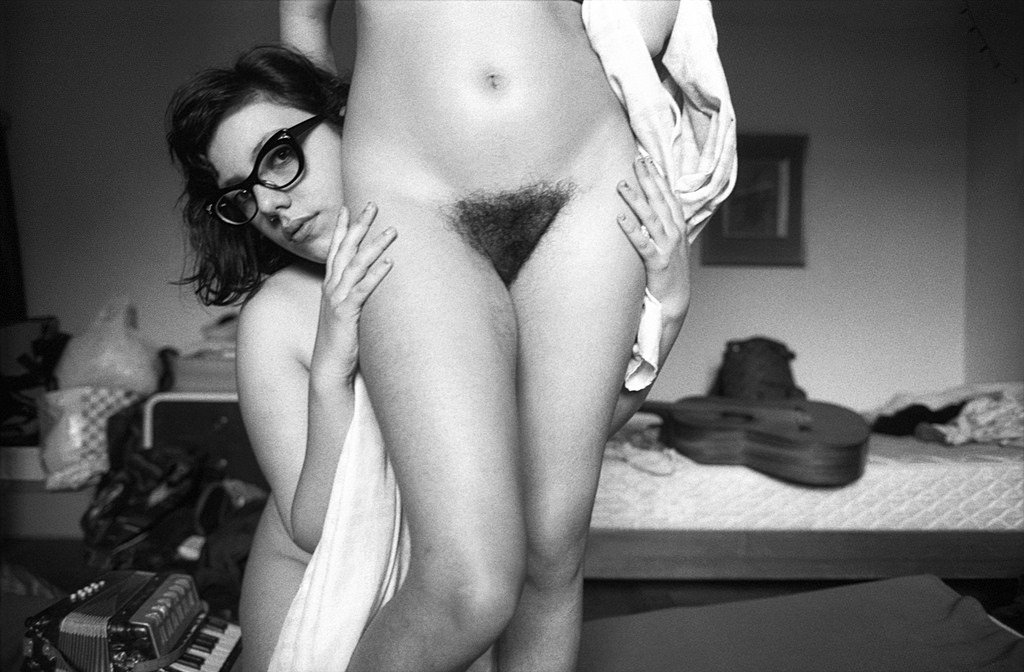
Paula AparicioUntitled (2014)

If there is a single, salient aspect to Aparicio’s work it’s likely the way her photos exude a feeling of post-coital tension between “the waning of ecstatic satiation and the waxing hunger of wanting more.

This tendency is well suited to her style; but, it’s especially noticeable in the way she photographs women.

I’ve lobbed a couple of shots over the bow of the Good Ship Female Gaze previously–namely with regard to Masha Demianova’s claim her work cultivates an equal and opposite response to Berger’s seminal male gaze as presented in Ways of Seeing.

And although I am doubtful, Aparicio would ever invoke the term female gaze to explain her own work, it would almost certainly be more functional applied to her work than anywhere else I’ve witnesses its deployment.

Upon what grounds to a base such an assertion? I am (unfortunately and much to my eternal chagrin) male bodied; therefore what the fuck can I possibly know about a female gaze?

Well, if there is such a thing as the female gaze–unlike the historical male gaze–it’s almost certainly the opposite of monolithic.

I know that growing up seen by others as ostensibly masculine, my experience of attraction, gender identity and sexual desire almost never lined up with my peers.

And I do realize it’s a dangerous assumption to take the braggadocio of hormonal male children as fact based, but I do know that while far ahead of puberty I shared an almost clinical fascination with sexual intercourse and that this fascination was age appropriate within my peer group, it remained a complete abstraction.

Let me try to unpack that a bit more–I feel a very profound need to articulate this correctly. We’d talked about sex, spent hours imagining the mechanics of it and my friends all tended to extend that imagining by connecting it to their sexual response. There was no separation in the expression of attraction and their sexual desire.

What I thought was attraction was actually a need to be understood. The people who listened to me, supported me and shared glimpses of their inner lives were always the people to whom I found myself drawn.

I remember the first time I ever experienced an attraction that linked up with my sexual desire. It was ninth grade. Her name was Michelle. She was my best friend and she’d had a growth spurt over the summer between junior high and high school. She didn’t really notice and I think her family was struggling to make ends meet with private school tuition, so she kept wearing the same clothes she had the previous year. Her favorite pair of pants were these white khakis. They’d been a bit on the tight side the previous year but now they might as well have been skin tight.

I remember walking behind her to class and noticing the visible lines caused by her underwear. I looked away, immediately. Partly because, I felt like I was violating her privacy but also because I found myself stunningly aroused. But my thoughts didn’t proceed from there to a litany of sexual things I’d like to enact with her. Instead, it orbited the notion of wandering if she felt toward me the way I felt towards her in that moment. The thought that there might be a possibility she did was the fantasy I brought myself to orgasm with again and again throughout high school. (Spoiler alert: she didn’t.)

I am hardly so daft as to suggest that what makes me think the notion of a female gaze applies to Aparicio’s work is because I experienced attraction in an unusual fashion. It’s more that the memory of the feeling resonates very strongly with something in her images.

preraphaelitebluesUntitled (2015)

As images go, there are a number of elements that might be tweaked here.

Each of the five frames invokes a degree of something not unlike the feeling of wondering whether it’s okay to look or whether one should turn away. The second and fourth frame present a vantage that is both voyeuristic and confessional while also simultaneously neither. As such, the self-conscious posing for the sake of posing self-consciously awkwardness of the middle frame takes hold.

Small faults, really when stacked along side the precociousness of the top and bottom images–both of which I adore; but it’s really the top one (which is just alluring as fuck) that prompts me to read these images as a staggeringly astute commentary on the implications of self-portraiture.

In this The Year of Our Lord Instagram, with it’s accompanying glut of selfies, it’s difficult to untangle questions of self-definition (ridiculous as such a concept is at its root), the ontology of obsessive documentation, etc.). It’s become less about what we see in the mirror as opposed to the ways in which mirrors serve as preview windows for cyber representation.

That’s what gets me about this: the image maker is employing the camera as ersatz mirror. As if, to say this is not carefully cultivated version of me or even the me that friends and family know and love, it’s the me I carry with me everywhere and always.

Edward WestonNude [Charis, Santa Monica] (1926)

I have a conflicted relationship with Weston’s photography: on the one hand, his images don’t do much for me; on the other, I consider his print making skills unsurpassed.

Yes, Pepper No. 30 was printed by Weston’s son. And yes, it features the dynamism of a stiletto pressed against your jugular. But the prints made by Weston’s son–although never less than monumental–are good because the exaggerate what the senior Weston was so astute at underscoring in his work: dimensionality conveyed by means of rigorously exacting control of tone and texture.

Perhaps I’ve just worked too long with B&W film but the skin tone in this looks more perfect than I can fit to words. I don’t miss color. In my head, Wilson’s skin looks exactly how I see skin in my head. (And I love, so much, that one of the most iconic images of feminine beauty in the photographic canon features a woman with unshaven legs and pubic hair.)

You can want to be drawn me like one of those French girls all you want. Me? I want to see (and be seen) the way Weston saw Charis.

Source unknown – Title Unknown (20XX)

Artfully depicting masturbation is not an easy feat.

The act is private, sequestered. Thus, the question of how one witnesses such goings on becomes central—is it voyeurism, exhibitionism or a bit of both?

The more voyeuristic the image, the less intentional it appears, the more it relies upon the reputation of the image maker to supplement its ‘artistic’ merit.

The more exhibitionist the image, the less artful it appears–exhibitionism being rooted in self-consciousness and the efficacy of art being so commonly measured on its ability to annihilate notions of self and other.

This scene suggest an altogether brilliant fucking with this dichotomy: subvert the distinction between subject and object. What’s one of the oldest means of doing that? Reflections.

Now, I will not argue the young woman is unaware of the camera. (She definitely is… at least initially but she’s watching herself trigger and experience her bodies sexual response.

This discursive nesting of contexts–for me at least–continually refocus my attention on her increasing arousal and accompanying pleasure.

That to me is such a fucking turn-on that I really can’t even…

(NOTE: I had previously published .gif excerpts from this clip. I’ve elaborated somewhat on the comments accompanying those .gifs in an effort to tidy things up a bit.)

Mona Kuhn – [↖] Untitled from Evidence series (200X); [↗] George by the Door from Evidence series (2002); [←] Libellule from Evidence series (2006); [+] Untitled from Native series (200X); [→] Untitled from Venezia series (20XX); [↓] Jacintha from Evidence series (2006)

I cannot in good conscience endorse Kuhn’s work wholesale. I fucking love the photos above–this one is great, too; but, hearing her defend her work is rather off putting.

She’s big into nudes due to their ‘timelessness’ and the human body as a ‘residence’. She’s quick to point out that she’s also interested in totality and, as such, sexuality being an element of physical embodiment–which is problematic for it’s failure to include the experiences of folks with an asexual reality–it is clearly a facet of her work.

She’s walking the same high wire as another photographer with whom her work shares overlap (a focus on nudes, specifically within French naturalist communities), namely: Jock Sturges.

I find her work much less disingenuous and of a higher quality but it still vexes me that she dodges accusations of sexual overtones in her imagery because while I totally think Sturges is a perv who goes to great lengths to insist he’s not a perv–and to be clear here, I’m reclaiming ‘perv’ in a non-value judgement-y, re-appropriative, sex-positive way–Kuhn images function due to a sexual tension. (I’m referring specifically to Jacintha [above] but I think there’s a voyeuristic heavy-handedness motivating the concealing/revealing of nudity, i.e. her depth of field–which clever–is also a wee bit salacious in the way it invites squinting leers.)

What always ends up nudging me away from these concerns is how powerfully the photos communicate a palpable sense of intimacy. I’ve always maintained that narrativity and how we determine what is and is not narrative holds up a mirror to questions of the function of eroticism. Increasingly, I am beginning to think that it’s a trinity: narrative, intimacy, eroticism.

Lisa Kimberlyfern (2014)

Of the titans of fine art photography, Jeff Wall is one of my favorites. I remember seeing Milk for the first time and being just blown the fuck away by its simple audacity.

In the early to mid-90s, Wall deviated from his more straigh-photography-as-occasion-for-excess-&-spectacle approach and began experimenting with photomontage. The results were completely unexpected–rendering worlds appearing simultaneously hyper real & computer generated; the perspective not quite right but not obviously wrong either; a projecting of the fact that there are seams but as soon as looking for them they scurry from sight.

I see similarly simple audacity in lisakimberly’s effect wizardry enhanced self-portraits. (There’s a bit of 3cmlin there, as well.)

Admittedly, that may not be obvious. Both Wall and Yung Cheng Lin employ a blank for the audience to fill in as they see fit. In the case of the former, it’s a narrative insinuation (settings, props, characters), whereas in the latter everything points to either a perverse visual pun or explicit insinuation towards which every element of the image points.

Kimberly’s images are possessed with a similar feeling that the individual elements reference a sum greater than their parts and there is a sense of a very specifically felt and experienced vision.

However, there’s an absence of cues that might allow the viewer to parse what that larger understanding of the work might entail. Yes, there are exquisite colors, subtle, nuanced effects (check how her face is completely in shadow, yet you can still see the crown of her head through the halo) and a beautiful woman.

In other words, Kimberly has a painters feeling color and and a careful eye for detail. At the same time, her photos granted a glimpse into something which feels like a complete, autonomous world; yet, given the image there is little offered other than an assurance that it exists and exists elegantly.

Very strong work from a young, entirely self-taught photographer. You’d do well to familiarize herself with her efforts.

Lina Scheyniusamanda (2014)

If you do any reading on Scheynius, after the model turned photographer angle, you’ll invariable hear folks opine ever so elegantly about how her work focuses on intimacy or is preoccupied with the so-called female gaze.

I won’t object to either suggestion but I do find the tendency towards reducing a complicated, nuanced work to one or two of it’s representative elements almost always does a disservice to the artist and the work.

To my eye there is always something related to an effort to externalize and give voice to a primal, gnawing physical desire.

I don’t remember where I read it–perhaps in Scheynius’ recent interview with Zeit–where she recalls how one of her first modeling contracts stipulated that she could not gain more than a cm in any of her measurements over the course of a year.

And in much of her self-portraiture there is an element of violence in the way she documents her body that is always in dialogue with a ferociously unapologetic presentation of sexuality and a flirtatious ambivalence towards coyly implicit and outre explicit.

However, this approach to depicting herself doesn’t extend to others. The unflinching eye she turns on herself, becomes tender, seeks the wonder in light on skin, the line of the body in space–a fierce awe that acknowledges the connection between physicality and sexuality while refusing to sexualize the subject against the parameters of how they wish to be seen in any given moment.

Clare LaudeUntitled self portrait from When Water Comes Together with Other Water series (2014)

I spent the winter break of my junior year of college watching Fassbinder’s arguably best film Berlin Alexanderplatz.

Upon returning to my filmmaking class, I felt a spark to get out and make something. It seemed like I had all these new and intriguing ideas.

One of my classmates–and truthfully my only rival for dominance in the class–inquired what I’d watched over break. It was so casual and off-handed that I didn’t realize the trap until I was snared.

Tarkovsky, Wenders and Fassbinder are unparalleled geniuses, he started: But to schmucks like you and I what they offer in inspiration is just as addictive as any drug. We much be wary in approaching them, mindful of the profound effect they have on us.

I thought of him as a preposterous bloviating dickbag at the time, but increasingly I’m realizing he isn’t wrong.

And that’s what sucks me in to Laude’s work. She wears her profound regard for artists such as Andy Goldsworthy and Tarkovsky on her sleeve but does so in her own distinct voice–I’d label it quiet, more in the way of the lack of volume being the point (think John Cage’s 4’33").

Further, I think I just share a certain affinity of personality with the artist since she expresses a connection to two of the most important places to me in the world: Island and Berlin.

And I’m always excited to see nude self-portraiture seamlessly integrated into fine art photography as an element instead of the sole focus.

Aubergine – Moon Marie (2014)

Three thoughts:

  1. Fabulous pose! The toes notched in the crook of the left ankle being the coup de grace.
  2. Compositionally, the shot might have benefited from being about two feet back from it’s present position so that Moon Marie’s left arm wouldn’t have been lost and the inherent dynamism of the pose would stand out more clearly.
  3. There’s been a spate bucking the standing or reclining modeling pose conventions: this one from Sophie Barbasch’s Fault Line series and this by Eylul Aslan clone Lukasz Wierzbowski for Beware Magazine. (EDIT: Also, one of the best ever NN Submissions.)

4201Title unknown (2014)

There’s an all but impenetrable mystery surrounding the site that posted the above image.

What I know is that earlier this year, the site runner posted bevy of images by a Polish photographer and friend identified only as STOTYM. The work was all exceptional; however, one struck me as evidence of a weapon’s grade visual sensibility.

Over roughly the last week, new, seemingly original work has appeared. It’s a hodgepodge of bleak, voyeuristic on-location B roll outtake frames and experimental nudes.

I can’t go as far as saying it’s all good; but, all of it is fascinating.

A leitmotif emerging in the work is an idiosyncratic interaction with reflections.

Reflections can serve a number of different purposes and given infinite time and prolonged interest, it would probably be possible to winnow their uses down to a handful of distinct categories. In general, reflections introduce notions of doubling, documenting the documentarian or allowing for an otherwise impossible angle of view. (Any categories are hardly mutually exclusive. laurencephilomene-photo, for example, shoots reflections of her subjects–without knowing it, one wouldn’t necessarily pick up on this but it is a very interesting added layer of conceptual consistency.)

Whomever is making the pictures posted by 4201 is doing something unprecedented in presenting distinguishable parts of a reflection that contribute to an intricately constructed whole.