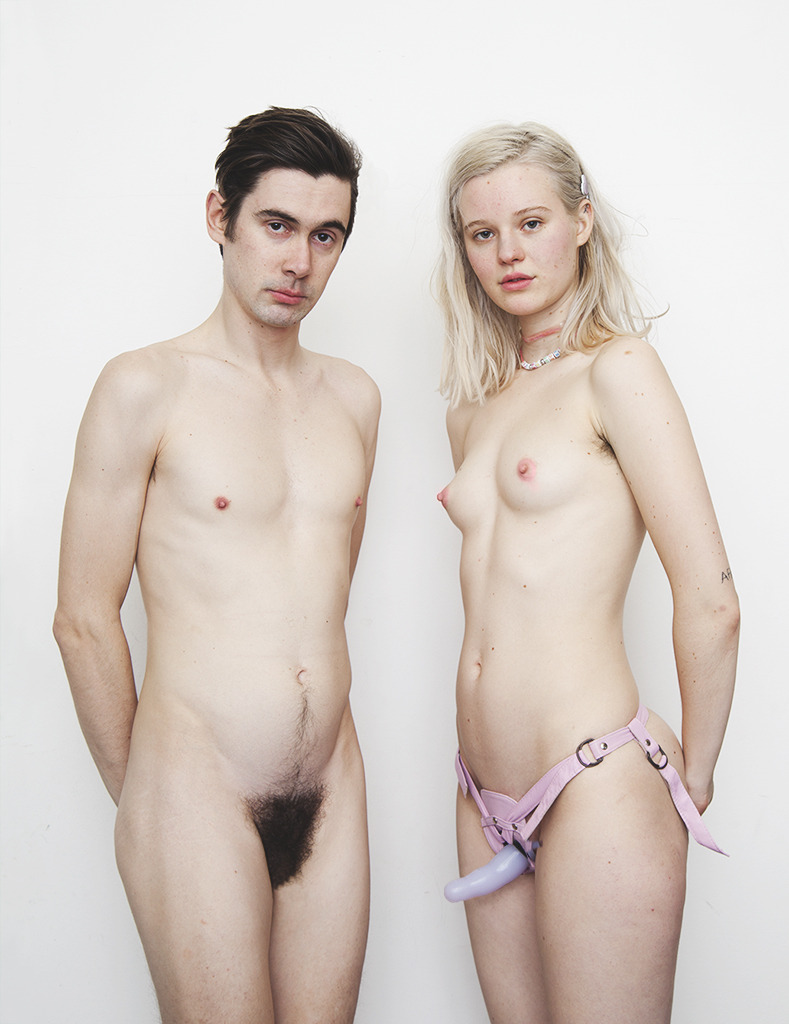
Haute gender non-conformity FTW.
Haute gender non-conformity FTW.

Idea for Making Heteronormativity (& It’s Representations) Suck Less Shit through a Tube, Part One
Strictly designate as foreplay all actions prior to the first instance of fully qualified female orgasm; depict foreplay using cute line drawings.
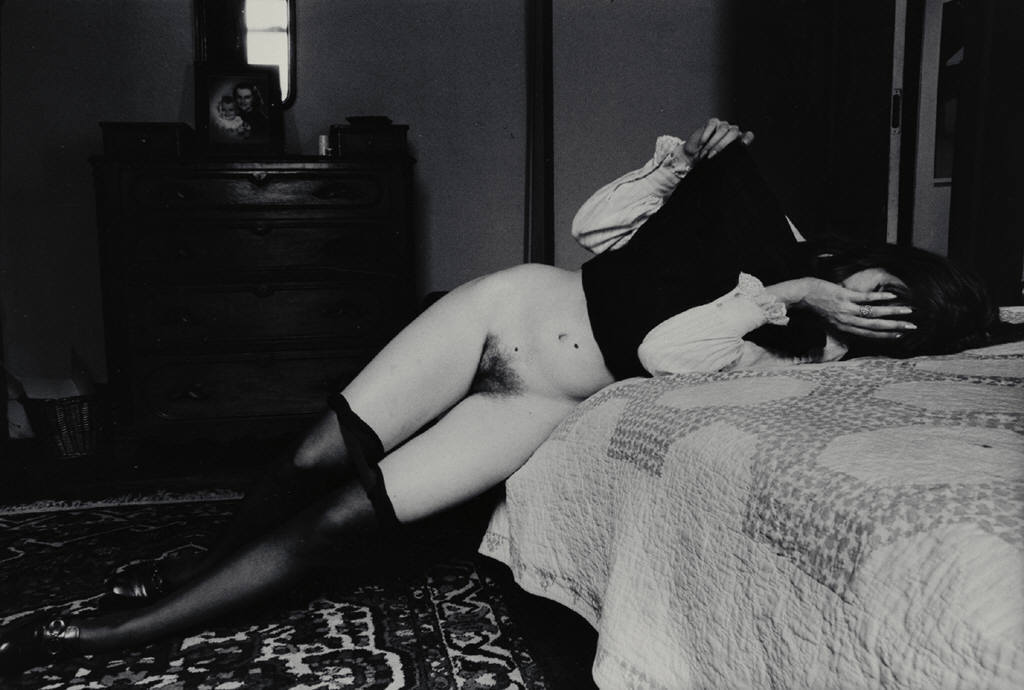
Duane Michals – Untitled 1968

youarecordiallyinvitedtopissoff:
I dig this image. Part of it is definitely due to the latent pyro in me. Plus it captures all the best of what Kowalsky—no, not Kowalski—brings to the table as a violist-by-day/photographer-by-night.
Yet, I feel my response has to address the indebtedness of Kowalsky’s work to Brooke Shaden—whose work I loathe.
What makes Kowalsky’s work attractive—besides the violist bit (I am a love fool for musicians, dontcha know?)—is the manner whereby she dodges Shaden’s derivative interpretations with sincere photographic inquiry. Her images tell the story of how she sees herself as well as how she wishes she was seen.
In other words, photo manipulation is not an end in and of itself to Kowalsky—and make no mistake this and much of her work are composites (to which I normally object but if I’ll give Jeff Wall a pass…); instead, the implausibility of her contrived images recall in-between-ness of the moment after you glimpse something you are certain is impossible and the moment before you looking again to discover it was just the play of the light sparking your eyes’ imagination.
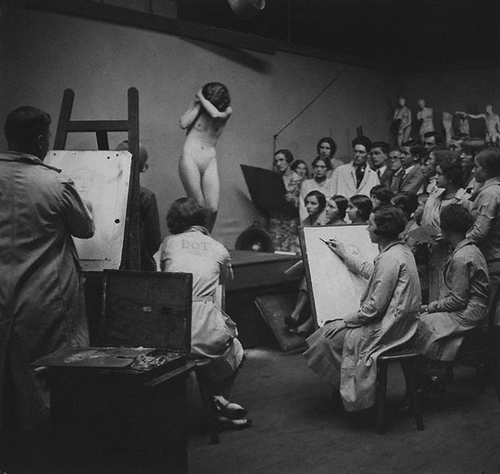
I endlessly bitch about lackadaisical composition so here’s an example of a photograph with fucking impeccable composition to balance things out a bit.
A loose rule of thirds is at work here. The young woman ostensibly nude modeling for a life drawing class stands inside the central-vertical third of the frame while the central-horizontal third of the frame starts at the top of the standing man’s head in the left foreground painting and extends to somewhere between echoed elbows of the two young women—one sketching, one sitting—in the right-hand mid-ground.
To the right of the standing man in the foreground and seated young woman there is a break the guides the eye toward the center of the frame; everything in the center, however, is stationed just inside the third-lines. This has the effect of pushing the viewer’s gaze outward.
What is fascinating is how that outward tension is then countered by the fact that all the eyes in the room are on the model—which immediately draws the eye back to her. Also, Cazneaux strategically positions the pencil held by the seated sketching woman toward the model’s mons pubis.
Unlikely everyone else, whose attention is focused on her, the model seems to be aware of the camera, facing it directly with head bowed and hands raised to cover her face.
One might say something about the constant framing and reframing the eye does on the fly when confronted with this photo. More interesting, perhaps, is the way the composition both insists on itself at the same time it cancels itself out.
Truth be told, there is never an instance in everyday life where a group of people could stand so picturesquely without direction. Thus, the image is inherently stylized. But it does not appear that way—and appears instead an authentic glimpse into an art lesson.
I can’t help drawing a correlation to the Zen tradition of koans, specifically the notorious: what is the sound of one hand clapping?
Victor Hori offers one of the best commentaries on the purpose of the question:
…in the beginning a monk first thinks a kōan is an inert object upon which to focus attention; after a long period of consecutive repetition, one realizes that the kōan is also a dynamic activity, the very activity of seeking an answer to the kōan. The kōan is both the object being sought and the relentless seeking itself. In a kōan, the self sees the self not directly but under the guise of the kōan… When one realizes (“makes real”) this identity, then two hands have become one. The practitioner becomes the kōan that he or she is trying to understand. That is the sound of one hand.
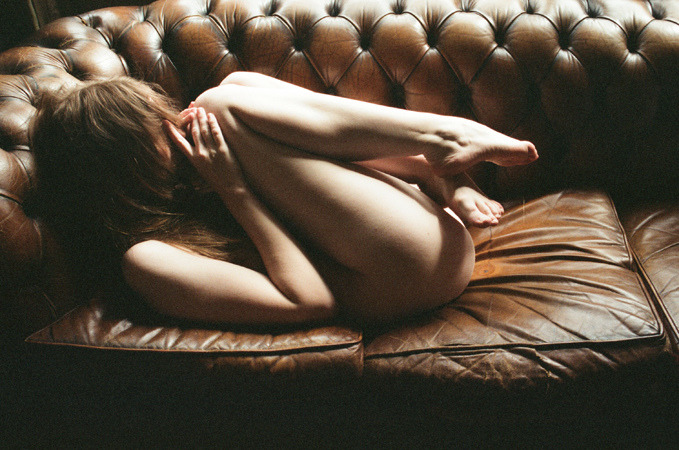
Lina Scheynius’ photographs are above all sincere in their straight-forward simplicity and lack of self-conscious pretense—capturing not only the truth of a moment but something of the initial wonderment which sparked her mind and brought the viewfinder to her eye.
Like many young, internet-famous image makers she works at the interstices of documentary, editorial and erotic photography but her handles the material with a rare prescience.
Take this self-portrait where she appears starkly naked but protectively curled up on a leather couch. She is both seen and unseen.
I cannot help but apply that to her sense of herself as a photographer. She presents the world she sees from behind and through her camera. This is especially interesting given familiarity with her larger body of work as she takes great pains to push her personal boundaries more than her models.
In the minefield resulting from conceptual concerns over the visual representation of sexual identity and body politics, although what Scheynius’ is about is perhaps more instinctive than the collaboration between Traci Matlock and Ashley MacLean, it is no less vital or interesting.
And frankly, there are a lot of photographers who could learn something from this. I am sick unto death with voyeurs hiding behind cameras snapping away as they have models enact their most deeply repressed fantasies. (I am thinking here of an individual who I would rather not name but will give apply the psuedonym Reynard Yale.)

youarecordiallyinvitedtopissoff:
The color of the wall is highly complimentary to her skin and emphasizing both the translucent white and indigo pattern in her wonderful bra as well as the reddened impressions of the straps on her back.
It reminded me of a similar image of marks left by a bra but more than that it reminded me of a pose figuring prominently in perhaps the second most transcendent sexual experiences of my life.

Untitled
Is it me or is there something almost post-coital about the way this feels to the eye—towel-wrapped, shower-wet hair and still damp skin sheathed in afterglow and diaphanous light?
In spite of being digital, I wish this were an image I had made. It exemplifies so many imagistic attributes I hold dear:·
All that is missing is a narrative seed, one moment suggesting what came before and what follows. But this is more of a tone poem, it would seem.
Tone poems, though, are slippery as eel skin. And there is a tendency to use them as an excuse for untouched inconsistencies.
For example, the framing here pans the camera slightly right to ensure the golden light on her back appears reflected in the mirror; this wawker-jawing complicated by the extreme wide angle is nearly balanced out by the uneven curtain rod’s counter-angle—keyword: nearly.
Also, her pose is odd. It is clearly staged but she holds it in such an unself-conscious way that it from avoids appearing contrived.
These inconsistencies cut both ways: justifying the unresolved aspects as endemic to the work is what makes it great; it is also what keeps it from being truly exceptional due to such justification obfuscating the implicit awareness the image provides of viewing something up to a terminal point—the snapping of the shutter—and then being left with little except the technical inconsistencies to ponder for clues that simply don’t exist.
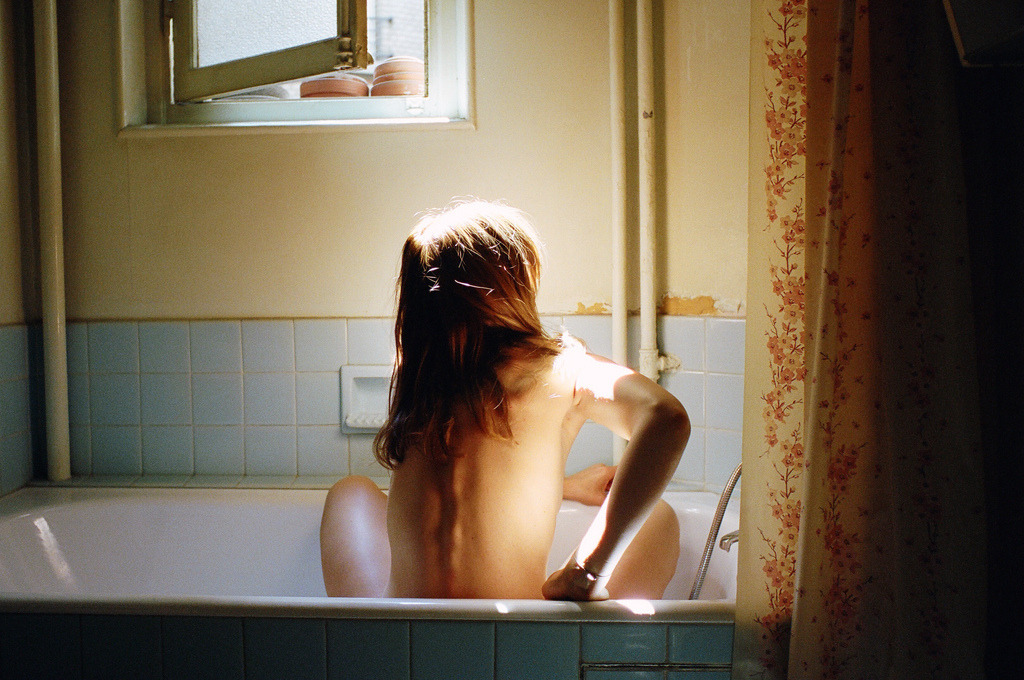
390. by Nicolas Sisto
The first thing I see, the thing that reaches out and smacks the shit out of me is the light. Fucking A.
Next and simultaneously, I notice the color of the tile and the way the light diffuses on her skin, in her hair—the way it suffuse the blue tiles and tub.
This is the sort of light photographers kill for, a distinct cousin to the magical cinematography in Malick films.
Further it’s analog, a real photograph—any detail in the highlight with such bright white hot spots would be DOA in digital. And the photographer is clearly trying to emulate the tenebrist contrast range and vivid colors of Polaroid’s late 90’s palate.
Also, in the images favor is its inclusion of two quintessential photographic tropes: nudity and miraculous light.
Still, even though I want to like this, I can’t; the light alone isn’t enough. There are two glaring flaws:
First, who sits this way in an empty bathtub? I mean honestly. It’s overly self-conscious and awkward. Look at how gorgeous I am just plopped down here in this pool of perfect light… ladiladidah.
Interestingly, there’s an outtake from this same sequence. In it some of the light’s grandeur gets lost, the pose is at least less self-conscious and therefore less contrived.
Yet, in both case the composition is fucked. You see it a lot—envisioning a strictly balanced and symmetrical shot within the frame and shooting hand held. That saying close only counts in horseshoes and hand grenades goes triple for symmetrical images. Either keep the hand held camera and accentuate the asymmetry or use a motherfucking tripod.
I am posting this photo along with the link to its sibling not to bash either so much as point out that somewhere between them is an image I wanted to see in both but didn’t. The hint of what might have been but never was is pretty incredible to me.

Is not the most erotic portion of a body where the garment gapes? In perversion (which is the realm of textual pleasure) there are no “erogenous zones” (a foolish expression, besides); it is intermittence, as the psychoanalysis has so rightly stated, which is erotic: the intermittence of skin flashing between two articles of clothing (trousers and sweater), between two edges (the open-necked shirt, the glove and the sleeve); it is this flash itself which seduces, or rather: the staging of an appearance-as-disappearance (Barthes, pg. 9-10).
Perhaps it’s the introversion suggested by the huddled pose or the comely skin. My eye—wishing it was a tongue—darts and circles the erect left nipple.
But the wetness of wanting is thwarted by the shallow depth of field which pushes my gaze away over oceans of cream floating morning glories, wilds rose and springs of red baby’s breath before being pulled back again over small breasts and pale skin to sunlit shoulders and long strands of red silk hair.
And in this seeing I have an honest-to-goodness itty-bitty petit mort every time I glance at this picture.
No, it’s closer to a lover shifting slightly and the movement sending cascades of shivers outward through the ebbing pulsing of orgasmic spasms.
A feeling not unlike the memory of pixie with snow white skin, wire straight, carbon black hair and mischievous eyes wider than miles of un-translated manga: I gazed as she reached across the table, her motion pulling the lower edge of her too-small t-shirt away from the waist of her too-large belted jeans. Thinner than a rail, the ridges of her spine led my eyes down to the orange on purple Victoria’s Secret underwear.
Edges are important. Particularly given their extensive history of being manipulated in order to objectify and sexualize the female body—expertly lampooned by Duchamp’s Etant Donnes.
But the headless woman does have anonymity. And where this previous implied women as little more than fodder for men’s sexual appetites, it now is put into service in order to facilitate the open expression of a sexual identity from behind the safety of a mask.
To be clear, I think that’s awesome; but like all awesome things, it is not without its problems. In this case, the line between anonymous expression and exhibitionism is razor thin at best. What is presented as artful and considered frequently suffers as a result of compositional inconsistencies necessitated by the requirement for anonymity.
This beautiful photograph is one of the few that manages to be rigorously consistent in its composition while also employing the frame edge as a means of masking idenity. A slight shift in perspective, however, would have almost certainly transformed it into something either nakedly exhibitionist or visually impoverished.
It for that reason I think most photo dabblers would do well to borrow from the book of Bellocq’s brother by making a thoughtful image first and then blacking out faces and identifying features later.
 Acetylene Eyes