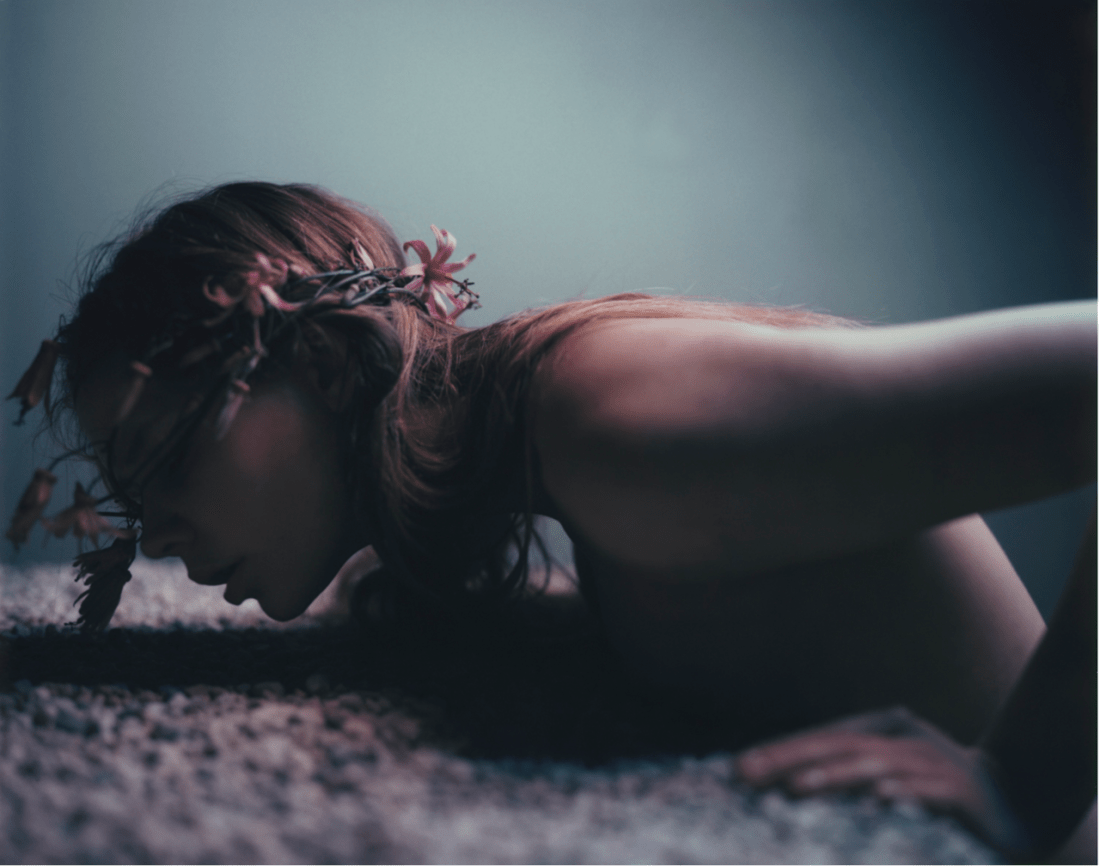
Marcel van der VlugtPassion Flower 4 from The Women series (1999)

There are so many things I dig about this that I kind of don’t even know where to begin…

I guess since it was made using analogy processes, it’s an actual instance of photography–so maybe let’s start with light.

When you’re Dutch–and van der Vlugt is ostensibly a Dutch surname–and as such, you hail from the same rich environment that produced Rembrandt and Vermeer, then there’s a decision to make: whether you continue the tradition of illuminating your scene with light traveling from left to right (the same way the eye is inclined to move over items that are intended to be ‘read’) or whether you try a different tact.

That’s why the layout of this is so intriguing. The light and the position of the model all push left. Look at the above image. Now I want you to close your eyes but before you close them I want you to remind yourself that you’re going to pay extra close attention to the details that jump out to you based on how your eyes scan the photo. Go for it.

Now: I want you to do the same thing only with this variation of the image.

To my way of seeing, this variation is nowhere near as effective as the original. The light and push of the pose in combination with the natural inclination to read images from left to right, makes the variation very much right side dominant. You notice the sublime lighting on the back of her head, the crown of flowers, the silhouette of her lips (which is my favorite part about this) but you lose the holistic totality of the photo that the original offers. (Like in the variation, I don’t notice the is it carpet covering the top of a table or is this something that was taken in a carpeted stairwell where the model is leaning against those intolerable Dutch staircases? I like to think it’s the latter; also, the light on her back and the tonal nuance in the soft gradient of the key light on the wall behind her.)

Mathilda EberhardUntitled (2013)

Eberhard has two Flickr accounts: one attributed to Anna Mathilda Eberhard started in 2009 and second attributed to Mathilda Eberhard started in 2010.

The first account is a scattershot of self-portraits (some barely legible, others jaw-droppingly acute in their deeply felt intensity and pathos) and just the right amount of savoir faire so as to court transgression without seeming posturing or pretentious.

With this first foray into the world of sharing photos on social media, it’s hard to pinpoint any pervasive influence. Although I don’t suspect for a second that someone could produce such compelling images without some sort of broad familiarity with photo history.

One thing to note is that specific, salient facets of what would become Laura Makabresku’s hackneyed style are prefigured as if in template form by Eberhard’s early work.

There’s something more melancholic about the second account. Moments of sheer joy, intermingled with a sense of crushing, isolation, loneliness. A number of her pictures invoke in me nothing so much as the feeling of being sexual aroused but lacking the motivation to address that sensation by seeking out affection from another or to opt for the route of self-pleasure.

The work grows more searching, incisive. This, for example, is an image indelibly imprinted on my visual memory.

But then the work slowed and stopped. With the exception of a collaborative project called Wild Flower–intending to show “photos of naked bodies in everyday environments to show that all people have a body and no one else has the right to take it away [sexualize/objectify] from the individual.”

The most recent Wild Flower post dates from December of last year.

As much as a adore the work of established artists like Mark Steinmetz, Igor Mukhin, Allison Barnes, Prue Stent or Erica Shires, what really excites me is work like Eberhard’s or k.flight’s.

Every time I revisit such work, I’m taken in by a new detail, a wonderfully atypical way of seeing and representing the world.

Truthfully, I think Eberhard is actually probably third on my list of folks I most want to collaborate with. Despite it’s unevenness, there are very few image makers out there whose work has wormed its way so deep into my brain.

It’s probably a lost cause but does anyone out there reading this know Mathilda? Is she still making work? Could you perhaps put me in touch with her?