[↖] Jean-Baptiste HuongUntitled (201X); [↗] Source unknown – Title unknown (201X); [↑] Source unknown – Title unknown feat. Victoria Daniels (201X); [←] @graveyrdslutTitle unknown (2017); [→] Source unknown – Title unknown (2013); [+] Erika LustXConfessions Vol. 4: A Talk Too Dirty feat. Poppy Cox & Dean Van Damme (2015); [↙] Abby WintersTitle unknown (2005); [↘] Source unknown – Title unknown (201X); [↓] Fabio BaroliSujeito da Transgressão #4 (2011)

Follow the thread.

image

[↑] Source unknown – Title unknown (201X); [↖] ZishyArya and Bailey Room Mates (2016); [↗] X-ArtRaw Passion (2016); [+] Source unknown – Title unknown (201X); [←] Source unknown – Title unknown (201X); [→] Source unknown –  Title unknown (201X); [-] Source unknown – Title unknown (2015); [↙] Source unknown – Title unknown (201X); [↘] Source unknown – Title unknown (201X); [↓] Nubile FilmsTitle unknown (201X)

Follow the thread: GIF Exception Edition

Helix Studios in collaboration with Matt LambertFlower (2017)

(The link for the title connects directly to the clip. The comments below refer more to the video than the above stills.)

Okay, so the trend where image-makers place some object super close to the camera so that it blocks part of the scene but is so completely out of focus that you can’t tell what it is–I guess it’s supposed to contribute a fly-on-the-wall immediacy?– is really super irksome to me.

Moving beyond that: I don’t understand 90% of the composition choices in this video. Don’t get me wrong it looks reasonably good–a broad dynamic range between shadows and highlights, naturalistic color fidelity and an attention to enhancing light to set the tone for scenes. (Erika Lust could learn a fuck tonne from this–although admittedly her compositions tend to be far more thoughtful.)

I do like the attention to sound design–the way heavy breathing was recorded and mixed is awesome. I don’t like the unnecessary fragmentation–I think it’s supposed to be diegetic; I think the scenes that don’t happen at the party, in the bedroom (the night exteriors) represent fantasy that one of the participants in the foursome is having. (Formally though that doesn’t work since all the participants are featured more or less equally, there’s no way for the viewer to identify who is experiencing the fantasy.)

This clip also ties into something else I’ve been realizing recently: visually differentiating between celluloid and digital. It’s a bit like the question of whether a zebra is black with white stripes or white with black stripes.

The emulsion on a film strip is exposed to light, creating a photochemical reaction where darker areas appear brighter (on the negative) and brighter areas appear darker. Essentially what the emulsion does is burn away where things are brightest–leaving only a thin layer of textured residue, if any, behind. Similarly, where things are dark, the emulsion experiences less of a photochemical reaction, leaving more of the emulsion in place.

When you pass light through the film strip the places where there are still emulsion block light passing through–thus looking at the film strip it appears that light and dark are reversed. But when you shine light through the image onto a sheet of photo sensitive paper, light shining through the thinner patches of emulsion appears brighter than the darker areas where the emulsion blocks light passing through the film. (Also, because most modern film emulsions utilize some sort of layering in their manufacture, an expertly exposed frame possesses a dimensionality in the grain structure formation that if one is an astute printer, can actually contribute a nearly impossible depth to the printed image.)

Or, to be succinct–something at which I am almost always abyssmal: photography studies light by documenting shadows.

In digital formats, you have 255 gradiations between your brightest highlight and darkest shadows. Thus, when you are shooting any scene, you are essentially recording the available light by placing it into whatever cubby hole between 0 and 255 the pixel on the sensor deems the light to be.

As such, digital is a record of luminosity (light).

Back to the zebra analogy: A simple way to discern celluloid from digital is to ask: whether black dominates or whether white dominates–the former is a indication of film, the latter indicates digital. (The exception to this is Jonathan Glazer’s Under the Skin.)

The above video is a great example of highlights being dominant because that vast majority of the scenes are brightly backlit. But, if you are interested–and keep in mind that it’s less clear watching a digital version of something as opposed to going to a screening where film is projected–compare this video with Blade Runner and my point will become astonishingly clear to you.


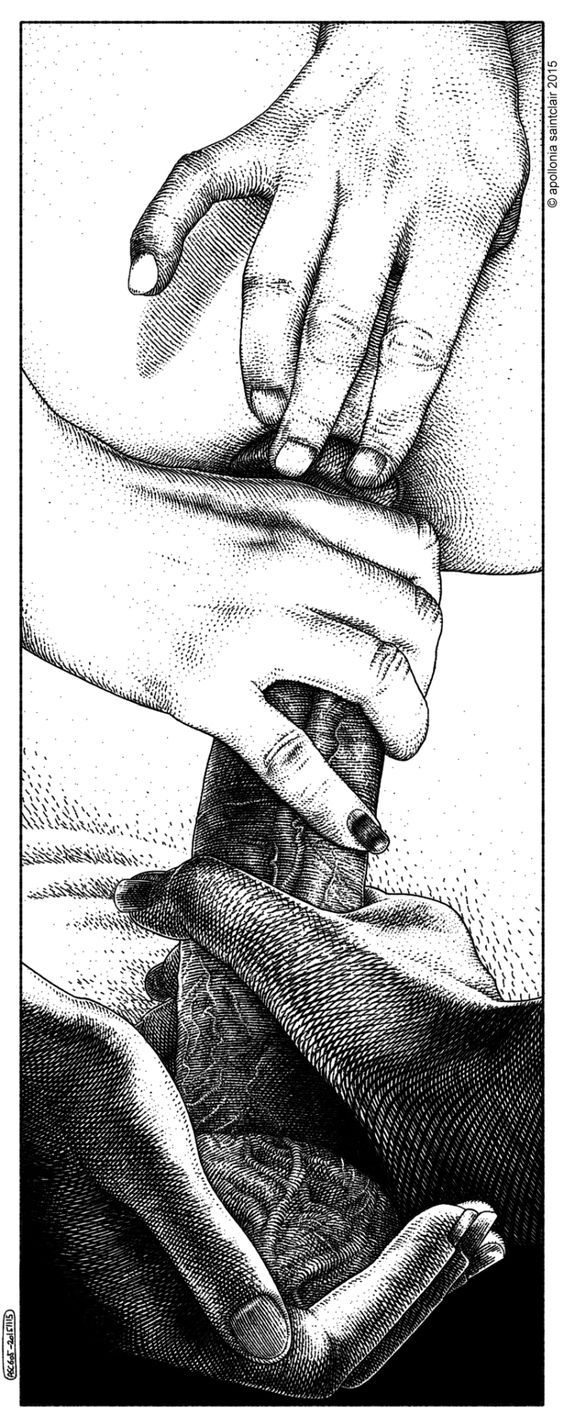
Apollonia Saintclair605 – Les béquilles [The Third Auxiliary] (2015)

Each time I re-encounter Saintclair’s work, my appreciation of her talent expands.

Like Mœbius–who’s syncretism of sacred (attuned to the rigorously established precepts of classical drafting and design in high art) and profane (explicitly graphic depictions of sexual activity) is almost certainly a major influence–Saintclair almost always releases work that is both salacious and eminently refined.

I adore the image above. I appreciate the fact that I actually sat here for ten minutes decoding the fact that the hands depicted here belong to four different people.

Further, I love the way her treatment of cross hatching and shading render appear to be almost art nouveau-esque when you are examining the piece close at hand, and then when you zoom out and see it at a distance, the stylization diminishes to affect a sort of photo-realistic look.

Compositionally, I can’t see how anyone could look at this and not appreciate the careful balance between highlight and shadow–I mean this illustration is, after all, a gradient from top to bottom (light to shadow). But like the yin-yang symbol, the shadows in the light area balance against light in the shadow areas. It’s masterful, really. (She’s probably also riffing on Escher here.)

Lastly: for three years–give or take and excluding guest curatorial stints–I’ve insisted on alternative between B&W and color images every other post on this blog. (I know, I know–your mind is blown.)

It’s not especially easy to pull of. There is a dearth of B&W stuff, a surfeit of color. So it’s refreshing to have an artist whose work successfully scratches a particular itch in such a virtuoso fashion.

(Disclaimer: this Tumblr was high af off Cali’s finest medical edibles while writing this post.)

Erika LustPansexuals (2015)

I probably shouldn’t base my opinion of this scene based on an 8 minute excerpted cut

…but all the problems I have with Lust crop up in abundance: solid concept hindered by uneven/lackluster execution.

I think the problem–besides the fact that her grip/gaffe team can’t set up lights fer shit (sheesh, invest in some softboxes and close down that key light by 2.5 stops)–is that Lust seems inherently preoccupied with subverting the male gaze typically associated with pornography.

She does this by soliciting fantasies from women which she then enacts for her cameras. Take Pansexuals, it treats a group sex scene in a typically porn-trope turn by using strip poker as a throw away plot device. That’s something I’ve never understood–strip poker is such a means of symbolically addressing power dynamics, creating tension, building anticipation. In essence, the game itself is a chance to hone the subsequent eroticism, to contextualize it. This seems to skip over all that to hurry up and get to the fucking. (Watching this I felt exactly like my 16 year-old self fast forwarding to the parts that got me the wettest.)

So while: yes, I’m always going to support a FFMM group sex scene that skews full on gay once your too far into it to back out. (I love shit like that because as I’ve said if you like watching people fuck, you should be fine with watching people who don’t fuck like you in the process of finding representations of people who do fuck like you), I do think everything about this scene is almost to awkward to even be sexy.

I mean sex at it’s best is always a bit awkward and group sex–in my admittedly limited experience–tends to be awkward. So I feel like maybe kudos for being honest in the depiction?

Truthfully, though I don’t think it’s the right kind of awkwardness. Like in this scene it’s Ermagerd Girl level awkward. And really, it’s usually more tender, idiosyncratic and charming.

Like this:

image

Or this:

image

Also, I’m reminded of Pina Bausch’s prompts designed to get her dancer’s to enact a mood or desire:

  • Copy someone else’s tic.
  • Do something you’re ashamed of.
  • Write your name with movement.
  • What would you do with a corpse?
  • Move your favorite body part.
  • How do you behave when you’ve lost something?