
Raggana Photography – Portrait (2015)
io fu gia quel che voi siete e quel chio son voi anco sarete (I was once that which you are, and what I am you also will be)
Raggana Photography – Portrait (2015)
io fu gia quel che voi siete e quel chio son voi anco sarete (I was once that which you are, and what I am you also will be)


Sam Scott Schiavo – excerpts from La Solitudine (2013)
This post presents the images as a triptych whereas on Schiavo’s website it’s a five panel progression.
I am not sure how to process it. None of the images considered individually are especially strong.
However, re-constructed as a triptych, the separate images form a cohesive whole: water droplets and reflections in the glass separating the subject from the camera diminish as the eye moves downward; the elbow’s reiteration strangely enforces as continuity between the top and center frame, easing transition.
Whereas, the discontinuity between the absence of the hand and arm in the center frame eases what would other be an especially jarring re-framing.
I dig the the images as a triptych. The difficulty I have is the individual images aren’t strong enough to stand on their own. And to me that’s one of the prerequisites of the polyptych form. Granted I am not well-versed in the formal conventions beyond altarpieces, Van Eych and Bosch.
Familiarity with the form is certainly important but there is something disingenuous about cramming a work into a form as a remedy for one-dimensional conceptualization and lackluster execution.
And that is a shame because in the age of iPhone panoramas and automated photostitch programs there are a few image makers who are creating fascinating polyptych’s. The ones that jump immediately to mind are: David Hilliard, Accra Shepp & Tom Spianti.
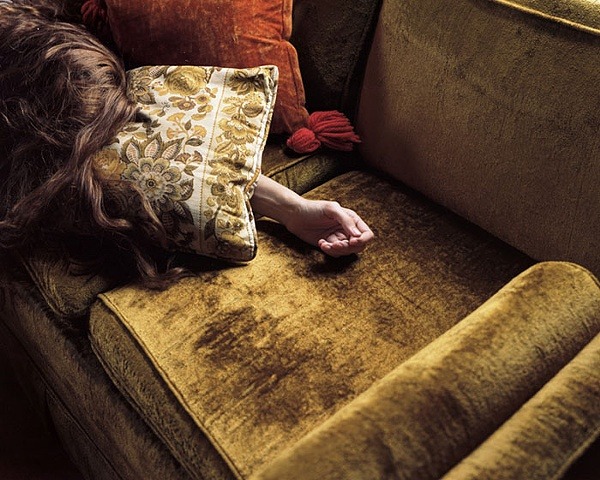
Anastasia Cazabon – part of From the Secret World series (20??)
Artist Statement:
These images are based on my own childhood, specifically the transitional period between the ages of 9-15. This period of liminality, when girls are on the threshold of womanhood, can be one of the most defining and vital stages in a woman’s life. In this stage of life, young women become acutely aware of the world around them and how they are portrayed within the world; physical appearance is suddenly pushed into the spotlight and with that comes insecurity, excitement, jealousy and narcissism.
Relationships with other girls are also critical and these friendships are often fleeting yet intense; feelings of love, envy and rivalry pervade adolescent female companionship. These friendships are also marked by polar swings of emotion – one day encompassing cruelty and the next kindness.
These images revolve around the secret, yet everyday lives of adolescent girls. The power of this transformative time is characterized by the struggle to reconcile one’s girlhood while moving into womanhood – an experience that elicits strong feelings of both fear and longing.

by fred.c.fred
Normal
0
false
false
false
EN-US
X-NONE
X-NONE
/* Style Definitions */
table.MsoNormalTable
{mso-style-name:”Table Normal”;
mso-tstyle-rowband-size:0;
mso-tstyle-colband-size:0;
mso-style-noshow:yes;
mso-style-priority:99;
mso-style-parent:””;
mso-padding-alt:0in 5.4pt 0in 5.4pt;
mso-para-margin-top:0in;
mso-para-margin-right:0in;
mso-para-margin-bottom:10.0pt;
mso-para-margin-left:0in;
line-height:115%;
mso-pagination:widow-orphan;
font-size:12.0pt;
mso-bidi-font-size:11.0pt;
font-family:”Garamond”,”serif”;}
Received wisdom maintains that a boy willing to hold a girl’s hair back is a ‘nice guy’.
Isn’t it more complicated than that? What if a girl doesn’t want her hair held back, wants to hold the boy’s hair back or wants another girl to hold her hair back?
If I were a boy I’d a girl to hold my hair back and were I a girl, I’d want to hold another girl’s hair back.
But I am neither/both and all I have are hair ties.

 Acetylene Eyes