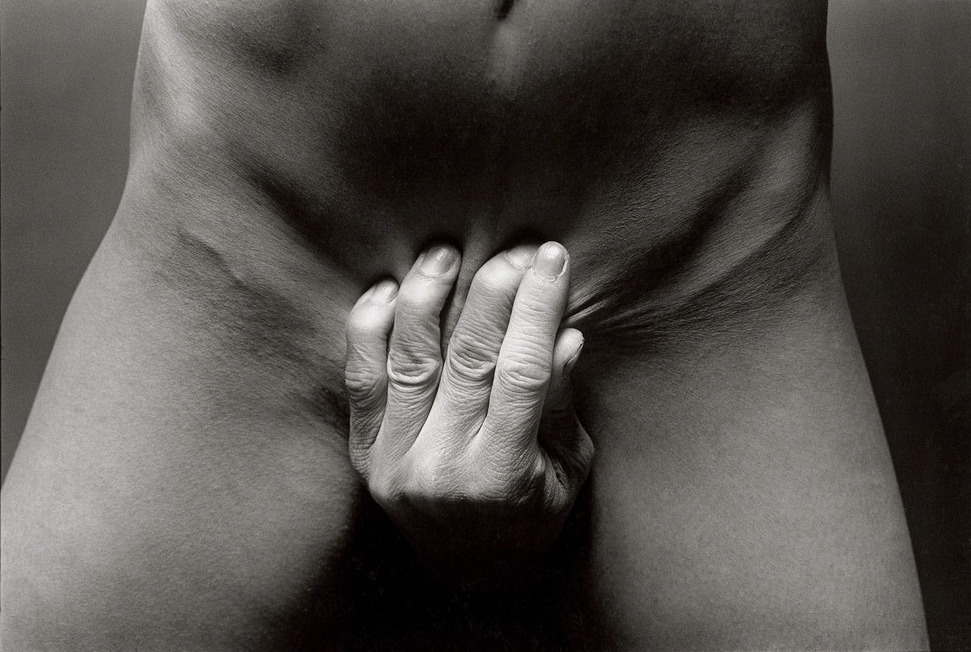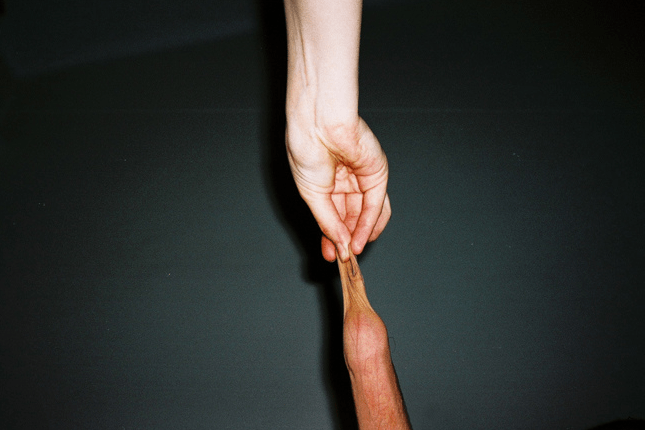
Eikoh HosoeEmbrace#47 (1970)

Dreams, memories, the sacred–they are all alike in that they are beyond
our grasp. Once we are even marginally separated from what we can
touch, the object is sanctified; it acquires the beauty of the
unattainable, the quality of the miraculous. Everything, really, has
this quality of sacredness, but we can desecrate it at a touch. How
strange man is! His touch defiles and yet he contains the source of
miracles.
Yukio MishimaSpring Snow (1968)

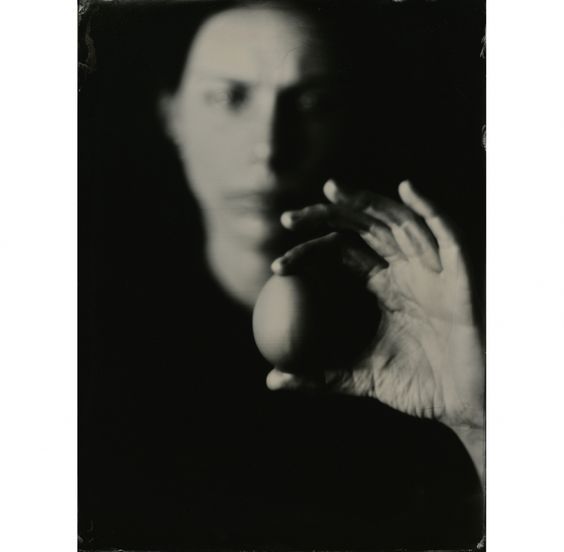
Isa MarcelliUntitled from Toccata series (2015-16)

In music, toccata means literally ‘light touch’ and is a designation afforded to a pieces (usually keyboard based but also sometimes including string instruments) which are notoriously difficult to perform but allow the musician to show off their deftly virtuositic lightness of touch.

With the image above, there are several layers of meaning to draw from this. First that the woman is holding an egg resonates with the title. (And I can’t help but recall the apocryphal account of Brunelleschi carrying a basket of eggs and dropping them as a result of his shock upon encountering Masaccio’s Holy Trinity Fresco.) Secondly, Marcelli is using collodion to produce ferrotypes. (Collodion wet plates experienced their widest usage during the U.S. Civil War–during which time collodion was actually used to close up severe wounds; but through a process involving a number of extremely hazardous chemicals, i.e. ether and cyanide, it was possible to produce a resilient negative image on transparent glass.) Also: collodion is not exactly the most user friendly format as you have roughly 12 minutes to evenly coat the plate, load it into your camera, expose and process the resulting image.

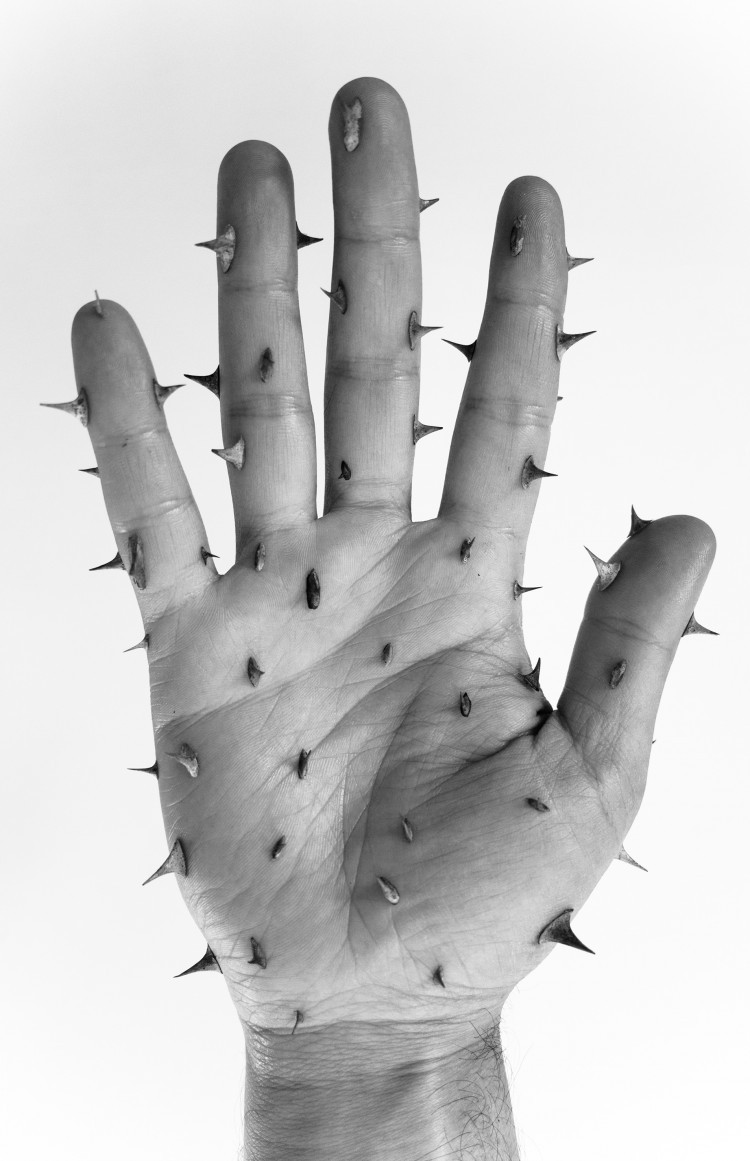
Matthew Draw – Multiple colors of love. (2016)

I’m writing this post while in Reykjavik. Technically, this is my vacation–and I’d hoped to have things sorted in such a fashion that I could just let the queue run. No such luck, sadly…

I’m posting this for you mostly because I like the line work. Everything is rendered with intensity of purpose–efficient, no wasted effort. Still there’s a sense of Michelangelo-esque discovery of the form hidden within the blankness of stone. (The thickness of the lines in certain areas seems but tentative and studied; the lighter lines on the ring and pinky finger de-emphasize their importance as anything but three dimensionally orientating facets of the composition.)

But the real reason I’m offering you this is because I’m sort of blank brained right now–it’s weird to travel to a beloved local while brutally depressed and to feel like the volume on your negative thoughts is turned down a bit due to a better environment but to then feel like the positive experiences that manage to creep in are happening to someone else separate from you?

Anyway, last night, I was rather stoned coming back from a tour. It had been one of those textbook clear Icelandic days that you are extraordinarily rare and the clouds were being rushed in by high winds and the sun was doing it’s slow setting thing that it does this time of year.

It was like the dome of the sky was having blankets slowly pulled over it, essentially like the world was being tucked in to bed for the night in slow motion.

The western edge of the horizon looked like lava was lighting the clouds from the inside. At one point there was a cloud that was shot through with this etheral blue–a color I don’t think I’ve ever seen anywhere else before.

I tried to take a picture of it with my phone but speeding through the growing dark in a charter bus; alas, that’s really not the best sort of vantage for the task. So I decided to watch and realized that the blue was a feature of the refraction of light. The outer edge of the cloud–the side closest to view–was this fantastic blue but the inner edge the side closer to the retreating sun was actually a vivid chartreuse. It made me think of the old masters with their oil paints–how they sculpted rich, super saturated colors by layering paint on their canvases.

So yeah, I dig this image. But! I also enjoy it because the use of color reminds me of the relationship of surreal colors I saw last night in the skies over the south coast of Iceland.

Taylor RadeliaUntitled (2010)

This crossed my dash attributed to William Eggleston.

On the one hand I can understand why someone would think that. It’s an image of a piece with Eggleston’s oeuvre–fixated upon seeing the beauty of colors despite the often numbing interference of the mundane.

It’s almost like this photo by Radelia is–from the standpoint of photography math: this + this.

There are still notable differences anyone who has spent any sort of time with Eggleston’s work really ought to have caught: namely, Eggleston doesn’t really use a strobe all that often and although virtually all of his work trades in sublimated sexuality, the above is a little too direct in it’s perverse punning to be a lost Eggleston.

Radelia’s image is fascinating though because it’s a rare work that both stands on its own to feet but also holds up well when compared with the work from which it clearly draws inspiration. That’s not a small thing at all.

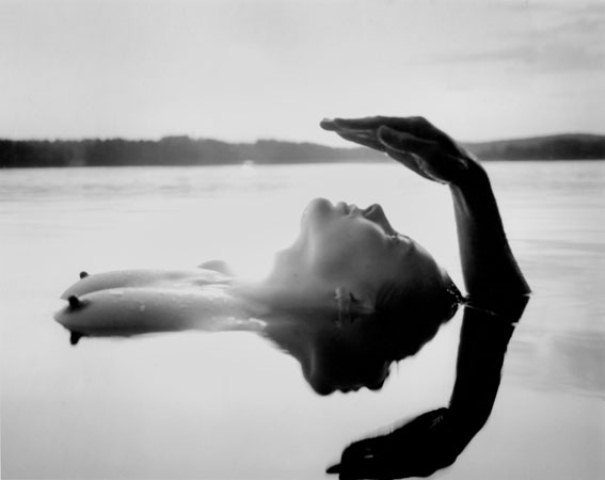
Arno Rafael MinkkinenSelf-portrait with Maija-Kaarina (1992)

Regardless of the discipline, I think anyone interested in pursuing the visual arts in an academic setting should be given a single sheet of paper printed on both sides.

The front would read:

Nobody tells this to people who are beginners, I
wish someone told me. All of us who do creative work, we get into it
because we have good taste. But there is this gap. For the first couple
years you make stuff, it’s just not that good. It’s trying to be good,
it has potential, but it’s not. But your taste, the thing that got you
into the game, is still killer. And your taste is why your work
disappoints you. A lot of people never get past this phase, they quit.
Most people I know who do interesting, creative work went through years
of this. We know our work doesn’t have this special thing that we want
it to have. We all go through this. And if you are just starting out or
you are still in this phase, you gotta know its normal and the most
important thing you can do is do a lot of work. Put yourself on a
deadline so that every week you will finish one story. It is only by
going through a volume of work that you will close that gap, and your
work will be as good as your ambitions. And I took longer to figure out
how to do this than anyone I’ve ever met. It’s gonna take awhile. It’s
normal to take awhile. You’ve just gotta fight your way through. –Ira Glass

The back would reprint the entirety of Minkkinen’s The Helsinki Bus Station Theory: Finding Your Own Vision in Photography.

Partly, I think it’s good form. Also, I feel like the assumption is made that the student wants to learn or they wouldn’t have enrolled in the course. But wanting to learn and having to learn are very different states–for example: as I approach middle-age I still want to learn to play the cello but when I was a toddler I didn’t so much want to learn to walk as I had no other choice.

Those who want to learn are a dime a dozen. The majority of them will become bored, will shirk the work or drop out.

But what academia does a shit job at is teaching you how to keep going when you don’t have a choice because to cease would be tantamount to death. Students are direly ill-prepared for those plateaus, brick walls and handfuls of hair pulled out frustrations that come part and parcel with practicing a craft.

I feel like leveling from the beginning–admitting it’s hard and dispirit but reminding folks that the process–no matter how wearying–is far more important than the product.

Or to put it another way: practice doesn’t make perfect. Only perfect practice makes perfect.

Zachary AyotteUntitled (2014)

This is really kind of great.

I’m not sure whether I think so due to the way the hand is positioned in the frame, the way the position of the hand corresponds to the tile and sink and the ever so slightly soft focus that comes from trying to focus with hold the camera and focus one-handed or that it recalls a series of photos Traci Matlock made employing her hands, water and objects in or around her kitchen sink.

Most likely, it’s both.

Sasha KurmazUntitled (2010)

Folks are fond of reminding me of Helen Levitt’s notion that the only substantive difference between making work and thinking about making work is whether or not you’re running film through the camera.

I used to object; splitting hairs on the grounds that Levitt was a street photographer and I’m a landscape photographer.

Then I saw this photograph and chugged a big ol’ tallboy of Shutting the Hell Up™.

Great work has this way of transcending the specific confines that contributed to its creation

I’m reasonably sure Levitt would object to mention of her or her work in the context of the image above.

And I’m not sure I’d take issue with her quibble. Kurmaz’s work is largely derivative–borrowing wholesale, in turns from Ren Hang, Maurycy Gomulicki and Igor Mukhin.

As a result, his body of work is distinguished more by its high-gloss, fashion/lifestyle than a distinctive photographic voice.

Still, browsing his Flickr proves Levitt’s point: as long as you are shooting there’s liable to be some perfect storm of mitigating circumstances where good work stumbles through in spite of everything.

This is one such image. (Also, to his credit, Kurmaz seems very aware of this image’s ability both to read as homage and to accomplish something distinct from the work it clearly references–something that functions similarly only using music instead of images consider the Beastie Boys’ monumental Paul’s Boutique.)

Mr. H浪奔 [Ben Lang] (2011)

Originally, this was supposed to follow up my post on close-ups and the notion of the foreign-in-the-familiar.

A series of unfortunate events–bad weather, illness, intoxication and the Internet at my accommodations crashing–made that impossible. Maybe it’s better that way.

I don’t necessarily dispute what I suggested. I just think the foreign-in-the-familiar indicates something more in line with those puzzles in children’s media where they a extreme close up that’s been all reoriented to be wawker-jawed and one has to recognize the original object.  (And one of them is always a goddamn manhole cover–WTF is that about?)

I would have been much better served by suggesting a metaphor with detail insets. For example: here’s the absolutely fucking brilliant Ghent Altarpiece; and here’s a detail inset of Eve holding some type of citrus.

In photography/digital imaging (which really need to be treated mutual exclusive disciplines that share a common lineage but suffered a irrevocable schism and are roughly as non-interchangeable as the Roman Catholics and Eastern Orthodoxy), the close-up is comparable to the detail inset de-linked from the original contextual totality. In other words: in art you see the big picture first and then a small detail of the big picture is brought into sharper focus–by focusing on a part of the whole the whole gains further specificity of meaning; in photography/digital imaging, it’s the other way around– one focuses on the detail and from the detail has to intuit the broader context. That’s great if a broader context has been exists, has been established, is explicit. The problem is when the close-up relies upon the interest generated by an atypical manner of seeing to sell the frame independent of broader detail.

(It occurs to me that this detail inset metaphor functions exquisitely when applied to cinema before–and I’m guesstimating here–the late 70s/early 80s with the exception of Dreyer’s The Passion of Joan of Arc; however, even that used close-up is an exceedingly well-reasoned and above all consistently applied manner.)

There is a great deal of contextual information that can be sussed out from The Frenzy of the Visible’s masturbatory Self-Portrait–things about the space occupied by the subject, that the light is daylight coming through a window, etc.. Mr. H, on the other hand–although clever in his framing which implies the explicit instead of showing it–removes any sort of contextual cue to focus attention on the ejaculatory aftermath of a male bodied individual masturbating to orgasm. I won’t lie: this makes my brain run 200 km/h in the wrong lane* about potential applications for the wonderfully surreal textures semen exhibits under the light pushing overexposure. Still, such detail would have been equally visible and more compelling–although also more explicit and therefore more challengingto present artfully–with more context.

Lastly, although its soft-core coyly pushing up against hard-core is hardly my cup of tea, Mr. H seems–after a cursory scan–to have a good bit more instinctive talent than any image maker I can think of making similar work targeted at heteronormative types.,