Judy DaterSelf Portrait Salt Flats (1981)

One of my all time favorite photos by Dater is her Self Portrait with Snake Petroglyph:

I don’t know how I’ve never made this connection before but it’s entirely possible–quite likely, actually–that this is was intended as a sort of paean to Francesca Woodman.

After all, Woodman took her own life in January of 1981–the same year that Self-Portrait with Snake Petroglyph was created.

There are other similar features–the camera anchored firmly on a tripod while the photograph positioned herself in the scene. There’s the similar sort of motion blur Woodman deployed so often. (Although, it is important to note that: here it used much differently.)

A common critical and art historical question centers less on whether Woodman was an important artist–the interest in her work certainly continues unabated–but there is a lingering question of whether or not any of her mature work would’ve incited the intense reverie and devotion. With notable exceptions, her oeuvre (as it is), has been culled almost entirely from work produced before she was even 20. And there’s an argument to be made that after her year studying abroad in Rome, she never managed to rediscover the same sharpness in conception and execution again. Her foray into fashion photography was incalculably heinous. (Although in fairness, my favorite photo of hers was made during her last year of life.)

I adore Woodman. There’s only a handful of artists whose work I’ve spent as much time with as hers. (When I’m feeling especially full of myself I tell people that we’re involved.)

But I think that Dater’s work from from the year Woodman died–whether she meant it to or not–suggests that perhaps Woodman had, in fact, peaked and was past her prime.

Even in Self-Portrait with Snake Petroglyph, the framing is pretty much just about as wide as Woodman ever got. In her later work, in fact, she retreated–favoring the more intimate close-up style that prefigured the age of the instagram selfie by nearly three decades.

Dater very much went the other direction. Pushing the camera further and further back. (Anyone who is an actual photographer will appreciate the way this increases the difficulty and risk of the composition–the eye is more willing to forgive a composition that almost works if it’s shown something interesting in the bargain.

With the image above there’s also references to Wythe’s Cristina’s World as well as both a reference and a feminist critique of Edward Weston‘s strident male gaze-i-ness.

Also, it occurs to me that although we can with hindsight see the link between Woodman and Duane Michals now, plain as day: I feel like it was perhaps problematic for a straight, cis, white girl to be appropriating so whole cloth the work of a gay man?
vivipiuomeno1:

Judy Dater (U.S.A. 1941) Untitled (Self-Portrait with Sparkler) 1981, Gelatin silver print, 15 × 19 in.

Dater’s Self Portrait with Snake Petroglyph is the first of her photographs I encountered.

I love it. (So much in fact, that I riffed off of when I made this photograph.)

Shortly after, I tuned into Imogen and Twinka at Yosemite and it’s narrative bent couldn’t be more relevant to my own photographic preoccupations.

The above is a more resolute photo, more symbolically charged.

Victoria Gannon’s commentary Judy Dater: On Vaginas and Earthworks is a addresses the broad strokes reasonably well: the Freudian notion that vaginas are voids needing to be filled, how the sparkler Dater is holding behind her back and between her legs serves as the focal point of the photo, the work’s position within a historical context of Second Wave Feminism.

Such points are clearly valid–although I bristle a bit at the notion that Carolee Schneermann’s Interior Scroll was anything less than proto-Third Wave. 

Yet, I think in Gannon’s effort to associate the Dater with feminism, there’s an overlooking of the radical ambiguity of this image. To her credit, she does note that the space behind Dater isn’t land, it’s an expanse of water–something I completely missed.

The light is also between day and night–whether it’s dawn or dusk, remains uncertain. (Although my gut says dusk.)

Further, Dater is standing behind a steam vent or fumarole. I have no idea if it was intentional, but I was almost certain it was a geyser.

Part of my reason for thinking that is a result of visiting iGeysir in Iceland–the site from which the word originates. (Spoiler alert: it’s a tourist trap par excellence.)

The thing that visiting there made me realize is it’s not just porn where folks fixate on ejaculatory spectatorship–when Geysir spews, everyone stops and watches with rapt awe.

I have no idea if Dater meant for the viewer to think of a geyser. But the way she’s standing, defiant–with the light dying out in the sky–with fire symbolically emanating from between her thighs, there seems to be something radically talismanic about her formulation with regards to this image, a reformulation where femininity is the site of an equal but opposite force of nature. Something perhaps less historically observed, but as this photo asserts, it’s high fucking time that prejudice was upset.

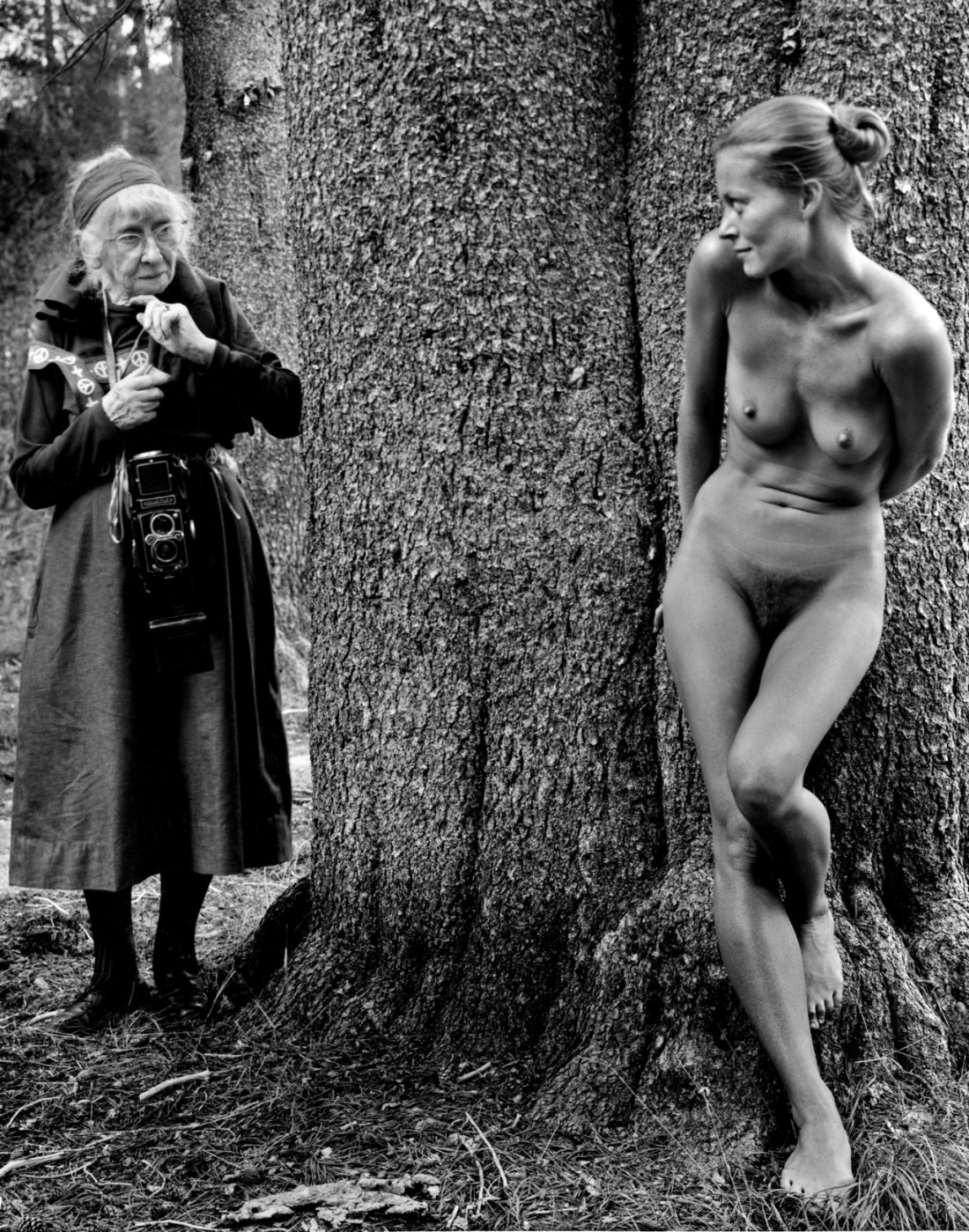
Judy DaterImogen and Twinka at Yosemite (1974)

I was completely unfamiliar with this image prior to this morning. And now that I know about it, I am sort of going crazy over it.

Long story short: I came to photography via cinematography and ever since I’ve been trying to figure out how to convey a narrative within a single, static frame.

There’s a lot of folks who are similarly fixated. Fewer succeed and some (looking at you, Crewdson) don’t even come close but continue to tout their work publicly as narrative despite a colossal misunderstanding of what narrativity entails.

This image is narrative as fuck. What we are seeing is indisputable. A woman with a camera has walked around a tree and to her surprise, encountered a nude woman eying her coyly.

Given only the image, we can surmise both what led up to this event and what will follow from it: respectively, a photographer was wondering through the woods looking for a scene to shoot and now having found it she will take a picture.

But… but… (sorry, totally v. emotional ova here) that framework suggests a number of questions: who is the photographer and why is this woman just leaning up against a tree naked?

And unlike so many images that rely on the inclusion of accompanying text or a title to activate the narrative, the title here–hallelujah!!–directly addresses those questions: the photographer is Imogen Cunningham, one of the first American female photographers; and the nude woman leaning against the tree is Twinka Thiebaud.

Further the mention of Yosemite serves the dual purpose of connecting this to the American photographic tradition–Eadweard Muybridge and Ansel Adams writ all the way into the fucking margins–and grounding it in the fact that this image came out of workshop (organized by Adams) entitled “The Nude in the Landscape.”

Apparently, Twinka character was conceptualized as a woodland nymph after Thomas Hart Benton’s Persephone. (Note how this intricately compliments the fantastical undercurrent of the initial narrative interpretation as well as presents a critical and conceptual weight to the mention of Yosemite in the title–i.e. the American west and it’s relationship to the nascent medium of photograph as a new mythology.)

I’m overcome by how incomparably perfect this is. This is the model for the work I want to make as a photographer.