As far as outsider art goes, it’s very difficult out outre P-Orridge.
I am hardly an expert on their (they identify as third gender and use them/their pronouns) life and work.
What I know is that if you haven’t you should absolutely know Throbbing Gristle’s 20 Jazz Funk Greats. (I can’t stomach much else TG did & Psychic TV totters on the brink of intolerable.)
All that being said: they were hugely influential to artists who have had a lasting impact on me.
I am not familiar enough with all the ins and outs of their life to really comment with any kind of definite hot take. They were impossibly controversial–in word, deed and thought.
At present they are being treated for Leukemia–it’s not looking good the last I heard. (Cancer fucking sucks.) If their work meant anything to you, you might want to consider support their GoFundMe for treatment. (How in the fuck did we get to this place in history where people have to crowd source their medical treatment…)
Source unknown – Title Unknown (201X)
Folks always give me shit about how I fixate on the framing/composition of a photograph or image. Yet, framing/composition contribute or detract immeasurably from the legibility of a photograph or image.
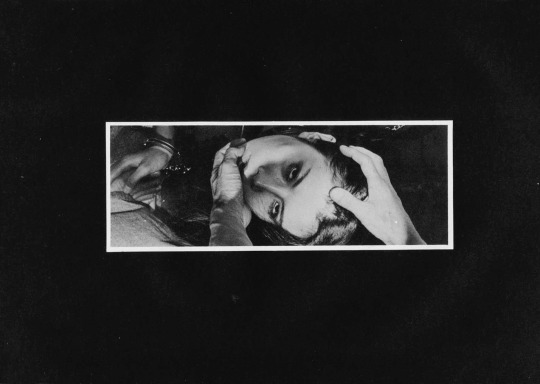
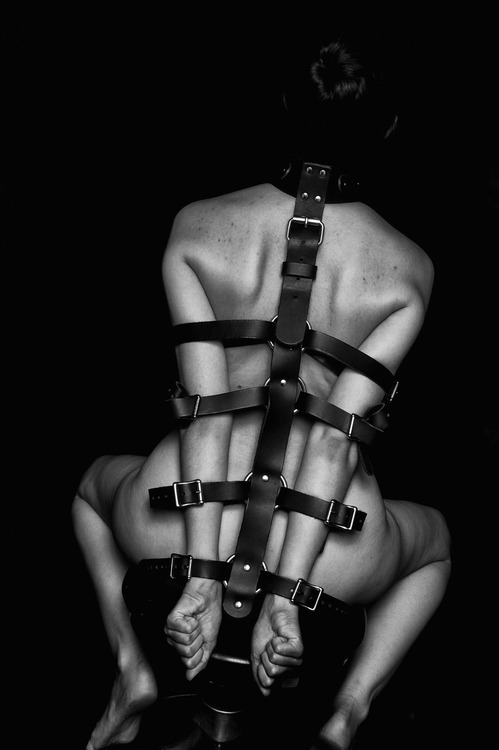
Take this, for example: it reads vertically and thus represents a rare instance where a skinny frame is logically consistent composition decision.
I’m fairly certain that this is not a panoramic photograph. (I’d wager it’s been cropped from a wider scene and digitally desaturated.)
Under normal circumstances, this is the sort of thing I avoid showcasing–except this is remarkably well-realized on two counts:
First, the affected white border around the image giving it a lurid news paper clipping/traditional dark room work print feel. (Both contribute a tactility to something that emphasizes the extremity of touch.)
Second, note the way different parts intersect in the space delimited by the frame–his hands, her face and handcuffed hands.
It’s partly the juxtaposition between the highlight detail of skin against the impenetrable background shadows, partly the way each feature converges at right angles to each other within the frame.
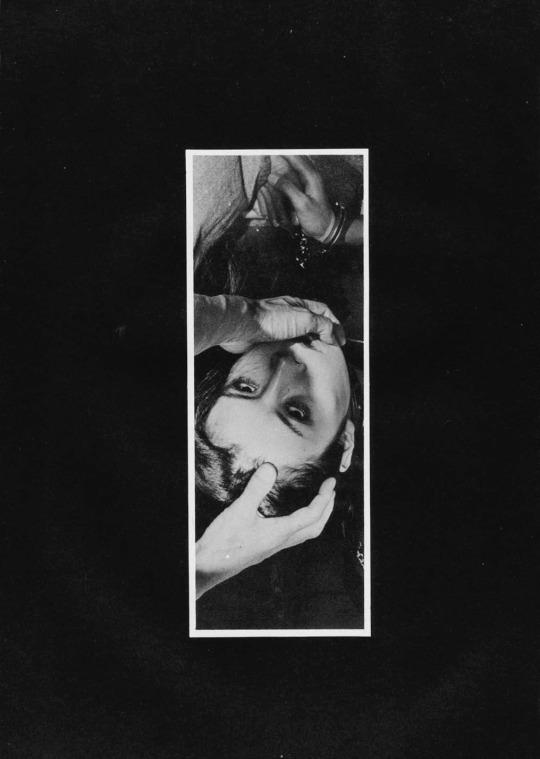
It’s also the way the camera is a witness as opposed to an intercessor. For example, rotate the image 90° clockwise gives you this:
Now maybe it’s just me but there is a certain way that with this orientation and hands entering the frame from the lower half (such as this) suggests that the hands belong to the photographer/image maker. Many folks are rightly criticized for this tact–looking at you Insuh Yoon. (Alternately, I did see this image made by Bang Sang Heyok, that while not a good image is–as far as I’m concerned–a successful proof of concept that there may be situations where the image maker/photographer insert themselves into the scene may actually serve a non-creepy purpose; in this case I appreciate that the image maker is attempting to preserve the anonymity of the subject in such a way that doesn’t not require decapitating them with the frame edges.)
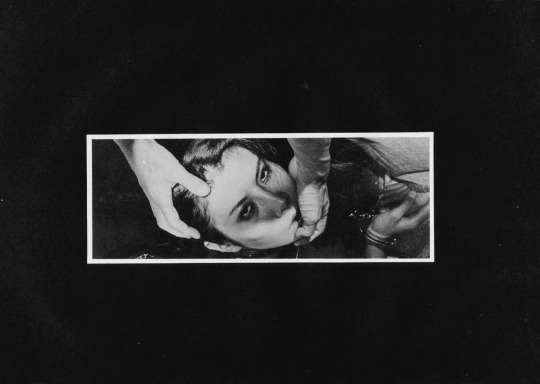
Let’s take it another step, actually. Here are the same images rotated 180° & 270° degrees respectively.
To my eye, the 180° rotation doesn’t read as well. I see the handcuffs before the hands. With the mass of negative space at the bottom of the frame, your eye immediately retreats and locks on the handcuffs.
The 270° one is more surreal–how are the hands at that angle unless there has been some sort of gravitational trickery with the staging/positioning of the camera. In other words, this orientation undoes the physicality established by the original orientation. And, given that this is ostensibly a BDSM image, that exact physicality is the raison d’etre of the image.
Lastly–and this goes out to the naysayers who take issue with my #skinnyframebullshit ethos: the argument that you employ to dismiss my objections is that there is fundamentally no difference between the way you read the original and the 270° rotation. And you aren’t wrong. You encounter the same information in the same order with both orientations but the logical consistency of the composition and conceptual interpenetration given the various orientations not to mention the shift in psychological impact is the reason I harp so much on the fact that image orientation matters a whole lot more than I think you’ve really bothered to stop and consider.
I’m not sure I can offer any sort of ‘proof’ of why it works so well. Part of it is likely the Caravaggio-esque chiaroscuro–with a single bright source of light that enters the frame at a severe angle.
There’s a minute depth-of-field, making her face stand out but also grounding it in the milieu in which this scene is transpiring.
And mind is being paid to the rule that all things being equal, visually speaking–balance between an odd number of things is always preferable to an even number– five hands, three rings.
What does it mean to use the problematic aspects of BDSM as a way to explore real power and real pain? Can images be recontextualized through words? What does self-exposure really entail? How are sex positive and sex negative feminists allied against certain kinds of sex and certain kinds of work?
[Trigger warning: see tags]
PART ONE: Fists
[A nude black and white photo of Lori taken from behind. She is seated on a stool, and her arms are pulled straight behind her by a leather bondage device. It has multiple straps and runs up her back and around her neck. Her face isn’t visible and her hands are clenched into fists. She is tilted at a noticeable angle.]
This device sent chills down my arms. I’ve owned a pair of leather restraints for years. I use them on a regular basis at work and occasionally for play. Usually I find restraints unremarkable. There was something about this particular device, though, something about its shape: halfway between the full arm binding of a straitjacket and the piecemeal straps of modern medical restraints, what the girls on my first psych ward called ‘the four points.’
You will only see straitjackets in museums and BDSM parlors these days. It’s not that straitjackets weren’t effective; on the contrary, hardly anything is more effective. It’s that they are horribly painful to wear for long periods of time. Wikipedia explains the physiological reasons with the standard detachment: “Blood tends to pool in the elbows, where swelling may then occur. The hands may become numb from lack of proper circulation, and due to bone and muscle stiffness the upper arms and shoulders may experience excruciating pain.” We’re more civilized than inflicting that sort of pain now.
We’re so civilized we speak in code. When the call came down the hallway for a Code… Code Orange, I think (or Yellow? Not Blue, that was death), we all knew to scatter. Calling codes is one of the many amusing ways psych wards are like commercial BDSM parlors, where the scatter-and-hide code is always ‘Clear’ If one didn’t hide, if one stayed and peeked around the corner, she’d see a man in a business suit being led into a room with a black bondage bed and black leather cuffs. Or, she would see a girl being held down on a white cot, straining against white canvas cuffs.
I made it a point to be as disobedient as I could without incurring consequences. I needed to prove to myself that I was still in control even though I was not able to leave. This tendency faded quickly enough in the BDSM parlor, where we were forbidden to come and go as we pleased to avoid drawing the attention of police to the fact that we fucked men in the ass with dildos and fists. In other words, our restriction was for the safety of the management, and for our safety, too. At ten days, my stay in the psych ward was too brief for my obstinance disappear. When the code was yelled, the orderlies shooed us down the hallway, but I ambled so slowly I fell behind the other girls, stopping right next to the doorway from which the yelling was emanating. I peered in, largely to see if I could, but also because I thought that someone should.
In it she details her experience working for an Austin based publisher–specifically: how the non-consent/heteronormativity/misogyny underlying 50 Shades of Grey have become a template for the way kink is packaged and presented in erotica.
Her account is horrifying; but also essential for the light it shines on the current mainstreaming of deeply problematic/irresponsible/unrealistic depictions of BDSM/kink.


 Acetylene Eyes