

[↑] Rikki Kasso – Untitled from Trouble in Paradise series (201X); [↓] Source unknown – Title unknown (201X)
[↑] Rikki Kasso – Untitled from Trouble in Paradise series (201X); [↓] Source unknown – Title unknown (201X)
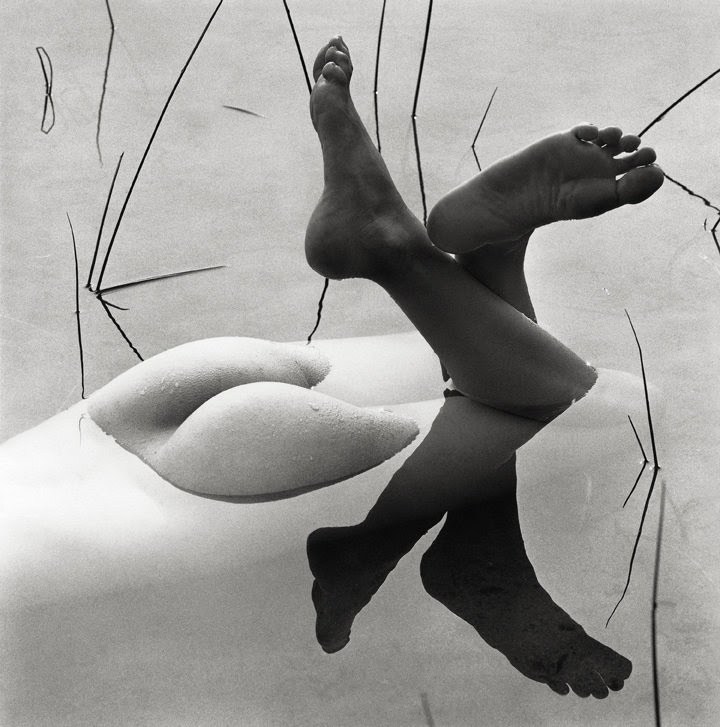
Karin Rosenthal – Funny Feet (1989)
I was left behind
with the immensity of existing things. A sponge, suffering because it
cannot saturate itself; a river, suffering because reflections of clouds
and trees are not clouds and trees.
—Czeslaw Milosz, from Esse (via malignantbloomer)

Cem Edisboylu – FRG3519 (2015)
I’m trying to figure out how to talk to you about Edisboylou’s work.
As best I can tell the work is primarily digital monochrome. There’s no one unifying thread. Yes, there’s a consistent focus on the solitude-isolation spectrum and a fascination with an arguably too rigidly circumscribed preoccupation with femininity as form–which is, yes, you guessed it: problematic.
It’s been said that the edges of an image’s frame are like a thumbprint. In other words, through attention to what’s included vs excluded, it is possible to reliably determine authorship.
No one is every going to confuse a Richard Avedon photo with one made by Robert Frank.
Avedon and Frank aren’t really the best examples. Genre-wise Avedon was a fashion photographer/portraitist and Frank was a documentarian. (Salgado–a fellow documentarian would have been a better choice…but I digress.)
Edisboylou doesn’t combine his work to one genre. A few of his images qualify as portraits, the rest are mostly distinguished by lofty, fine art aspirations.
The thing I keep coming back to in struggling to figure out how to encapsulate his work is an analogy to alchemy.
Generally, we’ve come to think of alchemy as some bent back old nutter with a Fu Manchu beard pouring bubbling concoctions from one test tube into another and then holding them up to light streaming in through a single clerestory window into a dank, moldering basement lab.
Of course, we think that the alchemist struggling to untangle the riddle chrysopoeia is hogwash. Although alchemy as a metaphor for leading a fulfilling, creative life is entirely valid–and arguably one of the less fundamentally detrimental metaphors for leading a better life; we take transmutation of lead into gold as literal, therefore deeming it inexcusably absurd but give Xtianity (a profoundly flawed metaphor at best) and Catholicism (with its transubstantiation, bread to flesh, wind to blood–an appropriation of alchemy) a pass.
It has always fascinated me that virtually all ancient traditions have a tradition of 4 or 5 most basic elements. And there’s a surprising overlap in that they all consider fire, water, wind and earth to be. (The eastern tradition includes metal as an element.)
Interestingly, these 4 (or 5) elements prefigured the eventual discovery and implementations that eventually became The Periodic Table. (The proposed fifth element in the western tradition, aether, informed early manifestations of Newton’s thinking on gravitation.)
So while yes, water and earth both figure prominently in Edisboylu’s work, it’s really aether to which, conceptually, I keep circling back. I’m not sure I can explain to you exactly why. But I think it might have something to do with potential vs. limitation.
I’m not a mathematician–I don’t have the chops for it (although number theory intrigues me), but it strikes me that the alchemical systems tend to be open ended whereas science is focused on replicability and that which is measurable–empiricism. (I can’t help but revel a bit in the fact that Rene Descartes, essentially the father of science, retroactively applied scientific precepts to interpolate ‘truth’ as to the interpenetration of the physical by the metaphysical, the perniciously resilient mind-body problem, Cartesian dualism et al.)
Alchemy is about potential, whereas science is about limitation. Or maybe, the better way to put it would be that alchemy aspires to outward expansion whereas science seeks accuracy and precision. (And it occurs to me that I’m further complicated things by setting this notions up as a diametric opposition. I’m not sure that’s helpful. It might be better to say that one is a hammer, the other a screwdriver; each has specific uses and secondary uses, including substituting the tools for each other in the absence of the other. Am I the only one who’s used the handle of a screwdriver as a hammer and vice versa?)
Kurt Gödel‘s incompleteness theorem famously used math tor prove that a system of symbols cannot be proven as true utilizing nothing more than the symbols intrinsic to that system.
There’s a great deal that one might reverse engineer about psychology with all this mess but I’ve meandered rather off the beaten path and I’d like to get back to the image above.
Perhaps one of the reasons I struggle to talk about style using more than a few distinct handholds here and there is because style is a category and by delimiting a category into increasingly specific subcategories, one eventually ends up with a category that holds only one thing–and what use is that beyond specificity for the sake of specificity.
A good category is one that is specific enough to group things with a prevailing theme or concomitant purpose without excluding a panoply of related overlap or intersection. It’s for this reason that I think stream of consciousness is actually one of the few truly useful categories. I loathe Joyce, for example. Have mixed feelings on Faulkner–The Sound and The Fury can bite my ass but As I Lay Dying is effing brilliant. Yet I adore Virgina Woolf. (Part II of To the Lighthouse is one of the most incredible bits of writing I have ever encountered and I’m trying to convince myself to actually excavate enough time in the near future to write that essay I’ve always been meaning to write on the Influence of To the Lighthouse on Antonioni, specifically the ending of L’Eclisse and Tarkovsky’s Mirror.
To those who actually read through all this: thank you. I realize this has been inexcusable intellectual masturbation (not to mention self-indulgent af) but it seemed disingenuous to just deem it aethereal without showing my work w/r/t how I arrived at that conclusion.
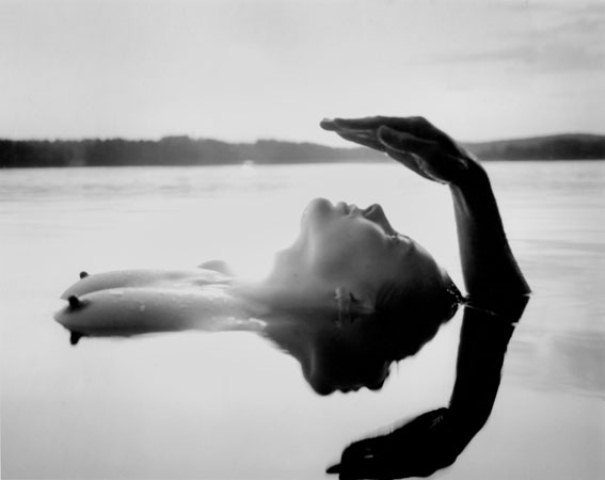
Arno Rafael Minkkinen – Self-portrait with Maija-Kaarina (1992)
Regardless of the discipline, I think anyone interested in pursuing the visual arts in an academic setting should be given a single sheet of paper printed on both sides.
The front would read:
Nobody tells this to people who are beginners, I
wish someone told me. All of us who do creative work, we get into it
because we have good taste. But there is this gap. For the first couple
years you make stuff, it’s just not that good. It’s trying to be good,
it has potential, but it’s not. But your taste, the thing that got you
into the game, is still killer. And your taste is why your work
disappoints you. A lot of people never get past this phase, they quit.
Most people I know who do interesting, creative work went through years
of this. We know our work doesn’t have this special thing that we want
it to have. We all go through this. And if you are just starting out or
you are still in this phase, you gotta know its normal and the most
important thing you can do is do a lot of work. Put yourself on a
deadline so that every week you will finish one story. It is only by
going through a volume of work that you will close that gap, and your
work will be as good as your ambitions. And I took longer to figure out
how to do this than anyone I’ve ever met. It’s gonna take awhile. It’s
normal to take awhile. You’ve just gotta fight your way through. –Ira Glass
The back would reprint the entirety of Minkkinen’s The Helsinki Bus Station Theory: Finding Your Own Vision in Photography.
Partly, I think it’s good form. Also, I feel like the assumption is made that the student wants to learn or they wouldn’t have enrolled in the course. But wanting to learn and having to learn are very different states–for example: as I approach middle-age I still want to learn to play the cello but when I was a toddler I didn’t so much want to learn to walk as I had no other choice.
Those who want to learn are a dime a dozen. The majority of them will become bored, will shirk the work or drop out.
But what academia does a shit job at is teaching you how to keep going when you don’t have a choice because to cease would be tantamount to death. Students are direly ill-prepared for those plateaus, brick walls and handfuls of hair pulled out frustrations that come part and parcel with practicing a craft.
I feel like leveling from the beginning–admitting it’s hard and dispirit but reminding folks that the process–no matter how wearying–is far more important than the product.
Or to put it another way: practice doesn’t make perfect. Only perfect practice makes perfect.
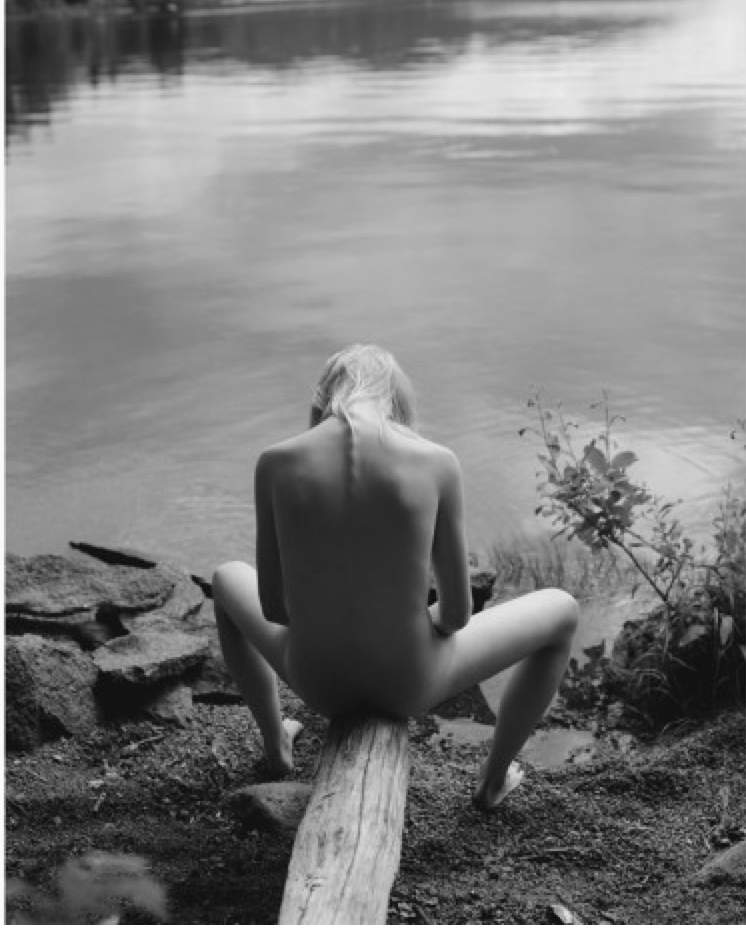
Massimo Leardini – Untitled from Scandinavian Girls (2013)
This wears its influences on its sleeve–Jock Sturges and Arno Rafael Minkkinen.
But it also shares common ground with Taiwanese genius Yung Cheng Lin insofar as it chooses implicit insinuation over explicit denotation, i.e. this could be nothing more than a simple image of a sprite nude young woman in nature, yet the pose here can just as easily be read as a sort of adolescent body curiosity which is perhaps even masturbatory; also the positioning of the log could reference Freudian misogyny or–I’ll pretend I’m an optimist today: an underdeveloped theme of genderfuckery. (I don’t really think that last suggestion fits because in this case the vertical composition is logically consistent with the image; yeah, it’s phallic as fuck but at least the skinny frame is logically consistent.)
In other words, I’m into this image on a conceptual level and not so much w/r/t technique–there’s almost no highlight detail which limits contrast and tonal separation by hazing out the middle greys. (Imagine what this would’ve looked like with the 3D pop that you can get when you effing nail the exposure with an appropriately contrasty film stock.)
 Acetylene Eyes