Vinson Smith – Flora Fauna (2017)

This was taken in Vík í Mýrdal, or Vík, on the southern coast of Iceland.

It’s a quaint little town. The main tourist draw is its utterly breathtaking black, volcanic sand beach. Also, there’s an iconic church position on some of the highest terrain in town. Here’s a film photo I took one of the half-dozen times I’ve been there:

image

The rock formation in the background of the first image is called Reynisdrangar. It’s a basalt sea stack.

But there’s a folk story about the sea stacks–two night trolls stole a ship and we’re dragging it back to shore. Unfortunately, the boat was either too heavy or they were further from their cave than they planned because they were caught by the rising sun and immediately turned to stone.

Judy DaterSelf Portrait Salt Flats (1981)

One of my all time favorite photos by Dater is her Self Portrait with Snake Petroglyph:

I don’t know how I’ve never made this connection before but it’s entirely possible–quite likely, actually–that this is was intended as a sort of paean to Francesca Woodman.

After all, Woodman took her own life in January of 1981–the same year that Self-Portrait with Snake Petroglyph was created.

There are other similar features–the camera anchored firmly on a tripod while the photograph positioned herself in the scene. There’s the similar sort of motion blur Woodman deployed so often. (Although, it is important to note that: here it used much differently.)

A common critical and art historical question centers less on whether Woodman was an important artist–the interest in her work certainly continues unabated–but there is a lingering question of whether or not any of her mature work would’ve incited the intense reverie and devotion. With notable exceptions, her oeuvre (as it is), has been culled almost entirely from work produced before she was even 20. And there’s an argument to be made that after her year studying abroad in Rome, she never managed to rediscover the same sharpness in conception and execution again. Her foray into fashion photography was incalculably heinous. (Although in fairness, my favorite photo of hers was made during her last year of life.)

I adore Woodman. There’s only a handful of artists whose work I’ve spent as much time with as hers. (When I’m feeling especially full of myself I tell people that we’re involved.)

But I think that Dater’s work from from the year Woodman died–whether she meant it to or not–suggests that perhaps Woodman had, in fact, peaked and was past her prime.

Even in Self-Portrait with Snake Petroglyph, the framing is pretty much just about as wide as Woodman ever got. In her later work, in fact, she retreated–favoring the more intimate close-up style that prefigured the age of the instagram selfie by nearly three decades.

Dater very much went the other direction. Pushing the camera further and further back. (Anyone who is an actual photographer will appreciate the way this increases the difficulty and risk of the composition–the eye is more willing to forgive a composition that almost works if it’s shown something interesting in the bargain.

With the image above there’s also references to Wythe’s Cristina’s World as well as both a reference and a feminist critique of Edward Weston‘s strident male gaze-i-ness.

Also, it occurs to me that although we can with hindsight see the link between Woodman and Duane Michals now, plain as day: I feel like it was perhaps problematic for a straight, cis, white girl to be appropriating so whole cloth the work of a gay man?

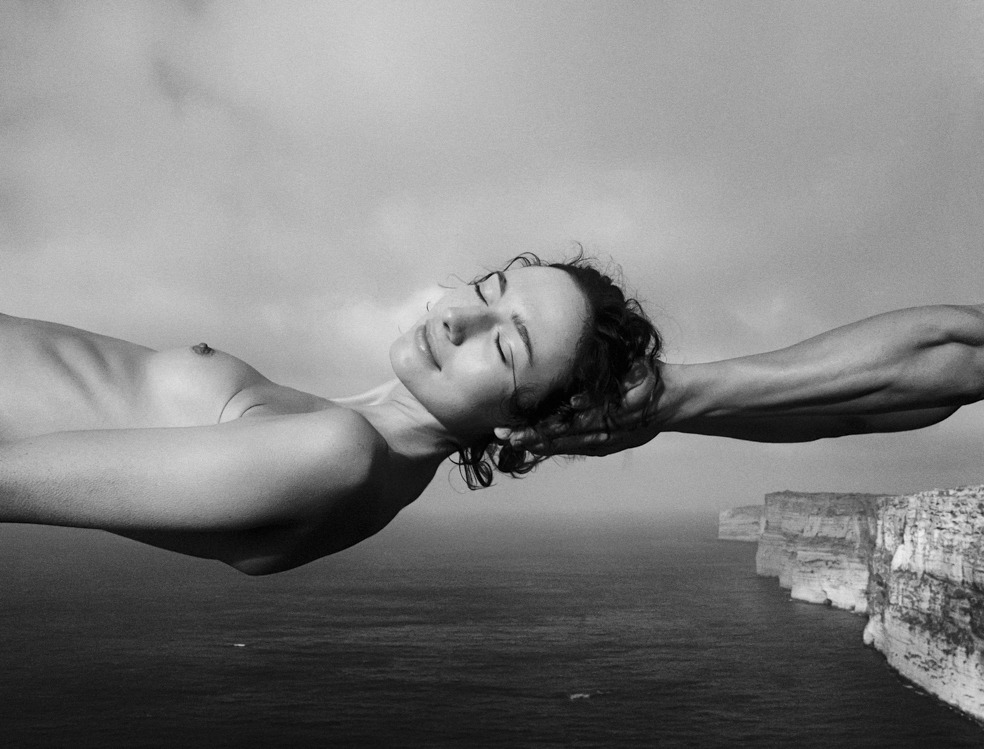
Arno Rafael MinkkinenLaurence, ‘Ta Cenc, Gozo, Malta (2002)

Honestly, this post should be relatively uncomplicated. If I had any sense, I’d point out that Minkkinen’s strongest work seems to always be the work that is–strictly speaking–the least original.

For example: Fosters Pond (2000) is unquestionably a riff on M. C. Escher’s Drawing Hands.

I’d characterize the above as Dalí’s Persistence of Memory + Klimt’s Water Serpents I remixed by Minkkinen.

But the idea for referring to it as a remix wouldn’t be mine; in this case, I’m borrowing it whole cloth from the most recent episode of Adam Conover’s TruTV series Adam Ruins Everything in which as the title proclaims Adam Ruins Art. (<—this link hits a paywall; you can find a pirated version of the episode on YouTube with a bit of elbow grease but here’s a link to the official upload of the segment most germane to this post.)

But there’s also a way in which this relates to other things which I’ve been thinking about a lot recently. From the prosaic: I’m really into Finnish metal–especially Circle and Oranssi Pazuzu (who I saw when they played their first show stateside earlier this year and remains the most incredible live performance I’ve ever seen). Minkkinen being Finnish as well–in case that wasn’t immediately clear.

And then two days ago I watched the recent documentary Burden focused on the life of proto-performance artist Chris Burden.

I was already super familiar with Shoot, 110 or 220–and his street lamp installation at LACMA (even if I didn’t immediately know it was his).

I found myself amazed an repulsed in equal measure. His unhinged behavior when his girlfriend broke up with him and he essentially made TV commercials to narrative revenge fantasies is extremely fucked up. His TV Hijack piece is equally fucked up but definitely maintains a rigorous self-critique that points out that the problematics are part of the point.

Still I find it interesting that he viewed himself as another historically great man of art. And frankly as much as Burden impresses me (at least in theory), I am increasingly put off by this great men of history bullshit.

There’s a great deal of current events that I didn’t/couldn’t include in the post preceding this. But whether it’s the current president using taxpayer funding to stroke his ego twice a day or an engineer at Google losing his job because he circulated a sexist as fuck and egregiously erroneous (his scientific claims about why there are fewer women in tech are bullshit, but he also implicit reifies the notion that here are only two genders) screed to his co-workers against diversity.

What we’re seeing happening in every corner of society right now is that those accustomed to privilege are having their privilege questioned/challenged and to them that feels a bit like oppression. Or, to put it even more plainly, consider James Baldwin:

Which brings me–of all places–to the current trial happening where Taylor Swift is suing a DJ who apparently groped her. I am not a TaySwif fan girl but I do have to say that her commentary and the way she is handling this situation are as scathing as they are stunning and astute.

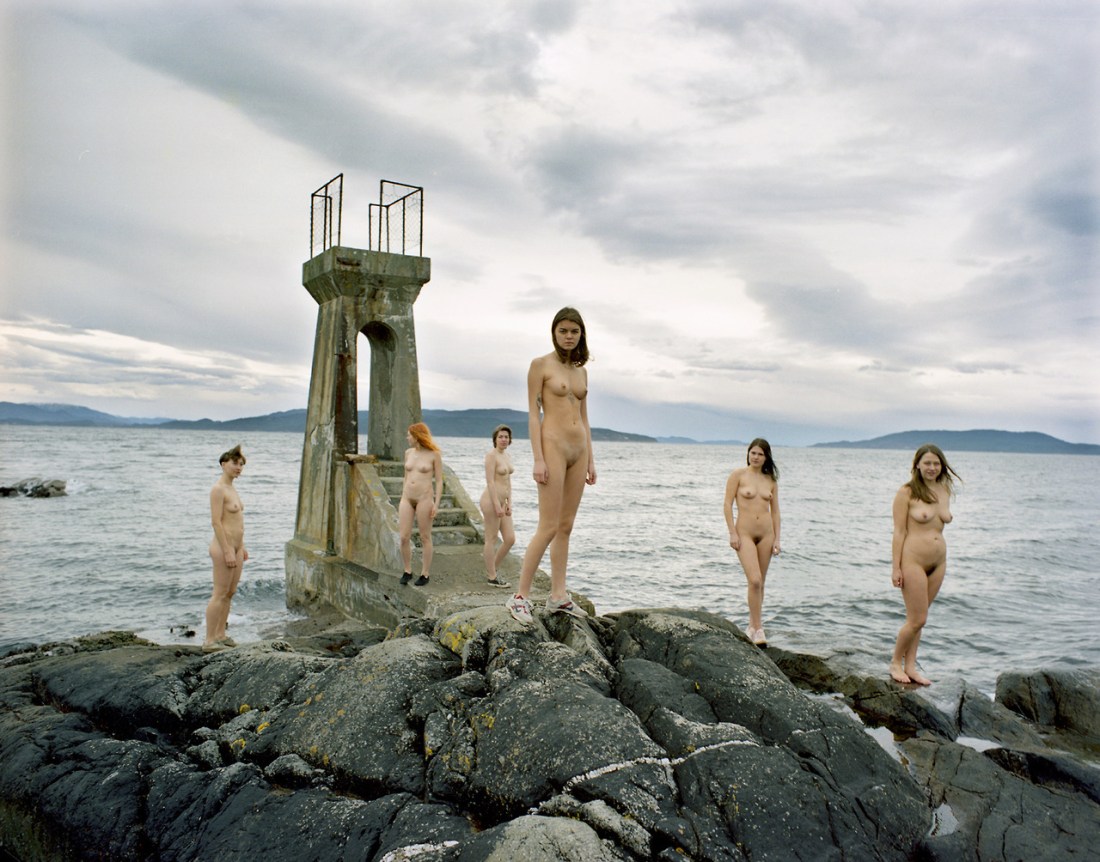
Linn Heidi StokkedalHaunting Hertevig (2017)

I have all sorts of #feels for Stokkedal’s work.

She hails from Scandinavia–specifically northern Norway. She favors film. (The above is Kodak’s ubiquitous Portra stock.)

In the course of this project, I’ve encountered her work on three separate occasions, each years apart.

My impression upon first seeing her work was–to borrow from Minkkinen’s ingenious Helsinki Bus Station theory–that she’d returned to the station a few too many times.

At first, her work was a mix of the sort of thoughtful but not necessarily innovative work of initial exploration upon picking up a camera for the first time. (What I’m beginning to refer to as the honeymoon period of learning the art of photography.)

Her work was a mix between fashion/glamour inflected editorial, portraiture and travel photography. The conceptual facet of the work was far more interesting than the execution–the fashion/glamour work evincing an unusual empathy, her portraiture suggesting a beginner conversant in both canonical luminaries like Robert Frank and Richard Avedon as well as crucial outsiders like Catherine Opie.

I browsed on–more or less forgetting about her until I stumbled onto some of the photos from her Felipe’s Cabin series. And while I’m generally not one to prop up the trying-too-hard-to-actually-be-a-thing notion of The Female Gaze ™–not because I don’t like the work that’s come out of such consideration, more that the notion is recursively self-justifying and as such tends to produce work that is limited in vision, execution, scope and impact. (Another way to say it, might be to note the work to which the term is applied and notice what artists reject it and which wear it like a gold medal–the former are almost categorically the only work of any lasting merit or consequence.)

There was a way in which Stokkedal growing interest in female nudes came across as authentic and ingratuitousness in a way that I’d not really seen before. Almost as if nudity wasn’t so much the point as just another possible fashion decision–I’d say another outfit but that would seem objectifying in a way that clashes with that to which I’m trying to point.

Her editing was super off kilter, ; with a fixation on self-conscious awkwardness. A diminution of technique and form in favor of immediacy of mood and tone.

Returning to her work now, I’m struck by a number of things. Her editing is still something I consider so endlessly bizarre as to be counter-intuitive. However, I’m beginning to see hints that there is a method informing the madness–a rejection of accepted norms with regard to posing, gesture and expression. (Something I relate to as a photographer who always wants the people I make photos of to act normal, not always point their toes and maybe even slouch a little–being themselves instead of stand in for some arbitrary at best socially accepted ideal.)

Stokkedal also has a rare knack for posing groups. (The above is a stroke of genius, actually–clustering the three women farthest from the camera together with the structural element in the background and then spacing the three other women who are more in the foreground closer to the camera, against the more prominent negative space of the landscape. Whereas normally you’d by more inclined to group the three women who are closer together more in the foreground to balance against the dominant concrete structure. This works partly because of the line of the clouds which drives the viewers eye left to right; also: there’s an understanding of the way the eye naturally interprets the six figures in different triangular relationship groupings given where the eyes is within the frame. It’s an attention to detail that very few people possess.)

Further, I’m intrigued by the fact that Stokkedal has an advanced degree in art history. I’m not surprised. No one with this level of attentiveness is ignorant of art history. But whereas most folks slavishly recreate the wheel–it seems as if she’s striving to strike out in her own direction.

Of particular interest is the fact that the title of the image Haunting Hertevig, as best I can tell is a reference to Norwegian painter Lars Hertervig. The difference in spelling seems like a deal breaker until you actually consider the paintings. In which case, there’s definitely overlap.

Here my brain sort of jumps the tracks a bit. Because I actually sort of dig Hertervig’s work. It reminds me of the Hudson River School (especially Thomas Cole) with a great big old caveat: the Hudson River School bores the crap out of me. Hertervig and Stokkedal are captivating.

This has been an issue with my own work. For years, I’ve resisted the label of my work as landscape–simply because landscape work tends to be an eyes glaze over rapidly, immediate turn off.

I think Stokkedal’s work has actually showed me a bit of why that is. It has to do with the argument John Berger makes in the first part of Ways of Seeing, where he talks about how there’s the first time seeing the Grand Canyon. But that for someone who has been there, in fact, lived there their whole life–it becomes mundane, regular and every day and the only way to reclaim that experience of seeing it for the first time is to watch someone else share it for the first time.

I’ve always struggled with this suggestion. The metaphor doesn’t completely work. It’s great for illustrating the relationship between the maker of a work of art, the subject of the work and the audience. Yet, watching someone else experience something for the first time is something in so far as we replacing seeing the thing with seeing someone else’s reaction to the thing–which is hardly the same.

Yes. That seeing for the first time–seeing as it were with the Eyes of God is indispensable. We need it for the total experience of art. But I’d rather go for a hike than look at paintings hanging in some stuffy gallery. I’d rather see it myself than experience it via mediated forms.

And I think that’s what Berger misses and I think why landscape work made by non-Americans does hold a big more interest for me: there’s a way in which boredom and the tomb of habit are an obstacle to my own creativity. The work that I make that means something to me is the work that manages to harness some bit of the initial magic of seeing with my own eyes for the first time. And it’s something I see in both Hertervig and Stokkedal’s work, actually.

(Lastly, writing this post has been the first time in years I’ve missed the peer mentorship of studying photography in academia. I’d do just about anything to have someone who made work like Stokkedal’s in my cohort–straight up.)

Katty HooverUntitled from Lake Como series (2014)

Places that hold meanings for people result in the construction of
unique ‘memory maps,’ yet many memories manifested in the landscape
leave little, if any, physical trace. A pile of water-worn cobbles on
the riverbank to mark the time and place when you first learnt to
swim–the autumn floods that year would have removed those. The tree bark
or bus shelter where we inscribed the initials of our first love–the
tree’s new growth will have erased most traces, and bus shelters are
repainted or replaced. A first pet buried in a garden, or offerings put
into the ground to commemorate a family member’s death–most are unlikely
to survive the rigours of time. […] At Malin Head in Donegal, thousands
of beach pebbles spell people’s names, signing themselves on to the
landscape through a physical act. In many cases, the names within soon
become illegible, the pebbles displaced by the feet of subsequent
visitors, or re-used for new acts of commemoration. The ways in which
people choose to mark space and commit events to memory suggests that
similar, small-scale practices in the past may also have been transient
or overwritten, with the vast majority not visible in the archaeological
record at all.

Adrian M. Chadwick & Catriona D. Gibson, from “‘Do You Remember the First Time?’ A Place through Memory, Myth, and Place,” Memory, Myth and Long-term Landscape Inhabitation, ed. Adrian M. Chadwick & Catriona D. Gibson (Oxbow Books, 2016)

vivipiuomeno1:

Judy Dater (U.S.A. 1941) Untitled (Self-Portrait with Sparkler) 1981, Gelatin silver print, 15 × 19 in.

Dater’s Self Portrait with Snake Petroglyph is the first of her photographs I encountered.

I love it. (So much in fact, that I riffed off of when I made this photograph.)

Shortly after, I tuned into Imogen and Twinka at Yosemite and it’s narrative bent couldn’t be more relevant to my own photographic preoccupations.

The above is a more resolute photo, more symbolically charged.

Victoria Gannon’s commentary Judy Dater: On Vaginas and Earthworks is a addresses the broad strokes reasonably well: the Freudian notion that vaginas are voids needing to be filled, how the sparkler Dater is holding behind her back and between her legs serves as the focal point of the photo, the work’s position within a historical context of Second Wave Feminism.

Such points are clearly valid–although I bristle a bit at the notion that Carolee Schneermann’s Interior Scroll was anything less than proto-Third Wave. 

Yet, I think in Gannon’s effort to associate the Dater with feminism, there’s an overlooking of the radical ambiguity of this image. To her credit, she does note that the space behind Dater isn’t land, it’s an expanse of water–something I completely missed.

The light is also between day and night–whether it’s dawn or dusk, remains uncertain. (Although my gut says dusk.)

Further, Dater is standing behind a steam vent or fumarole. I have no idea if it was intentional, but I was almost certain it was a geyser.

Part of my reason for thinking that is a result of visiting iGeysir in Iceland–the site from which the word originates. (Spoiler alert: it’s a tourist trap par excellence.)

The thing that visiting there made me realize is it’s not just porn where folks fixate on ejaculatory spectatorship–when Geysir spews, everyone stops and watches with rapt awe.

I have no idea if Dater meant for the viewer to think of a geyser. But the way she’s standing, defiant–with the light dying out in the sky–with fire symbolically emanating from between her thighs, there seems to be something radically talismanic about her formulation with regards to this image, a reformulation where femininity is the site of an equal but opposite force of nature. Something perhaps less historically observed, but as this photo asserts, it’s high fucking time that prejudice was upset.

mpdrolet:

Kourtney Roy

Kourtney RoyUntitled from Hope series (201X)

I really, really, really, really, really super (that’s five reallys and a super) dig this image.

There’s a way in which a figure in a landscape skews towards being indicative of an underlying narrative.

I could digress into speculation on the relationships with staffage, segueing into an analysis of staffage’s inherent narrative potential by contrasting an idiot like Gregory Crewdson who won’t shut up about narrative but whose work is fundamentally un-narrative and a masterful painting like Bruegel’s Landscape with the Fall of Icarus. (It’s worth noting that Roy’s image does suggest broad answers to the questions why is this character here–she clearly intends to go for a swim and is undressing to facilitate that. Before the moment we see now she was ostensibly not in the pool and we can presume based upon what we’re seeing that she will soon wade into the brackish water. Is her motivation being in a sort of dream-like state where she will sink into the puddle and be transported to another layer of a dream? Or are her actions driven be a sort of suicidal abandon–perhaps motivated by bourgeois ennui? Unlike Crewdson, Roy gives her audience nuanced implication from which to draw conclusion and does not rely on empty spectacle to miraculously catalyze the suggestion of the action leading up to this point and potential actions trailing away from it.)

Of course, there’s also comparisons which can be made with Stephen Shore’s American SurfacesHope seems almost self-consciously aware of it’s reverent emulation of the former.

But I think it’s all a little too easy to head down these rabbit trails. It’s not that I don’t think the work supports them–it very much does. And it’s not that while I am extremely fond of the above image, the rest of Roy’s work is a bit too late-70′s/early-80s high end fashion editorial kitsch in it’s frequently garish execution.

There’s an argument to be made that perhaps a more productive approach might be to examine the influence on her work of cineamatic auteurs. There’s a clear strain of Lynch–likely more directly localized in an idealization of Hitchcock. (It’s difficult to look at her supersaturated pastels and not think of Kim Novak’s wardrobe in Vertigo.

However, when you browse through Roy’s oeuvre–as I did this morning while sipping Chameleon Cold Brew Coffee–there’s a sense that you really miss the central thrust of her work examining her work as if it’s born solely from the influence of photographic progenitors. I dare you to try to look at her Carte blanche pmu/le bal series without flashing back to Jacques Tati–in particular: Playtime.