
Dreamshots – Girls (2014)
“Being with you and not being with you is the only way I have to measure time.”
— Jorge Luis Borges, “The Threatened”, The Book of Sand [El Libro de arena] (1975)
Dreamshots – Girls (2014)
“Being with you and not being with you is the only way I have to measure time.”
— Jorge Luis Borges, “The Threatened”, The Book of Sand [El Libro de arena] (1975)
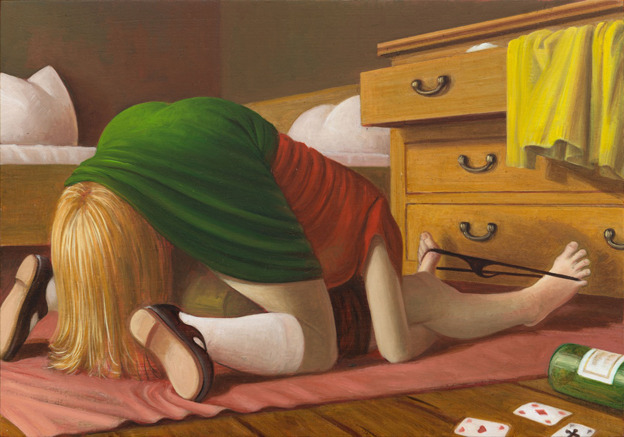
Falk Gernegross – Herz, Karo, Kreuz (2013)
I am not a painter. But of the dozen or so painters with whom I am acquainted, three are die hard adherents of mischetechnik.
I don’t claim to completely get the process but my understanding is that you construct a painting in layers. There’s an initial layer of underpainting that accentuates the shading. From their color is layered onto the image in a fashion so that light refracting off the layers creates the sort of randomization of color sheen that we expect of the world around us. (In other words: even a simple red isn’t really just one color–it consists of a range of so similar as to be nearly indistinguishable reds.)
You could probably tell from the fact that a notable percentage of the painters I know use the process, it’s very hip right now. And although I typically don’t care for the stuff people are employing it to paint–especially given that one of my all-time favorite paintings used the mischetechnik and very little that’s made subsequently improves upon Van Eyck’s Arnolfini Wedding Party.
Gernegross is not especially subtle or nuanced. He’s clearly obsessed with the mixed bag of joy and anxiety that accompanies adolescent sexual experimentation. But whereas other artist’s own this preoccupation, he presents adult looking surrogates in situations that are clearly intended to convey a post-pubescent reality.
I’m not entirely sure this works as a subliminatory strategy. I mean the defined bust of the girl in the red blouse and green skirt aside, this is clearly supposed to be two twelve year-old girls who were playing cards after school while sloshing wine nipped from the family liquor supply. They drink too much and things grow lusty.
Really, it’s probably the affronting style of the rest of his work that made him decide to build in a method of escape should he face criticism for the depiction, but honestly, save for the manner in which the girl on the bottom’s thong is positioned around her feet, there’s a matter-of-factness that’s worthy of Balthus–even if Balthus would’ve almost certainly rendered something more graphic than Gernegross’ explicit implications. But then Balthus’ was more interested in the ambiguity his work instilled in his audience than in ambiguity as a safety net against critical backlash.

Barbara Nitke – Bathroom Kiss from Kiss of Fire series (1995)
I have mixed feelings about Nitke.
Besides her stated aim of “find[ing] the humanity in marginal sex,” her work all features a clinically dispassionate eye.
This allows the viewer to bear witness to an awkwardly tender moment such as above. Her presentation of action as jarring, motion blur and off-kilter compositions have become endemic in the work of image makers interested in both fine art and BDSM documentation (I’m thinking here specifically of Aeric Meredith-Goujon and his ilk.)
What irks me is the insistence upon conceptual layering for the pornographic to receive art world credibility. It’s almost like for something to be deemed Capital-A Art, the pornographic has to be somehow mediated and/or commented upon by the work.
Let me give you an example: I’m beginning to consider (with some level of seriousness) pursuing a PhD in Art History. What I am interested in is studying the dichotomy between Art and Porn throughout history and then insofar as it can be reconciled suggest transgressive art as an art historical current seeking to point toward a synthesis between these two allegedly opposite poles.
Invariably when I’m talking to academics–trying to sort potential recommendations, seeking advice w/r/t receptive/non-prudish programs–invariably people ask me why I’m so interested in Jeff Koons or throw Noam Chomsky at me.
I detest Koons. And my favorite incident in Miriam Elia’s indispensible We Go To The Gallery relates to Koons–it’s the perfect take down of his vacuous work but it also serves as a damning critique of why the ‘art world’ tolerated his’ short-lived foray into porn with his Italian porn star partner.
(As far as Chomsky goes, I’m not even going to address it because people far more eloquent than I’ll ever be have already pointed out how it’s bullshit to code switch from critiquing capitalism to a feminist perspective without acknowledging the overarching shift in context. Chomsky’s is allowed to find porn distasteful; he’s not allowed to use his status as a notable (white, cishet male) Academic to attribute unassailable factual status to his own poorly considered concern fapping.)
I guess my point is simply: the subject of Art is inherently relateable to the human experience. Sexuality (or asexuality) is a facet of the human experience. Therefore it is well within the purview of Art to consider it.
I object to the pretense of bending the work into conceptual pretzel shapes to earn a distinct of being meritorious. I want more de Sades, Bellmers and Batailles; fewer Gaspar Noés.



Hans Bellmer – Study for Georges Bataille’s L’Histoire de l’oeil (1946)
Bellmer is one of a handful of artists that I don’t really know how to talk about.
I know more people are put off by his sadistic bent and his obsessed penchant for depicting sexualized pubescent female bodies.
I’ll never argue that the vast majority of his work isn’t pornography and I think that to the extent that it includes children, such work is actually unconscionably irresponsible.
The trouble is that the work is of an unusually high quality. Much of it has–rightly, in my mind–earned the distinction of Capital-A Art.
So the question is: does being of an exceptionally high quality give the work a pass when it comes to elements that toe over the line in terms of child pornography?
My background is academic. But–if I may confess something: I’m not a good academic. I have no patience for genuflecting at that Freudian shrine. Yes, the man suggested and subsequently implemented a ‘functional’ framework for quasi-scientific analysis. But the framework was gallingly sexist, heteronormative and largely misguided.
The criticism on Bellmer bends itself into pretzel shapes similar to several of his Dolls, trying to use Freudian notions or Sue Taylor’s ‘feminist’ defense of the artist or Catherine Grant’s Bellmer as ‘queer doubler’ tact.
I can abide pieces of each attempt to justify Bellmer but I can’t really follow them down the garden path to their various conclusions. It’s too much heavy lifting for something that in my mind doesn’t require it.
To my way of seeing, history is Bellmer’s justification. Think of that Picasso quip made when his portrait of Gertrude Stein was criticized because she did not look like her image: she will.
Bellmer’s rage against fascism and the cult of the perfect body do not read as if they’ve dated in 70 years. They very much fit in with the Tumblr erotica vein and with the current emergence of this sort of misplaced hipster nostalgia, these images could have been made a month or two ago. (Note: they’d still stand head and shoulders above similar modern images.)
Ultimately, what I appreciate about Bellmer is that–like Balthus–the mission of his work was to disturb. However, unlike Balthus–who one has the feeling was almost always the smartest person in any room her entered–Bellmer was open and in your face about the considerations underlying the work, while Balthus strenuously avoided any attempt to fuel equivocations about his motivations.
I find it curious that critics are so willing to give Balthus a pass but grin and rub their hands together when it comes to crucifying Bellmer. Yes, Balthus’ work is arguably of greater quality. But there’s something tempestuous, resonant and grotesquely messy to Bellmer. It’s as if Balthus sought to prompt people to ask better questions so that they might receive better answers; while Bellmer was more interested in leading folks to nothing more than being happy with better questions in the face of a world which is incapable of providing anything like what we think of when we think of an answer.

Source unknown – Title Unknown (201X)
One of the things I appreciate about Tumblr is that in the process of seeking out things I like I encounter a lot of stuff I would otherwise never in a million years seek out.
For example, I have less than zero interest in anime/hentai. Yet, I saw this while scrolling down my dash and I like it quite a bit.
I think what draws me to this is the way that it’s explicit but not especially graphic. In the context of the sort of anything goes excess for the sake of excess world of hentai, restraining the typical insanely graphic depictions of sexual behavior somehow–for me at least–conveys a stronger sense of intimacy.

Édouard Chimot – Untitled (1930)
This is clearly a sketch. By that I mean the figures are posed for the artist to render them. Yet here, how they are rendered is interesting. The presumable draped dais upon which they are standing is rendered in the drawing in sculptural fashion–the base requiring strategic load bearing functionality to support the figures rising from it. (It bears mentioning that the shading to suggest depth is masterful and I love the simple line and asymmetrical form of the standing woman’s breasts–an incisive application of the classical contrapposto posture to a female figure.)
And although the poses are hardly exact matches, the tone does remind me very much of Gustav Vigeland’s Kneeling Man Embracing a Standing Woman.
Also, I really like the cartoon face in the margin that appears like what I’d imagine the main character would be in a Jean Vigo directed anime.

Andrew V. Pashis – Red Clover Meadow (2008)
This isn’t a good photo–the composition is more concerned with getting the shot than rendering the scene in a clear and legible fashion.
Plus, I’m really not a fan of simulation, fakery or pretense in depictions of sexuality.
However, neither trait prevents me from outright adoring this image and it’s audacity certainly helps with that. The sort of devil may care presentation reminds me that some of the best sex I’ve ever had has featured a comparable setting–i.e. a place that is exceedingly public yet simultaneously secluded enough to render the chance of getting caught with pants down or dress up is not absent but small enough to justify the risk.
The rest of Pashis’ work is significantly more thoughtful than the above. It’s possible to see the broad strokes of the visual it-factor that marks most if not all Eastern European and Russian work so that you can spot it forty yards out. The feeling that nudity although culturally mired to a degree with sexuality is more a by product of the intensity of surviving the harsh winters. A matter-of-factness about the mad desire to soak up sun with as much skin as possible during the white heat of summer.
But whereas someone like Mukhin seems charged with a certain higher octane vitality when his work witnesses the more transgressive features of Russian youth culture or someone Evgeny Mokhorev’s likely inappropriately edgy fixation on young bodies as the locus of a darker yet also truer sexual freedom, Pashis is more openly voyeuristic, classically inspired, contrived and at times unapologetically aggressive in his presentation.
Although mad props are in order for his transformation of one of Ryan McGinley’s worst images into something fantastically crackling with the unfettered potential of being young, free and if not immune to consequence then aware that there’s no bending heaven so you might as well raise some hell.

Zanele Muholi – Terra Dick and her girlfriend (2012)
Things to know about Muholi:

Source unknown – Title Unknown (201X)
This is pretty much exactly what I picture whenever someone is talking about how sexually permissive San Francisco is.
Le sigh.

Source unknown – Title unknown (201X)
In general, I dislike close-ups. Yes, the can serve a purpose but sadly we’ve all but lost the work ethic and attention to detail/nuance/context in contemporary image making.
Close-ups in porn tend to be even worse–the reduction of physical intimacy to acontextual intersections of genitalia.
There’s something different about this, however. Yes, it’s #skinnyframebullshit–no, the framing is not logically coextensive with the notion of leaving some things to inference. But, between the way the flush in her cheeks shifts her skin tone toward the shade of her lips, the way her mascara-ed lashes highlight her fixation on the way she is experiencing sans boundary the body of another being is fascinating.
To me there’s a palpable sense of awe in a moment of unrestrained fulfillment of experiential curiosity. This resonates on a primal level with my first experience of sexually exploring a lover–and that’s something that’s super rare for me to encounter in porn; thus, when I do see it, I make a point of celebrating it.
This is lovely and hot as fuck. And if it fails as art, there is something intrinsic to it that has the potential to become the subject of artistic expression.
 Acetylene Eyes