





Erika LustI Wish I Was A Lesbian (2014)

In theory, Erika Lust’s approach to making pornography–outlined in her oft referenced TEDxVienna speech–appeals to me: an emphasis on context (characters are more than the performance of their respective sexualities) and diversity of modes of sexual expression are all v. on-point.

And it’s totally counter-productive but… the traditional trappings of porn are low-production values, improbably scenarios and exaggerated sexual performances. Thus, when you preempt the traditional with a more thoughtful diversion into the who, where and why instead of rushing into the what and how, you raise audience expectations with regard to ultimate quality whether you intend to or not.

That’s the great failing of Lust’s promise: by setting out to make better porn she sets her sights too low. She’d do better to expend her efforts trying to make art that just so happens to be pornographic.

Which is not to say that the above scene is without certain moments. Placing equal emphasis on graphic depictions of sexual expression and the physical response to those depictions is unquestionably inspired. However, those moments are ultimately diminished when they are spliced together in such a rough-shod, pretentious fashion.

And it’s entirely possible that I am putting too much emphasis on the fact that this scene was shot handheld. The current preponderance of handheld camera work in motion pictures is an enormous pet peeve of mine since with the exception of Lars von Trier (who is preoccupied with using a subjective cinema-verite approach in combination with editing to stylize ellipses of perception by a fly-on-the-wall observer) or the Dardenne Brothers (who have pushed subjective handheld cinematography to something perhaps not objective–framing necessarily precluding questions of inclusion/exclusion–but unblinking and entirely unselfconscious), there is a total obliviousness to the history and functionality of handheld camera work.

Granted, I haven’t seen the full scene but the excerpted clips suggest that the handheld nature of the shots is intrusive–it is supposed to be noticed. The audience exercises some sense of active voyeurism, a passive co-authorship. And while, yes, this arrangement allows for scenes like the young woman’s face in the third frame from the top and the lubing up of the strap-on in the sixth frame from the top, my response is that any narrative motion picture instructs the viewer how it is supposed to be seen in the first third of the first act. The expectations that this film establishes are cribbed from art-house/international cinema but it can’t follow through in execution once it arrives at the place where it’s always intended to be.

Paula AparicioUntitled (2014)

If there is a single, salient aspect to Aparicio’s work it’s likely the way her photos exude a feeling of post-coital tension between “the waning of ecstatic satiation and the waxing hunger of wanting more.

This tendency is well suited to her style; but, it’s especially noticeable in the way she photographs women.

I’ve lobbed a couple of shots over the bow of the Good Ship Female Gaze previously–namely with regard to Masha Demianova’s claim her work cultivates an equal and opposite response to Berger’s seminal male gaze as presented in Ways of Seeing.

And although I am doubtful, Aparicio would ever invoke the term female gaze to explain her own work, it would almost certainly be more functional applied to her work than anywhere else I’ve witnesses its deployment.

Upon what grounds to a base such an assertion? I am (unfortunately and much to my eternal chagrin) male bodied; therefore what the fuck can I possibly know about a female gaze?

Well, if there is such a thing as the female gaze–unlike the historical male gaze–it’s almost certainly the opposite of monolithic.

I know that growing up seen by others as ostensibly masculine, my experience of attraction, gender identity and sexual desire almost never lined up with my peers.

And I do realize it’s a dangerous assumption to take the braggadocio of hormonal male children as fact based, but I do know that while far ahead of puberty I shared an almost clinical fascination with sexual intercourse and that this fascination was age appropriate within my peer group, it remained a complete abstraction.

Let me try to unpack that a bit more–I feel a very profound need to articulate this correctly. We’d talked about sex, spent hours imagining the mechanics of it and my friends all tended to extend that imagining by connecting it to their sexual response. There was no separation in the expression of attraction and their sexual desire.

What I thought was attraction was actually a need to be understood. The people who listened to me, supported me and shared glimpses of their inner lives were always the people to whom I found myself drawn.

I remember the first time I ever experienced an attraction that linked up with my sexual desire. It was ninth grade. Her name was Michelle. She was my best friend and she’d had a growth spurt over the summer between junior high and high school. She didn’t really notice and I think her family was struggling to make ends meet with private school tuition, so she kept wearing the same clothes she had the previous year. Her favorite pair of pants were these white khakis. They’d been a bit on the tight side the previous year but now they might as well have been skin tight.

I remember walking behind her to class and noticing the visible lines caused by her underwear. I looked away, immediately. Partly because, I felt like I was violating her privacy but also because I found myself stunningly aroused. But my thoughts didn’t proceed from there to a litany of sexual things I’d like to enact with her. Instead, it orbited the notion of wandering if she felt toward me the way I felt towards her in that moment. The thought that there might be a possibility she did was the fantasy I brought myself to orgasm with again and again throughout high school. (Spoiler alert: she didn’t.)

I am hardly so daft as to suggest that what makes me think the notion of a female gaze applies to Aparicio’s work is because I experienced attraction in an unusual fashion. It’s more that the memory of the feeling resonates very strongly with something in her images.

Chih-Han HsuIMG_4363 (2009)

I know it the young woman in the fuchsia dress is almost certainly wearing some adorable undies beneath her dress and her genitals are not especially near her friends mouth.

Regardless, I would do almost anything to switch places with the young woman in the white dress.

From the standpoint of image integrity, I am not at all fond of the way her legs are cut off by the bottom frame edge. And despite the the careful balancing the inside of retaining wall with the vertical sidewalk seam, there is no reason whatsoever for #skinnyframebullshit.

The reason this image works are the supremely digable little detail flourishes: dark nail polish against the greywhite concrete, the ring on the girl in the fuchsia dress’ left middle finger that draws attention to her left knees delectable skin tone and how she is kneeling on the other woman’s hair.

I am not sure the funereal hands crossed over her chest is the most convincing pose. Her hands could be any number of places, doing any number of things depending on the degree of comfortability of the two models with each other.

But really the image works mainly because of the ambiguously coy Mona Lisa smile which could just as easily be read as look at this transgressive thing I am allowing myself to be seen doing or this is the first time I’ve let another girl taste me and it feels so much better than I had ever imagined it could.

amorsexus:

interchange

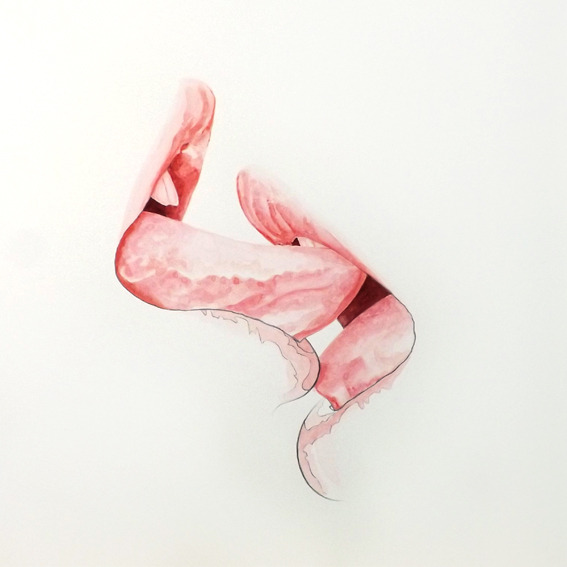
Work by Oscar Delmar (Watercolor and graphite)

Onomatopoeic words tend to grate on my ears even if I am intrigued by the concept of a word’s sound being its meaning.

Similarly synesthesia fascinated me; although, again, I am less interested in someones seeing the number one as blue than in the fact such an associative experience happens.

These and other word-concepts like them make me wish there were a term indicating a unity between medium and message. It would prove a helpful too for talking about images like this where the medium and the process involved in creating the final image bestows great authenticity to the truth of the message–  watercolor, the wet and mess of lips, tongues and teeth & the surreal impression of immediacy, color and texture upon execution that is rendered when the colors dry, respectively.

This post is guest curated by azura09:

Although you can find a video of a pretty girl with a strap-on almost anywhere, it’s rarer to see an an exhibitionist/voyeur scene where all the participants are female. In spite of my issues with the beauty ideals on display here, I’m attracted to this .gif because I have a good idea where I would fit into this scenario. And it’s not always a place I’ve felt comfortable occupying. 

I remember not having better words than “I’d like to be be beaten up a little” to describe the need to come out of sex slightly worse for wear. Even at the time, I knew this was straightforward desire, not a confession that I wanted to be splayed out and at someone’s mercy on a regular basis.
 
But what I didn’t know was that declaring these desires was a step toward feeling comfortable shaping someone else’s. And this .gif appeals to me because, while I’m not much of an exhibitionist, I wouldn’t mind showing my partner off in a scene like this, pushing them down on a hard surface while acquaintances in party dresses watched from a distance I negotiated beforehand.

passius:

I have reservations about this image: it can’t seem to make up its mind whether it’s entirely preoccupied with titillation or intimacy.

For example, the blocking emphasizes the clean-shaven vulva and anus for the benefit of the male gaze. Not to mention the #skinnyframebullshit—probably enacted to counteract heavy handed illumination as well as suggesting a moment outside space and time. (As visual shorthand, I’ve never felt such a tact work especially well; with maybe the exception of the seamless flashback scenes in The Frighteners—which if not exactly sensible were at least a novel technical exercise.)

However, there are at least two things I appreciate: the stripped down, stepped out of mound of clothing on the floor and the intensity of the intimacy between the two women. The clothing clearly speaks to what happened prior to the moment this single image was captured; it understands seduction as a process, not a single, discrete and isolated event. The chemistry and raw passion these women exude is thoroughly authentic and awesome to see. And in combination with the glimpse the discarded clothing offers of what preceded, this intimacy foretells a great deal of what will happen next.

In other words, there are clear elements of a story; or, put crudely: an incident with a beginning, middle and an end. After all, seductions are essentially narrative.

And if a picture truly is worth a thousand words, then why shouldn’t image makers tell a story, make a poem or preferably both all at once?