Gustav VigelandKneeling Man Embracing a Standing Woman (1908)

When it comes to sculpture, there’s a steep drop off in my familiarity compared with cinema, painting or photography. I can differentiate between Michelangelo, Bernini & Rodin but that’s about it.

As someone who reads oodles and oodles of Scandinavian crime fiction, I am familiar with the connection between Vigeland and Oslo’s Frogner Park. I’d never (embarrassingly) bothered to look into his work because I am (shamefully) lazy and laziness in combination with depression facilitates a both comfortable and cloyingly complacent apathy.

I’m not exactly enraptured by his work, but this is just fucking devastating.

With the female bodied figure standing over the supplicant male bodied figure, the discrepancy in respective elevation feels like a subversion of the Pietà motif.

Also, there’s an interesting ambiguity w/r/t whether or not the embrace includes a sexual component. Both figures are nude and the male-bodied figure seems to need out of some profound feeling of loss. Whereas, the female bodied figure might be attempting to push his head further from her genitals, closer to them or merely adopting a posture exactly halfway  between bodily acceptance and rejection.

It’s a completely atypical presentation of gender and I adore it for that and the craft is beyond on point–the detail in her braid, his face and texture.

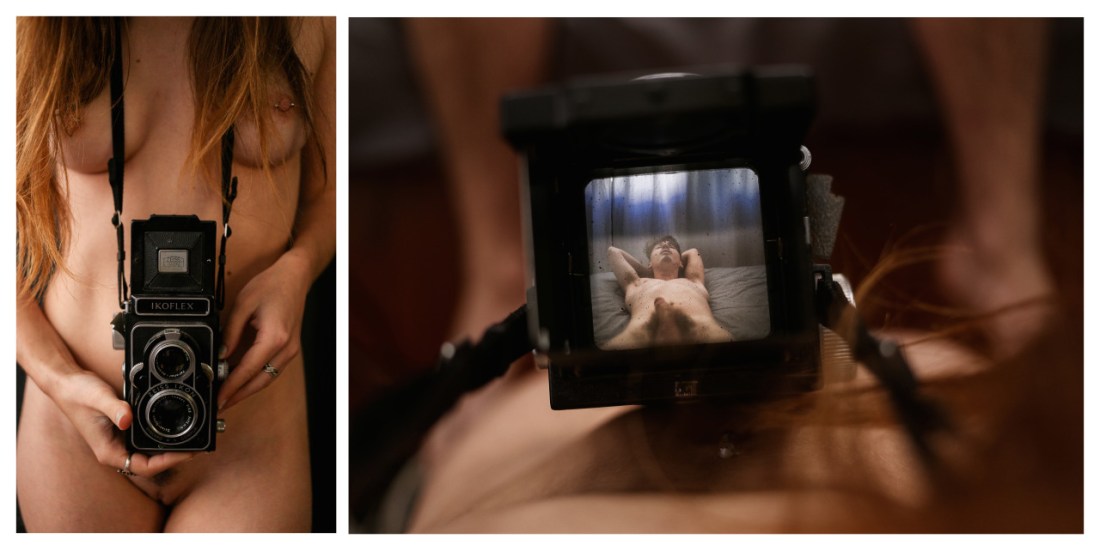
A & N – Nympho Ninjas Submission (2014)

Diptych ought to be read seamlessly.

The trouble–which in the end isn’t really trouble at all since it allows a far more benevolent interpretation–is that I initially see these images discontinuously.

There’s the obvious discrepancy in visual langague. The first frame being one of the most infuriatingly egregious examples of #skinnyframebullshit I’ve posted.

Plus, it is oblivious to the politics of frame edge dismemberment. (To anticipate the counterargument: preserving anonymity is a downright lazy justification. There are literally a thousand ways to obscure identifying features that don’t require decapitation. Yes, it just takes a bit more effort on the part of the image maker…

Pairing the first image with the second presents an interesting dichotomy. (It maybe even alleviates the tiniest fraction of the goddamn piss poor decision to opt for portrait orientation in the first image since it allows both images to fit together more intimately within the viewer’s visual field.)

The second image is very nearly perfect. Yes, I have a bias to frame-within-frames and viewfinder peaks but although the second image is great on its own, I think the interplay between it and the previous image are fascinating.

This interplay–as I read it–is a studied subversion of the male gaze.

The leftmost image presents a sample of said gaze; the right explicitly presents the viewer with a female POV.

All sorts of tangents and rabbit trails emerge. But what’s most important is to note that the male gaze is in-built, assumed. It sees the female bodied subject regardless of whether or not she sees–here she literally cannot see as she has no eyes.

Because the initial image informs the following image the female gaze sees but it is seen in its seeing.

(Whether intended or not, the fact that the male bodied subject does not acknowledge the camera is a sophisticated bit of conceptual reflexivity.)

The first frame contextualizes the second. Were one to draw a parallel with art historical tradition and subsequent influence in practice, one would go straight to the head of the class.

In the context of the first frame, the second frame’s richness diminishes the first; underscoring the glaring impoverishment–not to mention bias–of the male gaze..

This is as thoroughly subversive. And it occurs to me that unlike most -isms that take on definition by prioritizing this above that; feminism is a rare ideology wherein the criticism is also a performance of a suggested solution. The act of saying: voice like mine have been silence for centuries, what I have to say is as important as any thing anyone else has to say: therefore I will speak.

Source: Unknown

Um… so, uh… yeah: LOVE THIS. For you know, reasons and stuff.

At the same time: I hate it, omfg sooo much.

For once my objections have fuck all to do with curmudgeonly hyper-criticality. I object because I am devastated.

I have been trying and failing to make a self-portrait that is alarmingly similar to this; really, this and my idea two might as well be fraternally twinned.

But to top a sundae of injury with rainbow sprinkles of insult: this is just flat-out so, SO much better than any of my fumbled false starts and artless misfires.

And although I have no intention of giving up–I’m exactly the sort of fool for whom the prospect of defying impossibility actually serves as compelling motivation.

Of course, motivation alone doesn’t address the fact that I am not getting any younger and I will never be ripped with six-pack abs.

But my phenomenal lack of physical attraction isn’t even the most profound hurdle. This was almost certainly taken by another person. I only have and will likely only ever have–sadly: recourse to the self-timer.

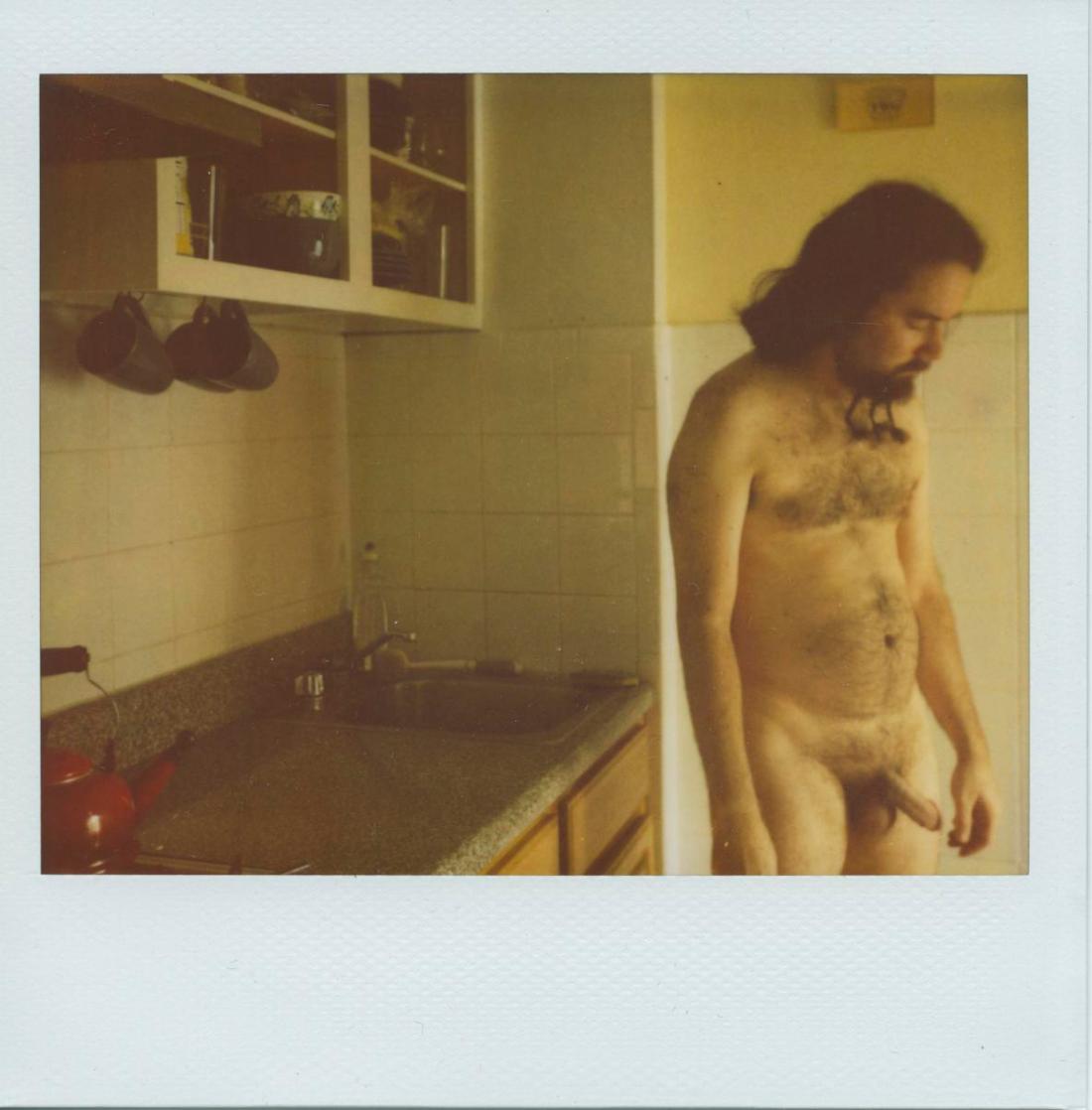
Mathilda EberhardUntitled (2012)

This is the fourth time I’ve featured Eberhard’s images.

I can’t lie: I am really rather fond of her work. Not all of it is good but there’s never any question as its veracity.

Mathilda Eberhard is always going to show a raw slice of her truth.

I feel as if this manifests in her work in a atypical and anti-photographic way. I am not at all sure how to say it without resorting to nebulous abstractions, so I’ll draw a metaphor: it’s as if image making is not unlike sewing. The thread pierces the fabric passes under it before piercing the fabric again to reappear. The tradition of image making emphasizes the importance of tracing the thread along the surface; and as an image maker you want to offer as vivid a glimpse of the thread as possible. It’s like Eberhard flips over the seam and then focuses on the absence of the thread–an inverted experience of negative time, a focus on the indecisive moment instead of the decisive one.

Personally, I am all about the leaning in brought by narrative tension–I want to know the story. There is no way to extrapolate any sort of story beyond something archetypally human–and therefore seemingly quotidian, mundane.

The thing is: I find myself investing far more into her work than I do with the majority of ‘narrative’ imagery. Perhaps, I have–in my own work–been looking for something in decisive moments that belongs only to the indecisive ones.

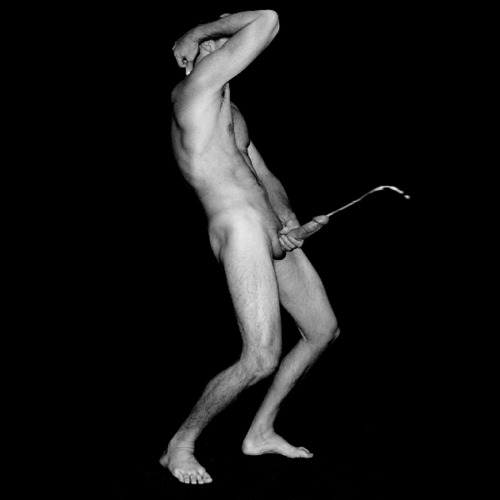
Jan SaudekThe Dancer (2001)

Consider:

  • the staggering tonal range and varied texture in the concrete backdrop,
  • the painstakingly graded skin tone (for me invoking little as much as the incisive crosshatching in Dürer’s etchings),
  • the obvious resemblance to Michelangelo’s David,
  • the subject is presented slightly off-center, cheated toward the source of light at frame left and formally balancing every aspect of the composition.

There’s no denying Saudek’s mastery; sadly, I find my frustration with his proclivity for shooting the same/image images in perpetuity an insurmountable obstacle to engaging with his work.

I absolutely see inspired flashes of anti-authoritarian glee, subversion and rebellion amidst the cloying repetition–all attitudes that resonate strongly with me. Ultimately, the work either commands my eye or it doesn’t.

This is one is just motherfucking goddamn incredible.

Source: Unknown

While I object to the sepia tinge, strobe vignetting and canted frame, the pervert in my is intrigued by this image.

I have certain reservations about imagery depicting threesomes; therefore, I appreciate how the above eschews the typically stultifying heteronormative script.

I read something about fluid sexual orientation. Namely, I don’t stop to ask is that boy gay or bi. (Although I admit that with the way his head is being forced into the woman’s pubis, I could understand that reading.)

Does it really matter? Everyone here is clearly enthusiastically engaged/invested in the proceedings.

‘Straight’, ‘gay’, ‘bisexual’ and ‘genderqueer’ are words, labels. Increasingly, treated as if it were a discrete street addresses: 123 Main Street, Podunkville, ID.

I don’t think it’s that simple. At best, ‘bisexual’ is comparable to one New Yorker telling another she lives in Brooklyn–as opposed to Manhattan, Queens or the Bronx. (As far as I’m concerned there are only four boroughs.)

Saying I am a bisexual woman who prefers women to men is analogous to mentioning that she lives off the Lorimer L stop.

If she really trusts the person with whom she is talking, she might say: I’m on Ainslie between Leonard and Manhattan.

Even that falls short. Each of us manifests a singular sexual persona; labels are broad, vague and ambiguous, they will always fail to summarize the intricacies of our desires. Words merely facilitate communication by nudge us toward a better heading, towards the truth.

Source: Unknown

This is not an objectively ‘good’ image. Overexposure leaches color from an already truncated palate; while the framing–presumably orchestrated to preserve anonymity is painfully awkward. (Scooting the camera back as little as two inches and squaring the level would have done wonders.)

Still to my eye there is something magical here–although I am not entirely sure how to explain my meaning.

It seems–in my head, at least–more of a still from an amateur sex tape than a discrete image; I keep imagining how things will proceed from here.

Not knowing the source, it seems inappropriate to project my own sexual predilections onto an image that has fuck all to do with me, instead of reading and interpreting things at face value.

Here’s somethings things that grab my attention:

  • Both are smiling in playfully curious/knowingly smirking way,
  • He is laid out, open and on display while she is more curled into herself,
  • His pubic hair is carefully trimmed,
  • Her red lacquered nails draw attention to the slightest bit of motion blur, suggesting teasing strokes,
  • Her hair is a mess, having what could be a either bed head or post-coital, shower wet hair that has dried unevenly over the course or further lovemaking sessions,
  • And, she’s wearing what may well be a wedding ring.

All of it taken together suggests to me the crucial distinction between the taking of pleasure and the receipt of it. One is a central tenet, the prerogative of patriarchy; the other: demands a willingness to surrender, to become vulnerable, to let go and in letting go, letting another.