
Asher Moss – Untitled (2013)


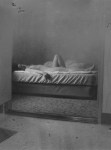
Daisuke Yokota – Untitled from Taratine series (2015)
I can’t look at Yokota’s work without thinking about disintegration.
His work emphasizes imagery keen on eschewing concrete visual representation and instead offering something teetering on the brink of abstraction. The effect might best be described as a strobe used with infrared film shot in near complete darkness and the film subsequently pushed, over-developed or otherwise mangled post exposure. There’s frequently a fixation with grain enlarged to the size of golf balls, the space between grain as a sort of craquelure; fixer streaks mar the film, dust and hair become randomized, scintillating scotoma-esque focal points and the occasional hint of color reads somewhere between an opalescent oil smear on rainwet asphalt and B&W negs left to sit overnight in spent blix.
I’ll grant the use of color is masterful. But for the most part methinks the work doth seethe too much. It’s too bleak to be so entirely ambiguous about whether what it’s presenting is beautiful, a nightmare or a bit of both. (I’d wager that Yokota is probably very into Brakhage.)
That’s why the Taratine series appeals to me–unlike the rest of the work which seems clinical and detached. There’s a sense of relationship and involvement, something from which the rest of the work suffers from the abject lack of.
I object to a lot of the compositional decisions undertaken but there is something compelling about the poses in the above images. Except for the miasmatic haze hovering above the figure on the bed, the image on the right might very well be a lost Callahan of his beloved Eleanor. It’s all more painterly than that and I can’t help but think of someone like Titian or Goya.
Yet, what’s most fascinating is the image on the left. The pose is stunningly dynamic–but the visual dynamism of it is actually played away from the camera but in a way where it isn’t lost in the image.
It reminds me of Romanian auteur Cristian Mungiu’s post screening comments at the US premiere of Beyond the Hills. He spoke about working exclusively with long uninterrupted takes and how frequently at least one of the two phenomenally talented actresses wound up with their back to the camera. How does a performer convey emotion when at least half of their facilities for expressing that emotion are obscured? We in the modern world have a desire to see everything in an immediate, unmediated fashion; this urge is actually to our detriment as frequently what we don’t see is more compelling than what we do see and how an awareness of this notion permeated much of the blocking in the film.
If I had the opportunity to ask one question of Yokota, it would be: to what extent are you consciously aware of trying to formulate a new language of photographic representation of the human body exclusive to lens based visual culture?
It may not be at the forefront of his practice but it’s something that would very much be in keeping thematically with his work up to this point. Further, I think it’s actually an entirely crucial endeavor.
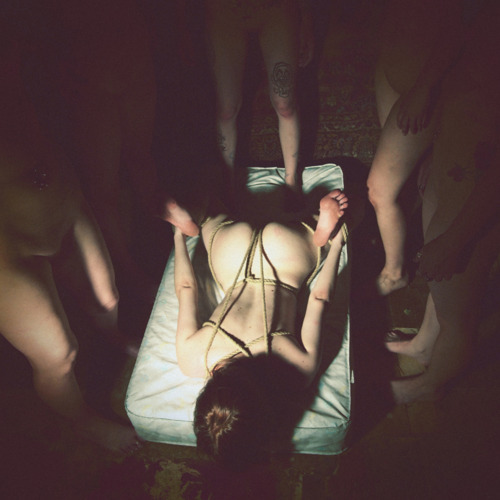
Source: The first instance of this image seems to have been posted by Chelsea Lee. Another image from the same shoot, suggests it’s Ms. Lee with her wrists bound to her ankles here.
Right off, the murky exposure in concert with the positioning of the five women standing around Ms. Lee’s prone body vignette the frame in a way more than a little reminiscent of the Polaroids hidden away in a burnt out abandoned house littered with pornography a showed me back in back in junior high.
It reminds me of this image, too.
I could reiterate points made previously; however, looking at this I am realizing something about my relationship with BDSM imagery: when such imagery is divorced–as this is–from perform the expected heteronormative gender roles (male=dominant; female=submissive), I am rather fond of it.
In my experience, there is a vitality to being completely at the mercy of another. Yes, I prefer such experiences sans restraints. Yet, there is something about rope as a symbol enabling something of trust and surrender to be brought to bear on exchanges that might otherwise remain ambiguous.

You know that saying about how a friend will bail you out of jail at 2am while a true friend will be sitting next to you in the cell saying: damn, that was fun.
I think it’s a wise aphorism but I guess I reckon friendship differently than most people.
To me a friend is someone who would ask to tie me up in this fashion and I would without a second thought consent
A true friend would just tie me up and proceed to push me outside my comfort zone and so thorough transgress the bullshit notion of boundaries that I would only be able to whisper Meister Eckhart’s prayer: thank you, thank you, thank you.
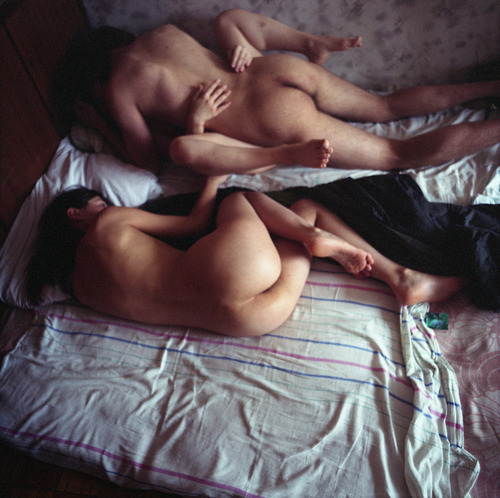
I spend a lot of time preoccupied with notions of community—how to foster, improve and sustain them.
I was raised in an insular, religious cultish community. It was neither the best nor the worst situation; it was just another thing that happened to me.
Somehow, I managed to survive it.
It’s now just shy of two decades since I cut ties with that life. It has been for the best, without question.
But I would be lying if I denied frequently feeling rootless—a tumbleweed tossed wherever the fuck the wind blows.
It’s not the group sex that gets me—although I am not opposed to that by any means; it’s witnessing the shame and stigma my former community directed toward any expression of sexuality transmuted into a sublime collective experience.
 Acetylene Eyes
