
Christophe Pok – Untitled (2016)
Remember,
the entrance door
to the sanctuary
is inside you.
—Rumi (via blackshivers)
Christophe Pok – Untitled (2016)
Remember,
the entrance door
to the sanctuary
is inside you.
—Rumi (via blackshivers)
Source unknown – Title unknown (201X)
There were girls who would tear you apart with their lips.
–F. Scott Fitzgerald
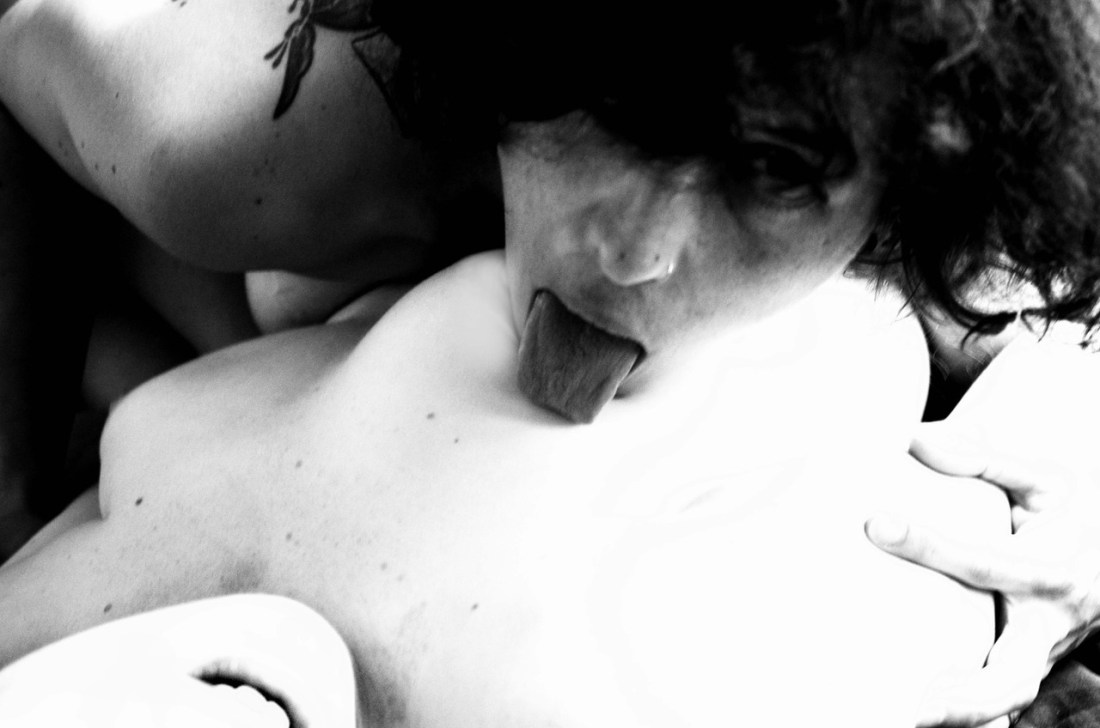
deluckas13 – Untitled (2018)
There’s this delightful sense of yin and yang balance to this image.
Imagine there’s a diagonal line dividing the frame from the lower left to upper right; note: how with the exception of the highlight on the shoulder & back of the arm in the upper left corner, almost everything in the upper portion of the frame is composed of shadow to midtones (with heavy preference given to shadow areas); in the lower part of the frame it’s the inverse mostly highlight but hints of mid-tones, too.
I also really dig how the area of shadow at the left of the frame suggests a right pointing triangle–which strengthens the urge for the viewer’s gaze to move from left to right across the image. This in turn conveys a sense of the extended tongue slowly advancing over highlight-blown, pale skin.
There’s a second triangle formed between the slightly parted lips, tongue and shoulder grasping hand at frame right–which forms a roughly up pointing triangle. (This is part of why the image reads as if the tongue is being dragged upward and not downward.)
It’s nice how the image begins with the darkness of the underlit separation between bodies; whereas, the grasping hand at the right seems to merge two bodies into something singular and inseparable.
Plus, it’s really great how this is technically ‘gram safe–attending to the letter of the law while flipping both middle fingers in the direction of the the spirit of that law.
Most impressive, however, is the rare care both in underscoring the voyeurism inherent in the image as well as telegraphing that you are welcome to watch but this isn’t for the viewer or about the viewer so much as the viewer is just being allowed to see something and they should be grateful for the glimpse.

Megan Cullen – Untitled (2016)
I am the type of girl who sees something and pretty much immediately feels something about it. It’s a great skill for someone who is–ostensibly–an art commentator. (Honestly, it’s effing exhausting af in the here and now of day-to-day exigencies.)
Usually, I’m pretty good at pointing in the direction of why I feel the way I do about what I see. However, there are times when I know that I like something but I am not immediately able to convey any sense of the why of my feelings.
This is one such image.
The pace of keeping up with running this blog, on top of holding down a FT job and also trying to focus on my own various creative efforts–I am not always able to dig in long enough to suss out the whys.
Typically, I either append relevant quotes which expand, compound or complicate the photo/image in a way that feels like it points in the direction of what I feel but have no idea how to articulate. (Same with my #follow_the_thread and #juxtaposition tagged posts; #palette posts were originally similar but increasingly it’s just proven to be a much more clearheaded and coherent–therefore less abstract–way of “speaking” about color.)
Present, I am–after much weeping and gnashing of teeth–finally operating with a bit of a queue buffer. So I’ve had a little bit of time to sit with this image and work to untangle some of what appeals to me about it.
At first blush, I have mixed feelings about the composition. Either the camera or the bus is not level and the camera has not been especially reoriented to compensate. The mass of black in the upper left corner renders the frame top heavy and cumbersome.
However…
The immediacy of what’s depicted diminishes the impetus on getting a perfect frame in favor of baseline visual legibility requirements.
And I’m cheating a bit and putting the cart before the horse here. My initial reaction to this was bus (public), boob (’private’). (I am and will forever be a sucker for things that transgress on entrenched notions of what constitutes public and what constitutes private.)
The next thing I notice is that there’s two people in the frame. The anonymous young woman flashing people on the street (?) and another woman cracking the fuck up inside the bus–presumably aware of what’s happening. (The initial immediacy of the image expands by placing the image maker and by dint the viewer in a relationship of both see and seen, in a way which self-referentially indicts the voyeurism of seeing with an empathy of an awareness of the political and absurdist facets of being seen given discontinuous overlapping contexts.)
This immediate sends my brain scurrying to make connections with other examples of similar charged visual depictions. In this case, I immediate remembered oan-adn – The passenger (2015) and k.flight’s 2008 self-portrait titled in the back of the bus.
After a bit more contemplation I noticed that there’s what is without question the symbol for an eighth note on the side of the bus directly below the boob peeping through the open window. This adds a narrative implication to the image. (I think anyone who attended a quotidian American middle or high school has experiences of the abject tedium of being stuck with a bunch of classmates on an interminable bus ride. It’s not difficult to image that boredom inspiring the students to see if they can begin a process of brinksmanship where you do things in such a way as to be seen by your classmates but not noticed by chaperones. I am very taken with narrative potentiality–always.)
Really, though in this case I’m all about that eighth note, or as the British refer to it a quaver. Consider the definition of quaver:
verb (used without object)
verb (used with object)
noun
Quaver is actually the pitch perfect word-concept to accompany this image. And it pushes my brain even further because although it’s been years since I’ve studied music theory it strikes me that generally eighth notes are more a function of time signatures with an integer divisible by 3 in the numerator–as opposed to the more standard numerator divisible by 2.
When I was a child my mother referred to this as the difference between march time (2s in the numerator) and waltz time (3s in the numerator). She explained that all you had to do was pay attention to the way your body wanted to move with the music. If you want to march in a straight line it’s two based; if you want to turn in circles it’s three based.
This image is absolutely in waltz time.

Ethan James Green – Connor Wall for Arena Homme+ (2016)
Green started as a fashion model but he eventually moved from in front of the camera to behind it.
I can think of several others who have followed a similar trajectory: Ellen von Unwerth and Lina Scheynius, specifically. What’s interesting about those two names is that I actually mostly dig both their stuff–because I adopt a particularly dim view when it comes to self-proclaimed fashion photographers. (Looking at trash like Helmut Newton; also, even though Annie Liebovitz calls herself a portraitist, her practice is thoroughly rooted in practicum and I have a strident dislike for both her and her work.)
But I feel like folks who start as models and then transition to roles as photographers and image makers, I feel like they are more inclined to bring clearly negotiated and carefully realized considerations about the nature and purpose of photographs and images to bear in their work. (It’s kind of analogous to a contention I’ve had for years–namely: if you put a dancer, i.e. someone who learns choreography and performs piece focused on notions of contemporary movement, into a room with a digital image maker and introduce a the topic of interrogating conceptual art; the dancer will crush the image maker at a rate which would render the occasional triumph of the image maker as statistically inconsequential.)
What former models bring is not so much a more organic sense of pose and presentation–although that is definitely the case with Green’s image of Connor Wall. Mostly there’s this emphasis on the physicality of the body. The one hand on the splurtting hose the other down his boxer briefs is a clever visual pun. But really that’s set dressing.
The hose explains the wet skin. The frame is composed in such a way that the light grey of the skin of Wall’s upper body stands out in a pronounced fashion–as does the water emanating from the hose. (A sort of emphasis speaking to the constant inconstancy of physical form.)
I don’t think this is perfect. Wall’s eyes are too deeply set and the way they just sit there like slitted event horizons and the way the top and left side of his head have no separation between the background stand at odds with everything else. Still, I am far more interested in this in 99.2% of fashion photography.

Source unknown – Title unknown (201X)
I always think it’s hilarious when someone like Lars von Trier or Luc Besson are accused of sexual harassment or assault, respectively–and the news is treated as if there’s a real question as to whether the accusations are true. For example: I’ve seen the entire back catalog of both men and given that it’s not actually difficult for me to believe the accusers. (Same with Woody Allen, honestly; like have you ever suffered through one of his preposterous, narcissistic films?)
But there’s also the backlash against these moves toward something more like parity of justice. Reactionaries tend to say things like: so I guess I’ll have to quit being nice to my female co-workers or else I might wind up saddled with harassment chargers. I find that a disingenuous rejoinder–if you are making the remark then you’re both aware that you said something that made someone else uncomfortable and feel that it wasn’t the big deal the other person made it out to be; in other words: you know that you’re behavior can be seen as a problem but you think it’s incumbent upon others to cater to your comfort level even if it means ignoring their own.
The point I’m making and what it has to do with this image is that in the immediate aftermath of #MeToo there were a group of prominent models that wanted to ban photos or images where the photographer/image maker reaches into the frame to touch the model’s body. (The folks in this case were arguing for a de facto ban on such images.)
I was super onboard with the spirit of the law in this case. I mean work by Insuh Yoon and 9mouth are intensely problematic with a lot of the stuff they do.
The letter of the law? Yeah, I’m less on board with that. So much has to do with context and across the board prohibitions tend to be problematic.
I think if you frame things as a photographer or image maker should never touch a model. That’s probably a good rule. However, I can see situations where touching the model is agreed upon. I’m generally very much against touching models in any way shape or form but as I’ve become friends with models and have built a solid foundation with them, things get a little more porous. When I do touch a model it’s usually to brush aside a loose strand of hair or to change the angle/way they are holding something. I’d never be comfortable touching a model as in the above image whether or not my hand was also in the frame.
But that begs the question as to whether or not this is a model. Like if this is two lovers and making images is part of some sort of ritual foreplay, is it wrong for their to exist images like this.
As gross as the trope of photographers and image makers who use their steady stream of lovers as models in their work, I do think there’s likely situations where it’s appropriate for a photographer/image maker to document things in their lives.
I’ve noted before that the bottom frame edge in any photo or image has an intrinsic functionality as a sort of fourth wall. So I think it might be better to first ask whether or not the viewer of the photo/image is a witness or a voyeur? (One of the biggest problems with work that features the photographers hand jutting into the frame is when it equivocates on whether or not the photographer/image maker is seen as a surrogate for the viewer.
The hand here is absolutely a surrogate for the viewer. The composition is voyeuristc and less documentary… except: it’s more complicated than that.
The depth of field is such that both the foreground and background are blurred. (And effect I adore.) In the background, the woman’s face is just enough in focus to determine that her face has taken on blissed out expression but the blurring allows her a degree of anonymity and privacy.
It’s clear she’s reach back to either indicate her anus or most likely to insert a finger to begin to loosen her sphincter for anal penetration. In most cases when a disembodied hand enters the frame if the hand is meant to read as the photographer/image maker’s there’s usually an emphasis on the taboo nature of the touch. It’s a possessive squeeze of a buttock or the spreading of labia, in this case the hand is more about maintaining the explictness of what is being seen while rendering it less graphically illustrative. That taken together with the flash and the ostensible scene of presumably a prelude to coitus–there’s something surprisingly sophisticated about this.
But that’s the other thing: this is one girl’s interpretation. Others’ mileage will almost certainly vary. Which is I suppose my point: I’m not very much in favor of a total ban or total permission. I suspect it’s really more nuanced than that and that given the language and familiarity with social, political and historical context I think the average person can easily learn to identify what’s maybe not ideal but is at least less outstandingly creepy and inappropriate.

Eleonora Manca – [←] Inventario #659 (2016); [→] Inventario #665 (2016)
Great images have both a history and a prehistory; they are
always a blend of memory and legend, with the result that we never
experience an image directly. Indeed, every great image has an
unfathomable oneiric depth to which the personal past adds special
color. Consequently it is not until late in life that we really revere
an image, when we discover that its roots plunge well beyond the history
that is fixed in our memories. In the realm of absolute imagination, we
remain young late in life. But we must lose our earthly Paradise in
order to actually live in it, to experience it in the reality of its
images, in the absolute sublimation that transcends all passion. A poet
meditating upon the life of a great poet, that is Victor-Emile Michelet
meditating upon the life of Villiers de l’Isle-Adam, wrote: “Alas! we
have to grow old to conquer youth, to free it from its fetters and live
according to its original impulse.”
―
Gaston Bachelard, The Poetics of Space

Michael Philip Manheim – Floating Star from Aqua series (2003)
There is no top or bottom, no absolute
positioning in space. There are only positions that are relative to the others.
There is an incessant change in the relative positions throughout the universe and the observer is always at the centre.
–Giordano Bruno


[←] Miguel Villalobos – Logan (2009); [→] Dmitry Chapala – UQrJcn7XU08.jpg (201X)
Juxtaposition as commentary
EDIT- this post was originally to juxtapose Villalobos and Man Ray–specifically the latter’s 1923 photo of Bernice Abbot:
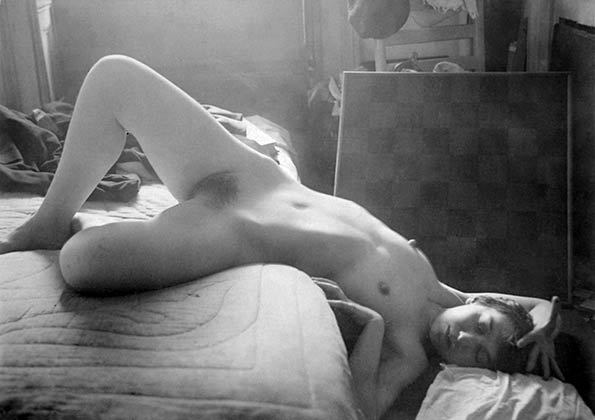

Lionel Prince – Untitled (2017)
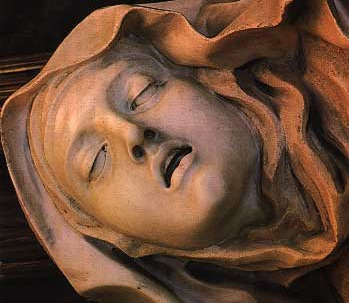
Back in February, when I juxtaposed an image of Bernini’s The Ecstasy of St. Teresa and Brassaï’s Le phénomène de l’extase, I had rather something else in mind when I started.
See the juxtaposition I suggested was not exactly insightful: someone else had connected Dali’s The Phenomenon of Ecstasy (which includes the woman’s face from Le phénomène de l’extase) with the face of St. Teresa in Bernini’s sculpture.
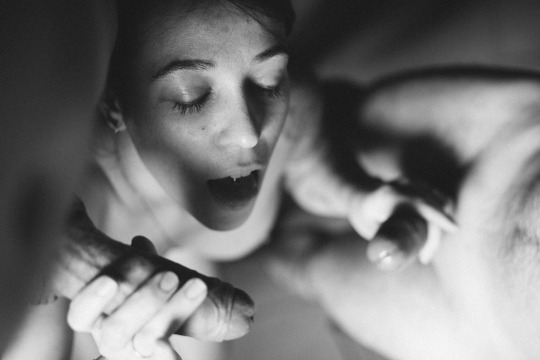
Initially, I wanted to present Bernini, Brassaï in tandem with something more modern and art porn-esque and to categorize it as a ‘follow the thread’ exercise.
At the time, I was unable to find a satisfactory third image. This would’ve been utterly perfect.
Compare this detail of Teresa’s face with the above:
Also, from the stand point of visual dynamics, I’m starting to believe that the bottom edge of the frame has an implicit correlation with the notion of the so-called fourth wall. Consider the above and how it’s #skinnyframebullshit orientation places the viewer in the POV surrogacy with the person belonging to the lower of the two penii. Note how landscape orienting the frame adds the impression of a voyeuristic fourth party:
 Acetylene Eyes