Dienes is known primarily for early portraits he made with Norma Jean Mortenson before she became Marilyn Monroe.
His worked primarily with nudes in natural settings. His poses tend to be ripped straight from Greek antiquity and there’s not a lot of differentiation between photos.
This is uncanny in a way the rest of his work just isn’t. From the standpoint of form–the models pose is a bit awkward. I’m not sure the positioning of the head works for the image but the way the models body echoes the form of the rocks upthrust is a bold choice.
The problem is… well, there are problems plural. First, while there are reasons to center the horizon line in a photographic frame at the center of the picture plane–it’s generally not a great strategy. It’s better to ask which contributes more to the meaning of the purpose of the frame and then going preferring whatever will carry the most weight. Or, depending on what the frame is depicting, perhaps giving the most important aspect too much weight obliterates any sort of ambiguity.
If Dienes had wanted to emphasize the upthrust of the rock more, he should’ve included more of the ground than the sky. To emphasize the surreal aspect of it, he could’ve treated the sky preferentially.
Further, the contrast isn’t quite right–it’s as if the contrast has been dialed down on everything in the frame except for the model’s skin tone.
Honestly though those are all minor problems that could’ve been erased merely by adding a red filter–resulting in a darker sky, light crowds and an increase in textural differentiation in both the boulder and surrounding sand.
His work is singular (+1); his compositions are arranged compellingly (+1) and always imbued with a strange sense of existing as a prelude to sudden, dynamic motion (+1).
…except while trying to figure out what I wanted to convey with this post, I think my perspective has shifted slightly–the trouble is I don’t know quite how to translate from mental impression to language.
The first part of it has to do with the fact that he seems to be producing less work these days. Now, this is only my impression. I don’t follow him super closely and Tumblr is (unfortunately) a platform increasingly hostile to folks who make work in line with his–thus it’s entirely possible that he’s migrated to another platform.
Interestingly, when you look over his work–his learning curve remains impressively near-vertical. It doesn’t all work and I think there is a strong argument to be made for him developing a more contemplative approach to editing–the work is all distinct and eye-catching but there are times when it feels as if more ends up being less. (Take the scene above–I can’t find the original post of this photo but there are a half dozen frames from the same shoot; not one of the others is as captivating as this is.)
The second piece of my reaction to this is tied up in notions of evolution. This one is larger due to bringing my own baggage to bear subconsciously when I engage with (i.e. decode) visual documentation.
At present most of my friends are in their early-to-mid 30s. (I’m in my 40s, fwiw.) And I am starting to notice a trend wherein there seem to be two potential outcomes to any longstanding commitment to the project of self-determination: there’s a degree of comfortability which begins to entice. A still small voice saying: you’ve done the hard work for so long–time to ease up and enjoy the rewards for which you have worked so very hard.
The focus becomes how do I maintain what I have and when you get right down to it doubt and the nitty-gritty of personal reflection and growth are actually inimical when it comes to preserving the status quo.
It’s a perspective I–quite frankly–do not comprehend. Willis’ work signals (at least to me): that the status quo is BS and that the only thing worth pursuing is the dissolution of sedentary compulsions in the embrace of chaos, uncertainty and discovery–whatever its costs.
That last bit actually ties into another consideration–when I talk about the ‘intersections of art and pornography’–although I am definitely questioning the mutually exclusive nature the framing is recapitulating the framing it supposedly denounces.
I’m not sure I’ve found a better way to convey what I mean just yet. But I do think Willis’ work functions as an imposition of the artist of the question if the debate about art vs pornography might better be considered in terms of both and neither instead of either/or.
Practically, I’m not sure the long term implications are all that much different. However, once you see that sort of pioneering spirit as motivating the work–it renders the work all that much more enticing. (At least that’s my response.)
As far as outsider art goes, it’s very difficult out outre P-Orridge.
I am hardly an expert on their (they identify as third gender and use them/their pronouns) life and work.
What I know is that if you haven’t you should absolutely know Throbbing Gristle’s 20 Jazz Funk Greats. (I can’t stomach much else TG did & Psychic TV totters on the brink of intolerable.)
All that being said: they were hugely influential to artists who have had a lasting impact on me.
I am not familiar enough with all the ins and outs of their life to really comment with any kind of definite hot take. They were impossibly controversial–in word, deed and thought.
At present they are being treated for Leukemia–it’s not looking good the last I heard. (Cancer fucking sucks.) If their work meant anything to you, you might want to consider support their GoFundMe for treatment. (How in the fuck did we get to this place in history where people have to crowd source their medical treatment…)
Source unknown – Title unkonwn (201X)
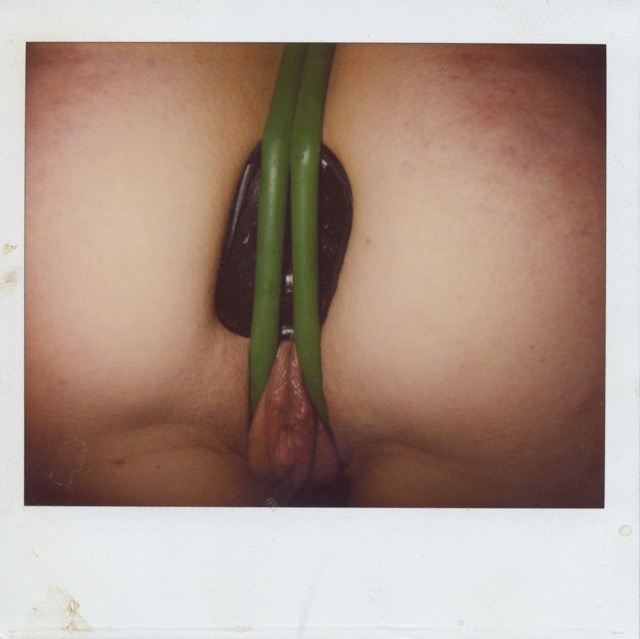
In biology: a ‘raphe’ is a longitudinal seam that usually indicates some sort of mid-line.
There’s one in the medulla oblongata as well as one running from the anus through the mid-line of human genitalia. (pictured above you can see the perineal raphe.)
It is thought that the biblical account of creation where God removes a rib from Adam to make Eve is actually an errant translation and that the actual meaning was something closer to a reference to the fact that unlike most placental mammals, humans do not have baculum. (The folk wisdom is that since god took the bone from Adam and used it to make eve; the raphe is less seam and more vestigial scar tissue.)
Initially, the plan was to use this post to heap praise upon Allen’s thoroughly distinct and downright exceptional analog photography.
Then I read her artist statement/bio… new plan: let’s talk about how artists speak about their work.
There’s this notion–as far as I know originating with Renoir–that art ceases to be art as soon as it begins to require explanation.
Practically speaking Balthus’ 1968 retrospective at the Tate was probably the last time anyone has gotten away with the let the work speak for itself tact. Curators, gallerists and the gatekeepers of high culture all demand artist statement tributes and offerings of a modicum of veiled explanation. (I am not suggesting that instinct is entirely pointless… just that it almost always undercuts the mystery and nobility of the work. (Not to mention situates the audience in a position not only of passive acceptance but inferior receptivity where one must be educated regarding the merit of what one is has or is about to experience.)
It is very rare that an artist’s statement not only clarifies but also illuminates. Allen’s is an example.
…Sometimes
I just want to photograph things, see the pictures and burn the
negatives. It’s overwhelming at times, all these memories trapped in
36x24mm acetate frames.
..I’m
not doing this for myself, I don’t have much say in what’s going on.
When I look back at what’s come through and what’s been made, I don’t
know how I did most of it. It was another person than I am now. And
now I’m making things that one day I’ll look back on and say, I’m
another person now, once again.
…Everyone’s
a photographer. It’s not so precious anymore. The “print” is lost… on
a search to find it. Old cardboard with moisture stains and a
distressed image with a small frame around it, nothing fancy, something
cherished. I’ve got ideas, about to act on them.
…Fever. Avoiding suicide.
…There’s
actually a group of aliens making my work, I have no idea how it’s
done, they just give it to me and I present it, that’s what you see
here.
…I’m
waking up with the sun everyday, I can feel it peering over the horizon
like a cat meowing to be fed. Laying in bed, thinking about who is the
real Banksy, some article online got my brain spinning too early,
again. I have a ton of friends who are all half my age, I know there’s
something to analyze there. Watching people my age turn into their
parents, they said that would happen. I feel no sense of beginning,
middle and end, I’m living in a timeless existence where one day I will
cease to exist, taking that last breath and never saying anything more
into this world. I’m lost there, in that last breath, extending it for
as long as I can.
…Someone asked me this week what are my photos about? Okay, no one asked me, I was asking myself. And I stood there, silent.
….These
last couple series I’ve been working on, Gestures, Sunken Dream and
Earth Water are shot with 35mm film using multiple exposure techniques.
I shot fireworks, underwater sea life at the aquarium, plants and the
sea and then reshot the same rolls with a figure posing in my studio.
There’s never any digital modification on my photos. I could probably
create something similar with less orchestration involved but It’s just
too easy to use photoshop, I need to be challenged. I don’t like taking
the easy way out, I’ll get burned if necessary. I like process. I
like figuring it out. I like going to the museum and looking up real
close to the canvas and figuring out how the artist made something, and
then I want to know if they were feeling what this piece makes me feel.
I start to wonder about strangers…
… The three stages of Emotional Exile: Shock, Surrender, Catharsis.
… I’m not a fan, I’m an admirer.
… 4:20
….I used to hate photographs where the feet or hands were cut off, but now it doesn’t bother me.
…I
trust myself more than anyone else, especially when it comes to
developing my own film. My kitchen and dining area are my lab. I
photograph my friends, or will pose myself. Some of my friends are
people I’m really close to, some are people I’m not as close to but I
feel a strong connection with. All these people who are at different
places in their lives, figuring it all out.
…There’s a sense of surrender, but not in a losing sense, one who surrenders to themselves and gives up on apologies.
….When
nothing seems like everything and everything seems like nothing.
no-mans-land feels like an invisible trap door. No one, not a one. In
the ear of the great sea, I call it closer. Hear the blahs slipping
into aahs. Timing is a mother fucker.
….I’m
just really into passion fruit. I love the contradicting taste, the
sweet and the sour, the fact that it’s not easy to eat, that I have to
shove my face inside it to lick out all the seeds.
….That
moment when I go out on the road with just me, my cameras and a bag of
various clothing pieces. Into the wild, following the weather until it
brings me somewhere and then I set up the tripod, figure out what to
wear, if anything, and prepare the camera for a shot. Meter the light,
focus, filter. I have 10 seconds to run into place and then place
myself there as if I belonged. On to the next. I promise myself that
every moment I even think about photographing, I have to stop and
capture it. I’m not taking anything for granted.
….There
are a million ways I could describe myself and today I’m going to put
it like this… I’m a contradiction but I mean everything I say. The
noise of the city gets to me and I’m counting the days until I get to
where sweaters. I’m dreaming of traveling to far off places with just
me, my camera and a sense of adventure, meeting random amazing souls
along the way.
I won’t be able to enumerate all the ways this statement compliments her work. However, there is a central theme: fragmentation.
She speaks of her work as if aliens possessed her and while in control her body made the work. She also uses multiple exposures. There’s mention of how the past is discontinuous with the present, etc.
The form of the statement replicates this approach–the disjointed thought fragments in the writing mirror the visual form of her work.
David Bowie famously practiced decoupage–he’d tear up his lyrics and then re-order them looking for new patterns to emerge. Allen is doing something very similar with both her photography and her statement. In effect: making sense of her statement doesn’t so much explain the work as it offers a map of how to approach the work–that is: getting a sense of the words on the page is a process that is more or less interchangeable when applied to the work.
It all reminds me of a conversation I had while back with a friend who was telling me about a course she took where a writing professor taught a course on literary form but in a way which reduced form to graphical representation.
It strikes me that Allen’s work is very much about illustrating how to use photography to read between the lines. (And with the notion of reading between the lines there’s traces of Renoir’s notion of art being opposed to explanation–i.e. telling someone to read between the lines means that you either won’t do it for them or that you can’t because it’s so obvious that if they can’t see it, then the explanation won’t help them.)
Between the lines is actually an idea which can be graphically illustrated, actually:
Yet, it is possible to deploy the same elements of the above graphical representation in a host of manner which preserve the conceptual integrity of the original while providing more open ended interpretations:
Or:
The ratio of shadow to highlight are the same in all three examples, yet they each have a different psycho-aesthetic effect.
It’s a huge leap to realize that photography is hard wired with the ability to illustrate what is between the lines. But that fact that Allen not only realizes it but is exploring the possibilities so assiduously is goddamn breathtaking.
Whatever Eberhard lacks in polish, she more than makes up for with her audacity.
Apologies if this is a repetition of a previous persnickety and pedantically harped upon point–however, I am presently too inebriated to be able to figure out how to navigate out of this post and onto my blog to check whether I’m remember on of innumerable discarded drafts (there have been a lot more of those than usual lately, alas) or if it’s just something I thought about addressing and then just couldn’t figure out how to fit it all to words…
Anyway, during the nightmare hellscape that were MFA applications, I thought a lot about why I am drawn to the implications of narrativity much as the magnetized tip of the steel needle finds north on the face of a compass.
On the surface, I am intrigued by the power of stories. People can love you because of and through a well-told tale. Stories can connect people. Yet, the can also be used as Trojan Horses secreting ideological payloads.
My time as a film making student taught me that I might not be as great at judging the merit or lack thereof as far as those sorts of payloads.
I asked myself what would be involved in implying the entirety of a story with a single, static frame?
There are really two reliable ways to do this:
Illustrate a story that is uber familiar to your audience
Or, stage a tableau that allows for a familiar dramatic scenario (Pathos).
Both require being relate-able–a less direct way of saying looking to what has come before. This leads to the sort of work where being lesbian or trans is just another character trait… like born in Louisville, KY, Gay, really likes kabob, etc. as opposed to a wholistic aspect of and projection from the character’s self.
And what we’re finding out is that it’s a lie that our love is only recognizable in the way it mirrors straight love. But we have our own language, or own deeply incised pathos and when you see them you–if you are capable of love–see them too and they mean the same to you.
Eberhard was really far ahead of the curve in a lot of ways. She’s challenging the limits of what pathos allows for in the most fantastic ways.
I haven’t seen any new work of hers in almost half-a-decade. She has an instagram–but it’s private. I would do just about anything to know what she’s up to these days. (She is in the top three on my lists of artists I would do just about anything to facilitate.)
If anyone reading this maybe knows her and could help a super fangirl out it would be supes appreciated.
There’s something disorienting about the way this image fits together.
At the outset, there is a focus on the subject. The skin tone is stylized–it skews a bit too red in the shadows, decidedly too yellow in the highlight; however, the overall effect contributes a sense of mid-to-late spring/early summer.
I am reasonably confident that this was made by propping a smart phone against a shampoo bottle on top of a closed toilet let. Twarowski is sitting with her back more or less against the tub. (Also, there’s likely been some in phone editing of the image–I’d guess that the divergence in skin tone was likely in service of creating a sense of depth and separation between her face/shoulders and the shower curtain behind her.)
I am curious about the 22 and presumable 23 tattoos on her outer biceps. But more than that I find myself entirely wrong footed by her website and the way it preserves a notion of personal vs. professional work–in this case the distinction is between ‘diary’ and ‘work’.
The ‘work’ section is… well, it looks like someone who is trying to make their approach to image making appear commercially viable. (As I’ve mentioned recently: I’m not convinced this is ever a productive approach.)
Now, hope over to the ‘diary’ section; see the difference–there’s a shimmering and vital intensity to the more personal work that is utterly lacking in the professional reckoning.
Is this something emerging from training or is it fallout from the belief that something is productive only insofar as it is saleable?
Also, I’m dubious about this notion that photography/image making works best with this sort of additive approach. Where an artist sets out to make work which fits within a specific conceptual niche–essentially building a body of work to fit a prerequisite schema. I personally think it’s better to put in the time making the work that interests you and then approach it in more of a subtractive, freeing the form trapped within the mass of work.






 Acetylene Eyes