
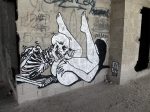
[↑] Artemisia Gentileschi – Magdalena desvanecida (1625); [↓] Unga – Untitled (2014)
Juxtaposition as commentary.
[↑] Artemisia Gentileschi – Magdalena desvanecida (1625); [↓] Unga – Untitled (2014)
Juxtaposition as commentary.
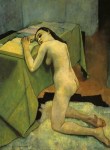
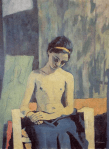

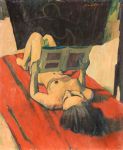
Felice Casorati – [↖] Vocation (1939); [↗] Ragazza di Pavarolo (1938); [↙] Reading a Book (193X); [↘] Nude Reader Reclining (1943)
Felice Casorati’s female nudes (c. 1930s) were known as shocking in
their time due to their unusual perspective. Whereas most female nudes
seem to dehumanize the female body by making it a subdued object of the
male gaze, here Casorati’s nudes are disinterested in their observer,
often seen occupied with other tasks like reading, reclining, or just
generally “looking away.” The unusual use of color also aids in turning
the female subject into a sickly/earthly figure whose existence is not
hypersexualized but instead becomes a source of uneasiness or intriguing
activity.

[↑] Eric Fischl – Bad Boy (1981); [↓] Elle Muliarchyk – Title Unknown (2010)
Juxtaposition as commentary

Gerard van Honthorst – The Incredulity of St. Thomas [detail] (1620)
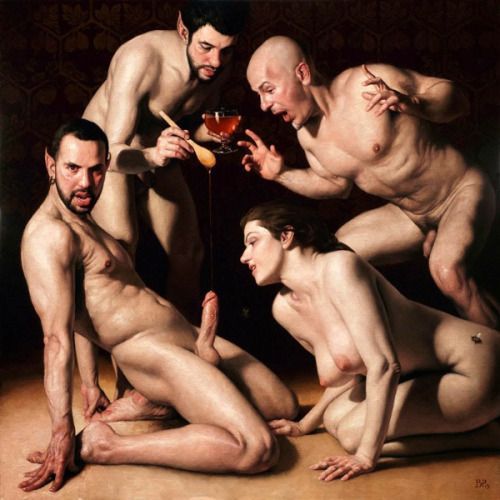
Barahona Possolo – Sweet (2013)
I love this.
Stylistically, it wouldn’t be out of pace displayed side-by-side with any of Caravaggio’s biblical paintings. (In fact, there would be a reasonably interesting paper comparing/contrasting the influence of both Caravaggio (with a distinction between his biblical vs mythological work) and Klimt‘s paintings after 1900 in Possolo’s work.)
Granted, such explicitly suggestive depictions don’t really exist in the Western Art Historical Canon. There certainly aren’t rigidly errect penii in Caravaggio–however, I believe there may be a few lurking in Klimt’s criminally under-appreciated sketches.
But my point here (as well as with this blog) is there is no reason there couldn’t be/shouldn’t be graphic depictions of sex in art.
And that’s not to say this completely works. Ostensibly, the fellow on the top left is ladling honey out of one of wide mouth wine glass with a wooden spoon and letting it drip onto the engorged glans of the man on the lower left. (Note: the wine glass bears more than a passing resemblance reminds me to a similar object in Vermeer’s The Wine Glass.)
On the right half of the frame, you have the exuberantly performative excitement/delight of the guy on the top and the transfixed and lets be honest clearly thirsty AF woman on the lower right.
Some of the other facets are much more difficult to decode. Like–there’s a feeling that all the men in the image are aware of each other but the woman seems oblivious to everything except the honey marinated hard-on. (Let’s be honest, that is the locus here.) This conjecture is at least supported by the strange elf like ears all the men have.
I’m not really sure what the bumble bee on the woman’s flank indicates either–given the context of the image it seems it could speak to her sexuality and contrast that against the seeming ambiguity of the elf-eared ones; yet if that’s the case there are potential ways in which it could be interpreted that the image erases gay, lesbian and bisexual women. (And that’s not ever cool.)
But what really strikes me about this image–and like so much of the way my brain works this isn’t an association I would have made if I hadn’t read this article several days ago–the way he of the honey slicked dick breaks the fourth wall reminds me of the way Robert Mapplethorpe performs a similar action in (arguably) his most notorious image. It’s as if both are saying: this is who I am. But in the case of this painting there’s an insouciance and arrogance in contrast to Mapplethorpe’s studied gravitas.

Kerstin Drechsel – Untitled from if you close the door series (2009)
With the exception of The Cabinet of Dr. Caligari, I’m not all that fond of expressionism.
In fairness, I can’t imagine Drechsel fancies herself an expressionist. But I think there’s an argument to be made that while if you close the door starts off more classically photo-realistic as it becomes more enmeshed in the private experiences of loves, it begins to disintegrate into something that shares elements of expressionism.
I love how the work is at once both graphic and implicit. The sometimes fumbling awkwardness of the exchanges.
Take this image: I can’t get over the matching knickers. The way each partner is stimulating the other and holding the other at a distance. (The one on the left in an effort to watch her lovers body and the one on the right because she is approaching orgasm–note the way the partner on the right has her lips parted but at the same time this expression is partly elided by the clumsy shadow her partner is casting across her face.
I also really like the vaginal shape of the composition. It’s not at all subtle but in the context of the work it’s a powerful statement about whom and for what purpose the work was created (i.e. it wasn’t made for white cishet dudes to objectify).
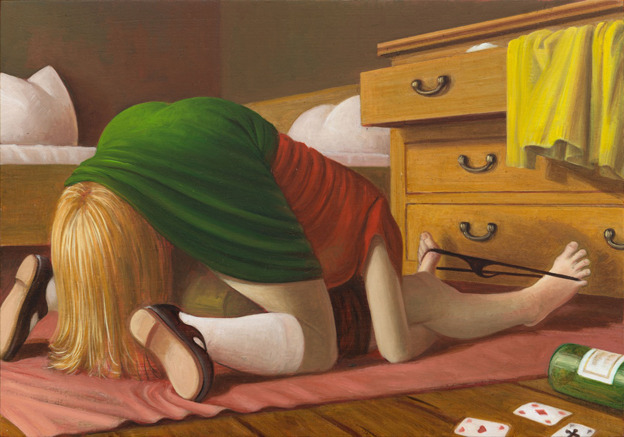
Falk Gernegross – Herz, Karo, Kreuz (2013)
I am not a painter. But of the dozen or so painters with whom I am acquainted, three are die hard adherents of mischetechnik.
I don’t claim to completely get the process but my understanding is that you construct a painting in layers. There’s an initial layer of underpainting that accentuates the shading. From their color is layered onto the image in a fashion so that light refracting off the layers creates the sort of randomization of color sheen that we expect of the world around us. (In other words: even a simple red isn’t really just one color–it consists of a range of so similar as to be nearly indistinguishable reds.)
You could probably tell from the fact that a notable percentage of the painters I know use the process, it’s very hip right now. And although I typically don’t care for the stuff people are employing it to paint–especially given that one of my all-time favorite paintings used the mischetechnik and very little that’s made subsequently improves upon Van Eyck’s Arnolfini Wedding Party.
Gernegross is not especially subtle or nuanced. He’s clearly obsessed with the mixed bag of joy and anxiety that accompanies adolescent sexual experimentation. But whereas other artist’s own this preoccupation, he presents adult looking surrogates in situations that are clearly intended to convey a post-pubescent reality.
I’m not entirely sure this works as a subliminatory strategy. I mean the defined bust of the girl in the red blouse and green skirt aside, this is clearly supposed to be two twelve year-old girls who were playing cards after school while sloshing wine nipped from the family liquor supply. They drink too much and things grow lusty.
Really, it’s probably the affronting style of the rest of his work that made him decide to build in a method of escape should he face criticism for the depiction, but honestly, save for the manner in which the girl on the bottom’s thong is positioned around her feet, there’s a matter-of-factness that’s worthy of Balthus–even if Balthus would’ve almost certainly rendered something more graphic than Gernegross’ explicit implications. But then Balthus’ was more interested in the ambiguity his work instilled in his audience than in ambiguity as a safety net against critical backlash.
[←] Takahiro Hara – Title Unknown (2012); [→] Steffen Drache – Title Unknown (201X)
Juxtaposition as commentary
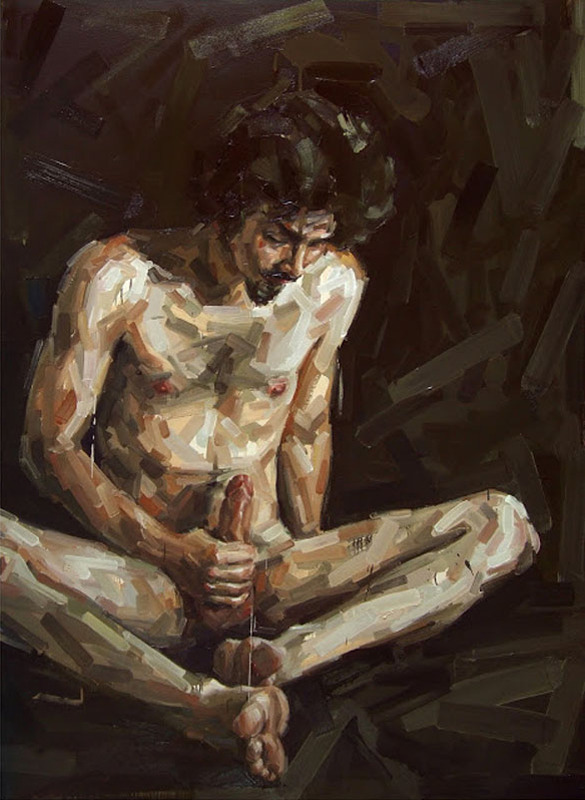
Fabio Baroli – Esto és peor (de Cristo à Tepes) from Apropriações Textuais series (2008)
I’ve featured a Baroli painting once before even if I didn’t know to whom to attribute the work at the time. (It remains one of my favorite images I’ve ever posted.)
Even though most of the attention he receives is due largely in part to the erotic/transgressive work, he has produced a broad spectrum of work.
These images (here, here, here and here) pull together a sort of comic book style confrontation with Chuck Close pastiche.
In other works, there’s the unmistakable flavor of Degas.
The unifying thread with these various approaches is likely a simultaneous attraction to and revulsion from the simple, direct compositional dynamics of murals. For example, although Diego Rivera tends to pack as much detail in his frames as possible, if you focus on the way Rivera presents individuals distinctly within the visual milieu, you’ll recognize their echo in Baroli’s rendering of his subjects.
Honestly, I’m so enamored with his preoccupation with genitals and masturbation as motifs, that it’s difficult for me to step back and look at the work critically. If I do that, however, there’s some weird stuff going on. The linear application of paint–which often reminds me of band-aids, tends to remain broad and nebulous around the edges, become more refined as the shape of the subject is defined.
The use of layering and color is masterful. You can tell that the application is not just suggestive of an understanding of color theory, it’s a short of showing the seams of how painters achieve such sublime colors; however, the more bandage-esque suggestive of tonal accuracy fades when Baroli reaches the genitals of his figures. (Or, at least as far as penises go. His depictions of vulvas are really abstract.)
It’s clear that he is interested in the notion of the relationship between physicality and visual representation as well as sexual and individual identity. He’s obvious invested in fucking with those boundaries.
Also, there seems to be a certain perhaps reflexivity between his conception of genitalia and sexuality that could further perpetuate the sexualization of bodies. I’d wager he’s aware of this; and I see his preference for depicting erections as a likely effort to preempt such criticism. However, I’m not 100% convinced it succeeds.
As much as a dig the emphasis of solidarity of experience over embodiment in
Sujeito da Transgressão #4, it feels as if it’s predicated on an implicit gender bias that doesn’t necessarily turn me off of the image but renders me uncomfortable because the work still very much turns me on–if that makes a lick of sense to anyone other than the voices in my head.

Enrique Simonet – Anatomy of a Heart (1890)
I ❤ this so, so much.
Yeah, the rim light along the pathologist’s left shoulder lacks any vestige of subtly. And the two-point perspective is pretty much an attention-starved, sugar-rushed five year old running around screaming lookatmelookatme.
Simonet’s work runs a gamut of influences but his work is consistently unsubtle and painstakingly, hyper composed. The trick with this image is that whereas his work usually features large groups of people presented frozen in position to utter perfection, the stillness resonates here in a way that doesn’t contradict the material.
When you pay careful attention, you start to notice that the regardless of whether it’s clumsy or not the rim light actually causes both the texture of the pathologist’s jacket as well as emphasizes the masterful treatment of graded light on the walls; the unsubtle two-point perspective shepherds the eye across the frame in a way that upon first pass communicates the trope and upon subsequent passes patiently indicates small details, ex. the shape of the heart echoing the shape and heft of the sponge, the exquisitely rendered reflection in the wash basin and the green doodad in in the container on the window ledge.
I might refer to obvious influences: to Rembrandt’s The Anatomy Lesson of Dr. Tulp… but Simonet is actually far less out-and-out theatrical in his staging (I’m reminded of Tony Zhou’s ingenious contrasting of uninteresting framing/blocking in most current Hollywood multiplex fodder vs. the inimitable Akira Kurosawa); while the greenish hint of the woman’s skin is a quote from Caravaggio via Delacroix’s infamous amplification.
In effect, Simonet’s painting one-ups every single one of it’s antecedents. Not through any sort of Newtonian humblebragging but by wearing it’s love and respect on it’s shirtsleeve, demonstrating them through action instead of discursively holding forth on them. The truly great ones always seem to take a perspective on their own work reminiscent of brilliant folk historian Utah Phillips’ metaphor for the relationship between history and the individual:
Time is an enormous, long river, and I’m standing in it, just as you’re standing in it. My elders are the tributaries, and
everything they thought and every struggle they went through and
everything they gave their lives to, and every song they created, and
every poem that they laid down flows down to me – and if I take the time
to ask, and if I take the time to see, and if I take the time to reach
out, I can build that bridge between my world and theirs. I can reach
down into that river and take out what I need to get through this world.
 Acetylene Eyes