This post is guest curated by azura09:

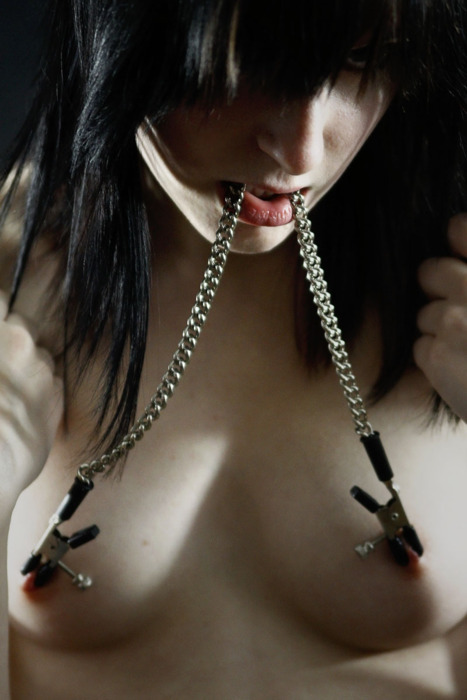
When I had a crashpad membership recently, one of my favorite videos included a scene where a Domme made her sub hold the chain to her nipple clamps in the manner above while she was aggressively fucked.

There were many things I liked about this scene: how the Domme was assertive without being cruel, how the sub followed orders in an almost casual way, and how gleeful this sustained rough sex obviously made both of them.

It’s true that there are some tricky things to navigate when one partner enjoys being objectified during sex, and I certainly wouldn’t want to downplay the reservations some people may have toward this kind of roleplay. 

Then again, I don’t want to avoid the fact that I find consensual objectification, especially when my girlfriend is hellbent on being a good girl, hot.

In reasons related to this, I’m attracted to how the girl in this photo is holding the chain fast between her teeth as if the idea of decreasing the pain to her nipples has occurred to her, but she is wholly intent on resisting this impulse.

Is not the most erotic portion of a body where the garment gapes? In perversion (which is the realm of textual pleasure) there are no “erogenous zones” (a foolish expression, besides); it is intermittence, as the psychoanalysis has so rightly stated, which is erotic: the intermittence of skin flashing between two articles of clothing (trousers and sweater), between two edges (the open-necked shirt, the glove and the sleeve); it is this flash itself which seduces, or rather: the staging of an appearance-as-disappearance (Barthes, pg. 9-10).

Perhaps it’s the introversion suggested by the huddled pose or the comely skin. My eye—wishing it was a tongue—darts and circles the erect left nipple.

But the wetness of wanting is thwarted by the shallow depth of field which pushes my gaze away over oceans of cream floating morning glories, wilds rose and springs of red baby’s breath before being pulled back again over small breasts and pale skin to sunlit shoulders and long strands of red silk hair.

And in this seeing I have an honest-to-goodness itty-bitty petit mort every time I glance at this picture.

No, it’s closer to a lover shifting slightly and the movement sending cascades of shivers outward through the ebbing pulsing of orgasmic spasms.

A feeling not unlike the memory of pixie with snow white skin, wire straight, carbon black hair and mischievous eyes wider than miles of un-translated manga: I gazed as she reached across the table, her motion pulling the lower edge of her too-small t-shirt away from the waist of her too-large belted jeans. Thinner than a rail, the ridges of her spine led my eyes down to the orange on purple Victoria’s Secret underwear.

Edges are important. Particularly given their extensive history of being manipulated in order to objectify and sexualize the female body—expertly lampooned by Duchamp’s Etant Donnes.

But the headless woman does have anonymity. And where this previous implied women as little more than fodder for men’s sexual appetites, it now is put into service in order to facilitate the open expression of a sexual identity from behind the safety of a mask.

To be clear, I think that’s awesome; but like all awesome things, it is not without its problems. In this case, the line between anonymous expression and exhibitionism is razor thin at best. What is presented as artful and considered frequently suffers as a result of compositional inconsistencies necessitated by the requirement for anonymity.

This beautiful photograph is one of the few that manages to be rigorously consistent in its composition while also employing the frame edge as a means of masking idenity. A slight shift in perspective, however, would have almost certainly transformed it into something either nakedly exhibitionist or visually impoverished.

It for that reason I think most photo dabblers would do well to borrow from the book of Bellocq’s brother by making a thoughtful image first and then blacking out faces and identifying features later.

When printing something one is given two options: portrait or landscape.

As best I can tell this is a vestige of painting: vertically oriented images were favored for portraits while horizontal frames lent themselves to the panorama of landscapes.

Although arguably more of an unconscious convention in painting, this logic has been actively internalized by photographers and virtually enshrined by digital image makers.

The trouble is two-fold: the logic of photography is not interchangeable with the rules and precepts of painting (no matter how the latter interpenetrates the former). When applied to each other, these conventions produce schizoid, contradictory compositions.

Photography—and by dint digital imaging which however misguided is based upon it—has internalized the landscape orientation.  Unlike painting, I do not think this internalization has been unconscious—after all, if you have ever looked at a strip of 35mm film on a light-table there is an easy-to-see bias towards horizontal framing. (I am so accustomed to this that when I encounter vertical compositions now, I tend to tilt my head sideways when looking at them.)

Portrait orientation is not without its uses in photography and digital imaging. Unfortunately, it more often than not contributes very little to the compositional ‘sense’ of an image; serving expedience by quickly fitting the subject to the frame—instead of forcing the image maker to contemplate the discontinuity between the subject/frame and subsequently address it in a more artful manner.

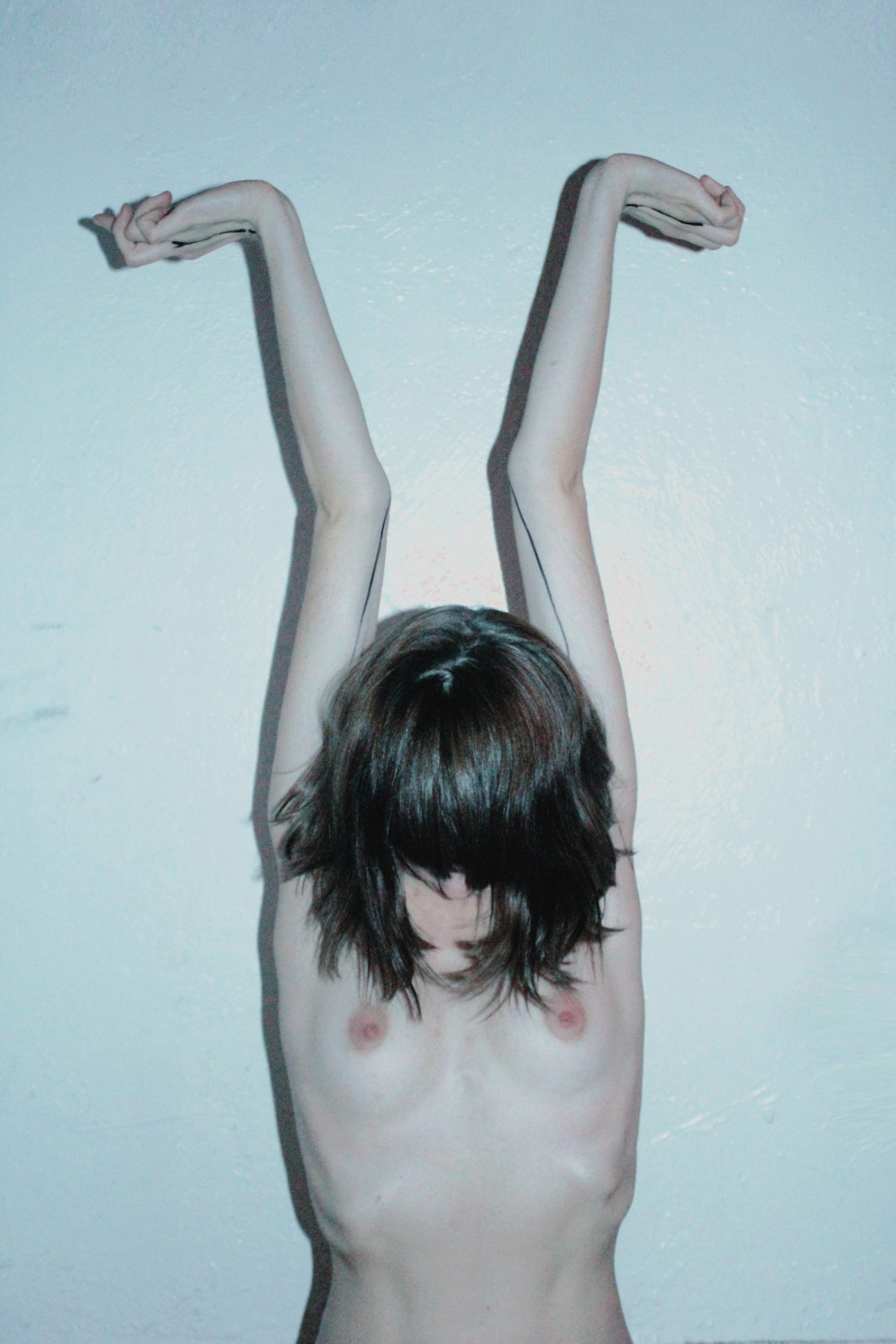
The above has almost certain been cropped. But I would wager its orientation was originally vertical. (The individual responsible for the image contacted me with assurances that the image was originally horizontal but was cropped to accentuate the vertical.) And although I think horizontal framing would have worked better (EDIT: Having seen a sample of the original image, it is better), I will admit that unlike the vast majority of portrait orientations, the image maker is clearly aware of the manner in which the shift affects how the image is seen.

The frame echoes the subject’s form. On its own, that is the worst of lazy justifications; however, in this case the poses, the simple line work of what I find to be one of the sexiest tattoos I have ever seen and the narrowed view work as a visual approximation of the feeling one gets from indulging in a much needed stretch.

Further, the portrait orientation allowed the photographer to be closer to the model, lending a sense of heightened intimacy while also preserving anonymity.

Finally, I would be remiss not to admit a large part of my reason for posting this is the model’s unnerving resemblance to someone upon whom I currently have a maddening crush.
I love their closed eyes, the bright flush to their faces, the bodies tense with forestalled impatience— I want you to enjoy it, enjoy me enjoying you enjoying it—a full-blown sensory flashback: I remember my knees shaking and teeth transformed to mercury quivering in my gums and the weight of knowing— God himself did make us into corresponding shapes like puzzle pieces from the clay; knowing is not enough against wanting, wanting to see this through tired-tired eyes spread holy-holy awed and wide as the wet of lips meeting and our fumbling lead boned find those secret fleshy spaces with their tiny, tiny alters to bear and burn lonely so many offerings.

The pale one, her fingers slid up almost to the wrist into the others blue-grey briefs, deeper; while she is herself caressed through white knickers— I remember the slick groove of a dew pussy leeching through cotton and then glistening silken on gliding fingertips.