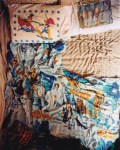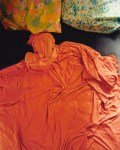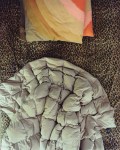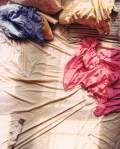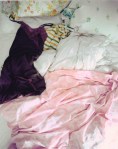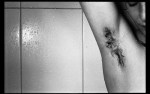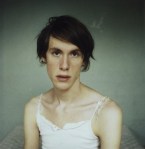


Amy Montali – [1] In the Garden (2004); [2] History (20XX); [3] Souvenir (2009); [4] September (2007); [5] Stain (20XX); [6] Holiday (20XX)

I’m sitting in a cramped little vestibule-like area that opens off my shitty basement apartment into a claustrophobic backyard sobbing my stupid eyes out.

You know those moments: when warm light touches the world just right; and the perfume of spring lingers in the breeze; or, the players on the stage play their music as if muddy horns and staggering joy were the only magic anyone ever needed, when words or subtle turn of phrase makes the truth of the song, a chorus you can’t help but sing and in singing it, singing as if singing were the only one that might maybe save this sick and dying world.

I exist for such moments. And people always fault me, tell me my expectations are unrealistic, that I am asking too much.

But then, then I stumble upon beauty like this. Work that shows me the world I already see, proving that someone else sees it too, sees hope and beauty and love and so, so much more joy than all the words ever spoken could circumscribe. And it is all so terrifyingly easy to overlook…

In those moments, I always know I ask for too little; I should ask for more.

Amy Montali is everything.

Everything.
knitphilia:

gaywitches:

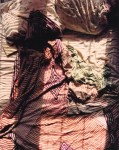
Lesbian Beds by Tammy Rae Carland

Gaaaaaaah!

Despite the recognition of William Eggleston, Stephen Shore, Joel Sternfeld and Jeff Wall–photographers work work either predominantly or exclusively in color–there is nothing approaching consensus on the purpose and/or role color plays in image making.

Admittedly, I am only familiar with the proceedings in a manner similar to the way the geek table in a high school cafeteria is privy to the latest scuttlebutt at the popular kids table. Best as I can tell, it centers on whether or not color is intrinsic to the raison d’etre of the image; or, is it instead, merely a decorative addition.

As someone who prefers B&W to color and whose use of color is usually governed by whim rather than reason, I don’t feel effectively equipped to interrogate questions over the use of color in a work.

However, I do suspect this work might well be considered in such conversation.

Moving away from considerations of color–difficult to do as the work hinges on color–the conceptual underpinning of this work is fucking stellar. With so much of the bigotry LGBTQQAI folk facing being unduly fixated on what happens in beds, behind closed doors; Carland counters this fetishization by remind us that just like us lesbian couples also share beds for the purpose of sleeping–a thoroughly normal, human activity.

There’s are touches of personal identity, yet everything still remains anonymous. The work stands on its own, presenting its perspective in a straight-forward, face value manner that leaves only one question: why these beds? A question answered in turn by the title.

Astute, exciting work.

***

This image was reblogged from knitphilia. I don’t want to embarass her or gush in too sploosh-y a fashion but I adore her blog. A-goddamn-fucking-DORE. Her curation is over-the-moon superb. Please follow her if you aren’t already and for the love of all that is good: check out her pretty masculinity and handsome femininity tags.

Igor Mukhin

Normal
0

false
false
false

EN-US
X-NONE
X-NONE

/* Style Definitions */
table.MsoNormalTable
{mso-style-name:”Table Normal”;
mso-tstyle-rowband-size:0;
mso-tstyle-colband-size:0;
mso-style-noshow:yes;
mso-style-priority:99;
mso-style-parent:””;
mso-padding-alt:0in 5.4pt 0in 5.4pt;
mso-para-margin-top:0in;
mso-para-margin-right:0in;
mso-para-margin-bottom:10.0pt;
mso-para-margin-left:0in;
line-height:115%;
mso-pagination:widow-orphan;
font-size:12.0pt;
mso-bidi-font-size:11.0pt;
font-family:”Garamond”,”serif”;}

If it moves, Igor Mukhin likely shoots it; if it doesn’t, he’ll still take aim.

With nearly 5000 images—split between B&W film scans and Leica AG M9 captures, amassed over 6.5 years—perusing his photostream is like mainlining a hyper-distilled, chaotic mélange of interesting, occasionally ingenious work.

My head doesn’t wrap around such profligate excess easily—limitation is too central a feature in my own process. (Read: I am poor.) But I can let that slide. What I fail to fathom is how Mukhin’s haphazard, throw-it-at-the-wall-to-see-what-sticks curatorial approach works at all, let alone results in such jaw-dropping examples of all that photography should embody.

(To avoid unnecessary disappointment, skip his staid personal website.)