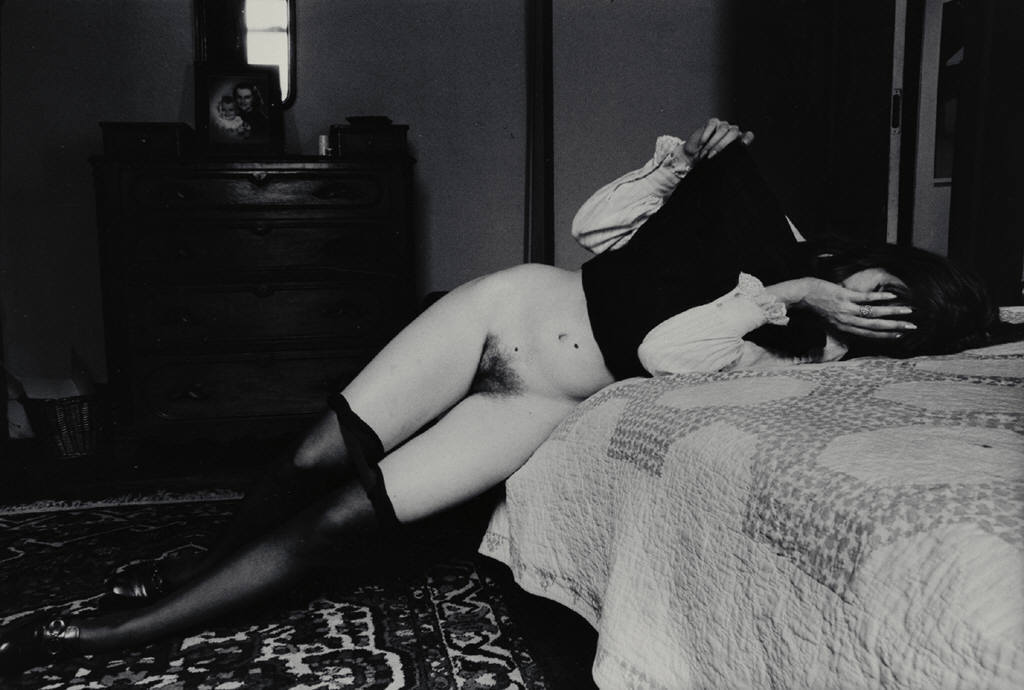
Duane Michals – Untitled 1968
Duane Michals – Untitled 1968
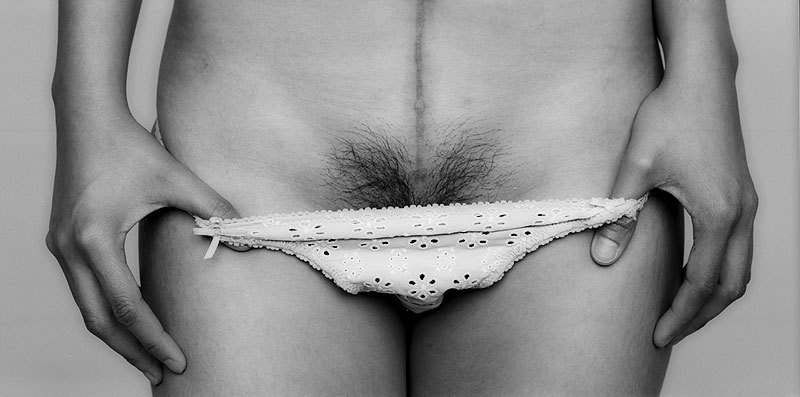
youarecordiallyinvitedtopissoff:
Baryta print from the SIX/TWELVE series.
The Fish by Elizabeth Bishop
I caught a tremendous fish
and held him beside the boat
half out of water, with my hook
fast in a corner of his mouth.
He didn’t fight.
He hadn’t fought at all.
He hung a grunting weight,
battered and venerable
and homely. Here and there
his brown skin hung in strips
like ancient wallpaper,
and its pattern of darker brown
was like wallpaper:
shapes like full-blown roses
stained and lost through age.
He was speckled and barnacles,
fine rosettes of lime,
and infested
with tiny white sea-lice,
and underneath two or three
rags of green weed hung down.
While his gills were breathing in
the terrible oxygen
–the frightening gills,
fresh and crisp with blood,
that can cut so badly–
I thought of the coarse white flesh
packed in like feathers,
the big bones and the little bones,
the dramatic reds and blacks
of his shiny entrails,
and the pink swim-bladder
like a big peony.
I looked into his eyes
which were far larger than mine
but shallower, and yellowed,
the irises backed and packed
with tarnished tinfoil
seen through the lenses
of old scratched isinglass.
They shifted a little, but not
to return my stare.
–It was more like the tipping
of an object toward the light.
I admired his sullen face,
the mechanism of his jaw,
and then I saw
that from his lower lip
–if you could call it a lip
grim, wet, and weaponlike,
hung five old pieces of fish-line,
or four and a wire leader
with the swivel still attached,
with all their five big hooks
grown firmly in his mouth.
A green line, frayed at the end
where he broke it, two heavier lines,
and a fine black thread
still crimped from the strain and snap
when it broke and he got away.
Like medals with their ribbons
frayed and wavering,
a five-haired beard of wisdom
trailing from his aching jaw.
I stared and stared
and victory filled up
the little rented boat,
from the pool of bilge
where oil had spread a rainbow
around the rusted engine
to the bailer rusted orange,
the sun-cracked thwarts,
the oarlocks on their strings,
the gunnels–until everything
was rainbow, rainbow, rainbow!
And I let the fish go.

robert mapplethorpe / bush
For me, the cloud of controversy surrounding Robert Mapplethorpe’s photographs becomes a filter through which I see them.
Mapplethorpe’s focus on taboo/pornographic content courts outrage. But it is an outrage unlike the allegations of child pornography leveled against Sally Mann for Immediate Family or claims of exploitation dogging Nan Goldin since The Ballad of Sexual Dependency; it is intended. Mapplethorpe invites a visceral reaction, even if that means pissing someone right the fuck right off.
Were that all he were about he’d be no more relevant than any other shock-solely-for-shock’s-sake artist. What makes Mapplethorpe matter is his realization that for good, bad or ill: even being pissed off at it necessitates at least some degree of visceral engagement with the work.
A dangerous thing when the work possesses a deep wonderment and the taboo/pornographic content is carefully underscored with an uncommon intimacy. Even more upsetting when technical craft is so stunningly refined—and not for its own sake, as a testament to a belief in the labor owed as a result of being allowed to bear witness to profound beauty.
This is may be why Mapplethorpe’s work remains controversial—one either sees and embraces its beauty or the dissonance between authorial intent & audience reaction creates a deafening feedback loop.
(Then again, I could just be floored by finally finding a depiction of fisting that despite being a bit too much of a close-up is masterfully executed and resonates with my experiences of feeling my hand encircled tightly with wetness and warmth.)
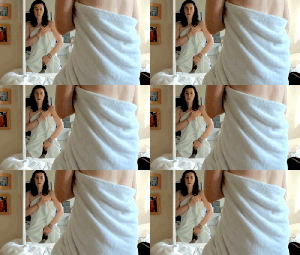


Artfully depicting masturbation is not an easy feat.
The act is private, sequestered. Thus, the question of how one came to be able to witness such goings on becomes a central—is it voyeurism, exhibitionism or a bit of both?
The more voyeuristic the image, the less intentional it appears and the more it relies upon the reputation of the image maker to supplement its ‘artistic’ merit.
The more exhibitionist the image, the less artful it appears. Exhibitionism being rooted in self-consciousness; the efficacy of the work of art being so frequently measured on its ability to dissolve notions of self and other.
These clips of a larger piece suggest an altogether ingenuous way of subverting this dichotomy: fuck with the distinction between subject and object. What’s the easiest way to do that? Point the camera at a mirror. (And I do not mean any of this teen-girl-shooting-her-reflection-in-the-bathroom-mirror Tumblr noise. I fucking HATE that shit!)
Now, I will not for a second argue that she is unaware of the camera—I am almost certain she is. But is she looking at it or looking at herself in the mirror? This becomes about the spectator watching her watch herself cause and experience her own pleasure.
For me it also has the effect of focusing me on her growing arousal—which while certainly mirroring my own is continually refocused on hers.

The above reminds me of a pinup photo. Or, more accurately perhaps: anti-pinup.
It replaces the manufactured glamor of Betty Grable with the (preferable to me) alt-punk body/sex positive grunge mien of Camille (Cam) Damage.
With all my bitching about how so many photographers cut up women’s bodies with slipshod framing, you would think I would be goddamn all over the pinup. (Can you recall one that doesn’t include the entire body? I can’t.)
But there are two things I find troubling about the pinup tradition. The first doesn’t apply but it lends weight to the second: in a pinup the model’s acknowledges the spectator’s gaze.
Miss Damage, while clearly aware of the camera on her, ignores it.
However, taking an existing form—in this case the pinup—and replacing its various components with their appositives does not a new form make; In other words: you can include all the thin, alluring, pierced beauties with a progressive take on body hair—and please do not misunderstand me, Miss Damage is so hot you have to spell it haute—but the result will invariably mimic the original form.
Inversion is like that, never quite managing to be subversive.
What bothers me is the inherent problem of pinups (as well as anti-pinups); whether intended or not, they serve as a metonymy wherein the whole of an individual’s sexuality is represented by a part, which is most often their sexualized body.
As much as I hate on pornography—it rarely struggles with this problem. Depicting the sex act is fundamentally narrative; it has a beginning, middle and end; demands choices with regard to the inclusion or exclusion of a mass of details.
As Nabokov noted: God is in the details.

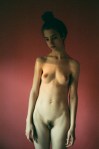
Take these photographs—similar in form and content, starkly different in execution.
Top: a stunningly young woman stands on a lanai, skin suffused by white hot tropical light. A medallion—perhaps an inch and a half in diameter—dangles just below her supersternal notch from a thin black cord encircling her neck; a visual trick that succeeds in making her tiny breasts appear flat. Her carefully manicured hands hook a thumb each in the elastic waist of her bikini, offering a glimpse of her depilated pubic area and labia majora. With her head tilted forward and right slightly—she appears as if interrupted in looking down at her body, judging how much of herself to reveal—eyeing finding the aperture and the spectator lurking behind it.
Bottom: Alba, (photographed by the devastatingly talented Lina Scheynius), a stunning young woman stands naked before an amaranth backdrop. Warm amber light—presumably from a window beyond the left frame edge—angles across her chest mirroring the line of her collar bone. Another illumination echoes the angle of the window—correcting it downward slightly— casting white across her right elbow, stomach, hips, unshaven pubis, finally finding her left forearm/hand as a result of the vague contrapposto bearing of her pose. Shadowed, her head gaze downward; focused on something only she can see. A single stray strand of hair escapes the bun atop her head, dangles by her cheek.
I know I am always going on about the politics of frame lines. To what extent I mean that as pertaining to graphically sexual images or all images, I am not sure I can articulate yet.
There is a general “rule” on this matter when it comes to image making: if you have to amputate a limb with the frame edge cut midway between joints instead of closer to the joints; this creating a more life-like rendering. (Don’t ever decapitate! Seriously if you are concerned for your anonymity just take a normal picture and black out your face in Photoshop, already!)
Which of the above follows this rule? What is the effect?
Also, note how the vertical frame edges in the top image do not line up with the fence or the edge of the patio.
The young woman in the top photo is sexually appealing in the extreme. After first blush, she is perfect. At the same time, she is not someone I am convinced could ever be known in any sense. Her eye contact purports a false intimacy, implies that if our paths ever crossed I would be best served to view her as nothing more than her exquisite body instead of seeing her as someone with a life that goes well sometimes, others not so much; who has needs both met and unmet. I am not saying she is objectified so much as reduced to an archetypal idea.
On the other hand: with every shred of context removed except her body, I find myself wondering who this Alba is, what her inner life is like at the same time I am aware that she wouldn’t owe me an answer if I ever met but that if I were lucky she might not mind being asked.
In the end, the last image is for me sexier; like most of Scheynius’ photos its restraint, patience and passion sears itself like a brand onto your visual memory.

In his The Birth of Tragedy, Nietzsche—bear with me—suggests Athenian drama as the highest form of human art due to its seamless fusion of the two most basic human tendencies; he termed these: the Apollonian (critical) and the Dionysian (libidinal).
Perhaps, this is not a bad way of beginning to analyze whether and to what extent a work of intended as pornography can transcend the intention of its creation and be seen as art.
This image suggests an approach to me because I have two very equal and opposite responses to it that can more-or-less be mapped along axes of critical and sensual responses.
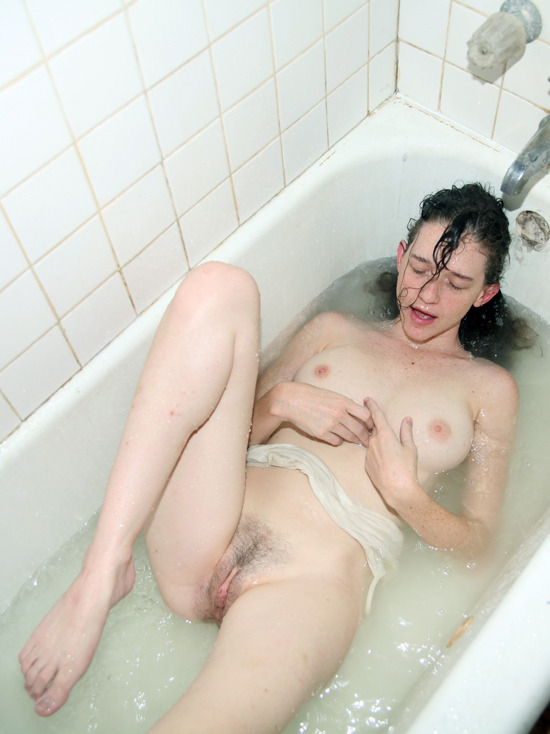
Looking at this image with a critical eye I appreciate that, excepting for her knees and feet extending beyond the edge of the frame, this young woman is presented intact within the frame. If she were to feel so inclined she could get up and walk away.
She is aware of herself being seen at the same time she refuses to engage the spectator by closing her eyes and positioning her feet in a way which ensures the focal point remains her body as a whole not just her vulva.
On the other hand, the kitchen backdrop is hell of problematic. Whether intended or not, it portends an unchallenged allegiance to prevalent patriarchal attitudes.
Technically, the image is over-exposed and would have benefited immeasurably from the photographer taking a half step back before clicking the shutter. Also, the bright light falling on both the subject and the wall behind her flattens the image.
My libidinal response to this image is less conflicted. This woman is my decidedly my type: petite brunette with Eastern European features and barely-there breasts; and wonder of wonders, she has pubic hair—a hairless pubis can be breath-taking when it is the exception not the rule but I prefer hair down there.
But I cannot read this either as an Apollonian or Dionysian. My gaze drifts until it locks in on the slight glimpse of the hollow held by her labial folds. Then her set against the (cold?) wood floor reintroduce the angle at which her porcelain legs. My eyes scan upward and I find myself faced again and again with another human who desires (and is desired), dreams(is dreamed of) and needs (and is needed).
(via captio)
A not insubstantial number of images indelibly imprinted on my mind have been made by Traci Matlock and Ashley MacLean—or, as they are perhaps better known: Rose and Olive of tetheredtothesun on Flickr and Nerve.com photo blog fame.
One cannot talk about Rose and Olive without addressing process. As I recall, they their work was always intended as a collaborative undertaking: Rose shot Olive and Olive shot Rose. The subject of the resulting image became the final authority on whether or not the image would ever see the light of day. In this way the subject is also a co-author of the work—an especially clever fuck-you to the proprietorial expectation of traditional male spectator.
Their work rings truer than most, resonating with a sense that this moment was something that happened just as you see it here.
The result has always been in my opinion some of the most sexual explicit photographs—if not so much in content, in implication—I have ever seen.
It’s possible to dismiss it as cloyingly exhibitionist, but the trust between the two is too wide-eyed in its unwaveringly dedicated sincerity.
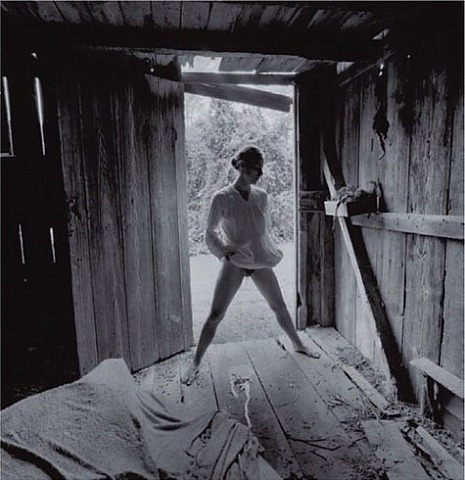
Emmet Gowin Edith Danville, Virginia 1971
When I study Gowin’s work I am always struck by its deep reverence. Whether his subject is his wife Edith, or various members of her family or his later aerial landscape, each image is treated with the same quiet wonder.
In Edith Danville, Virginia 1971, Gowin’s wife stands in the doorway of a dilapidated shed and pisses on the floor—the scene is handled with a quiet awe rather at odds with ‘taboo’ of enjoying the sight of someone urinating.
Whether intended or not, it strikes me that this is reverent watching is not at all unlike the way pissing is commonly depicting in pornographic media.
The actress informs her partner she ‘has to pee’ and moves several steps away to stand with her legs spread wide or more often than not to squat. With this movement her body transforms from the discrete catalogue of penetrable orifices and denuded erogenous zones it is likely to have been presented as for most of the scene to something whole and complete. She gazes down at her cunt, or looks away from the camera like Edith—breaking her near constant, self-conscious awareness of the spectator. She begins to piss but by the time she remembers she is expected to be self-conscious, the camera has begun to zoom in on the fluid ensuing from between her legs.
‘Having to pee’ is, unequivocally, a need. Given the raison d’etre for porn—manufacturing male pleasure—admitting that women have needs is unusual. Admittedly, sexualizing yet another aspect of female bodied experience is problematic, but for me that is trumped by how hot it is when porn—however tenuously— implies the truth: nothing provides more pleasurable than meeting the needs another.

Francesca Woodman’s confrontation for confrontation’s sake ethos is very punk rock—unshaven armpits and pubic hair, the gritty B&W; the highly sexualized nature of her work, how that work rigorously thwarts the proprietorial gaze of the traditional male spectator.
 Acetylene Eyes
