girlsrule-subsdrool:

Gonna have to tie this tight for it to stay on when I pull!

When I see this image my first thought isn’t the square format/cropping, the way close-up diminishes context and affects questions of consent in BDSM imagery or the numerous technical shortfalls. No, my singular thought is: I want to be her.

To be teased with the gentlest of tugs; a smidgen harder and a simple length of twine becomes an effective, improvised lead; too hard and everything comes undone in an exquisite moment w pain attenuates almost immediately—even if it will be hours, days maybe, before it fully ebbs.

I can almost feel the sharp premonitions stretching ache into sting on towards hurt; I nearly whisper:

Please, not too fast this time—make it last. Don’t let the world suddenly bloom bright with pain too soon. Please. Make me earn the relief and sadness which rush in after like swollen tide churning grey sand.

pulmonaire:

 (by jɑne.)

I love this. LOVE.

Originally, it was supposed to reblog via sporeprint Wednesday morning but was deleted for ‘violating one or more of Tumblr’s community standards’.

Huh? Why? It’s not like it’s risque. In fact, it’s downright tame compared to what I usual post and G rated by Tumblr standards.

I wonder if maybe there’s something afoul with the attribution? Both this post and the aforementioned deleted post are both sourced to a Flickr user with the alias hisplainjane–maybe that’s incorrect?

After scanning through her images I didn’t see this one. Granted, at present I am locked out of my account, so I guess it could be a restricted image. (Why on earth, though?)

On the other hand it is not exactly out of line with the rest of the work–even if it is of a much higher quality. Or perhaps I am just so jealous and awed as a result of it’s simplicity, surreality and ambiguity. I mean, Jesus Harold and Maude Christ, it’s goddamn dead fucking sexy.

It took longer than am willing admit– along with a good bit of lost sleep and an uncharacteristic stroke of good luck– but I found a cross post. This one lacks the nearly 25K notes.

letmedothis:

let me give you a taste

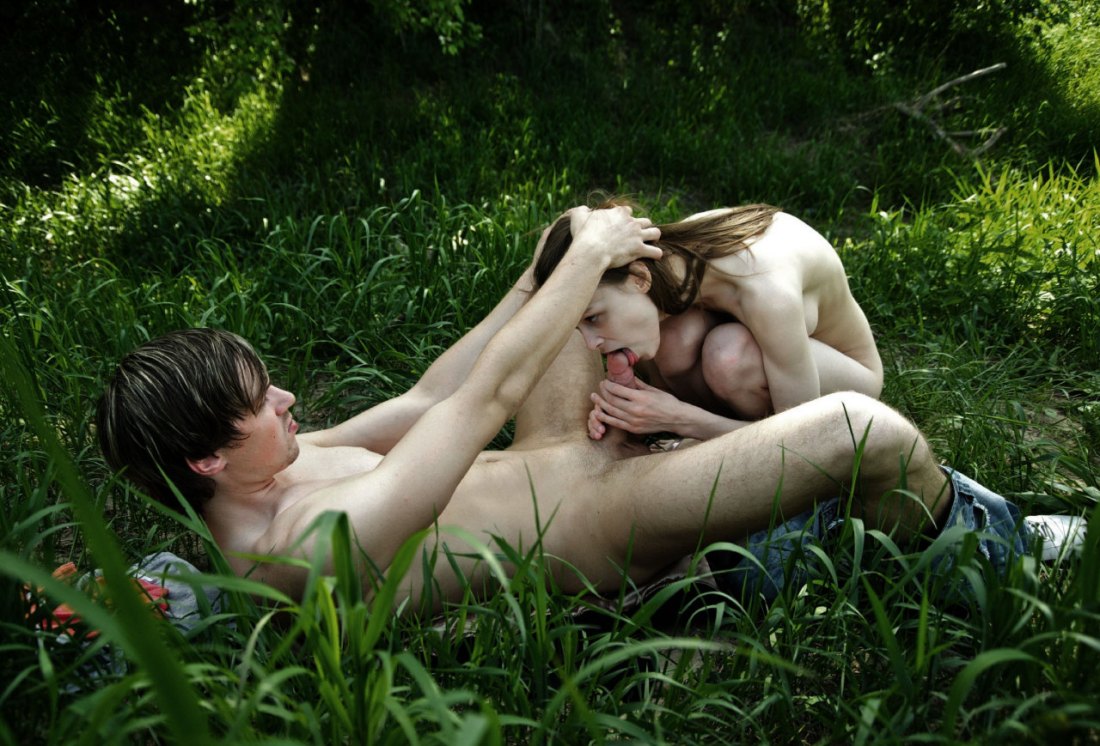
I posted an image featuring this pair back in early December

It’s cropped and the colors were mangled to hell—can someone explain to me Tumblr’s pervasive affection for the offset slider? I continue to dig that image and stand by my original comments.

Thus I was excited to happen upon another image featuring the same pair even if it was clear although the colors were better the composition was decidedly less inspired. Still, I have do have a soft spot for erotic imagery that leaves the man more exposed than the woman.

Then I noticed the boy’s expression which reads to me as a sort of haughty bitch-why-aren’t-you-deep-throating-my-shit-already pout. Uh, hello Fuckwit. She has her soft, warm tongue on the most sensitive part of your anatomy. Please die. Now.

I should have left it at that. But no, I am trying to be a more thorough curator. I just had to query TinEye.

And le sigh, it’s true the images are part of a series. It’s hosted on BeataPorn. (There’s a FREE PREVIEW of the series but probably unnecessary spoiler: it’s the same old eyes-bleeding-from-uninspired-repetition-of-the-routinzed-hetero-normative suck-and-fuck charade.)

graeandresen:

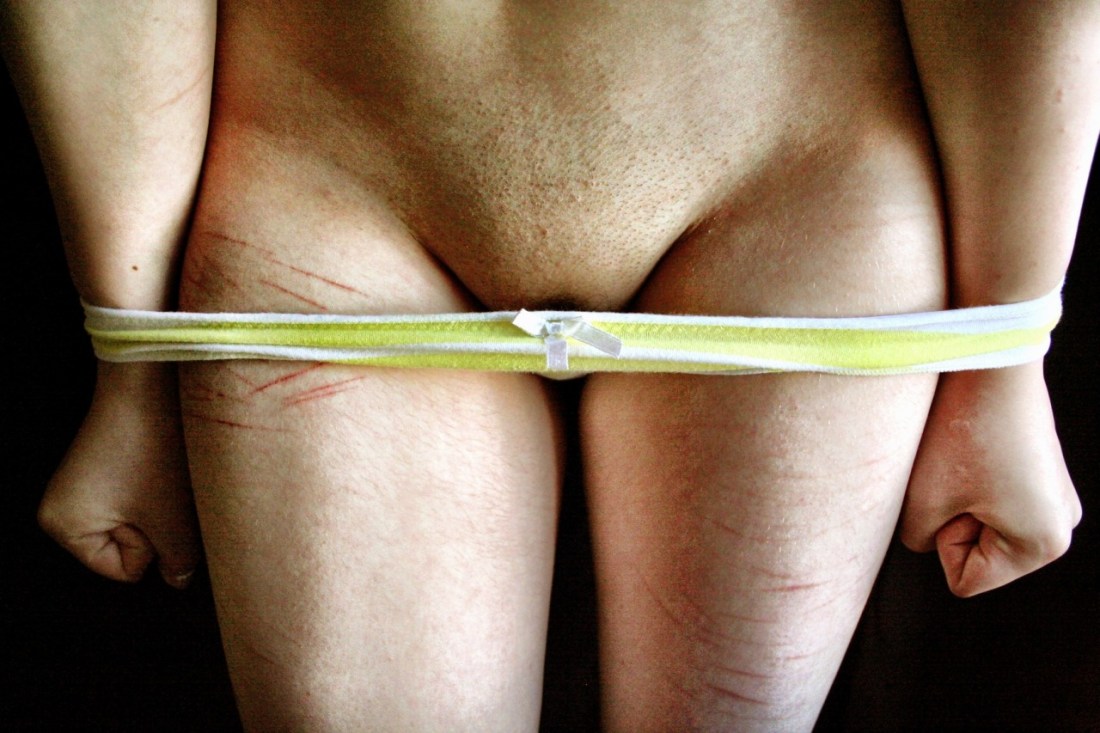
cutter painties – Copyright © Græ Andresen

Normal
0

false
false
false

EN-US
X-NONE
X-NONE

/* Style Definitions */
table.MsoNormalTable
{mso-style-name:”Table Normal”;
mso-tstyle-rowband-size:0;
mso-tstyle-colband-size:0;
mso-style-noshow:yes;
mso-style-priority:99;
mso-style-parent:””;
mso-padding-alt:0in 5.4pt 0in 5.4pt;
mso-para-margin-top:0in;
mso-para-margin-right:0in;
mso-para-margin-bottom:10.0pt;
mso-para-margin-left:0in;
line-height:115%;
mso-pagination:widow-orphan;
font-size:12.0pt;
mso-bidi-font-size:11.0pt;
font-family:”Garamond”,”serif”;}

A former flat mate—who despite being super rainforest crunch is still a friend—claims all conflicts arise as a result of unmet needs.

I chalked it up to hippy naiveté. And I would have dismissed it outright if not for the implicit critique of what qualifies as need.

Needs, to her, included the basics: food, water, shelter and clothing as well as safety, fulfillment and love. She argued being alone or unfulfilled in life causes suffering no more or less physically debilitating than hunger or thirst.

Of course, she went on to use the notion as an aide in unpacking geopolitical concerns—an at best reductive approach—which resulted in me dismissing the idea.

I’ve been re-evaluating that decision. It’s partly as a result of learning that in a month I’ll be laid off from perhaps the only job I haven’t utterly reviled. And the one thing making me not despise this job was learning first hand that I was dead wrong to dismiss my friend’s ideas because when it comes to interpersonal relationships in small groups/communities are concerned, meeting or failing to meet individual needs makes all the difference in the world.

Thus, all this messy brain spew gets entangled with this image. 

I can’t claim to be a cutter. On the other hand, claiming I have never cut myself seems a more egregious mistruth. I look at the few small scars that have yet to fade and they do not seem like they belong to me. I never cut to see myself bleed or to feel anything, I cut because in those trance-like moments there was a very real feeling that I was cutting through my body in order to reach something I wanted to destroy with the totality of my being.

It’s the strangest things to feel nothing when presented with my own case; yet, when faced with a cartographic account of similar travels, I ascribe meaning ex nihilo: maplines of unmet needs.

I identify with everything in this image. The clenched fists self-restrained, tightly cinched and pinned by panty elastic to her hips. The three day stubbly growth on the mons pubis—an outward effort to adhere to perceived norms.

There’s further resonance for me: yesterday, I left my desk to wander the deserted world where I work. With all the doors propped open I wondered in an out of buildings. I wasn’t aware that I’d had any destination in mind until I found myself standing in the doorway of the now empty room where the young woman upon whom I have a crush slept, woke and struggled over the nine months. 

All that remained was a silica gel pack against the baseboard, a small sheet of cream cardstock gatefolded with different flavors of tea printed on each section, the corner of a blue and white Nestlé plastic wrapper, a few pennies scattered among a litter of baby dust bunnies. Fingernail clippings on the desk and bureau; sequins and a Bobbie pin in otherwise empty drawers. Three or four Kleenex in a CVS pocket pack behind the mirrored medicine cabinet door above the commode and thin white bar waiting in the shower soap dish.

Presence in absence, it’s the obverse are I’ve known for so long—I no longer cut my body, no longer want to destroy, I just want to break through to reach someone, anyone, to touch and in the moment give a portion of what was given to me back to you.

This post is guest curated by azura09:

nevver:

How to bend light

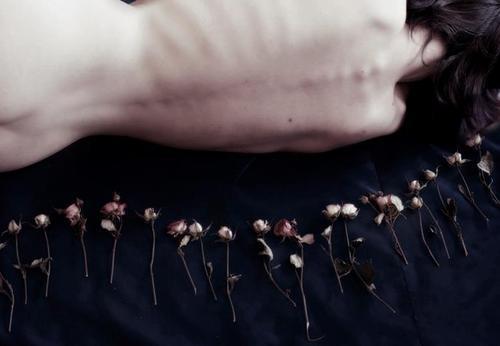
And in the dark we will take off our clothes
And they’ll be placing fingers through the notches in your spine

When I first looked at you in the almost-dark, scared that you would not like my breasts. That I would see disappointment on your face. But you still pushed me to touch you, my fingers climbing your back as I held you and kissed you near your mouth. 

Years pass and I’m used to your hatred of overhead lighting. I expect it when you reach over to turn on the desk lamp or light a candle I don’t like the smell of, wax and apple cinnamon. I’m grateful for the way you now know my body so well it’s not necessary for you to see me, but yet you still want to look.

Ilina Vicktoria

An increasing number of image makers claim to have been disproportionately influenced by Andrei Tarkovsky; few benefit from comparison. (Only two come to mind: Bela Tarr and to a greatly diminished and inconsistent effect Gus Van Sant.)

I am not sure Ilina Vicktoria espouses Tarkovskian influences but considering this famous still of Anatoliy Solonitzyn as Pisatel in Stalker crowned with twisted tree branches bears more than a passing resemblance to the top image, I’d say the odds are good she does.

Her angle of view and scale are different. Also, in her photo the branches serve less of a crown than a mobile artfully counter weighted with Siberian dogwood berries. (Also what is with that distorted blob: is it a light leak? How is it’s position so freakishly perfect to balance out the baseboard/floor and curtains at the lower right edge of the frame? It’s slightly unnerving given the clear Stalker reference—a film notable for being shot twice due to the lab ruining the original footage.)

Something deeper links Vicktoria to the famed Russian auteur, something more than similar content and shared nationality, something more like an attitude toward the image. An attitude built upon a belief of what images are meant to do.

Tarkovsky tries to say something about this attitude but his explanations skew all-to-readily toward justification and abstraction. But it wasn’t until searching for the aforementioned still of Solonitzyn for this post that I stumbled upon this awesome article on Stalker. In it, Brecht Andersch describes the effect Tarkovsky’s films achieve as follows:

The members of Tarkovsky’s audience, if only subconsciously, are brought to awareness of their own hidden depths, of the calling of the soul, of the imperative quest for the sacred. To see his films is to experience the process the Russian filmmaker described as “scales falling from the eyes”.

And that is how you can spot the real Tarkovskians even from low orbit: they are less interested in creating beauty as revealing it was there all along. (Not at all unlike Michelangelo trying to free the form which existed within the stone with his Unfinished Slaves—I can’t help but think Tarkovsky had these monumental sculptures just as much in mind as he did Acts 9:18.)

The question I am left with is: how the transcendence of discovering what is in plain sight instead of manufacturing spectacle can be applied to the visual depictions of sexuality (which is itself a pathway to transcendent experience.)

(Kudos to youarecordiallyinvitedtopissoff for once again bringing another mindblowing photographer to my attention that I never would have otherwise found.)

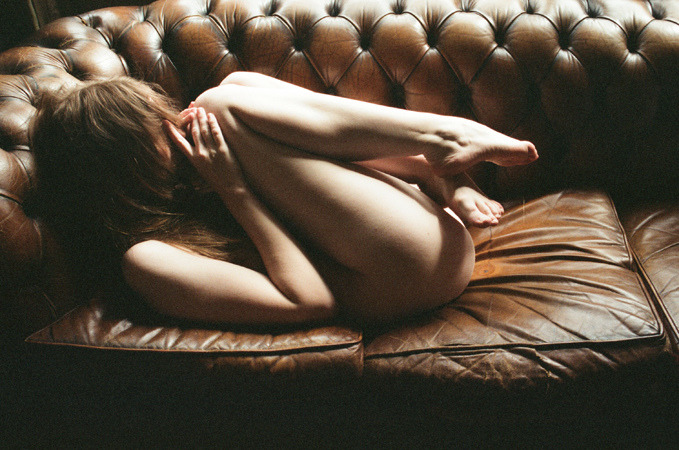
Lina Scheynius’ photographs are above all sincere in their straight-forward simplicity and lack of self-conscious pretense—capturing not only the truth of a moment but something of the initial wonderment which sparked her mind and brought the viewfinder to her eye.

Like many young, internet-famous image makers she works at the interstices of documentary, editorial and erotic photography but her handles the material with a rare prescience.

Take this self-portrait where she appears starkly naked but protectively curled up on a leather couch. She is both seen and unseen.

I cannot help but apply that to her sense of herself as a photographer. She presents the world she sees from behind and through her camera. This is especially interesting given familiarity with her larger body of work as she takes great pains to push her personal boundaries more than her models.

In the minefield resulting from conceptual concerns over the visual representation of sexual identity and body politics, although what Scheynius’ is about is perhaps more instinctive than the collaboration between Traci Matlock and Ashley MacLean, it is no less vital or interesting.

And frankly, there are a lot of photographers who could learn something from this. I am sick unto death with voyeurs hiding behind cameras snapping away as they have models enact their most deeply repressed fantasies. (I am thinking here of an individual who I would rather not name but will give apply the psuedonym Reynard Yale.)

Normal
0

false
false
false

EN-US
X-NONE
X-NONE

/* Style Definitions */
table.MsoNormalTable
{mso-style-name:”Table Normal”;
mso-tstyle-rowband-size:0;
mso-tstyle-colband-size:0;
mso-style-noshow:yes;
mso-style-priority:99;
mso-style-parent:””;
mso-padding-alt:0in 5.4pt 0in 5.4pt;
mso-para-margin-top:0in;
mso-para-margin-right:0in;
mso-para-margin-bottom:10.0pt;
mso-para-margin-left:0in;
line-height:115%;
mso-pagination:widow-orphan;
font-size:12.0pt;
mso-bidi-font-size:11.0pt;
font-family:”Garamond”,”serif”;}

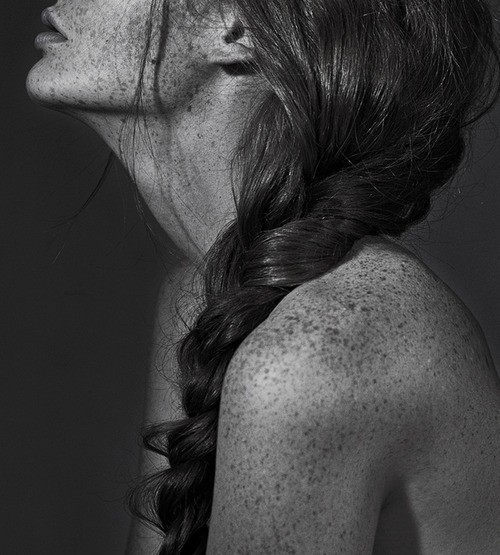
Great googly moogly aren’t freckles goddamned sexy as fuck?

And their effusion on this young woman’s shoulders and face is truly resplendent.

Now I could follow my usual knee-jerk rabbit trail with regard to composition—a horizontal frame would have almost certainly improved this photograph—but the freckles seem more the point.

Photography and digital imaging distill the space and time of a select visible area down to a two-dimensional representation. In the process, a great deal is changed and/or lost completely.

To a degree, image makers exercise control over what remains in the picture. For that reason, I am constantly unnerved that given a field of so many options the results of what stays and what goes tend to be so starkly homogenous.

Most images provide a record of an objects position in a particular spatial field at a given moment in time. How often though is the object treated as more than an insinuation representation of itself? Or, to say it in a less abstract way: when was the last time you say an image wherein skin was presented as more than the container for representation identity or a symbolic placeholder?

It’s not just pictures of people, it’s fabric, wood, everything. Photography fails more often than it succeeds to give solidity to its representations. A means of accomplishing that is beginning to think less strictly visually. There is this amazing sensory overlap between sight and sound—a sort of synesthesia that everyone shares: the sight of different textures affects our eyes differently, in a way that is—in fact—somewhere between seeing and feeling.

For example, consider this image of coffee beans ground to varying coarseness. By looking at them you see the different visual texture but that impression is processed in some fashion as an awareness that each feels different.

That’s ultimately what I adore about this image: her freckles add texture to her skin and thus weight and solidity to her body. She is not a representation; she’s a living, breathing, dreaming being with fears, hopes and ideas who also happens to be breathtakingly beautiful.

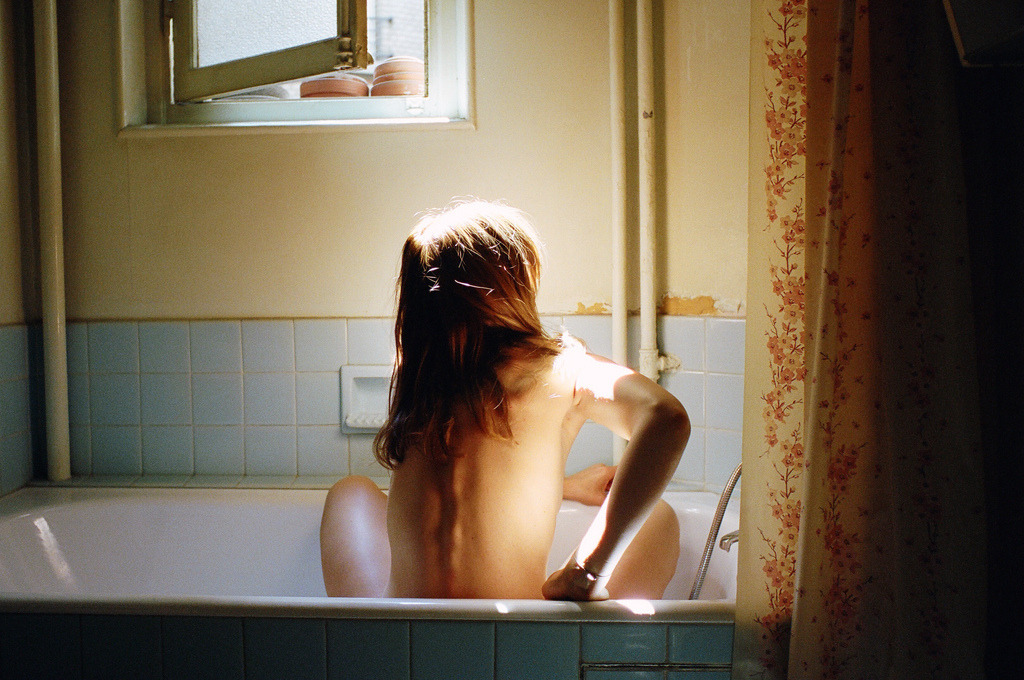
390. by Nicolas Sisto

The first thing I see, the thing that reaches out and smacks the shit out of me is the light. Fucking A.

Next and simultaneously, I notice the color of the tile and the way the light diffuses on her skin, in her hair—the way it suffuse the blue tiles and tub.

This is the sort of light photographers kill for, a distinct cousin to the magical cinematography in Malick films.

Further it’s analog, a real photograph—any detail in the highlight with such bright white hot spots would be DOA in digital. And the photographer is clearly trying to emulate the tenebrist contrast range and vivid colors of Polaroid’s late 90’s palate.

Also, in the images favor is its inclusion of two quintessential photographic tropes: nudity and miraculous light.

Still, even though I want to like this, I can’t; the light alone isn’t enough. There are two glaring flaws:

First, who sits this way in an empty bathtub? I mean honestly. It’s overly self-conscious and awkward. Look at how gorgeous I am just plopped down here in this pool of perfect light… ladiladidah.

Interestingly, there’s an outtake from this same sequence. In it some of the light’s grandeur gets lost, the pose is at least less self-conscious and therefore less contrived.

Yet, in both case the composition is fucked. You see it a lot—envisioning a strictly balanced and symmetrical shot within the frame and shooting hand held. That saying close only counts in horseshoes and hand grenades goes triple for symmetrical images. Either keep the hand held camera and accentuate the asymmetry or use a motherfucking tripod.

I am posting this photo along with the link to its sibling not to bash either so much as point out that somewhere between them is an image I wanted to see in both but didn’t. The hint of what might have been but never was is pretty incredible to me.