Jan SaudekThe Dancer (2001)

Consider:

  • the staggering tonal range and varied texture in the concrete backdrop,
  • the painstakingly graded skin tone (for me invoking little as much as the incisive crosshatching in Dürer’s etchings),
  • the obvious resemblance to Michelangelo’s David,
  • the subject is presented slightly off-center, cheated toward the source of light at frame left and formally balancing every aspect of the composition.

There’s no denying Saudek’s mastery; sadly, I find my frustration with his proclivity for shooting the same/image images in perpetuity an insurmountable obstacle to engaging with his work.

I absolutely see inspired flashes of anti-authoritarian glee, subversion and rebellion amidst the cloying repetition–all attitudes that resonate strongly with me. Ultimately, the work either commands my eye or it doesn’t.

This is one is just motherfucking goddamn incredible.

Anastasia Cazabonpart of From the Secret World series (20??)

Artist Statement:

These images are based on my own childhood, specifically the transitional period between the ages of 9-15. This period of liminality, when girls are on the threshold of womanhood, can be one of the most defining and vital stages in a woman’s life. In this stage of life, young women become acutely aware of the world around them and how they are portrayed within the world; physical appearance is suddenly pushed into the spotlight and with that comes insecurity, excitement, jealousy and narcissism.

Relationships with other girls are also critical and these friendships are often fleeting yet intense; feelings of love, envy and rivalry pervade adolescent female companionship. These friendships are also marked by polar swings of emotion – one day encompassing cruelty and the next kindness.

These images revolve around the secret, yet everyday lives of adolescent girls. The power of this transformative time is characterized by the struggle to reconcile one’s girlhood while moving into womanhood – an experience that elicits strong feelings of both fear and longing.

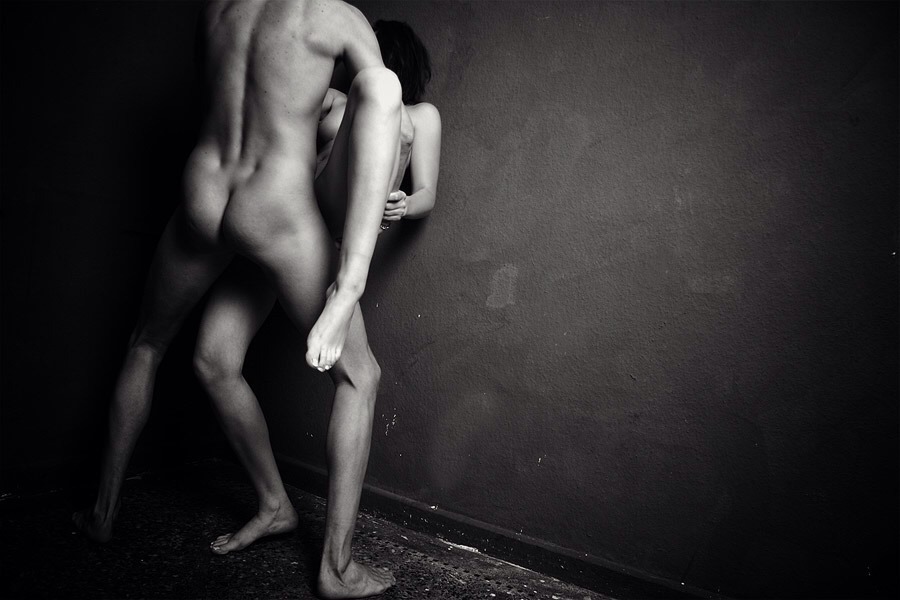
Butow MalerLena and Extreme (2013)

This appears to be from Maler’s eMagination 05: Porn Art. (A full, lo-res preview is available on Blurb.)

Here: my gaze enters the frame following the baseboards rightward thrust; the reversed symmetry of her left food to his right foot draws my eye away from the deep shadows dominating the left third of the frame; reverse symmetry is emphasized again by the echoed angles of their opposing, correspondent legs.

Upward trajectory is reinforced by the momentum of his taut musculature–sumptuously rendered in B&W–leaning into her body her body at an angle almost perfectly perpendicular to the baseboard approach vector.

In the gap between their bodies, her right breast is framed and balanced against the dizzyingly sharp focus on her left hand transferring her unsupported weight onto his arm, which in turn pulls her center of gravity towards him; the way his arm hiding her face (LOVE); the nearly seamless skin tone merging between the inside of her left knee and his triceps. 

Lastly, I notice the wall’s texture. (Look closely, the faintest hint of it recurs in the left third of the frame, differentiating between the strobes vignetting and shadow cast by his body.

For all it’s sophistication, the couple’s pose is unwieldy. Yes, it convey some of the immediacy, the laser-like focus on sensation that can mark the initiation of intimacy. All well and good but this doesn’t square with Maler’s subtitle: Porn Art.

Word order is always telling: art appended to porn. On one level, the implicit claim works: the images demonstrate a solid grasp of craft and familiarity with art conventions. On another level: thought the presentation is consummately ‘artistic’–I find it neither especially arousing nor justified in its pretense to Art.

In effect, it has matters turned the wrong way ’round: it’s one thing to make sexuality the crux of one’s creative output; quite another, to create work from a template of what is considered meritorious–it is possible to make Art that is pornographic (Klimt’ll tell you all about it); Porn Art is not nor will it ever be a ‘real’ thing.

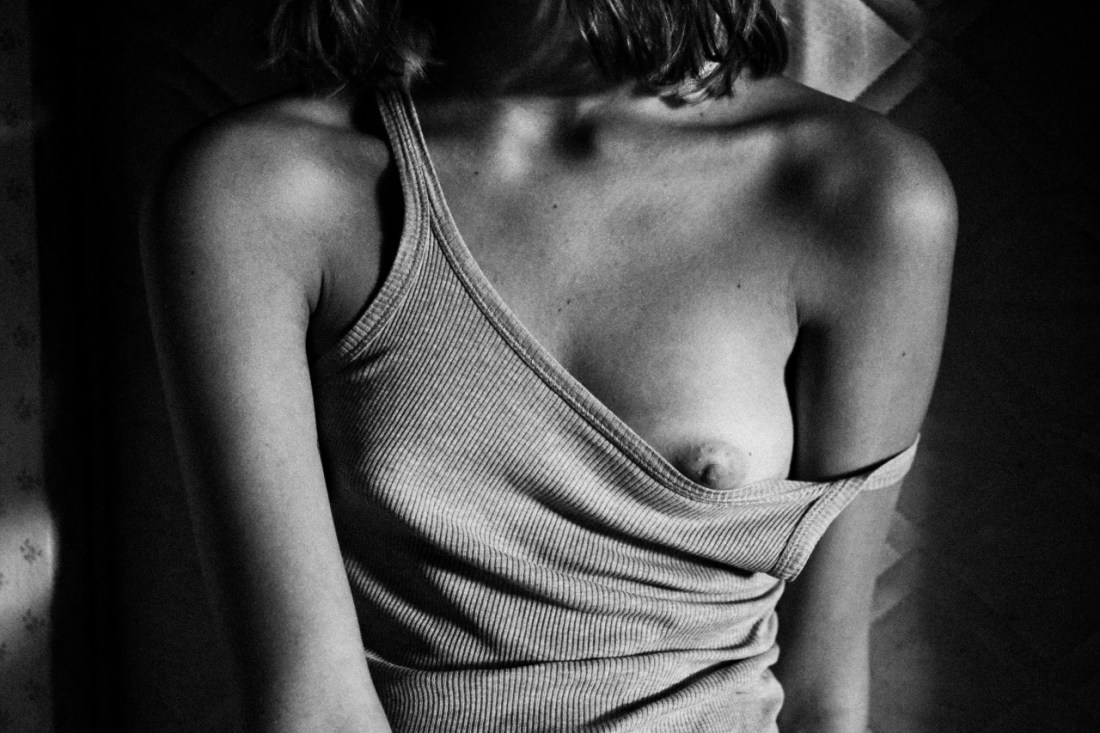
danishprinciple:

nicely in b/w

As per usual, I don’t like images that cut off the subjects head to preserve anonymity. There are literally a million more thoughtful ways to do it.

I am, however, enamored with the texture not just of her shirt but the way the light not only adds dimensionality, it gives a papery luster to her skin.

Texture isn’t only an aesthetic interest. I am highly sensitive to tactile stimulation. For example: on a good day so much as the rough seam accidentally sliding over my nipple as it is above would turn me on.

Then there are days–like today–where the thought of it is nearly enough to make me come like gangbusters.

These are the days wherein I would almost prefer to be no more than this goddamn alone.

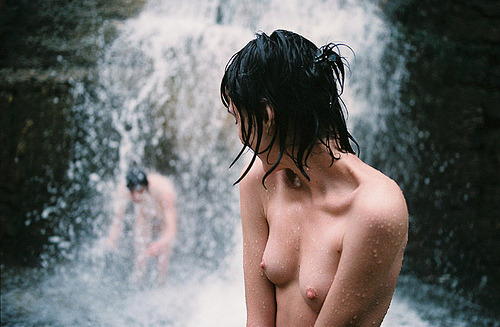
David Meskhi – from When Earth Seems to Be Light series Title Unknown 2008.

Meskhi’s website presents his as a photographer preoccupied with athletes, skateboarders and soldiers. Shooting predominately flat black and white, his inclusion of occasional, irreverent bursts of color do nex to nothing to lessen the work’s dour murk.

By contrast– and as suggested by the title– his When Earth Seems to Be Light series is full or warmth and whimsy.

It’s maybe not good but it is undeniably more accessible than the other work showcased.

It is incomprehensible that this image does not appear on the site. Instead, another image of the same young woman–Anna, apparently is featured. The second image isn’t bad; it’s casual immediacy seems forced, as if it seeking to neuter the sentimental nostalgia.

And I see how someone could read the image I posted could as self-indulgently sentimental. It is a little; However, that’s not always a bad thing–arrive for the nostalgia, stay for the Art.

In this case, neither sentimentality or nostalgia pull me in. It’s the sheen of water droplets on her skin, the texture of her wet hair. And I absolutely love how she is turned away– it reminds me of the hypothesis posited by either Edward Snow or John Berger that the young woman in Vermeer’s Girl with the Pearl Earring is simultaneously turning toward and away from the viewer. (If you’ve got seven minutes to kill, check out: a physicist tackling this question.)

I confess that this image does cause me to lapse nostalgic. But that is due to the content more than anything pertaining to the execution. See although I am in my… er… well, further from my teens than I have ever been, I missed out on a lot of normal– at least for John Hughes movies–social rites of passage.

I played Spin the Bottle a handful of times but was always told that at least one of the people playing had promised my mom that they would make sure I didn’t play. I would beg and plead but there would always be a caveat that if the bottle landed on me, the most I could do would be choose two other people to kiss. (The stopped letting me play altogether when I began suggesting two boys or two girls should kiss.)

I also realized sometime last year that I have never been skinny dipping. And it’s not that the repressive environment I grew up in was so effective and getting kids to not be kids. It was more that I wasn’t invited to gatherings where those types of things happened.

One of my New Year’s resolutions was to go skinny dipping this year. But the truth is I have just as many people to go with then as I do now.

rawpix:

May5†h♥new/sense…inside(Vadim Stein)★

Normal
0

false
false
false

EN-US
X-NONE
X-NONE

/* Style Definitions */
table.MsoNormalTable
{mso-style-name:”Table Normal”;
mso-tstyle-rowband-size:0;
mso-tstyle-colband-size:0;
mso-style-noshow:yes;
mso-style-priority:99;
mso-style-parent:””;
mso-padding-alt:0in 5.4pt 0in 5.4pt;
mso-para-margin-top:0in;
mso-para-margin-right:0in;
mso-para-margin-bottom:10.0pt;
mso-para-margin-left:0in;
line-height:115%;
mso-pagination:widow-orphan;
font-size:12.0pt;
mso-bidi-font-size:11.0pt;
font-family:”Garamond”,”serif”;}

Stein’s images suffer from critical wounds, shot through and through as they are with magic bullets of commercial viability.

In that manner his work is of a kind with Edward Weston—a photographer who epitomized the craft of photography but whose work leaves me cold.

Stein almost certainly holds Weston as a formative influence. And while I do not think he’s achieved a similar level of mastery yet—despite my ambivalence toward his content, Weston’s black and white prints are un-fucking-paralleled—when he pushes the limits of his over-produced, studio lighting comfort zone, Stein makes riveting images.

What grabs me here is the shadowplay and its emphasis of the tactile—sand, granular and smooth, against fluid human skin. (The ability of images to invoke something akin to sight-for-touch synesthesia is a long-running personal preoccupation.)

Also, it makes me think it’s high time I re-watched Hiroshi Teshigahara’s The Woman in the Dunes.

Normal
0

false
false
false

EN-US
X-NONE
X-NONE

/* Style Definitions */
table.MsoNormalTable
{mso-style-name:”Table Normal”;
mso-tstyle-rowband-size:0;
mso-tstyle-colband-size:0;
mso-style-noshow:yes;
mso-style-priority:99;
mso-style-parent:””;
mso-padding-alt:0in 5.4pt 0in 5.4pt;
mso-para-margin-top:0in;
mso-para-margin-right:0in;
mso-para-margin-bottom:10.0pt;
mso-para-margin-left:0in;
line-height:115%;
mso-pagination:widow-orphan;
font-size:12.0pt;
mso-bidi-font-size:11.0pt;
font-family:”Garamond”,”serif”;}

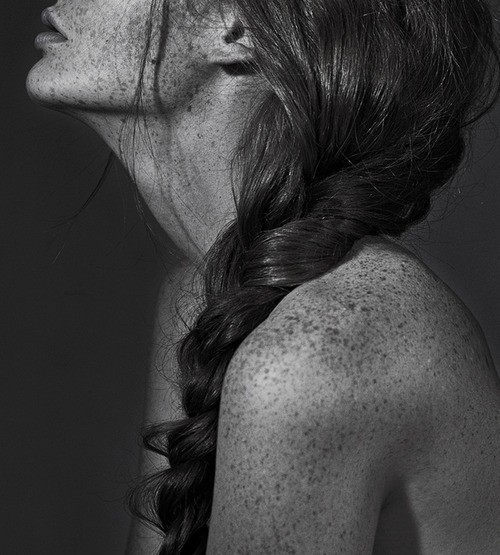
Great googly moogly aren’t freckles goddamned sexy as fuck?

And their effusion on this young woman’s shoulders and face is truly resplendent.

Now I could follow my usual knee-jerk rabbit trail with regard to composition—a horizontal frame would have almost certainly improved this photograph—but the freckles seem more the point.

Photography and digital imaging distill the space and time of a select visible area down to a two-dimensional representation. In the process, a great deal is changed and/or lost completely.

To a degree, image makers exercise control over what remains in the picture. For that reason, I am constantly unnerved that given a field of so many options the results of what stays and what goes tend to be so starkly homogenous.

Most images provide a record of an objects position in a particular spatial field at a given moment in time. How often though is the object treated as more than an insinuation representation of itself? Or, to say it in a less abstract way: when was the last time you say an image wherein skin was presented as more than the container for representation identity or a symbolic placeholder?

It’s not just pictures of people, it’s fabric, wood, everything. Photography fails more often than it succeeds to give solidity to its representations. A means of accomplishing that is beginning to think less strictly visually. There is this amazing sensory overlap between sight and sound—a sort of synesthesia that everyone shares: the sight of different textures affects our eyes differently, in a way that is—in fact—somewhere between seeing and feeling.

For example, consider this image of coffee beans ground to varying coarseness. By looking at them you see the different visual texture but that impression is processed in some fashion as an awareness that each feels different.

That’s ultimately what I adore about this image: her freckles add texture to her skin and thus weight and solidity to her body. She is not a representation; she’s a living, breathing, dreaming being with fears, hopes and ideas who also happens to be breathtakingly beautiful.