The Death of Youth – Guetcha (2016)

As I’ve noted several times already: a cliche is a cliche because it allows one a reasonable handle on something that is otherwise unwieldy and fraught with complications.

The adage against cliches emerges from the fact that by using them, one is refusing to re-engage with and analyze a concept that isn’t necessarily one-size-fits-all anew. In other words, the advice against cliches isn’t that cliches are inherently bad so much as their ready made-ness presents an obstacle to independent thinking.

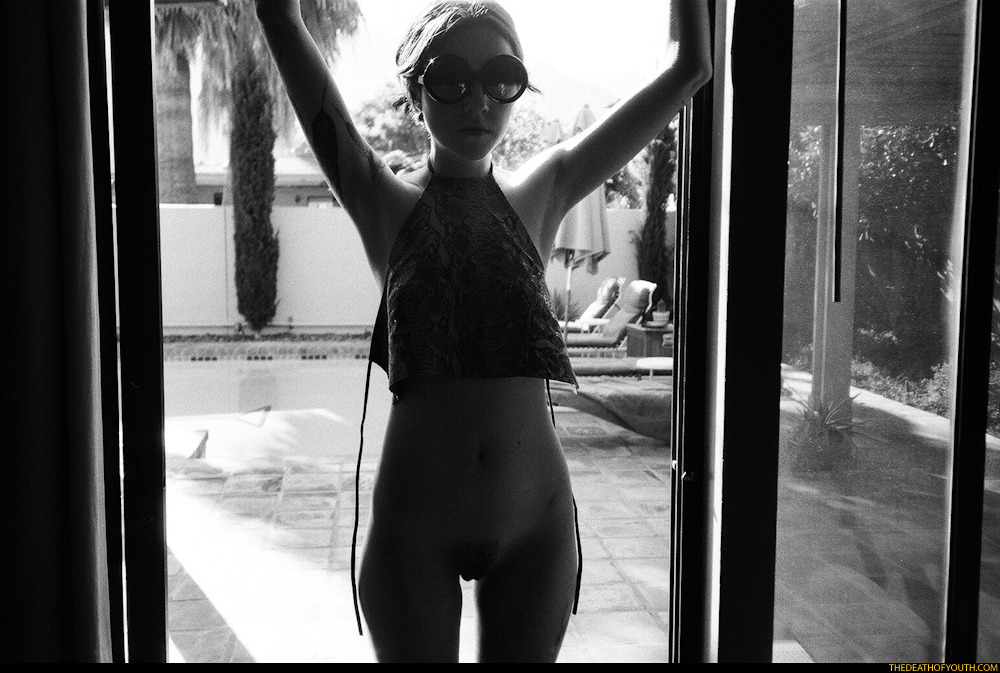
The elements of this image are cliche to the point of ubiquity: luminous lighting kissing the skin of a nude model standing before a milk white background.

Here though, the cliche serves as a foil–drawing attention away from the elements; instead, highlight the compositional attention to shape, line and tonal form.

I’d argue it’s too dark–and I don’t think that’s a matter of opinion given that the underexposure results in lose of shadow detail in Guetcha’s hair and along the right side of her face. But it’s easy to let that sort of teensy mistake slide when the result is this dynamically eye-catching.
msjanssen:

lovely backlight!

The Death of YouthAlanna (2012)

@msjanssen has already covered ¾ of what’s so arresting about this image.

All I can add is that you also need to consider the angle of the light. Yes, it’s backlit; but while the background is bright and the foreground is dark, the angle of the light is falls in such a way that you can actually make out the general shape of Alanna’s face and unlike the flattening silhouetting effect of backlighting, her body has dimensionality–you can see the shape of her hips and tummy and just make her pubic thatch.

Also, you can gather enough to get a clear notion of the pattern of her top–which is super cute. The loose hanging strings contributing a casually coy hint of eroticism.

I’m generally put off by tDoY’s semi-slick, desert counter culture as new glamour aesthetic ethos. And while I think there’s room for improvement with the above image–Alanna’s left elbow gets lost in the shadowed doorframe and the down tilt of the wide angle lens renders the plumb lines of the door as converging instead of parallel and this encourages a downward cast of the gaze that walks a razor wire line between breathless appreciation and leering; in turn that renders the way both her arms and legs are amputated problematic regardless of which side the viewer tips toward.