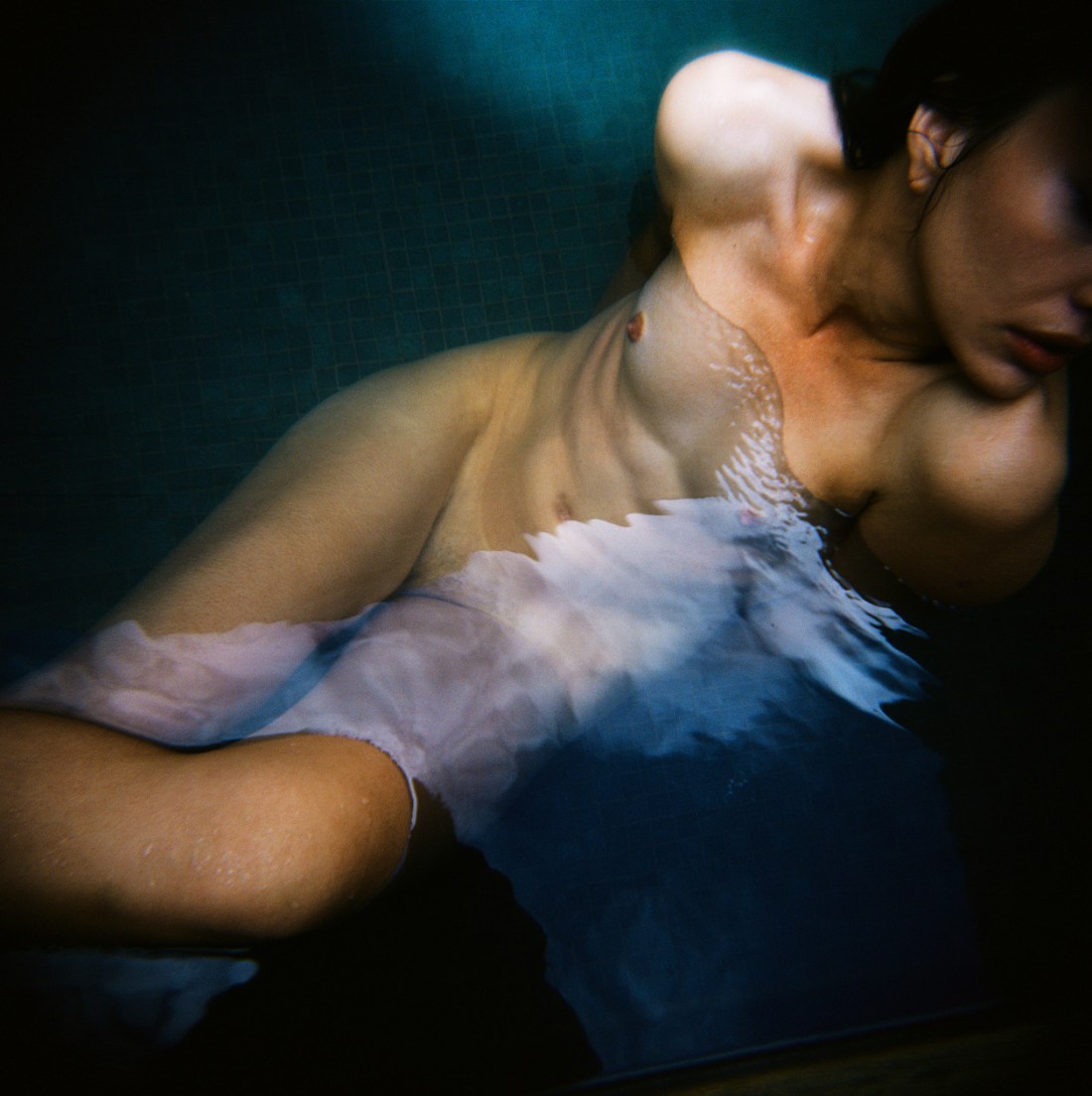
Taylor RadeliaUntitled (2010)

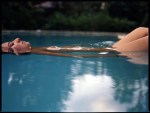
This crossed my dash attributed to William Eggleston.

On the one hand I can understand why someone would think that. It’s an image of a piece with Eggleston’s oeuvre–fixated upon seeing the beauty of colors despite the often numbing interference of the mundane.

It’s almost like this photo by Radelia is–from the standpoint of photography math: this + this.

There are still notable differences anyone who has spent any sort of time with Eggleston’s work really ought to have caught: namely, Eggleston doesn’t really use a strobe all that often and although virtually all of his work trades in sublimated sexuality, the above is a little too direct in it’s perverse punning to be a lost Eggleston.

Radelia’s image is fascinating though because it’s a rare work that both stands on its own to feet but also holds up well when compared with the work from which it clearly draws inspiration. That’s not a small thing at all.

Eber FigueriaLeonard Lucas (2016)

Be careful. The moment
you start talking you create a verbal universe, a universe of words,
ideas, concepts and abstractions, interwoven and interdependent, most
wonderfully generating, supporting and explaining each other and yet all
without essence or substance, mere creations of the mind. Words create
words, reality is silent.


                   –Nisargadatta Maharaj (via emergentseas)

There is a voice that doesn’t use words.
Listen.
                   —
Rumi (via blackshivers)

Rodolfo AsinNoelia (2013)

A black and white photograph (and I say photograph specifically because no matter what your opinion on digital, there is no damn reason anyone should be working in B&W in digital–it’s just poor form) can convey a lot of things. It can be sinister, moody, clinical, severe, etc., etc.

In other words, a B&W photograph no matter the concept or execution carries a sense of shining a light onto a scene in a such a way that allows the viewer to discover the foreign in the familiar.

Color just doesn’t work like that. A photo or image can be in color and be good and important and sumptuous without really even being about the color.

So every B&W image is at a certain level monochromatic in the same way and every color photo or image appears in color in a different way.

Loosely speaking, when we are interrogating color images there are two sorts of photos/images: those in color and those about color.

To my mind, William Eggleston is really the only photographer who ever managed to cobble together a body of work managed–largely–to accomplish both.

Eggleston established a beach head that allowed other photographers–like Stephen Shore, Jeff Wall and Joel Sternfeld to emerge. These photographers were interested in trying to bridge the gap between color as facet of the image and color as intrinsic to the images manifold meaning.

Yet, most work post-Eggleston color work seems less interested in solving a problem like color than dealing with issues of color fidelity, depicting mundane normalcy (for some reason B&W always seems more immediate and authentic, even though it’s not how we naturally perceive the world) and the employment of color as a means of orchestrating emotional response.

Whereas, folks like Harry Gruyaert, focused on color itself.

Now what I find interesting is that to a certain degree Shore, Sternfeld and Gruyaert and desaturate their photos, the images lose some of their punch but they still work. (With Gruyaert, you have to bear in mind that he titled his images. Also, I’ll concede that this might be splitting hairs since both Shore and Wall both work in both color and B&W.)

Eggleston desaturated is just fucking pointless–the color is effectively the glue holding everything together.

These days–sadly–most of the raft of internet famous photographers & image makers produce images in color or B&W and more likely a combination of the two. But I’m hard pressed to name anyone who like Eggleston is making work that only works in color. @pru-e is the first person who comes to mind. (But that’s also not entirely fair since she’s arguably one of the best up and coming image makers in the world.)

Asin, like Shore, Wall and Sternfeld, loses a good bit of his punch in a desaturated reimagining of his work. But he is doing some extremely exciting things with color. The work absolutely loses some of its punch in B&W but it also loses a vitality that the color contributes to the scenes.

I’ve featured another of his images several years back and I was just as taken with his use of color then as I am now.

Elina BrotherusBlack Bay from Artist and Her Model series (2010)

I’m frequently asked how I know so much about art history. My response is usually two fold:

  1. I don’t really, and
  2. What I do know is the result of having a Survey of Western Art professor that while not an especially dynamic classroom presence was passionate about the ethos embodied during the Renaissance and the endless possibilities for conceptual interrogation presented by modern art; also, he took a personal interest in my endless reserve of irreverent curiosity.

People usually tell me that by virtue of being able to identifying the latter proves the erstwhile as a fallacy.

While I can certainly follow the logic leading to such an assertion, I feel like there’s a lot that I learned that never took. Given a a list of epochal buzzwords, I can probably do a workperson-like job of putting them in proper chronological order. I can probably even identify a half dozen famous works that sprung from various movements. But it all seems so arbitrary to me, I have a difficult time applying factual trivia I memorized in order to be able to fill in a blank on an exam towards an sort of practical purpose.

In other words the relationship between/ruptures/disjunctions governing the disparity between say Expressionism and Impressionism is something about which I have a really difficult time giving more than half a fuck.

On the other hand, I am INTRIGUED by mapping the evolution of representation of 3D space in 2D (aka perspective) from Giotto to Fra Angelica through Masaccio to Perugino and Rapheal in the Italian Renaissance on to the deconstruction of perspective that was Cubism.

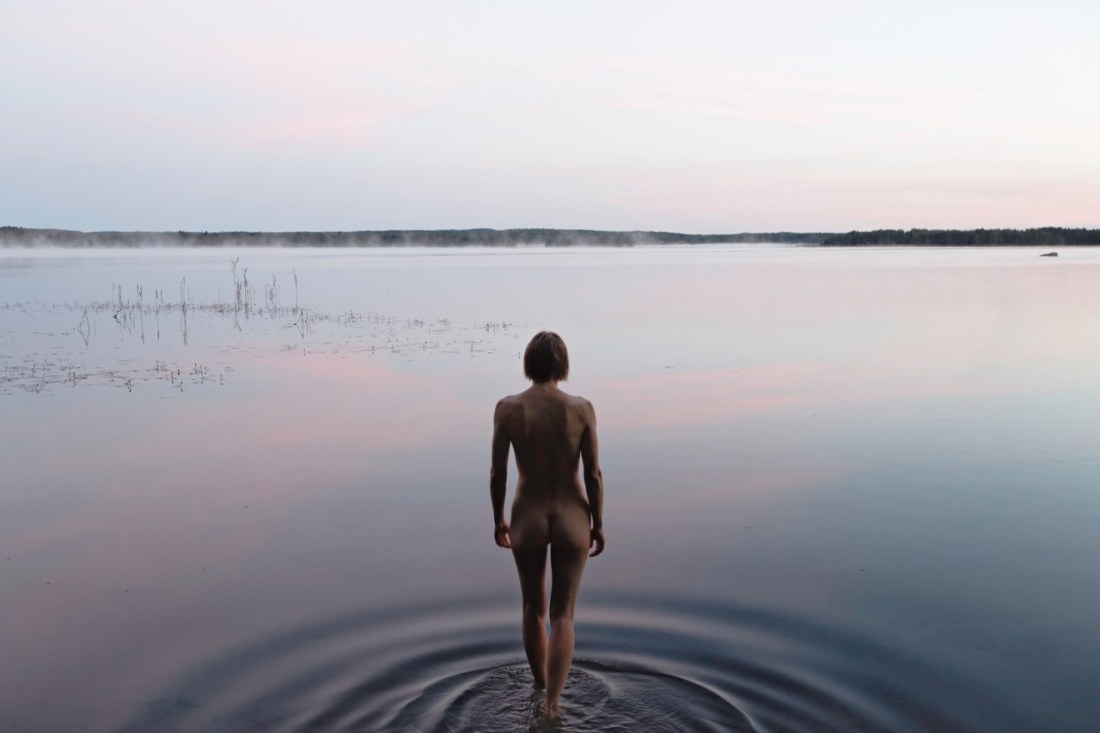
Brotherus’ image reminds me of Adi Putra’s Once in a Blue Moon. Yet that similarity is likely less due to influence (think of influence as pouring a portion of wine from one glass into another) than a sort of positioning in an art historical context (thing of the art historical context as the grapes that are used to make Cabernet Sauvignon, it grows virtually everywhere and is the same grape but climate, soil and other conditions shifted the taste so that two different wines that come from the same fruit taste entirely different).

The one image reminding me of another actually cued a third image. I couldn’t remember the title but I remembered enough of what’s depicted–a man, dressed like a dandy, standing on what appears to be a mountain peak staring into the clouds.

It’s not a mountain, in fact; it’s a jagged shoreline–not just clouds but also fog. The painting is of course the definitive work of romanticism, Caspar David Friedrich’s Wanderer above the Sea and Fog.

Friedrich famously proclaimed:

[T]he artist’s feeling is his law.

It strikes me that both Brotherus and Putra are working within a similar scope as romanticism–Brotherus is likely influenced directly whereas Putra is almost certainly unaware of any connection to the broader art historical context. (That’s an assumption but one based on the fact that I’m not inclined to suggested Putra is a fine art photographer whereas there’s nothing else that better applies to Brotherus’ work.)

Interestingly, I think a goodly amount of the work produced by internet famous photographers and their ilk actually embodies an unconsidered, knee-jerk affinity for a romantic approach.

So while I’m not 100% on board with Brotherus’ work, I do appreciate that she definitely appears to know what she’s doing with it. I just feel like her work would benefit from a shift away from a sullen reimagining of Wordsworth and instead striving for something closer to a Walden era Thoreau as itinerant nomad.

Vojtěch V. Sláma – [↖] Catherine in the Pond, Slatina, Czech Republic from Wolf’s Honey series (1998) [↗] Lucy, Jevišovice, Czech Republic from Wolf’s Honey series (2003); [↙] Ka. Te. Mi., Slatina, Czech Republic From Wolf’s Diary series (2006); [↘] On a Schooltrip, Stříbský mlýn, Czech Republic from Wolf’s Honey series (1999)

Is not the most erotic portion of a body where the garment gapes? In
perversion […] there are no
“erogenous zones” (a foolish expression, besides); it is intermittence,
as psychoanalysis has so rightly stated, which is erotic: the
intermittence of skin flashing between two articles of clothing
(trousers and sweater), between two edges (the open-necked shirt, the
glove and the sleeve); it is this flash itself which seduces, or rather:
the staging of an appearance-as-disappearance.

Roland Barthes, The Pleasure of the Text

Benoit PailleRainbow Family member 39 (2011)

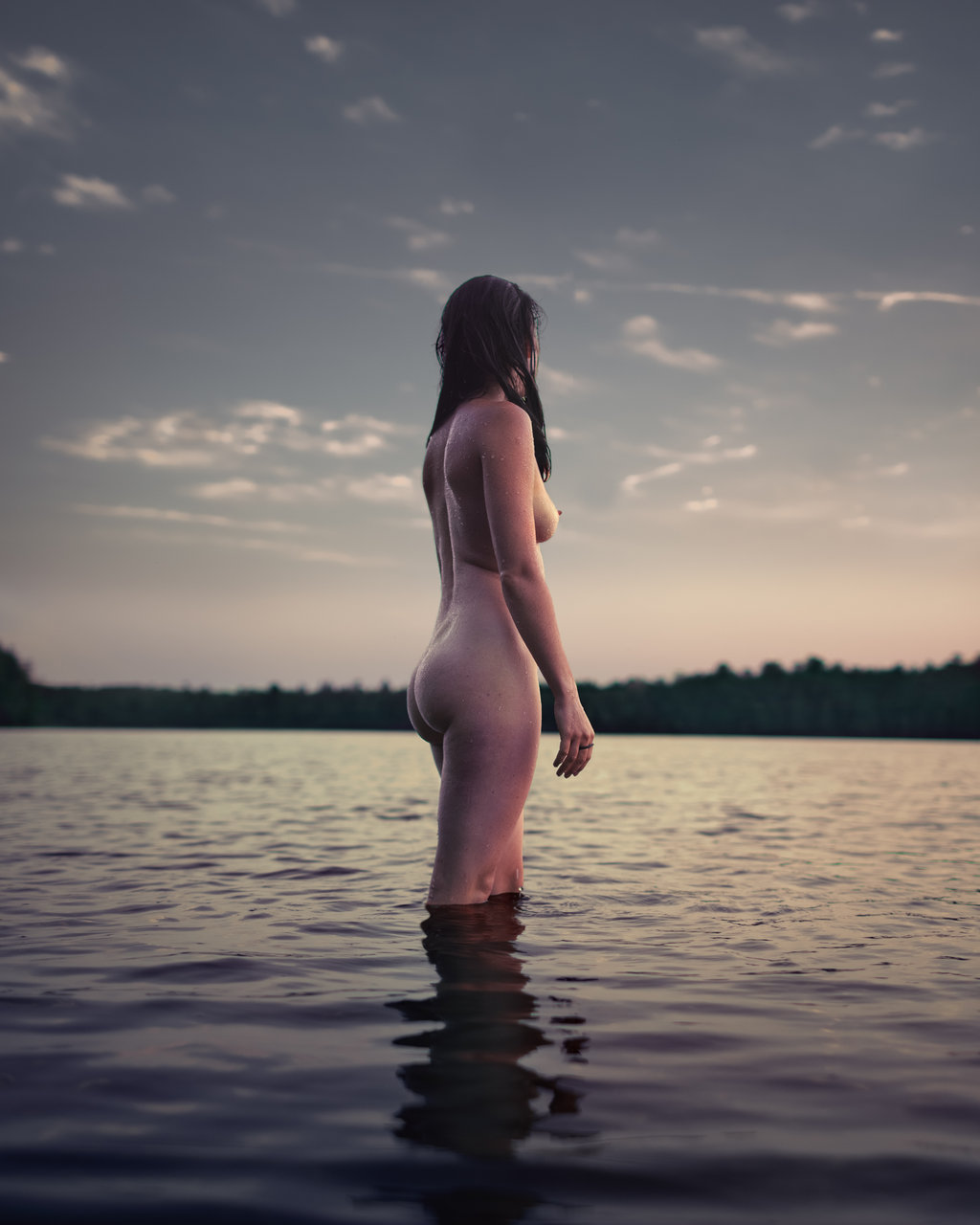
I can’t think of a contemporary image maker who casts a wider net than Paille.

In the last five years, he’s explored Crewdson-esque quasi-narrative, made a bunch of stuff with strobes mounted on drones, used a video game as a point of departure for landscape work, created realistic scenes via masterful Photoshop manipulation and made portraits of business owners in and around Paris.

Not all of it works. Yet, what’s surprising is how much of it does. And usually what makes that which works do so is a direct result of Paille’s fascination with surreal, psychedelia-inflected lighting.

The above is wonderful because of the subtle and dynamic gradation of skin-tone–red, purple, pink and peach tones that present with something like an inversion of the sky. (I’m saying it poorly–but think of the sky as if it were a positive and the woman as if she were a negative placed onto a positive field.)

The slight cant of the horizon and the way her reflected shadow goes completely black in the water all work together for an arresting, incisive image.