letmedothis:

spoil me

Still from A Surprise Guest featuring

Straight-up (pun maybe intended), this is some Grade A #skinnyframebullshit.

Yes, it’s nice to see Cindy presented head-to-toe sans frame line amputation/decapitation. But the result is all wawkerjawed.

I am going to overlook the original image being both in color and bordering on overexposed– I fail to understand how shooting to the right is preferable to just exposing correctly in the first fucking place. But, why did some idiot feel compelled to de-saturate? Was the goal to produce a flat, low contrast image? If so: bravo– mission accomplished.

Technical concerns aside, the image’s awkwardness also works in its favor. It is, after all, an image belonging to a larger more-or-less sequential, implicitly narrative images. For example: before I researched this image, I was fairly sure that this young woman walked in on the young man in the tub, things escalated and she began to undress. (As far as I can tell, that is in fact, what happens.)

There is also the ripe implication of what will happen next: the scenario will proceed to intercourse. Thus, this single image contains all the information for the viewer to discern the entire narrative arc without seeing any other image.

The possibility of distilling a story to a single narrative image seed is an idea with which I am pathologically obsessed. And for all its faults, I actually prefer this to the arbitrary, narrative pretense of photographers like Gregory Crewdson, Sébastien Tixier and Reverend Bobby Anger. (If you disagree with this premise: attempt to envision what happened immediately prior and what will happen next. (Pro-tip: you can’t; despite all the gum flapping about narrative, when the work has more in common with the so-called ‘tone poem capturing the something of the weight in moments heavy with emotion.)

But, I would have posted this for nothing more than the way Cindy is standing over the boy in the tub, her expression which might actually be an unfeigned premonition of pleasure. Plus, I think it is so, so hot that she still has her top on.

danishprinciple:

[Siren by] Stephen Carroll

I am about as anti-digital as you can get short of Nottinghamshire circa November 1811.

In the broadest strokes my grudge distills to rejecting the commonplace assumption that since the physical process and user interfaces involved in making a photograph and a digital image is similar, there exists an interchangeable equivalency between them.

Fucking bullshit.

Analog photography produces a physical artifact representing a moment in time. That resulting artifact—negative or positive—stands in relationship to both the moment of creation and all subsequent retellings.

Digital image making translates light into a phenomenally long string of ones and zeros.

As a result of these differences, each process responds differently to similar situations.

  • Digital can’t handle overexposure; negative stocks benefit from mild overexposure.
  • Digital has immense depth of field even large apertures; film shot using fast lens with the aperture fully open have a narrow depth of field (DOF).
  • Digital makes it easier to capture an image in low-light settings as result of its extended DOF; however, digital is incapable (and will always fall short) of rendering a true black.

Digital works best when its limitations are embraced instead of obfuscated. (Recall the scenes in Zodiac where they are driving around at night and nothing is really dark so much as murky vs. The Social Network where wide open prime lenses stopped down to the correct aperture using ND filters in an effort to create a more filmic DOF and instead resulted in emphasizing the deathly plastic pallor digital imposes on everything and looked less like film.)

As much as a detest digital, there are a small group of people who embracing the multifarious shortcomings of digital and do interesting things.

  • Noah Kalina has created a cottage industry using the sweet spot just inside to digital overexposure margine for fashion editorial work.
  • Pedro Costa’s Colossal Youth is one of the few instances wherein digital proved superior to film.

After seeing the image above and how it employs the same deathly plastic pallor I loathe so much in digital as a hyper-stylized means of conveying the ethereally phantasmal splendor of fading light on still water and wet skin.

selections from Caroline MackintoshThigh Deep series

This is so how I want to celebrate my birthday this year.

Alas, with two or three exceptions my friends wouldn’t be down for drunken skinny dipping. (And I am way too chicken shit to suggest it as an option.)

Maybe next year. (Probably not though.)

Le sigh.

(Soundtrack suggestion: Oceanic)

youarecordiallyinvitedtopissoff:

Jessica Silversaga

171.

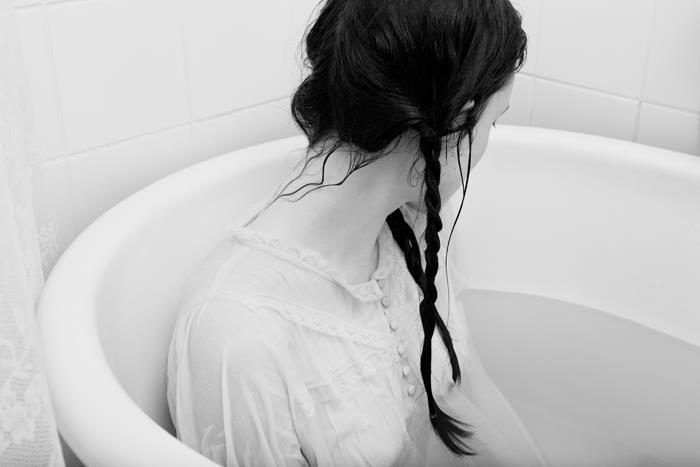
The dreamy ethereality of Jessica Silversaga’s work compliments her affection for fairy tales.

Despite their suffused light and idyllic innocence, her images have nothing in common with the ubiquitous Disney versions except the subject of beauty. But where the mass market films reify the notion that goodness always carry the day, Silversaga’s images employ the mechanism of the original materials—wherein the brutality of cruel, pricking thorns frame the delicate rose, rendering it all the more beautiful as a result of sinister intentions.

The brilliant white of tiles and tub, the few clinging strands of wet hair escaping thin braids at her neck and her averted face are replete with beauty.

But why is she turned away. I question whether she has a face– perhaps there is nothing but ragged skin lining the edges of a gaping black void.

Maybe such a response is a result of having seen too many horror movies. (Although I do not think I am entirely off base… she is after all turning left and as the eye enters the frame and passes left to right over it it becomes clear there is nothing she can be looking at. Interestingly, if this image were flipped and she was looking to her right, I think the singular thought would be she was merely turned away.)

It does not matter whether she has a face or not, what matters is her knowing what it is to hold chaos in one’s palm because like us all she too has a body.

By knowing this, we also know she is not another dime a dozen damsel waiting for deliverance from distress.

She is the thorn and the rose. As are we all.

(via captio)

A not insubstantial number of images indelibly imprinted on my mind have been made by Traci Matlock and Ashley MacLean—or, as they are perhaps better known: Rose and Olive of tetheredtothesun on Flickr and Nerve.com photo blog fame.

One cannot talk about Rose and Olive without addressing process. As I recall, they their work was always intended as a collaborative undertaking: Rose shot Olive and Olive shot Rose. The subject of the resulting image became the final authority on whether or not the image would ever see the light of day. In this way the subject is also a co-author of the work—an especially clever fuck-you to the proprietorial expectation of traditional male spectator.

Their work rings truer than most, resonating with a sense that this moment was something that happened just as you see it here.

The result has always been in my opinion some of the most sexual explicit photographs—if not so much in content, in implication—I have ever seen.

It’s possible to dismiss it as cloyingly exhibitionist, but the trust between the two is too wide-eyed in its unwaveringly dedicated sincerity.