Clips from the first part of this scene can be seen on XVideo.

***

My first instructor in film school was a regal woman of Indian sub-continental extraction. On the first day while I second guessed all the decisions that had brought me there, she went around the room, greeting everyone by name with a Namaste + a bow; she explained it meant the spark in me acknowledges the spark in you.

***

About a month ago, an acquaintance/friend was chatting with me. We had been talking about a number of superficial things when the topic suddenly shifted to childhood trauma. I had to figure out ways to deal with [the] darkness, and they were definitely not healthy, she said.

***

When I was eight I was preoccupied with black holes. They intrigued me because light could not escape them.

I wondered if one could focus darkness in the same manner as a flashlight focused light + and the respective beams were pointed directly into each other which would win out?

***

Why isn’t there a word for the darkness in me will not turn away from the darkness in you?

There is but it is not a word. I speak it with lips, with tongues + touch. And while I speak everything is dew wet—new and true.

***

This darkness in me stares into the darkness in you.

passius:

porn4ladies:            passius:

Olga Karasik404 2013

The use of the mirror here is goddamn inspired– obscuring both women’s faces within the frame. (See!! There’s no reason to decapitate yourself in your images to maintain your anonymity. A little creativity goes a long way and makes for better pictures.)

It’s obviously beholden to Francesca Woodman; but it wisely cribs a page from the rock and roll rule book for performing cover songs: make it better than or do it different.

Karasik filters Woodman’s concerns through her own aesthetic sensibility in a way that marks it as reinterpretation instead of a rearranging of elements in a template.

Sadly, it’s either some #skinnyframebullshit; or, :::shudders::: cropped. (I loathe a we’ll-just-fix-it-in-post attitude. Do it right the first time or go the fuck home. Post-production is a safety net in the unlikely chance it becomes necessary; the entire fucking point is not to need it.)

I guess at least evinces some thought went into the decision to opt for the skinny frame.

Excuse me while I throw this down, I’m old and cranky and tired of hearing the idiocy repeated by people who ought to know better.

Real women do not have curves. Real women do not look like just one thing.

Real women have curves, and not. They are tall, and not. They are brown-skinned, and olive-skinned, and not. They have small breasts, and big ones, and no breasts whatsoever.

Real women start their lives as baby girls. And as baby boys. And as babies of indeterminate biological sex whose bodies terrify their doctors and families into making all kinds of very sudden decisions.

Real women have big hands and small hands and long elegant fingers and short stubby fingers and manicures and broken nails with dirt under them.

Real women have armpit hair and leg hair and pubic hair and facial hair and chest hair and sexy moustaches and full, luxuriant beards. Real women have none of these things, spontaneously or as the result of intentional change. Real women are bald as eggs, by chance and by choice and by chemo. Real women have hair so long they can sit on it. Real women wear wigs and weaves and extensions and kufi and do-rags and hairnets and hijab and headscarves and hats and yarmulkes and textured rubber swim caps with the plastic flowers on the sides.

Real women wear high heels and skirts. Or not.

Real women are feminine and smell good and they are masculine and smell good and they are androgynous and smell good, except when they don’t smell so good, but that can be changed if desired because real women change stuff when they want to.

Real women have ovaries. Unless they don’t, and sometimes they don’t because they were born that way and sometimes they don’t because they had to have their ovaries removed. Real women have uteruses, unless they don’t, see above. Real women have vaginas and clitorises and XX sex chromosomes and high estrogen levels, they ovulate and menstruate and can get pregnant and have babies. Except sometimes not, for a rather spectacular array of reasons both spontaneous and induced.

Real women are fat. And thin. And both, and neither, and otherwise. Doesn’t make them any less real.

There is a phrase I wish I could engrave upon the hearts of every single person, everywhere in the world, and it is this sentence which comes from the genius lips of the grand and eloquent Mr. Glenn Marla: There is no wrong way to have a body.

I’m going to say it again because it’s important: There is no wrong way to have a body.

And if your moral compass points in any way, shape, or form to equality, you need to get this through your thick skull and stop with the “real women are like such-and-so” crap.

You are not the authority on what “real” human beings are, and who qualifies as “real” and on what basis. All human beings are real.

Yes, I know you’re tired of feeling disenfranchised. It is a tiresome and loathsome thing to be and to feel. But the tit-for-tat disenfranchisement of others is not going to solve that problem. Solidarity has to start somewhere and it might as well be with you and me.

Hanne Blank  (via mooncrumbs)

Goodness, yes.

(via feminesque)

thebodyasconduit:

‘And in this vision

the present is also revealed as a ruin.’

(Hal Foster)

*

by Traci Lynn Matlock

June 20th & July 9th, 2013

film

More often than not, articulating what’s going on in my head is like trying to fit an iceberg through the eye of a needle.

It’s like I see 300 images compressed into three seconds and I have to recall every bit of it with eidetic specificity. 

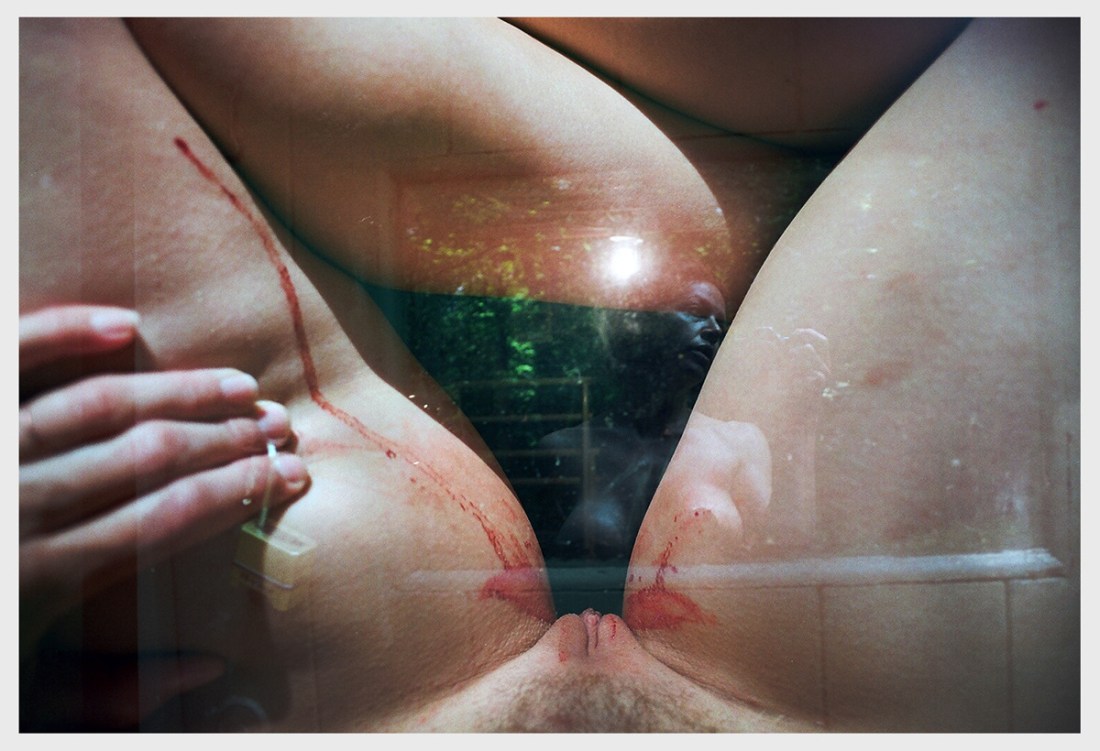
With this image what I can remember runs something like: ugh, multiple exposures; and, must Art always be goddamn sexist, there’s what, centuries worth of images featuring featuring women as essentialized, sexual objects but how many images can you think of where a female bodied individual is portrayed as a someone with a vital inner life independent of what a man thinks of her or the audacity to—clutch the pearls—depict menstruation; and, what would Szarkowski’s reductive Mirrors and Windows make of this?

The enormity of seeing the original thought surface, the marvel of its intricate perfection is all but lost.

My recall is sometimes astounding. I live for those moments.

During the remainder of the time, its like guessing at the original picture based on nothing more than a handful of puzzle pieces.

Occasionally, the pieces lead to more pieces. Given enough time, I can confidently point to an approximation of that first notion. Most of the time though, I can’t.

At which point I am left with the choice of giving up or trying to say something that manages to make sense of the pieces I have and hopefully points however glancing toward what I want to say.

Stories, I have learned, are a valuable tool in this process. Telling a story doesn’t always turn up more fragments. But it frequently triggers additional moments of astonishing clarity.

It doesn’t feel like there is a connection but I feel compelled to talk about how I discovered Matlock’s work.

Usually, I attribute my motivation to buy my first 35mm SLR to encountering her work. But that’s personal mythology; not the truth.

At the time, I was in film school studying cinematography. The summer between my junior and senior year was the first time I was not scheduled to shoot anything for anyone else and couldn’t afford to shoot anything of my own. So despite knowing nothing—less than nothing: fuck all—about still photography, I snagged a Nikon 8008s with a 50mm f1.4 lens. The salesman had to help me load the first roll of film.

The first handful of rolls turned out better than I had any right to expect. And after being prodded by my ‘adopted’ sister, I put some of my stuff up on Flickr. (This was back in the days of the simpler, more elegant interface and with it the now long gone pervasive sense of community.)

Part of me relished nominal attention my photos received. I likely would have bored of it, if it hadn’t been for the Explore feature.

After about six months of shooting, I hit my first plateau. The magic was far from gone but the process had begun to feel like work. It was that dead man’s land between Thanksgiving and Xmas and in combination with my frustration with my photographs, extremely loneliness and handful of other mitigating circumstances, created a perfect storm during which I stumbled onto Matlock and Ashley MacLean’s collaborative work under the moniker tetheredtothesun.

I remember distinctly that this was the first image I saw. Seeing it produced a feeling identical to the moment of surfacing, of mental clarity. Only, the three second time limit had been lifted. I could sit and stare; wonder at it all. Dwell there for a time.

I cannot understand how everything in my life since then has hinged on the flipping of that switch. I still don’t completely understand it. But it opened my eyes to the fact that the work I was making ran contrary to what I longed to create. Further, it lacked willingness to be vulnerable to others.

It’s not especially clear but the original thought I wanted to write about here was a bit of an extended metaphor. Something to do with the way parents track their child’s growth with pencil marks on a door frame. So much of my own creative development lines up in my mind with photographs Ms. Matlock has either helped to make or made herself. (I will write a goddamn dissertation of a post if I ever manage to track down her photo of Smashley titled something ‘a well-explored room’,.)

I don’t get her multiple exposure work. It doesn’t move me in the same way as her more candid images.

Matlock was recently interviewed by The Photographic Journal. Reading it I was reminded of how influential her work has been in my development as a photographer. It’s simultaneously thrilling and unnerving.

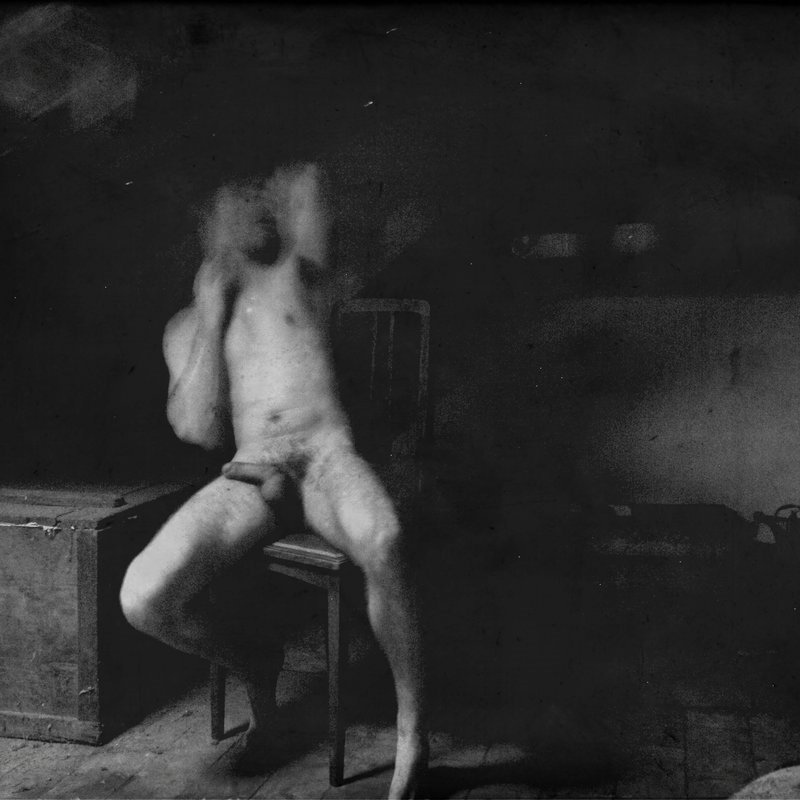
I have tried to source this but neither Google Image search or TinEye are coming up with anything conclusive.

This uncertainty exacerbates my polar reactions to it. Most of the time, the muddiness is reminiscent of Duane Michals early-ish work, particularlly a moment of perfection.

But there are also times–like writing this–where the position way his arms are positioned and his motion blurred face feel more like a horror film, a sort of  E. Elias Merhige’s Begotten-esque haunted house where the ghost seduces then strangles the amorous.

I don’t know what to make of it. Not in an I don’t give fuck one about it, though. It’s so true what is said about the distance between what we love and hate is much less than the disparity separating love from apathy.

There something else rattling around in my head about the body as a house haunted by a soul, but language and I are having another one of our frequent sullen tiffs. Besides, any time it starts to feel like the only thing I have ever known, I start to forget how the stories go.

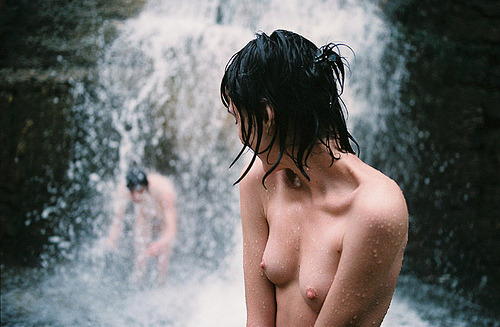
David Meskhi – from When Earth Seems to Be Light series Title Unknown 2008.

Meskhi’s website presents his as a photographer preoccupied with athletes, skateboarders and soldiers. Shooting predominately flat black and white, his inclusion of occasional, irreverent bursts of color do nex to nothing to lessen the work’s dour murk.

By contrast– and as suggested by the title– his When Earth Seems to Be Light series is full or warmth and whimsy.

It’s maybe not good but it is undeniably more accessible than the other work showcased.

It is incomprehensible that this image does not appear on the site. Instead, another image of the same young woman–Anna, apparently is featured. The second image isn’t bad; it’s casual immediacy seems forced, as if it seeking to neuter the sentimental nostalgia.

And I see how someone could read the image I posted could as self-indulgently sentimental. It is a little; However, that’s not always a bad thing–arrive for the nostalgia, stay for the Art.

In this case, neither sentimentality or nostalgia pull me in. It’s the sheen of water droplets on her skin, the texture of her wet hair. And I absolutely love how she is turned away– it reminds me of the hypothesis posited by either Edward Snow or John Berger that the young woman in Vermeer’s Girl with the Pearl Earring is simultaneously turning toward and away from the viewer. (If you’ve got seven minutes to kill, check out: a physicist tackling this question.)

I confess that this image does cause me to lapse nostalgic. But that is due to the content more than anything pertaining to the execution. See although I am in my… er… well, further from my teens than I have ever been, I missed out on a lot of normal– at least for John Hughes movies–social rites of passage.

I played Spin the Bottle a handful of times but was always told that at least one of the people playing had promised my mom that they would make sure I didn’t play. I would beg and plead but there would always be a caveat that if the bottle landed on me, the most I could do would be choose two other people to kiss. (The stopped letting me play altogether when I began suggesting two boys or two girls should kiss.)

I also realized sometime last year that I have never been skinny dipping. And it’s not that the repressive environment I grew up in was so effective and getting kids to not be kids. It was more that I wasn’t invited to gatherings where those types of things happened.

One of my New Year’s resolutions was to go skinny dipping this year. But the truth is I have just as many people to go with then as I do now.

Juan TroncosoPremonición 2009 (Made with a Nikon D300)

There are strong similarities between Troncoso’s work and art historical precedents. For example: Iluso smacks of Margritte, Real’s bad acid trip made flesh, borrows from a similar work– which escapes me at the moment but also used fragmented images attached to models’ bodies for unnerving effect–both owing a thing or fifty to Max Ernst.

But I can’t help thinking the references are little more than premeditated sleight of hand. The first clue is the image quality. There simply are not that many people around who can coax decent greyscales from digital equipment. Second, though his Flickr account is noteworthy, his personal website–despite its awkward and unwieldy layout– is incisively curated.

My Spanish is quite rusty but I ran Troncoso’s artist statement from the body of work in which this image features through a translation engine. What resulted was borderline nonsense. I tried to clean it up a bit–bear in mind my Spanish grammar is severely limited by my utter impoverishment when it comes to English grammar:

These images were performed over the course of five years and are chronologically arranged to portray a questioning evolution. A journey of visual interventions that came together in interpretations and symbols. Each photograph is a projection of my imagination, inspired by feelings involving me with this world. [A world where] reality and time intertwine with the infinite. The images seek to portray this connection.

Correlations with Margritte and Ernst shift to the background and I am left thinking of Yves Klein–specifically Saut dans le vide. Whether or not this is an astute response, there is something of Klein’s brash dynamism in Troncoso’s work.

Honestly, it matters less to me how they work than that they do–quite well, in fact.