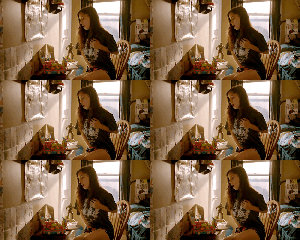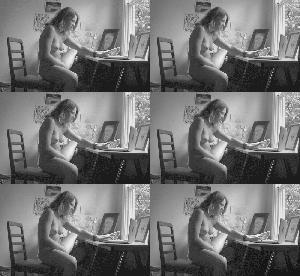
Daisuke YokotaUntitled from Taratine series (2015)

I can’t look at Yokota’s work without thinking about disintegration.

His work emphasizes imagery keen on eschewing concrete visual representation and instead offering something teetering on the brink of abstraction. The effect might best be described as a strobe used with infrared film shot in near complete darkness and the film subsequently pushed, over-developed or otherwise mangled post exposure. There’s frequently a fixation with grain enlarged to the size of golf balls, the space between grain as a sort of craquelure; fixer streaks mar the film, dust and hair become randomized, scintillating scotoma-esque focal points and the occasional hint of color reads somewhere between an opalescent oil smear on rainwet asphalt and B&W negs left to sit overnight in spent blix.

I’ll grant the use of color is masterful. But for the most part methinks the work doth seethe too much. It’s too bleak to be so entirely ambiguous about whether what it’s presenting is beautiful, a nightmare or a bit of both. (I’d wager that Yokota is probably very into Brakhage.)

That’s why the Taratine series appeals to me–unlike the rest of the work which seems clinical and detached. There’s a sense of relationship and involvement, something from which the rest of the work suffers from the abject lack of.

I object to a lot of the compositional decisions undertaken but there is something compelling about the poses in the above images. Except for the miasmatic haze hovering above the figure on the bed, the image on the right might very well be a lost Callahan of his beloved Eleanor. It’s all more painterly than that and I can’t help but think of someone like Titian or Goya.

Yet, what’s most fascinating is the image on the left. The pose is stunningly dynamic–but the visual dynamism of it is actually played away from the camera but in a way where it isn’t lost in the image.

It reminds me of Romanian auteur Cristian Mungiu’s post screening comments at the US premiere of Beyond the Hills. He spoke about working exclusively with long uninterrupted takes and how frequently at least one of the two phenomenally talented actresses wound up with their back to the camera. How does a performer convey emotion when at least half of their facilities for expressing that emotion are obscured? We in the modern world have a desire to see everything in an immediate, unmediated fashion; this urge is actually to our detriment as frequently what we don’t see is more compelling than what we do see and how an awareness of this notion permeated much of the blocking in the film.

If I had the opportunity to ask one question of Yokota, it would be: to what extent are you consciously aware of trying to formulate a new language of photographic representation of the human body exclusive to lens based visual culture?

It may not be at the forefront of his practice but it’s something that would very much be in keeping thematically with his work up to this point. Further, I think it’s actually an entirely crucial endeavor.
Source unknown – Title Unknown (20XX)

There’s things I really don’t like about this:

  • I’m not exactly fond of how the vast majority of porn targeting cis dudes fetishizes anal as the pinnacle of the heterosexual experience of intimacy (Queer depictions of anal intercourse get me super hot and bothered, tho, so I’ not kink shaming by a long shot.)
  • What is with the spreading of the labia as a motif in hetero porn featuring anal? Is it a legibility thing? Like the equivalent of look mom no hands except a look it’s in the number two hole not the number one hole?
  • The image has almost certainly been desaturated.
  • The braids and hair tie featuring a bow are clearly designed to add a barely legal lolita vibe to the scene.

That’s quite a bit to not like, I know. But the fact that the image is essentially narrative goes a hell of a long way to bridge the gap between my initial distaste and something like a reluctant interest in the image.

The scene is clearly by the side of a road somewhere–you can see the open care door and the grass in the background.

A blanket was put down first. The stud doesn’t just bend her over the hood of the car. In other words, there’s some concession to comfort.

It’s not hard to imagine how these two ended up here. They were driving and were suddenly both horny. Well, then why not road head? One gets the feeling that this is a pit stop before a weekend spent with one or the others family. They’ve pulled off the road to get one last intense fuck in before arriving.

I like that he’s watching her and dear lord, her expression–which to me reads as one of those responses to a sensation so intense and completely overwhelming that it expands to encompass all of your temporal cognition.

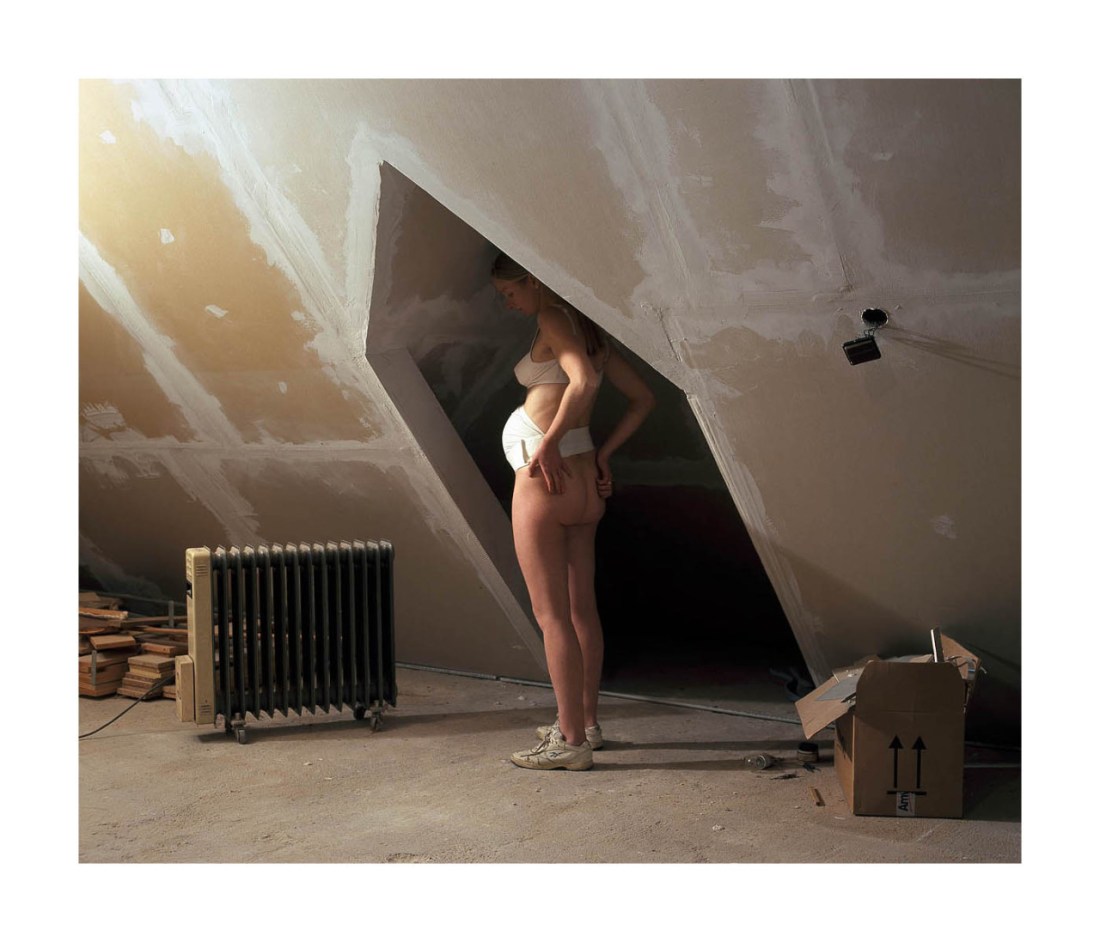
Gábor Arion Kudász – The Attic [Bogi] from Middle series (2005-2011)

There are critiques to be made here but I’ll not be making them since they don’t interest me.

Instead, I would like to point out how much this work diverges from Kudász’s early work which can really only be described as aggressively formal. And by that I mean it’s all very thoughtful features lucid clear conceptualization and technical accomplishment.

It also reeks of a self-conscious fine art photographic raison d’etre.

Middle is almost playful. Yes, it continues to evince top shelf skill–I’m still reeling from this exquisite image of a child (eyes closed) hiding behind a glass faced door, leaning up against a textured wall in a courtyard.

But there’s also whimsy: a picture featuring a woman standing in the middle of dense brush holding a chainsaw–naked except for work goggles and her jeans and knickers pulled down around her ankles; another picture of a presumably partially disrobed woman sitting on a chair in a field, a naked man stands over her framing her through a camera that blocks his face–the woman tracing the index and middle finger of her right hand upward along the inside of the man’s left thigh.

It’s all ultimately flawed–but it’s as if the flaws are the cracks that allow a sense of life to get into the work. And much of the life is the result of the pithy, clear eyed notes extracted from the diary of Kudász‘s wife which presented as a time line corresponding to the images, contextualize them in the stream of day-to-day family exigencies.

Year: Four

Acetylene Eyes began on November 15th, 2012.

The initial motivation was one part I-already-spend-several-hours-a-week-browsing-Tumblr-so-why-the-hell-not-participate mixed with two parts each generalized existential frustration and creative stagnation.

There’s no way I could have imagined all the ways things would shift, morph and evolve over time; but, I’m reasonably proud of what I’ve bumblingly stumbled onto here. It’s a fucking metric shit ton of work to but it’s generally gratifying.

The past year featured 351 posts–five shy of a post a day. Granted, my schedule being what it is I primarily post on weekends. Going forward, my hope is to be able to reinstate a queue.

Also, I would really like to follow more blogs but at present I spend approximately two hours a day just keeping up with my dash. This has hampered my ability to branch out as I’d like to keep showcasing images that aren’t already in circulation among my follower base.

There are two ways to potentially rectify this: if we’re mutuals and you know a great blog, definitely pass it along. Also, I started a Patreon–if you like Acetylene Eyes, please consider supporting this project.

Lastly, I would like to thank several mutuals who have encouraged me, provided exceptionally well-curated/accurately sourced material on their blogs and who have advocated for me to the broader Tumblr-verse. I’m thinking specifically of @wyyoh, @sporeprint, @mrchill, @tanyadakin, @thebodyasconduit, @lisakimberly, @marissalynnla, @reverendbobbyanger and @msjanssen.

My heart–to the extent I possess such a silly thing–goes out to those in
Paris. Luckily the two folks I know there are safe.

In the same breath: while I refuse to lose sight of the
tragedy/trauma, I’m apprehensive about the fallout for Muslims and
refugees. After attacks such as these, there’s almost
always a spike in violence against innocents because of perceived ethnicity/religious affiliations.

Please bear in mind that terrorists who walk into night
clubs wearing explosive vests and firing automatic weapons into crowds
of bystanders represent Islam only insofar as Xtians who murder abortion
providers represent Xtianity.

The problem IS NOT religion; it’s
the politicization of religion. Thus, to all the assholes seeking to
make Islamaphobic hay of yesterdays events (Bill Maher, various right wing fuck wits), you are just as bad/guilty as ISIL–if not worse because you are playing at the same reprehensible game.

Edward YsaisUntitled (2013)

I’ve had this image saved as a draft for almost a year. There’s no arguing that it’s chiaroscuro is executed with skillful aplomb. It’s memorable, quality work and I like it… but I’m conflicted about it.

At first, I thought that the both women were the same person. That’s largely because I am absolutely awful when it comes to facial recognition. For example: If I’m meeting someone I don’t know all that well, when I scan a crowd I’m noting things like height, hair color, build and body language.

I don’t think these are the same women (it’s not entirely clear but the woman entwined with the man appears to have longer hair than the one in the mirror). So my initial impression of this as a critique of the male gaze–wherein the male surrenders to sexual bliss while the woman is condemned to a duality of experience wherein she not only experiences sensation but also stands detached monitoring and critiquing her the relationship between her experience and the male consumption of her experience.

Without that anchor, I’m not really sure what to make of the image. Is this a threesome? There’s a sheen on the woman in the mirror’s skin that could be suggestive of such a scenario. But it fears more like a nightmare–a woman dreaming about her lover cheating on her.

And that’s kind of where things start to unravel for me. In my experience as a dreamer, mirrors straight up DO NOT work like they are represented here. In other words, my experience is that the mirror only reflects a part of me–i.e. my head or I don’t have a reflection.

This dissonance opens a door to some critical considerations about the work. Yes, it’s pretty. Yes, the lighting is sumptuous. Yes, it’s almost certainly riffing on Velázquez‘s Las Meninas.

However, note the way Velázquez uses available light as the primary motivation for his composition. In other words, the perspective the viewer is presented is one which given the light renders a composition built around a masterful understanding of space–especially distance and depth.

Ysais’ image is alarmingly flat. The light functions to render the scene legible and in no way informs the composition. And once you follow that rabbit trail, you realize that due to the slight down tilt of the camera–presumably to compliment the mirror–the vertical slat of the partition at the extreme left of the frame is put askew. Further, the horizontal and vertical slats, transitioning to the bas relief to the damask pattern to the drape and the echoing drape in the reflection–the artifice of the frame becomes hard to suspend in favor of disbelief.

It’s something I’m discovering in my own work of late: the distance between a bad image and a good one is exponentially less than what separates good from great.

vivipiuomeno1:

Emmanuel Sougez 

ph. (French, 1889-1972)

There’s not a great deal of information on Sougez floating about in the digital aether.

From what I’ve gleaned he was part of the New Objectivity which was among other things a rejection of Expressionism.

The term New Objectivity originates from the German, specifically: Neue Sachlichkeit.

Via Wikipedia:

Sachlichkeit should be understood by its root, Sach, meaning “thing”, “fact”, “subject”, or “object.” Sachlich could be best understood as “factual”, “matter-of-fact”, “impartial”, “practical”, or “precise”; Sachlichkeit is the noun form of the adjective/adverb and usually implies “matter-of-factness”

I’m not about to say such a definition is useless; however to me it is practically useless–I have no idea what purpose it serves much less how I am intended to apply the information henceforth.

The question this image begs–at least for me–is: what constitutes the primary focus of the image: the woman or the draped fabric?

As to an anwer: I’m inclined to say both; therefore neither.

Well, a clever interlocutor might inquire: how is it both and neither?

Here I can do little more than point. But I suspect the question of whether it’s the woman or the drape is functionally identical to the reason Uta Barth isn’t a minimalist.

It’s something to do with the interpenetration of human perception of space and human intervention in space that is perceived–in this case the area over which the camera hoveringly waits.