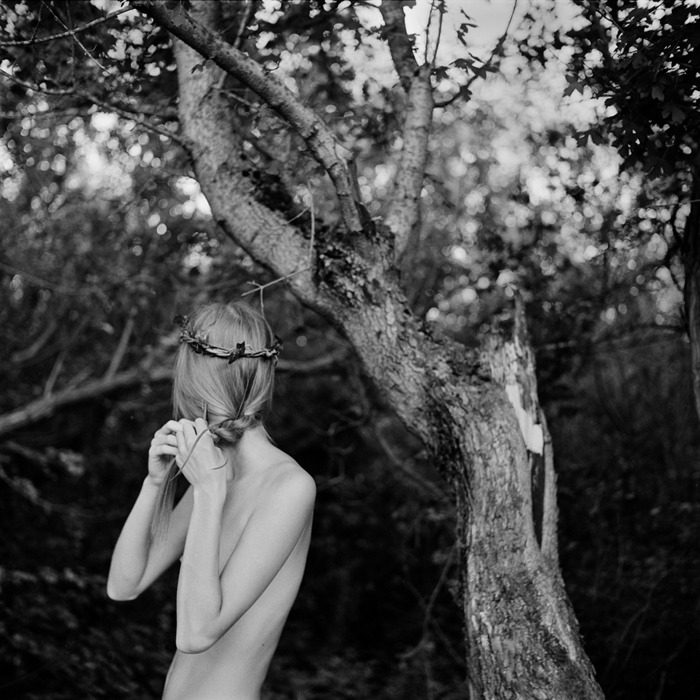
Mariya Kozhanova Untitled from Prussian Brides series (201X)

There are so many things this does well–the tree trunk twists up and stretches away  into the background, the young woman leans every so slightly toward the camera to counterbalance this retreat (it’s rare to see such shallow depth of field used to interesting, thoughtful effect); not to mention the effing lovely cinematic bokeh…

I don’t have any quarrel with this photograph in and of itself. In fact, I’m rather fond of it. The thing that baffles me is the rest of Kozhanova’s Prussian Brides series. I don’t understand the use of eye contact with the camera, POV shots, not to mention her homage to Jock Sturges and startling similar ways her shooting windows is reminiscent of Michelle Arcila.

The statement of purpose accompanying this body of work–contributed by Russian curator Irina Cmyreva– (unfortunately) further muddies the matter. After localizing the work in the history and tradition of Prussia (now Kaliningrad), she connects to work with the ‘original Prussian legend’ where:

[A] dead bride in ancient times whose tomb was opened and it was discovered that she had disappeared. The Prussian Bride is a kind of
film or literary narrative about a girl’s dream of an old house within
an ancient estate in the forests. The month of May is the time when
nature awakes again and is reborn. It is the time of the ancient legends
and the folk celebrations of the “May Bride”. In her re-telling of the
legend of the May Bride, Kozhanova incorporates Prussian culture in the
blond beauty of the girls, the old style of the dresses they wear and
the architecture of the house itself.

It speaks to how much better the above photograph is than the rest of the project that verbal diarrhea such as this actually serves the work. But it detracts a great deal from the rest of the images in the series.

The images are not a stand-in for ‘a kind of film’ or a literary narrative. They might be a bit of a dream–that would alleviate some of my more pressing concerns. However, in point of fact, it’s not. The work is precocious portraiture, edgy editorial or oneiric look book. By trying to be all those things at once, it ends up being none of them.

Kozhanova is still a teenager–a clearly clever and talented teenage. So I’m willing to give her some credit. There’s a chance a 6×6 camera is all she has and another chance that it was less her notion to tie her work together with a pat mythological reference. And even if she was directly responsible for both decisions, her work is sharper than a great bit of what’s out there.

thebodyasconduit [Traci Matlock‘s Tumblr] – Ruby Slipper (2015)

As much as I carry on about composition as a facet of qualitatively ‘good’ photography and image making, truth told: I always favor work which presents the singular immediacy of The Moment.

For example: this depiction of a threesome is indelibly imprinted on my psyche. Is it a qualitatively good image? I’d argue it’s no more and no less important than a broad swatch of Nan Goldin’s photos. The difference is the former is fixated on the immediacy of documenting a moment, whereas Goldin is more interested in photography as an act of memorializing.

Admittedly, both are two shadows cast by the same motivation; but, in Goldin’s case there’s an implicit questioning of how perception works. Given that it’s a hop skip and a jump to an assumption that the work must function as some sort of implicit eye training–exists at least in some part as a means of instruction in or illumination of How We See ™.

And to bring it back to the actual image I’m posting: Traci has been posting a lot of work she made last month with Ruby Slipper. Really, their recent collaboration is just the cat’s fucking meow–you really should check it out.

In looking at this work, I am starting to notice the ways Matlock has matured as a photographer. As long as I’ve known of her work, she’s been better than just about anyone at tapping into the objectless transcendence of The Moment. Her compositions have similarly always been on point. Yet, what is emerging in her work is a sort of hybrid between Stephen Shore’s ability to compose a perfectly balanced frame that appears as if he snapped it off hand as a casual afterthought; or, Garry Winogrand‘s seeming accidental–but in truth, anything but–perspectives.

The work also has something to say about the role color should play in photography. I think I’ve always seen Matlock as a follower of Eggleston; this making it even more clear–afterall, Eggleston pretty much single-handedly legitimated the Art value of color.

But seeing that it makes me question such an assumption. There’s really something here interrogating the boundaries between pigment on canvas and painting with light itself. The above image reminds me of a painting–which, of course, since I’m hung over as the queen in Maida Vale, I can’t recall the painter but it’s like van Gogh and Klimt collaborated.

I’ve put this all badly but my point is simply this: good work shows you something new; great work shows you something you’ve already seen in a new and different light.

Given that metric: Matlock’s work is probably whatever comes after good merges with great.

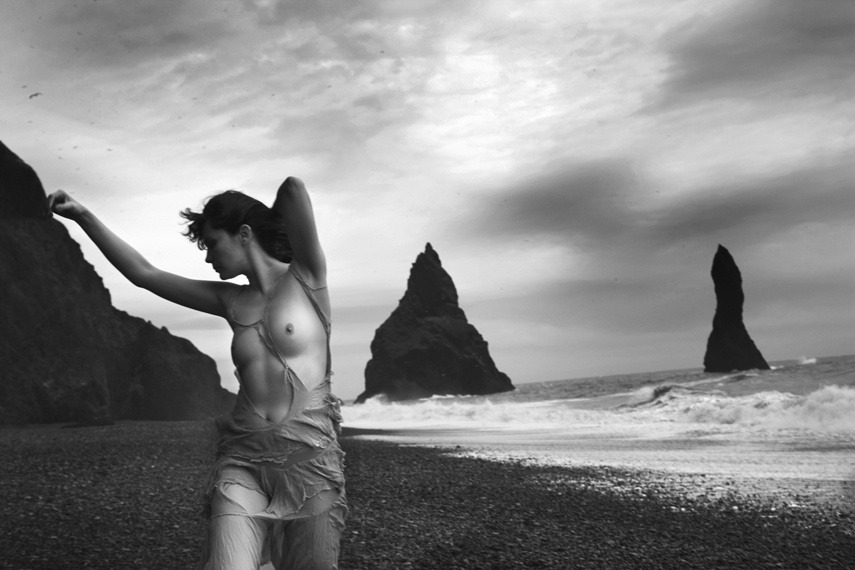
Silja MaggUntitled (201X)

Despite the fact that this sacrifices proper exposure for pushed contrast, I’d post it on the strength of the interplay between the tattered outfit and the gorgeous skin tone highlights.

But, I’m mostly posting it because it was taken on the volcanic black sands of Vík beach in Ísland, or as you’re probably more familiar with seeing it: Iceland.

The way that many of the misogynist literary giants write about how Africa gets under your skin is the way I feel about Iceland.

I’ve dreamed about it on a recurring basis since I was approximately eight. Initially, in these dreams I’d find myself in the middle of a vast expanse of arctic terrain. In the way dream logic works, I just felt that this was Iceland. It was a number of years before someone informed me of the epigraph: Iceland is green and Greenland is ice.

The dreams continued but shifted: I’d be on my way to the airport to fly to Iceland. But there’d be traffic or I’d have forgotten my passport.

Finally, two years ago, despite being unemployed, I through caution into the wind and spent a week there.

I’m not yet to a point where I can articulate the impact of this trip. All I can say is that I’ve booked tickets to visit again at the end of the summer.

I could never live in Iceland. Being as I suffer from severe Season Affective Disorder, the paltry 3 daylight (3 hours in Reykjavik at Solstice) would quite literally kill me. But it’s a place where I feel strangely not at home but in my element.

All that is merely to introduce the fact that as Iceland becomes an increasingly popular vacation destination and more and more photographers tap into the alien beauty of the land, there are sadly fewer and fewer images like this that so effectively encapsulate the feeling of being there that they make my soul ache with the most profound longing.

Bronte Sommerfeld – Untitled (2015)

A recurring thought I have about image making is the extent to which image makers are largely motivated by tangential compulsions. Pictures are taken to ensure that moments are remembered, to give voices to experiences which would otherwise pass silently into darkness, etc–it’s not so much about the image as what the image represents.

Whereas, I tend to think of ‘pure’ image makers as those who employ pictures as a sort of map for how they see the world around them.

Those with the former impetus are generally astute practitioners of the latter–but the lesson in seeing is secondary to that which the image bears witness.

I believe it’s easier for an image maker of the former stripe to achieve critical recognition and stature within their lifetime. And although I can’t in good conscience favor one at the expense of the other–the work of the latter strikes me as the path of most resistance.

Sommerfeld’s work seems to be of the latter variety. This image feels as if the image maker saw something in a moment and raised her camera to her eye guided by nothing more than precocious instinct.

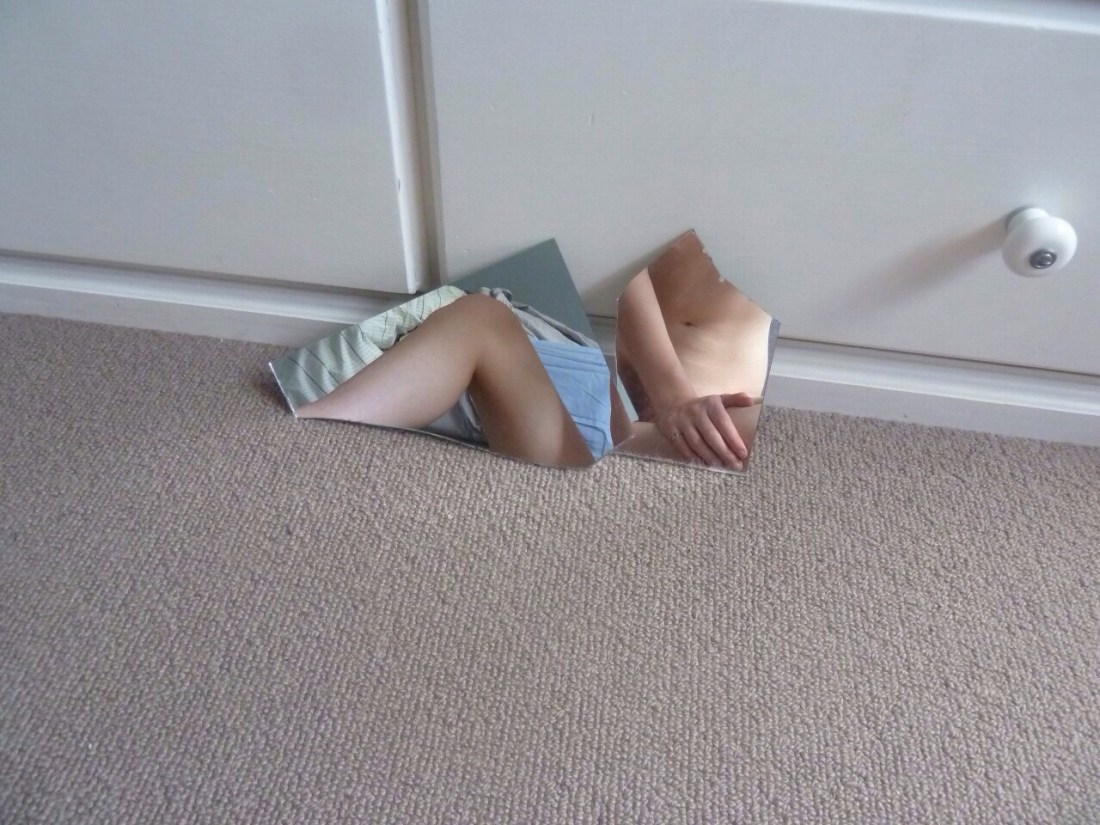
And what’s captured is fucking fascinating. The texture of the carpet, the suffused light with soft shadow stretching from the drawer knob insinuating a broader world outside of the frame, the mirror fragments presenting ostensibly naked bodies in a seemingly impossible configuration; the synesthetic texture of the carpet.

The trouble is: with the disembodied reflections presented at the center of frame, the angle of the baseboard, although flattering, sets up an imbalance that is in point of fact too strong to be resolved by the drawer’s vertical line or the drawer’s horizontal in the upper right corner. (Lining the drawer’s veritcal with the frame’s left vertical third would have resolved this but created the problem of losing the knob–something that I think would detract from the image. Thus, the real question is more or less carpet. My instinct screams more–I am and will forever remain a texture whore; but I suspect Sommerfeld would veer in the opposite direction; either way the difficulty of the diagonal baseboard becomes the sole compositional stumbling block in the image and can therefore be summarily addressed.)

Lastly: Sommerfeld is a truly interesting young woman. And if you consider that she made this video as a 16 year old high school student, I’m fairly certain you’ll understand why I would be completely remiss as a curator if I didn’t nudge you, my dear followers, in the direction of her endeavors.

Tangolarina241 – She the angel of small death (2014)

In spite of its compositional shortcomings–i.e. it favors the reflection slightly and the towel and chair distract from the focus on the image. (The ideal means of rectifying this would have been to move the camera back so that the grey tile strip would line up with the upper horizontal third and the body and the reflection of the body would be identical; however, as there’s already some barrel distortion, I’d be this was a zoom lens at it’s widest possible setting; and this being a bathroom, there probably wasn’t to push the camera further back. In which case, lowering it and reframing to balance her and her reflection would have made for a stronger image.)

Still: to be honest–I think this has more inherent potential than most of the work I post with qualified advocacy for elements of the work instead of the work as a whole. It’s partly the sly way it’s exists as both a self-portrait and a depiction of masturbation–that is simultaneously both and neither; and partly the ambiguity in performance serves as a sort of safety net for the fact that regardless of mastery of craft, Tangolarina’s Flickr photostream centers around this same rare willingness to be open and vulnerable in a world where we are not only told to shield ourselves, we are daily given thousands of reminders about what the world will do to those who ignore such admonitions.

Beautiful and brave work.

Rodolfo AsinVictoria Bernabei (201X)

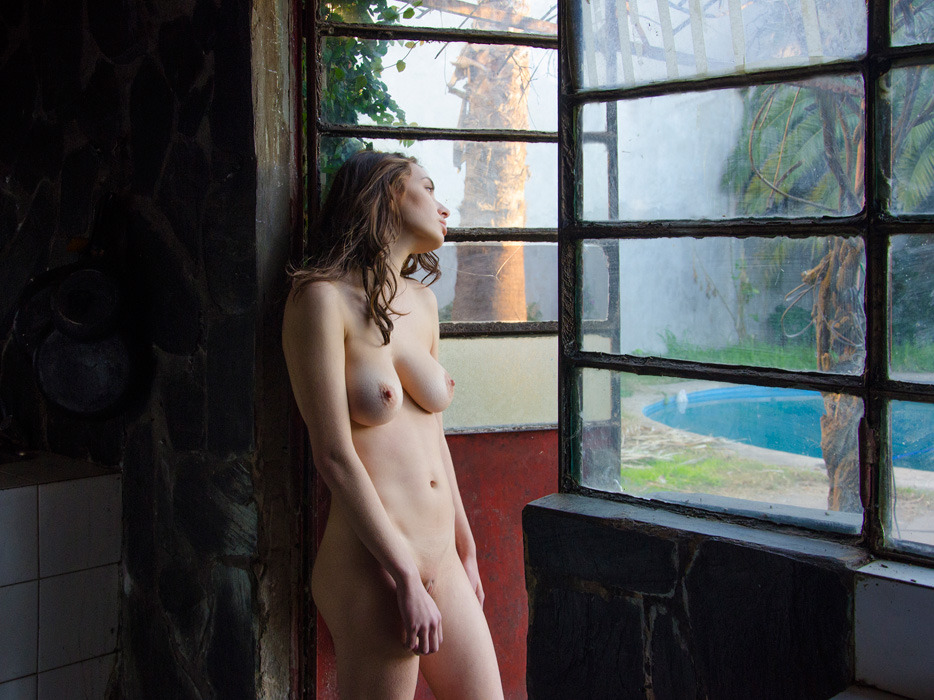
There’s probably in excess of a seven (7) stop dynamic range between absence of shadow detail and loss of highlight detail.

In order to accomplish that you really have to know the latitude of your emulsion/sensor and make sure your exposure is dead fucking on.

But what impresses me about this is the fact that you have both a strong blue (the water in the pool), a saturated green (the grass, palm fronds and plants above Bernabei’s head) and a distinct red (the lower panel on the door).

It requires a masterful effort to balance those elements in any image but all that is merely an overture meant to frame both the exquisitely rendered skin tone and morning/evening sun on the palm tree.

All that on top of a thoughtful, balanced composition.

It’s rare for me to encounter work that causes me to pause and independently consider color as anything more than a part contributing to the total sum of the image. Generally, when I think of what I would label masterful use of color it’s work from Eggleston or The Double Life of Veronique–arguably the best example of color cinematography in the western film historical canon. And not to diminish the brilliance of both, what I like about them is they make me think about the role color plays in the reading of an image. Yet, what the demonstrate isn’t easily applicable to my own photographic voice.

I can’t really process it all at the moment, but I feel the stunning color separation in this and the way it is employed in a layered fashion to re-frame the scene from a fine art meditation on the quietness of a moment to a sort of implication of the erotic potential in the physicality of the inter-relationship between being in a body, being caressed by light and therefore seen.

There’s definitely some problems with Asin’s larger body of work and objectification of women’s bodies but the skill of the photographer does manage to sublimate the objectification from time to time–to fucking spectacular effect.

Francesca WoodmanSome Disordered Interior Geometries (1981)

Although it’s on some level problematic: I have moments where I think of Ms. Woodman as if she were both still alive and as if she and I were a couple.

Let me try to clarify that so it’s less presumptuous and entitled: I read a lot of critics who bemoan her enduring appeal. They say she wasn’t really all that good. That she’s only canonized due to her broad public appeal–a sort of way to put asses in the seats–so to speak.

I don’t agree with either perspective. If anything Woodman was a great deal better than even her current popularity speaks to–her work still suffers from centuries of entrenched art historical sexism.

As to her enduring appeal, there is a way in which her work comes across as not exactly conversational but… wait, I know how to say it! I just need to steal from someone smarter than me.

In her brilliant summary of the best movie of 2014–Jim Jarmusch’s Only Lovers Left Alive–the lovely and amazing Knitphilia describes the interactions between Tilda Swinton and Tom Hiddleston’s characters in the film thusly: “the pair conversationally present amazing trufax to one another as love gifts.”

As vampires both have lived for centuries, they’ve seen and done it all. The range of new experiences open to them is if not long exhausted, finite. Yet, amazing trufax–and, and! Books and Art and Music as avenues of transmission–are something that can still stir awe in them.

That’s how I feel looking at Woodman’s work! It’s as if the medium is the message and the message is a constant stream of amazing trufax, little loving offerings that this insanely talented young woman who died shortly after my birth keeps leaving behind for me to glimpse if I pay careful attention.

Alena ZhandarovaEvita Goze (2011)

I’m reblogging this from mpdrolet–who if you follow me, you seriously ought to follow; he curates what hands down the best Tumblr blog. (Not to mention: and he’s forgotten more about fine art photography than I’ll ever know.)

It’s odd though because while he’s usually fastidious with sourcing; when he posted this image, he attributed it solely to Goze, linking to modeling work Goze did for Aiga Ozolina.

It’s absolutely worth the time to click through and check out all parties involved. (Especially consider the impact the collaboration with Goze has on the respective image makers codified styles.)

I’m not interested in comment on that, however–mostly because there is something about this image with which I am utterly enamored.

It reminds me of Martin Buber’s I and Thou wherein it’s postulated that their are two modes of relationships in the world–the relationship between a subject and objects (termed I-It) and the experience of transcendent, non-duality (termed I-Thou).

I-It, for example, involves a subject perceiving an object–Molly looking at a painting in a gallery, Dev reading the subway map, etc. I-Thou, on the other hand, like a gust of wind, wrenching open your window and a macaw flying into the room; you are so startled by the sudden and unexpected presence that for a moment you forget to resort to language in the instinctive drive to sort and identify situations; you experience an unmediated fullness of awe in the moment. (This is an example–you can certainly experience I-Thou moments looking at a painting in a gallery. Hell, I wouldn’t be alive if not for that possibility.)

Buber maintains that the spark of the I-Thou moment lies encased–not unlike an insect in amber–within the I-It moment that litter our lives.

* * *

As an off-the-charts introvert, I need a metric fuck ton of solitude in order to even halfway function as a human being. Yet, I do need a modicum of social stimulation–just not in a small talk/how about this weather/interacting with strangers at a loud bar; I need to feel connected to others.

One of my pressing struggles in my life is balancing the need for some sort of connectedness with the fact that I really only have recourse to more casual and frivolous interactions.

Imagine that we are standing on a cliff overlooking the ocean. I am standing facing you and your back is to the sun dipping towards the horizon’s shelf. Something in the color or the vista speaks to me, I enter into an I-Thou moment. All I can do–without slipping out of the moment–is instinctively point. Either you’ll see it and share the moment or you wont. Even if I could explain, the explanation would be a little like explaining a joke–that which was humorous is rendered sterile via translation.

* * *

I want to share the I-Thou spark that flickers just below the surface of this image. Don’t you see it? It’s staggering…

if you don’t the only thing I can suggest is to remind you of the scene in Klimov’s masterpiece Иди и смотри (probably one of my three favorite films of all time) where Florya shakes water from the trees and dances with Glasha in the rain?

Don’t you see it? Look. It’s right there…