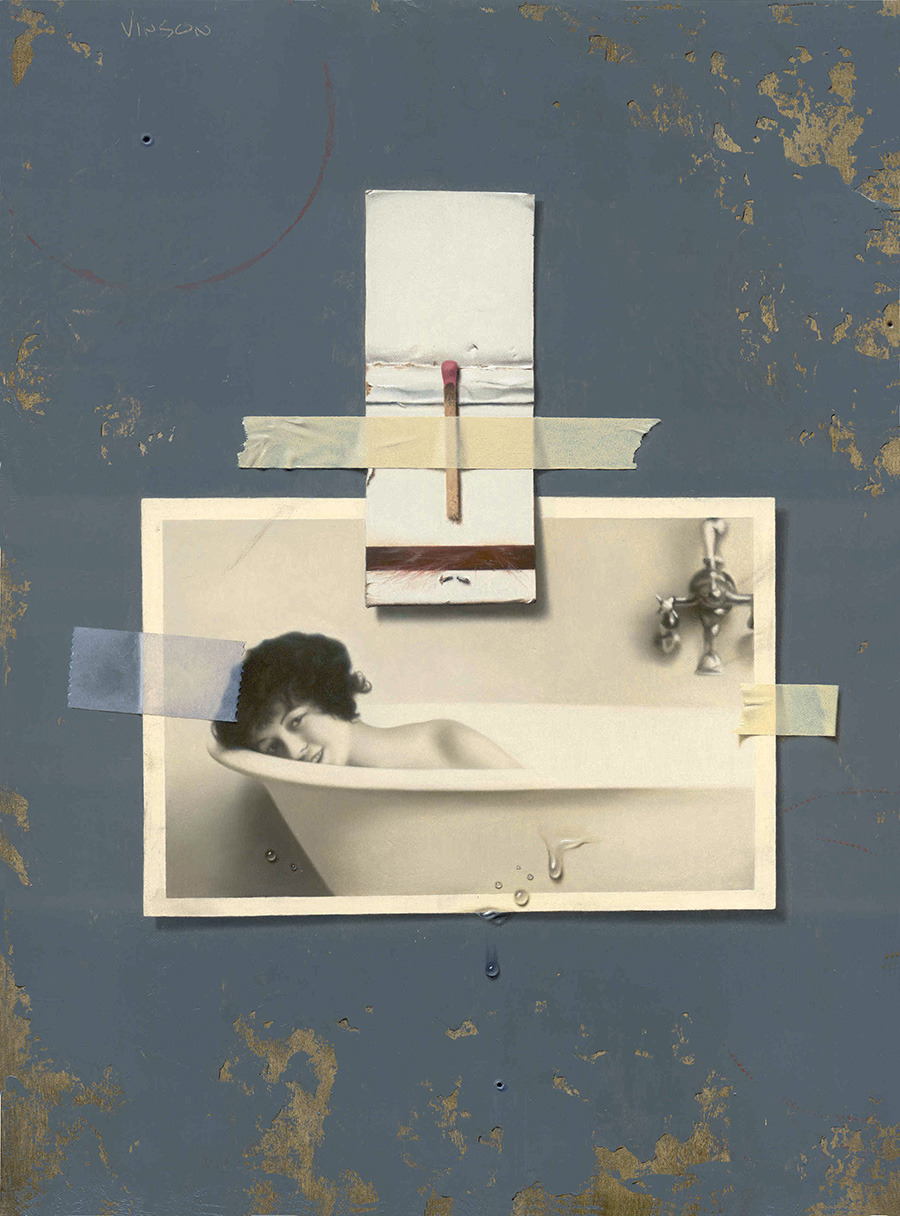
Adam Vinson – Memory Stained (201X)


Arseni Khamzin – Untitled (2013)
…holy shit: this. is. FAN-FUCKING-TASTIC!
It’s a compositional marvel, really–the interplay between line, texture and shadow vs. light is exemplary.
The subject is slightly off-center to the right of the frame; allowing the top and right of frame to be counter-balanced by the much darker shadows cast by the subject and chimney.
There’s an intoxicating variety of sumptuous texture–poured concrete, mortar, corrugated metal, skin, hair and fabric. (It’s an especially inspired touch that the lines on the tartan print blanket reiterate the two point perspective of the composition, but in their slightly imperfect alignment, they server to further direct attention toward the subject.
Why does it all work so well? Two years ago I would’ve just offered the cop out of attention to detail regarding texture and balance but actually, the frame works off a simple 45 degree clockwise re-orientation of the rule of thirds.
And I’m not even to the best part–this is a Pietà! Yes, it’s oriented differently. Traditionally, Pietà present Jesus from head to toe starting with his head at frame left and his feet towards frame right. [Can someone with a little bit more comprehensive of an Art History background explain the relevance of such positioning? I suspect there’s something to it (sacred vs profane, which would be interesting given the fundamentally humanist trappings underlying the codification of the trope)–not unlike the direction Ganesh’s trunk curls having distinctly different meanings.]
Yes, it’s also short a figure and the genders are swapped–or so it seems to me. But there’s really some fascinating reinterpretation going on surrounding the trope. I can’t help but think the point of this variation has something to do with the loneliness of existence and a sort of embodiment of that notorious line from Donnie Darko: every living creature on earth dies alone.
Lastly, this was made on Impossible Instant Black and White Film with Hard Color Frame–which in my experience is not the easiest film to use if you want to produce a thoroughly luminous result such as the above.
Stunning and exceptional.

Source unknown – Title Unknown (201X)
They were drinking and someone killed a wild boar and someone said, “hey look, I put my hand in it.” Saying goodbye is like that. You put
your hand in it and then you take your hand back.
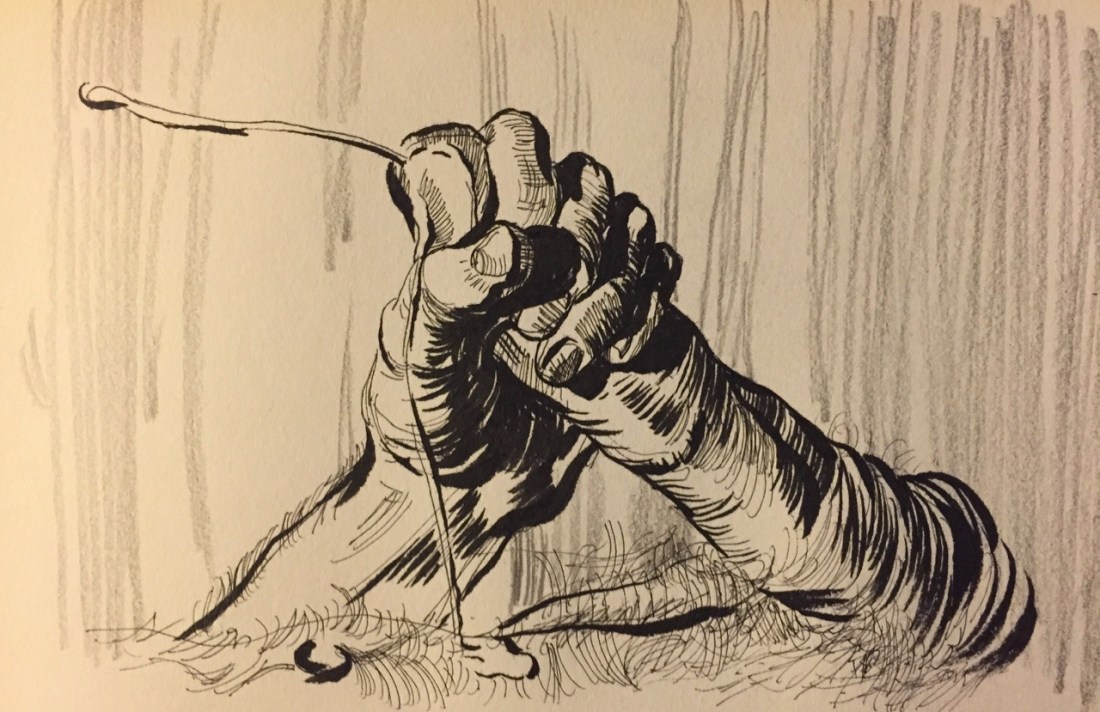
mou5elee – Untitled (2015)
Drawing/illustration is not a field where I have any sort of expertise.
About all I know is the stuff that crossing my Tumblr dashboard and that’s control by the interests and aesthetics of the blogs I follow.
Thus, it’s probably pretentious and definitely solipsistic for me to assert that most of the illustration work I see these days shows one of two characteristics–the sort of clean, minimal look that by this point has been completely co-opted by the tech sector (Apple, web dev standards, etc.) or this sort of Schiele-cum-Picasso styling.
I really like the above because based upon my limited understanding of trends and techniques in illustration, the way this is shaded actually reminds me of woodcuts.
The most important things are the hardest to say because words diminish them.

Source unknown – Title unknown (201X)
I have no idea where this image comes from but I absolutely love it.
It’s partially an aesthetic thing. Customarily, I’m not a fan of close-ups–to my way of thinking they excise too many crucial contextual cues/clues.
An acquaintance who attends the same monthly book club I do and is currently pursuing a Philosophy PhD has pointed out to me that she doesn’t completely buy my objection as she seems something valuable in close-ups ability to essentially build a context that allows one to see the foreign in the familiar.
I counter that this sounds an awful lot like those awful activities in children’s magazines where they show a close-up of the pattern on a manhole cover and invite the reader to identify the object they’re viewing.
She’ll fire back with Suren Manvelyan as an example of how an identical framing can serve as an impetus for the creation of art.
And I get tripped up because I don’t know whether I’m inclined to suggest her example is the exception that proves the distinction I’m drawing or if due to the dual notion of infinite–i.e. both the set of all real number extending in both negative and positive directions endless, while also the endlessly divisible space between any number in the above set–that Manvelyan is actually terribly disingenuous to the spirit of the initial premise. (Yeah, I know: I’m insufferable.)
A third thought occurs to me writing this now: perhaps, I’m not being entirely honest, either. I mean: I really dig a good bit of Lina Scheynius’ work–and she employs close-ups frequently–granted with just enough of a hint of context that you can usual fill-in any requisite blanks.
Come to think of it, the above image is actually something very much in keeping with Scheynius’ work. The perspective, angle of view and how the scene is presented in a fashion which pinpoints a specific, emotionally resonant detail and then provides enough of the surrounding context to insinuate an idea is very much a skill set she exemplifies. (Despite compositional and tonal similarities as well as the implication of bathing/water, it’s definitely not her work–the color is entirely too saturated to be hers.)
…
I’ve had this image lurking in my drafts for the better part of a year–knowing unequivocally that I am going to absolutely post it at some point.
The trouble is I’ve never really know what to say beyond the above knee-jerk reflection; however, the events of the last three months–in particular–and the last three years in general, render this image especially meaningful at present.
I’ve at least twice (1 + 2) before about how thoroughly amazing my living situation was during my junior year of college. Amadine, who is mentioned in the second post and that’s also not her real name, and I recently reconnected. It was intense–in a wonderful way and the immediacy and profound intimacy of the way we interact with one another has set my brain on fire.
The realization that I’ve come to is that being a severely damaged individual, I seek out others who have also been broken by life. I’ve spent most of my life surrounding myself with folks who have hard eyes and sharpened edges.
More and more, those are not the people I want to share my mind, my energies and my body with. I think that due to growing up in an environment where kind words weren’t offered unless they were inextricably tangled up in bitter, criticism. For example, my parents would always be like: oh, you could be doing so much better at this if you just tried and it’s disappointing for us but it doesn’t make us love you any less. Like what the actual fuck?
Increasingly, I’m attracted to kindness. Amadine was the first person who was ever kind to me seemingly without any sort of selfish motivation. And if I’m being honest, I am more than a bit smitten with her. But our respective situations make these feelings (which have been validated as mutual, or did I imagine a subtext that wasn’t present yet again?) extremely complicated. Also, we are tentatively discussing collaborating on the most ambitious creative project I’ve undertaken in more than a decade…
Really, that’s why I’m finally posting this because the feeling in this image holds a faint glimmer of what it’s like to share time and space with Amadine… for whatever that admission is worth and means to any of you out there.

Mathilda Eberhard – Untitled (2013)
Eberhard has two Flickr accounts: one attributed to Anna Mathilda Eberhard started in 2009 and second attributed to Mathilda Eberhard started in 2010.
The first account is a scattershot of self-portraits (some barely legible, others jaw-droppingly acute in their deeply felt intensity and pathos) and just the right amount of savoir faire so as to court transgression without seeming posturing or pretentious.
With this first foray into the world of sharing photos on social media, it’s hard to pinpoint any pervasive influence. Although I don’t suspect for a second that someone could produce such compelling images without some sort of broad familiarity with photo history.
One thing to note is that specific, salient facets of what would become Laura Makabresku’s hackneyed style are prefigured as if in template form by Eberhard’s early work.
There’s something more melancholic about the second account. Moments of sheer joy, intermingled with a sense of crushing, isolation, loneliness. A number of her pictures invoke in me nothing so much as the feeling of being sexual aroused but lacking the motivation to address that sensation by seeking out affection from another or to opt for the route of self-pleasure.
The work grows more searching, incisive. This, for example, is an image indelibly imprinted on my visual memory.
But then the work slowed and stopped. With the exception of a collaborative project called Wild Flower–intending to show “photos of naked bodies in everyday environments to show that all people have a body and no one else has the right to take it away [sexualize/objectify] from the individual.”
The most recent Wild Flower post dates from December of last year.
As much as a adore the work of established artists like Mark Steinmetz, Igor Mukhin, Allison Barnes, Prue Stent or Erica Shires, what really excites me is work like Eberhard’s or k.flight’s.
Every time I revisit such work, I’m taken in by a new detail, a wonderfully atypical way of seeing and representing the world.
Truthfully, I think Eberhard is actually probably third on my list of folks I most want to collaborate with. Despite it’s unevenness, there are very few image makers out there whose work has wormed its way so deep into my brain.
It’s probably a lost cause but does anyone out there reading this know Mathilda? Is she still making work? Could you perhaps put me in touch with her?
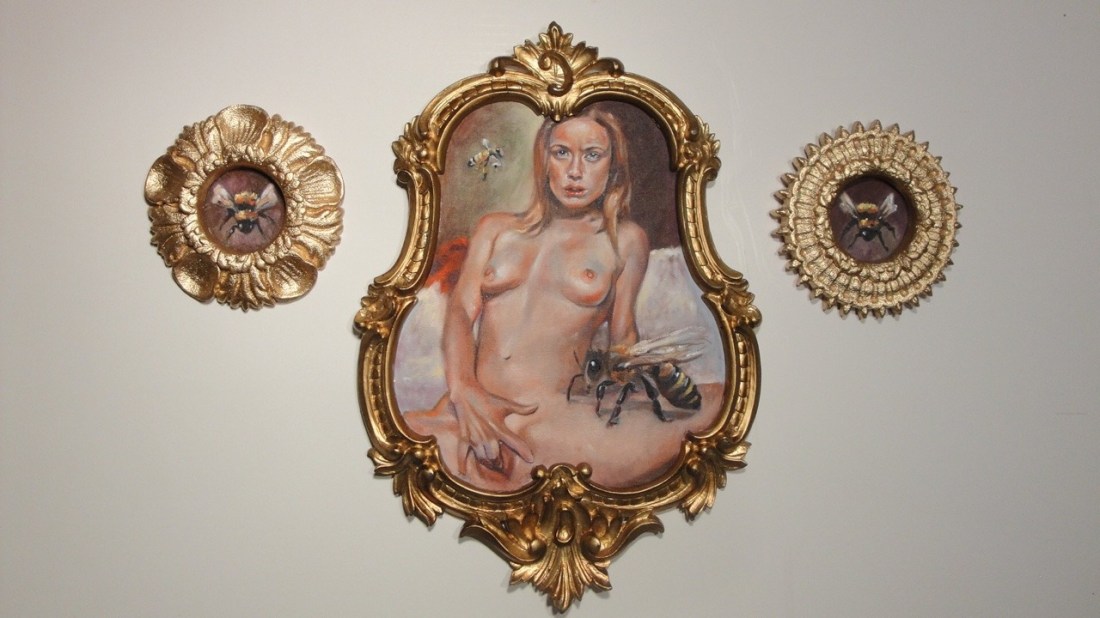
Crystal Barbre – Like a Bee to a Blossom, Like a Moth to a Flame (2012)
The flower doesn’t dream of the bee. It blossoms and the bee comes.
—
Mark Nepo, The Book of Awakening

Orgasm by Valie Export, 1966-67Film switches between shots of the origin of pleasure and its effects.
One of VALIE EXPORT’s first films is a brief and matter-of-fact treatment of lust. The question of whether the man and woman actually had sexual intercourse and who was responsible for the woman’s orgasm remains.

Source unknown – Title unknown (201X)
While I think this could probably be interpreted as an allegory of how to behave on the internet when given a front row seat to explicit content, i.e. drool appreciatively and keep your comments to your self.
But I’m gonna go a different direction. I saw this the morning after having a dream that was very similar in tone–look but don’t touch. I’m intrigued enough to want to track it down even though I suspect I’m going to end up turned off when I discover the original context.
Does anyone happen to know where it’s from?
 Acetylene Eyes