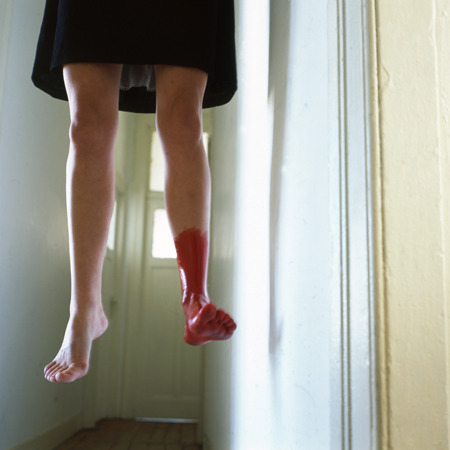
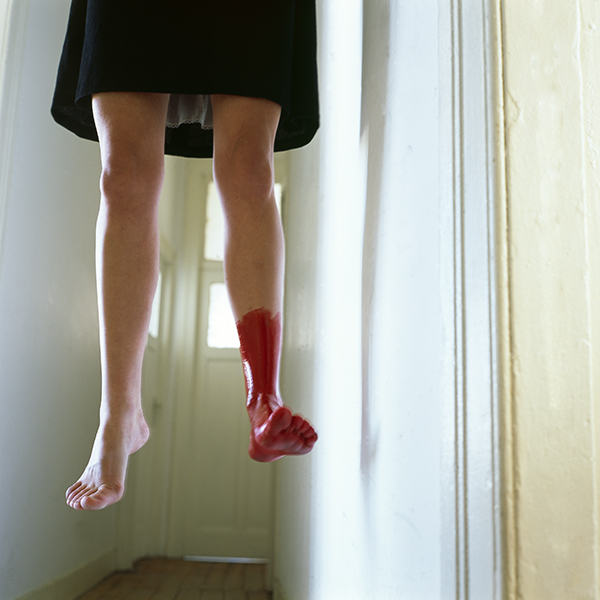
Pierpaolo Morra – Untitled (2015)

If you know a lot of cineastes and they irritate you with their endlessly self-conscious meta-commentary, ask them to name the best example of film noir. Sharks mid-feeding frenzy are a solemn affair by comparison. (I once saw someone successfully defend the Coen Brothers’ Blood Simple as the last true noir–a statement with which I hardly agree but you have to appreciate the audacity of choosing that as a last stand and managing to rout multiple attackers.)

This image gets me thinking about film noir. Particuarly Jules Dassin as the prototypical noir auteur. If you want to understand what noir entails, you could do much worse than studying The Naked City and Riffifi.

Ultimately though, I grudgingly agree with the camp that suggests Out of the Past as the last true noir. (I do understand the desire to attribute a more decisive dividing line a la Touch of Evil where you can pretty much say film noir was B&W and neo-noir is predominantly in color, but I think that glosses over a bunch of nuances–I’d argue Touch of Evil is neither noir nor neo-noir and instead exploited distinctions that subsequently demanded differentiation.)

Back to Dassin though: he’s interesting because he employs the ratcheting of tensions common in noir to a pointedly different effect. (Seriously, if you haven’t seen Riffifi, you’ll never be able to watch that scene in the secure vault in Mission: Impossible without shaking your head in visceral disgust.)

Dassin’s films are quite a bit more formal than your typical noir. They may share a common roster of themes and devices, but even after he was blacklisted and moved to Europe, his films never quiet shook the cast of the Hollywood Three Act structure.

That’s both why his films tend to be so bloody good but it’s also why they’re neo-noir or maybe preferable noir-ish.

In late 30s and 40s Hollywood studio films, if you watch closely you’ll notice that as far as B&W cinematography is concerned, there’s a zone system as applied to motion pictures at work. Things are lit in such a way that there is a pure white and a pure black in every frame and as many interval tones as is provided given the latitude of the film stock, creates a gray scale. It’s crazy. I know people who can’t light green screens as evenly as they lit white walls in studio films.

And yes, Dassin is willing to get muddy and grainy–but it’s usual in service of adding immediacy to the action at hand. Noir just didn’t function like that. It’s not that the DPs weren’t as skilled, it’s just that lighting was used in a far more expressionist fashion than as merely a means of illumination.

That’s why I dig this image. The rest of Morra’s work is (in my opinion) overly mannered. He’s definitely got a solid grasp on controlling tones but working in micro-shifts as he does, his editing needs to be much tighter. This image is underexposed but the underexposure works as a sort of life giving spark.

And I guess that’s really my underlying point. Modern image making gear has made it so you can point a camera in more or less the right direction and without thinking produce a pretty decent image.

But what will make you a better photographer is not what you get right or what you get wrong, it’s what you learn from what you get right and wrong.

So with that in mind, if you really want to become a stronger image maker: ditch shutter priority, aperture priority and matrix metering and embrace full manual everything.
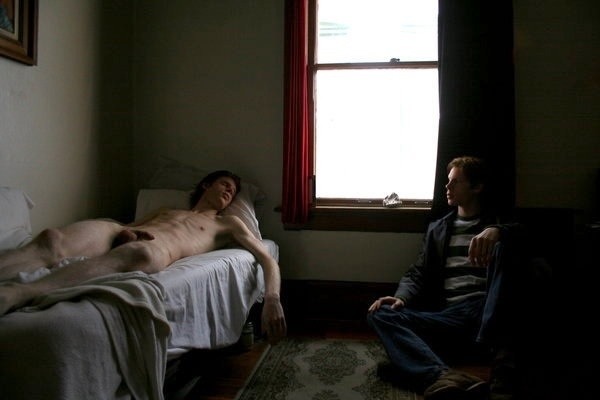
Source unknown – Title unknown (2012?)

Google image search and Tin Eye are both dead ends trying to determine authorship with the above.

A shame because it’s exquisite. (In my experience you can have the best gear in the world, meter seventeen different points and do the math to determine the perfect exposure. But in the end what allows an image to turn out like this has more to do with trusting the unconscious instinct the demands you stop down and you don’t question you just rotate the aperture dial to the appropriate setting and trigger the shutter.)

Also, I’m certain this is riffing off Michelangelo’s The Creation of Adam.

#650

Billionaire real estate developer Fuckface von Clownstick is currently leading the stupidly packed field of stupid contenders for the Republican candidate for US President.

The reason–despite largely being considered a joke candidate–is that he’s dispensed with the usual Republican code talk and is openly waving a banner of racism/xenophobia/misogyny/homophobia. And there’s nothing bigots love more than displays of flagrant bigotry.

Sandra Bland is said to have committed suicide while in police custody. Everything about this incident smells–from the obviously edited dashcam footage and Walker County, Texas’ history of racial oppression.

With continuing protests in Ferguson, MO marking the anniversary of Michael Brown’s cold-blooded murder by racist piece of shit with a badge, Darren Wilson–#blacklivesmatter is back in the news.

And if you want a textbook example of how not to respond, when faced with protesters Martin O’Malley–who is seeking the Democratic nomintation for US President–insisted ‘all lives matter.’ Interestingly, O’Malley is the former mayor of Baltimore and the situation leading to Freddie Grey’s death in Baltimore police custody can be traced back to policies enacted and general inaction in the face of escalating racial inequalities during the formers tenure. (Jeb Bush–who is also seeking the Republican nomination–feels strongly that O’Malley shouldn’t apologize since all lives do matter.)

If you’re at all confused about why responding to #blacklivesmatter by insisting all lives matter, someone drew a picture for you.

Elisha Walker, a transgender woman of color, was killed in North Carolina. Sadly, I’m not sure whether it was her or another transwoman of color who the media violently misgendered. The sick and sad truth is we’ve lost far too many transwomen of color this year. This isn’t okay.

And if you have any doubt how this is happening consider the bigotry that Mike Melgaard’s beautiful troll of people complaining about Target’s decision to remove gender labeling on toys and bedding.

Francesca WoodmanUntitled (1979)

One of the reasons Woodman is such a beloved artist pivots along the axis of her works’ radical accessibly–extensive knowledge of photographic history and/or technique isn’t requisite for immediate, profound appreciation.

The more craft gets under your skin though, the more an appreciation of Woodman’s work pays unexpected dividends.

The time I’ve spent with Woodman’s work lately has been–for the first time–somewhat frustrating. I think it was something that started as an inkling at the back of my brain after I visited the Guggenheim’s retrospective back in 2012.

The exhibit was laid out roughly chronologically and this brings into sharp focus how the themes and motifs with which she was obsessed were always preternaturally lucid and gathered at the fore.

It was fascinating to see the subtle ways she sharpened the work in small, nuanced increments from a Corsican vendetta knife to a blade so sharp that in the act of cutting it cut itself.

But what strikes me as something that has been overlooked is the extent to which Woodman’s view towards craft clearly shifted as she matured.

I’d wager a major factor in why no one has touched this is a result of the panoply of prints out there and the lack of accurate records of whether the print was made by Woodman herself or her estate (which as I understand it means that her father made them).

There is a trend though. Unlike the typical darkroom novice, Woodman’s early work is murky, mired in muddy tones. There’s a sharp divergence marked by the lead up to her arrival at RISD–her prints become more even, flirting with technical perfection. Her time abroad in Rome is when she produced her most visionary printing–embracing a seemingly chaotic (but ultimately studied and rigorously controlled) photographic tenebrism.

Her subsequent struggles with failing to crack into the fashion industry–my only substantive criticism of her work is that her fashion stuff is truly regrettable, and her return to more personal explorations are all marked by a pointed downplaying of stylized print making.

Much hay has been made of her debt to Duane Michals as a result of scrawling cryptic texts on some of her most well known work. But her printing strategy in her later work demonstrates a pathological obsession with replicating Michals interplay of tonality and grain.

So it was fascinating to see this contact print as a comparison with a print of the same image.

The negative is substantively underexposed. Note: how the contrast is decreased and the image is flattened by the crop and the softening of the shadow Woodman is casting on the wall behind her.

I prefer the contact print above; however, if you read the image (and I feel it’s safe to do so given the accompanying date) as an allegory on Woodman’s feelings about her failure as a fashion photographer, pushing the ugliness of the image in printing makes a hell of a lot of sense.

EL3 Imageryromahni-7 (2014)

The B&W work EL3 Imagery has authored is so bad it borders on offensive.

It’s
mostly that his compositions are either utterly dull or nonsensical.
Yet, there is sometimes interesting considerations show with regard to
color.

He’s clearly going for and falling well short of a portraiture of immediacy feeling a la the fabulously talented ryanmuirhead;
and while he lacks the brashness, audacity and stones of radical
reinterpretation of what constitutes complimentary colors that vk-photography​‘s work, there is something instinctively compelling about EL3 Imagery’s crisp rendering of ultra vivid reds, greens and blues.

In
the case of the above, I don’t have 3D glasses handy but I’m reasonably
sure this would likely take on added dimensionality if I were to look
at this while wearing them. That’s not quite enough to carry the image
but it’s not something I can recall thinking of an image previously.

Source unknown – Title unknown (200X)

Netflix’s Sense8 was renewed yesterday–the shared fictional birthdate of the series eight protagonists.

I’m not sure why I gave it a chance. The reviews were middling at best and I already have arguably too full a plate of shows that I follow with something not unlike religious devotion.

And truthfully, I spent the first three episodes frustrated and highly critical of the proceedings. But something shifted right around the 4 Non Blondes full cluster sing-along–I found myself weeping uncontrollably.

It’s not a perfect show but it is in my opinion a great one for all the ways it’s daring to challenge the conventions of what we should expect from entertainment.

One of the things that it manages–one thing which despite some of the notably sexist conventions of say the Matrix–is to push the Wachowskis’ tendency for inclusive diversity in casting to a heretofore never realized extreme. But beyond that, there’s a decidedly queer bias to the program. Virtually all the sex is either group sex or queer sex.

The image above reminds me of one of literally hundreds of scenes that have subsequently become stuck like a splinter in my mind. In it two gay characters, begin to make out. Things escalate rapidly and they forget that there dear female friend is watching them. She slides her hand down her stomach and into her bikini, beginning to masturbate while watching her friends fuck.

Under the direction of less attentive storytellers, it would have easily seemed creepy or inappropriate. But what shines through the scene is a respect for both an honest, unguarded personal expression and respect arising from deep connection and understanding of the boundaries of others.

It’s that feeling that I’m frequently trying to channel through this project. I think I fail more than I succeed. But I do hope that sometimes you feel it, too.

And truthfully, although I know it’s just a silly sci-fi show…Sense8 does make me feel marginally less abandonded and alone. I think that’s one of the reasons I cried when I found out it was renewed. Because I desperately need more Riley, Sun,  Lido, Nomi, Capheus, Kala, Will, and Wolfgang in my life.

More fabulously open and forward thinking depictions of queer sex are just a stellar fringe benefit.

Source unknown – Title unknown (20XX)

This is an interesting picture. I’d have preferred if it were a bit more evening exposed–all the shadow detail in her hair is gone whereas there’s still hints of detail in the cabinet or table to the left of the couch; also, if the camera had been raised perhaps a foot and moved back by a foot, you’ve have gotten both of them more or less fully in frame and enhanced the visual dynamism of the shot.

And as nice as I think the little details are here–i.e. her hand covering his and helping to hold her legs in position, her tongue and clitoral piercing and the books behind her legs on the couch cushion (hell, even the presentation of his erection and testicles is aesthetically pleasing)–what appeals to me about this is the question it perpetuates in my brain: is there a relationship between symmetrical representation and subjectivity?

I’m not at all certain the following applies anywhere outside my own head but I know that there’s always been this rupture or disjunction between the vision in my head and the final print. Generally, the small that rift, the better the photograph.

I think the thing is we tend to look at the world askew. The human brain is amazing at filling in blanks unbidden–sometimes to our detriment (most optical illusions are such because the brain straight up accepts its own grandiloquent assumptions on the regular).

I’ve gotten a bit ahead of myself. I need to backtrack momentarily.

Usually, I’m of a mind that there are two types of people in the world those that separate everything into two arbitrarily ‘oppositional’ extremes of a spectrum and everyone else who isn’t a pretentious douche nozzle. Yet, as blunt tools, things like Szarkowski’s windows vs. mirrors dichotomy do at least provide a set point of departure.

I think there’s another potentially useful distinction–images that are found vs images that are constructed.

It’s easy to just blame street photography as the singularity from which all found images emerge. Even in rigorously constructed studio work, there’s still an element of finding in the eventual edit. Yet, I think the distinction between objective and subjective, has something to do with symmetry.

Constructed work tends to flow outward from a place of symmetry. The trouble with symmetry is… well, it’s mostly an illusion. Spend enough time with a large format camera and you’ll begin to actually see the fruit of the whole Euclidean geometery projected into three-dimensional space. (In simpler terms: try drawing an equilateral triangle on the surface of a sphere. It’s impossible.)

When I’m trying to find an image, I’ll tend to see it but when I lift the viewfinder to my eye–the thing I saw that sparked my interest disappears. I sort of think it’s because what I saw came as a result of my brain projecting a symmetry onto the scene that either wasn’t there or was merely implied by what I saw.

When I experience this discrepancy between what I saw in my mind’s eye and what I see through the lens, I’ve learned to force myself to be patient. To do the heavy lifting, to search for something approximating the symmetry I perceived initially.

On the rare occasion that I succeed in finding it, there’s a sense that the image is less an image and more a window. The image maker steps aside in order to reveal the viewer the objective experience of seeing.

In the above image, there is a literal asymmetry. It’s not so much interested in the ordering of physical space as the conveyance of the moment. Yet, in that it is very clearly subjective. The camera’s focal plane is not a window but instead an approximation of some observer’s perspective.

The thing about symmetry is that we think of it as bilateral–in other words, vertical and horizontal mirroring in one point perspective. But symmetry can exist without centering.

I actually think that is what the brilliant street photographer Paul Graham means when he says:

I have been taking photographs for 30 years now, and it has steadily
become less important to me that the photographs are about something in
the most obvious way. I am interested in more elusive and nebulous
subject matter. The photography I most respect pulls something out of
the ether of nothingness… you can’t sum up the results in a single
line.

His work is full of found images that are more window than mirror and as much as Graham wants to chalk it up to elusive and nebulous subject matter, his work shines because of the way he finds a meta symmetry that doesn’t get in your way, doesn’t distract you from what your seeing but instead functions as a feeling.

The distance between the subjectivity of above image and the window-like objectivity of Graham’s best work is identical to the distance separating artful porn from pornographic Art.

Echoes of a dead end

A few housekeeping notes/updates:

The new, improved Tumblr makes you either keep the entire caption or toss it all when reblogging a post.

In general, it doesn’t bother me when people strip my commentary from things I post. I totally understand the majority of you are here for the pictures of naked people.

However, what I won’t abide is stripping of credits. If I went to the the time and trouble of sourcing something and you delete the attribution, I WILL BLOCK YR ASS. I’d say no hard feelings except that would be a lie. Don’t be a shit fer brains dick nose by disrespecting credits. (And I’m not a jerk. My occasional ‘Source unknown’ attribution can totally be deleted without consequence.)

In other news:

A photographer acquaintance helped me procure that panoramic camera I mentioned. And yes, it should be here just in the nick of time for me to drag it along on my trip.

Speaking of my trip… honestly, I am struggling with logistics a bit thus I figured I’d try to crowd source some assistance. I have had exactly zero luck finding local models.

As creepy as I find Model Mayhem–and I find it scalding shower repeatedly scrubbing with a bar of soap creepy–I tried to join. Uh, yeah… not so much. They keep telling me to confirm my account but I never receive the confirmation email. I’ve tried contacting a few folks who seemed promising by Googling them outside Model Mayhem… no response. (Is it creepy to do that? I have no idea… my neuroatypical side sees it as demonstrating resourcefulness and drive but several people have told me it seems stalker-y.) Anyway, if you know anyone or would be cool with signal boosting, I’d be grateful.

Lastly, I spend approximately 25 hours a week on this project and while I will absolutely keep doing it for free, a few folks have expressed interest in subsidizing my efforts. To that end, I’m starting a Patreon. It’ll probably be up and running in the next week or so. However, if between now and then you would like to contribute something to the cause, it would be greatly appreciated since I’m kind of really strapped for cash at present.