Patricija StepanovicUntitled from Skin series (2011)

As far as creativity goes, I feel as if there’s the person who is unflappably driven. Who sets out in one direction and plows ahead without looking back. The instinct motivating such single-mindedness doesn’t necessarily make someone a good image maker. But it does seem to improve the odds.

Stepanovic is decidedly not one of those single-minded obsessives. She’s more a chameleon–shifting styles and genres on a dime. (The only consistent facet of her work seems to be her favoring the milky texture that comes from soft-focus and underexposure.

I won’t go as far as to say I dislike her work–there’s only a handful of folks whose work I’ll openly call out as bad–but it’s largely uneven, obviously derivative (ex. Stepanovic | Arcila) and maybe even a little sad.

I say sad because the above image was one of her earlier efforts. It demonstrates an eye that although not strong has a certain precociousness for the tenuousness of an ephemeral moment. It’s also extremely creative. Usually blinds like these–besides being annoying–are employed towards a more film noir reminiscent end. This tosses the usual playbook and instead uses them as an innovative backdrop. (This same creativity manifests in much of the rest of the work, only more often than not it skews towards executing something that’s already been done and the result achieves strikingly less effect the the original.)

I’m not interested in self-conscious homage to artistic heroes. But I am interested in Stepanovic’s personal vision. The few times it slips through it outshines the rest of the work like the midday sun next to a candle. Thus, I know it’s in there somewhere. It’s just not all that present in the work. And that’s a crying shame.
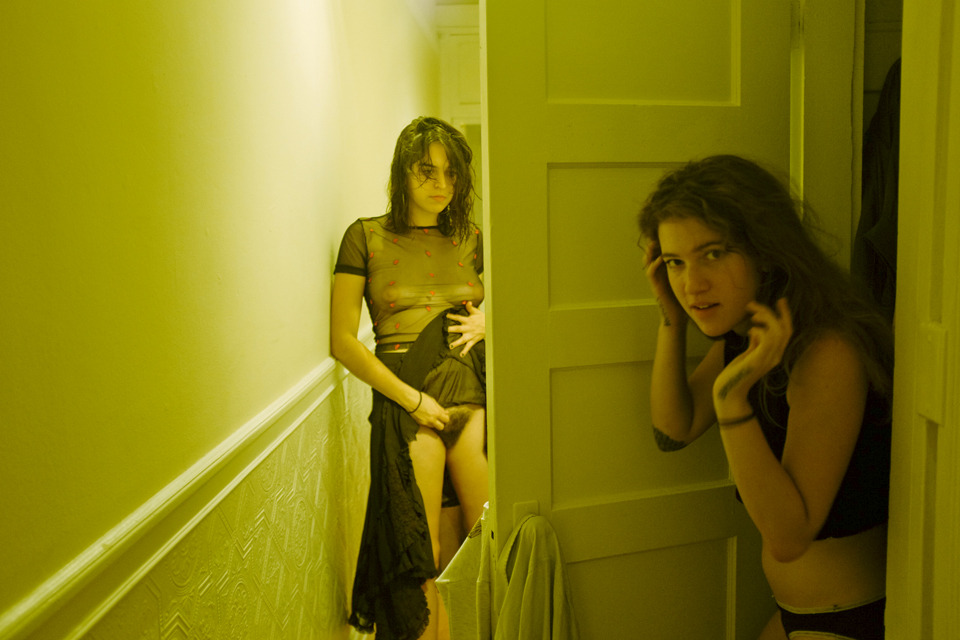
Vivian FuCheyenne and Eleanor (2014)

Independent of my projections on it, this is absolutely wonderful. There’s room for commentary on the way the use of color diverges from Fu’s usual and edges towards the surreal suffusion that have become Sophia’s hallmark. Also, the juxtaposition between the intentionality of the framing–how the top edge of the wainscoting aligns so perfectly with the lower left corner of the frame; and the immediacy represented in the off kilter vertical alignment between door jamb and right frame edge. (This of course echoes the staged/unstaged tension of the image.)

All blasted phenomenal, really. Still what gets to me is they way this image immediately linked arms in my mind with a self-portrait of Catalan feminist pornographer Maria Llopis.

I’m not entirely convinced I can explain the why beyond a general opposition: concerns over portrayal (Fu) vs. art as a process of secondary documentation with regards to radical self-actualization (Llopis). Both have their merits, purpose and place. Both are without question doing the Lord’s work… but I can’t help questioning–not to in so doing place an undue burden on young shoulders–but what I’ve seen thus far of Sophia’s work manages to walk a razor’s edge between performance and academnified activism by firmly anchoring the work in lived experience. If there’s a way to split the difference, I think she might be just the artist to manage it.

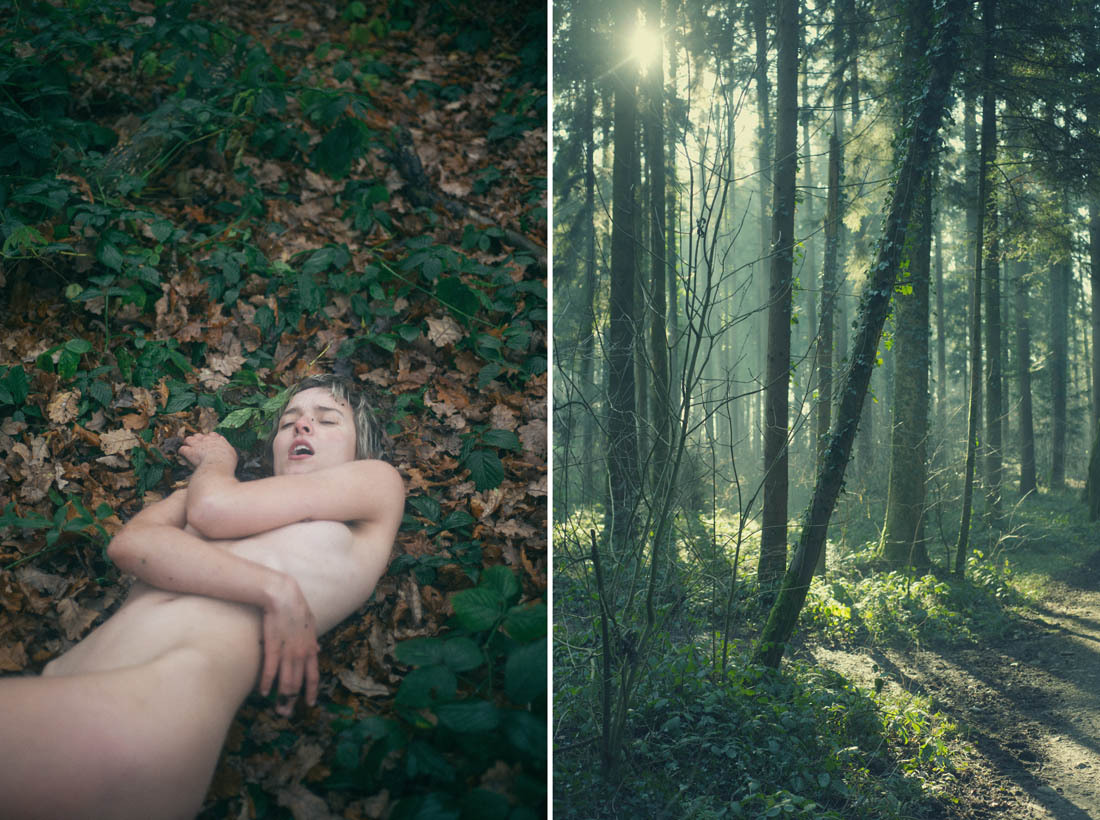
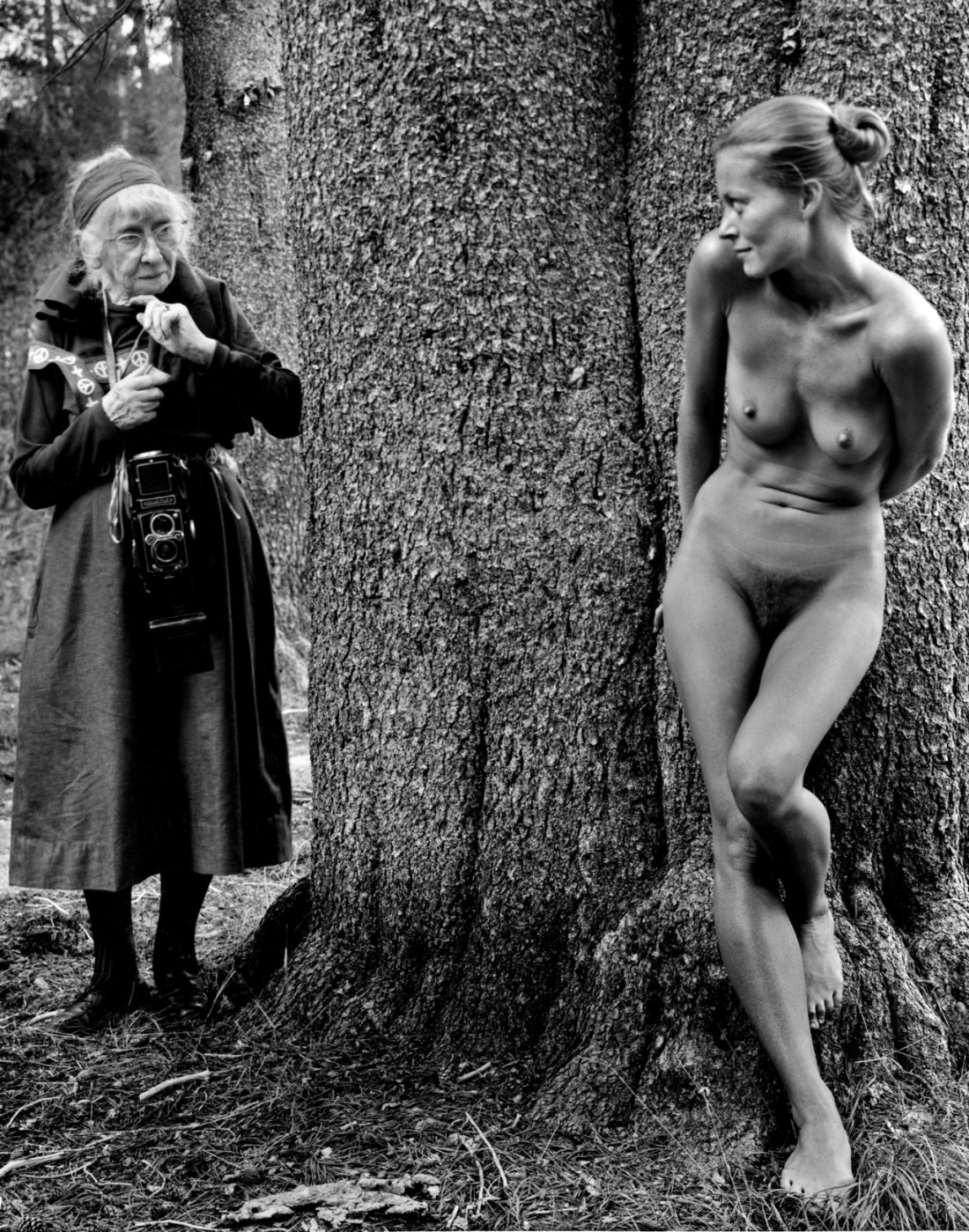
Judy DaterImogen and Twinka at Yosemite (1974)

I was completely unfamiliar with this image prior to this morning. And now that I know about it, I am sort of going crazy over it.

Long story short: I came to photography via cinematography and ever since I’ve been trying to figure out how to convey a narrative within a single, static frame.

There’s a lot of folks who are similarly fixated. Fewer succeed and some (looking at you, Crewdson) don’t even come close but continue to tout their work publicly as narrative despite a colossal misunderstanding of what narrativity entails.

This image is narrative as fuck. What we are seeing is indisputable. A woman with a camera has walked around a tree and to her surprise, encountered a nude woman eying her coyly.

Given only the image, we can surmise both what led up to this event and what will follow from it: respectively, a photographer was wondering through the woods looking for a scene to shoot and now having found it she will take a picture.

But… but… (sorry, totally v. emotional ova here) that framework suggests a number of questions: who is the photographer and why is this woman just leaning up against a tree naked?

And unlike so many images that rely on the inclusion of accompanying text or a title to activate the narrative, the title here–hallelujah!!–directly addresses those questions: the photographer is Imogen Cunningham, one of the first American female photographers; and the nude woman leaning against the tree is Twinka Thiebaud.

Further the mention of Yosemite serves the dual purpose of connecting this to the American photographic tradition–Eadweard Muybridge and Ansel Adams writ all the way into the fucking margins–and grounding it in the fact that this image came out of workshop (organized by Adams) entitled “The Nude in the Landscape.”

Apparently, Twinka character was conceptualized as a woodland nymph after Thomas Hart Benton’s Persephone. (Note how this intricately compliments the fantastical undercurrent of the initial narrative interpretation as well as presents a critical and conceptual weight to the mention of Yosemite in the title–i.e. the American west and it’s relationship to the nascent medium of photograph as a new mythology.)

I’m overcome by how incomparably perfect this is. This is the model for the work I want to make as a photographer.

Nagib El DesoukyUntitled (2014)

I don’t think those who follows this blog suffer from any sort of illusion when it comes to this author’s infallibility. Between lapses in grammar, sensibility and taste, I fuck up more often than not.

One of those fuck ups was ignoring El Desouky when he submitted several of images to me roughly two years ago.

The mistake I made–unfortunately, one I make with alarming frequency–was to judge the work based solely upon whether or not it engaged me.

That’s not put as clearly as I’d prefer. Let me employ a metaphor: craft–being a strictly mechanical process–is something anyone can be taught in such a way as to eventually allow them to achieve mastery. Passion, however, is a different story.

I’m not someone who believes that passion is something either inborn with or you’re shit out of luck. But I object to the notion of passion be something–like craft–that can be taught. It doesn’t work like that. Perhaps a better metaphor is either that of the heroes quest, or what shimmers between this wonderful list of rules for education penned by John Cage that’s making the rounds lately.

Or, to put it another way: I don’t think art teachers owe their pupils only constructive criticism. Much the way a Buddhist novice must wait outside the monastery for three days without food, water or encouragement, if one or several instances of brutal criticism are enough to cause you to foreswear a creative pursuit, then don’t let the door hit you in the ass.

All this is to say that although I still find myself put off by most of El Desouky’s B&W work (this incredible photograph being a notable exception), his tentative forays into color are fucking stunning.

I regret that I didn’t recognize El Desouky’s intense and unflagging passion sooner. And I’m calling myself out on it in a very public way, in the hopes that I learn from the mistake instead of continuing to perpetuate it.

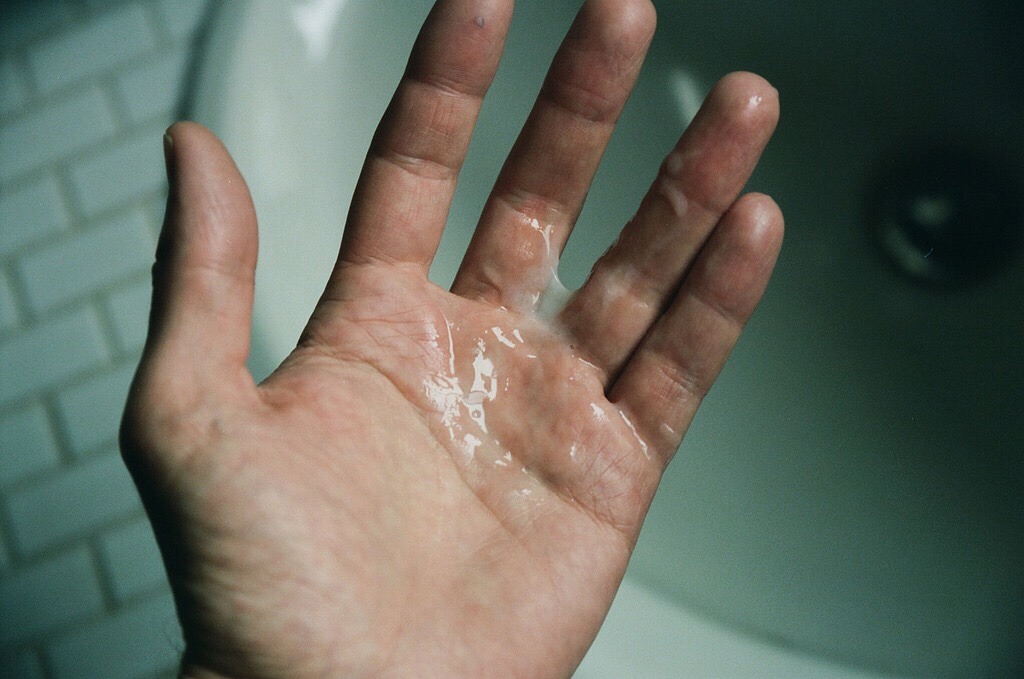
Zachary AyotteUntitled (2014)

This is really kind of great.

I’m not sure whether I think so due to the way the hand is positioned in the frame, the way the position of the hand corresponds to the tile and sink and the ever so slightly soft focus that comes from trying to focus with hold the camera and focus one-handed or that it recalls a series of photos Traci Matlock made employing her hands, water and objects in or around her kitchen sink.

Most likely, it’s both.

Source unknown – Title unknown (20XX)

Given that this looks as if it perpetuates the extraordinarily problematic trope in hentai where consent is gained through sexual coercion, I am probably guilty of bad faith by posting it.

But… :::avoiding eye contact::: I’m not sure how but independent of context this depicts not only something uncomfortably close to what I experience both physically and emotionally when someone brings me to orgasm, it also conveys what I feel when I bring my partner to orgasm.

The fact that they are both women that present varying degrees of femme-ness is crucial. As is the fact that the third woman down the alley has been alerted to their actions. I think I probably could explain why the third party contributes to the concreteness of this feeling, but I’m not sure if perhaps that’s maybe too personal for this venue. (Those of you who’ve been following for a while can probably venture some prescient guesses though…)

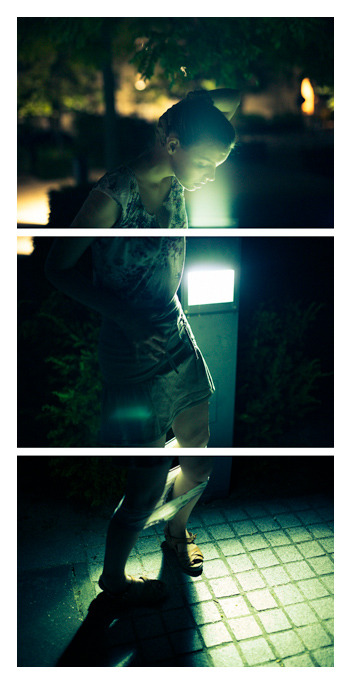
Tom SpiantiEve, Night Light Triptych (2008)

The above leaves me a thousand times more turned on than something like this.

It’s less to do with the going commando. (That’s certainly hot, though.)
It’s more the way it risks transgressing the boundaries between public
and private.

For example: if a woman is naked under her dress,
when I knows it, the knowing is usually limited to myself and her.
Whereas, in the situation depicted here, although it is highly likely
the situation will remain a secret shared between only two individuals,
there’s still the possibility that it’s not: that a third party
witnessed the transgression.

A conspiracy of two where it’s
impossible to know with certainty whether it was limited to two or open
to three is something that will always reduce me to a flustered,
twitterpatedly aroused mess.

(And just to be clear, a good bit of
Spianti’s triptych work is similarly fixated and both intriguing and
sterling as far as craft is concerned.)

Zsuzsanna Ujj – [←] Untitled (1989); [+] Untitled (1989); [→] Untitled (1989)

There’s not a lot that about Ms. Ujj to be found. She’s Hungarian and began making subversive self-portraits in the 1980s pretty much covers the extent of it.

She’s clearly preoccupied with the relationship between a woman’s body, how the woman sees her body and how society views a woman’s body. However, in this work, given the interactions of shadows (and the probable Jungian implications) and reflections (the resulting bifurcation of physical representation/ sight turned against itself), there’s more going on here than is readily discernible.

The dislocation is interesting and although I want to connect that to Picasso’s frequent mutilation of women’s bodies and while I know there’s an obvious metaphor with the individual vs. collective that relates to communism, my first thought upon seeing these was of the images of shadows burned into walls after the bombing of Hiroshima.

These images go a great deal deeper than most and they offer no ready made solutions or easy answers. In many ways, this reminds me of another work that is ostensibly about reconcile existence and beauty with the horrors of the nuclear age–Inger Christensen’s Alphabet (which is by far the best volume of poetry I’ve ever encountered).

lisakimberly:

austinkleon:

Credit is always due.

If you share the work of others, it’s your duty to make sure that the creators of that work get proper credit. Crediting work in our copy-and-paste age of reblogs and retweets can seem like a futile effort, but it’s worth it, and it’s the right thing to do. You should always share the work of others as if it were your own, treating it with respect and care.

I’m guilty of not always doing this, but I want to do better. We can all do better. Especially on tumblr, where reblogging without so much as an artist’s name attached to it runs rampant.

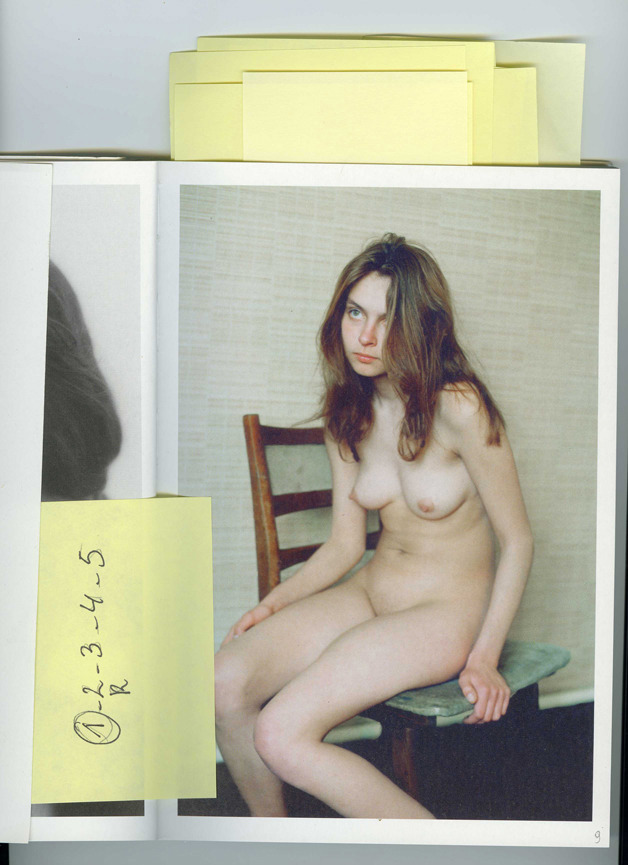
Arno NollenUntitled (20XX)

Although I can’t make heads or tails of Nollen’s work–it’s too scattered and profuse for me to know how in the Sam Hell I’m supposed to fucking approach it–this image walked in my brain like it was a cat that owned the joint and my brain had a front door I’d accidentally left open.

I can’t explain why I like it. It’s #skinnyframebullshit and the way her right ankle gets cut off is more than a little awkward. Yet, there’s something about her expression in combination with the self-conscious placement of her hands and her slouching posture that manages to reach in and completely short circuit my brain so that my only thought is Jesus Harold and Maude Fucking Christ on Christmas she is Helen of Troy beautiful, people would wages wars over her.

But I think–despite how off putting I find Nollen’s typical presentation–that in this case it enhances the effect of the image. The post-it notes recall a certain studious academic fervor that I suppose is an effort to undercut the sexualization and objectification that come to bear on the image. It’s half good first step and half cop-out but that it’s there at all feels reassuring in a way that it will probably take me another two years to even begin to articulate.