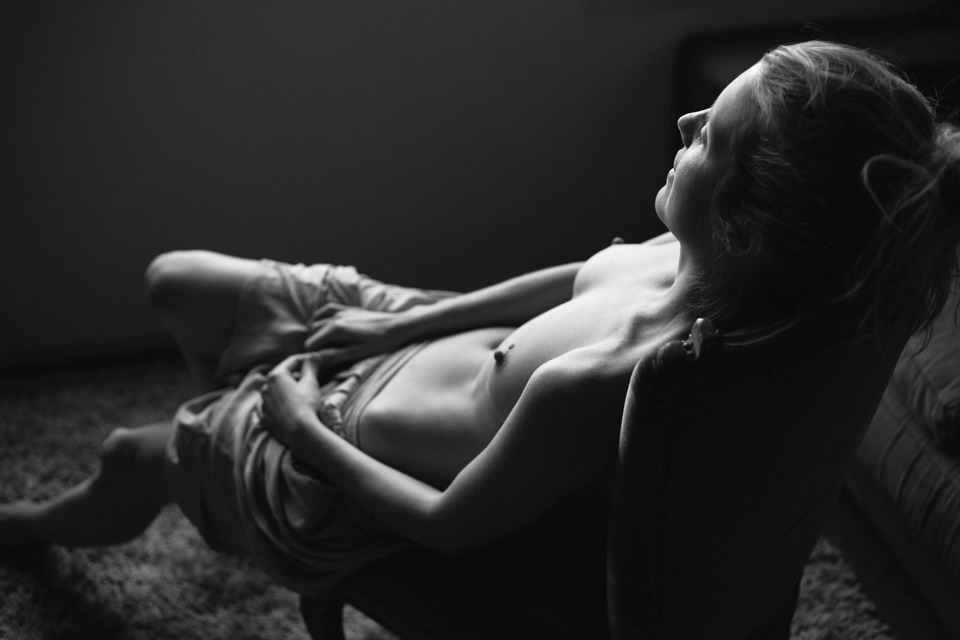
Daniel KlaasJoanna (2014)

The part of my brain that thrills in voyeurism enjoys portraiture. It’s a bit like a two-way mirror: I can watch without being seen.

But something about it is vaguely unsettling. I’ve been trying to work it out and I think it boils down to conceptual concerns over the negotiation of identity via depiction in visual representation.

That’s an annoyingly academic, overly verbose way of saying: at its most fundamental level portraiture establishes a thorny, four-way intersection between how the subject sees them self, how the subject wishes to be seen, how to photographer sees the subject and the how the photographer’s work is seen by the viewer.

Portraitists walk a razor wire tight rope between bearing witness and trading in what is effectively undeserved intimacy–i.e. the objectifying tradition of thinking I know because I have looked closely and seen.

Off the top of my head, Ryan Muirhead and Lynn Kasztanovics are the two photographers who manage to re-contextualize portraiture into something that testifies to the truth in the transaction of at once being, seeming, being seen and the politics of depiction while fostering subjects enigmatic non-object-ness. Muirhead does it with a mastery of craft and attention to the holy moments between defensive pretense and unguarded openness to the world; Kasztanovics collaborates with those she knows and trusts–her informality and the proximity to her subjects creates something not unlike the discomfort of someone sitting too close on public transit whom, contrary to all reason, you find yourself fighting the urge to reach out and caress their face.  (Lina Scheynius and Traci Matlock also fuck with portraiture in fascinating ways but both seem less interested in working within the form than transgressing it’s boundaries.)

Back to Klaas: he’s a Melbourne based photographer who favors analog photographic process. And I am not overly fond of his work but this image is quite unlike his typical milky exposures and rendering pose as contrived sculptural element. Instead, it reads as a sort of record of a moment in which the confluence in a body of subject and objective experiences of reality was quietly observed.

So there’s that. But also, there’s also fascinating technical considerations: the mid-tones are relegated to the background wall, couch and Joanna’s face. Everything is super contrasty with either deep, rich shadows or highlights pushed to the edge of blowing out.

Depth of field dictates the way the eye scans the image–It reminds me of mrchill, in that regard– and emphasizes her enigmatic expression, as if she is calm, comfortable, perhaps even a bit contemplative. (Note: the grace notes in her hand placement; probably my favorite part.)
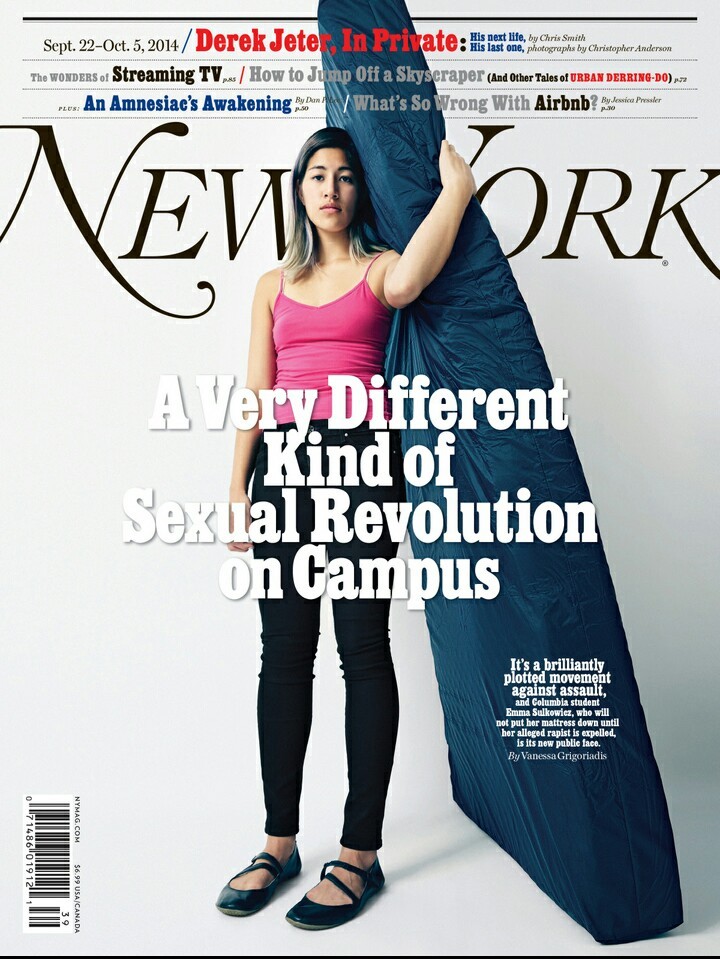
ashoutintothevoid:

Emma Sulkowicz is on the cover of this month’s New York Magazine and that is the coolest thing wow

I sat with Marina Abromovic for fifteen minutes–an experience which remains one of the most far reaching in my life.

But this… this is brave and extraordinary and devastating and elegant and absolutely fucking brilliant. And I tear up whenever I think about it.

Conceptual Art in 2014? It’s Emma Sulkowicz.

Sanders McNewFinancial Services, Minnesota (2009)

If you wish to shoot deliberately, to front only the essential facts of image making, and see if you can learn what it has to teach then go out into the landscape, I say. Take your square format, studio portraits and milky white backgrounds and shove them up your ass.

Except… well, sometimes I’m wrong and it’s a rare image that can not only make me admit I’m wrong but that makes me completely rethink my objections.

The focus here is on Brooke Lynne–she’s either trying on a new pair of glasses or nervously adjusting the pair she’s worn for months. There’s something both hyper posed and yet off-balance to it.

A milky white background typical decontextualizes the model emphasizing physicality. But although the backdrop certainly accentuates the shape of her body, the lighting and the simultaneous stylization and awkwardness of her posture emphasize shift attention to her gesture.

In most portraiture work in this style, I always feel as if the decontextualization is an effort to isolate the model; an invitation to objectify her.

This feels quite the opposite. LEss that there is no background than any background complicates matters unnecessarily.

In fact, browsing McNew’s Flickr leaves my head spinning at just how diverse a body of work given reasonably limited operating parameters.

[↖] Mark VelasquezUntitled (2013); [↗] Vlad Kenner [aka VK Photography] – Lady Sensuality (2014); [↙] Tomi KnoxLight the way (2013); [↘] asp photossecret beach (2014)

I distinctly remember my first encounter with the top right image. Few and far between are the images which command my attention like woah, got damn that’s bad ass!
It wasn’t the explicit nature of the image so much as the way that undercurrent seemed so inextricably entwined with an unapologetic–even confrontational–sense of self.
 
There was also enough playfulness to thoroughly unbalance–her expression of over-the-top offense that might be feigned but is maybe legitimate; indicating a seismic threat lurking just beneath the surface.
 
I noted her pseudonym–Lady Sensuality–and have actively followed her work ever since.
Despite having only worked as a model for a year and a half now–getting her start working with Mark Velasquez–she’s crafted a portfolio featuring collaborations with a veritable Who’s-Who of Tumblr image makers and is also beginning to shoot her own work.
After the unexpected success of my shot-in-the-dark that turned into an interview with french indie image maker Chill, I decide what-the-hell and reached out to Lady Sensuality about whether or not she’d be amenable to being interviewed.
She graciously agreed to answer a handful of questions.

Acetylene Eyes:It feels to me as if at least some of your work is preoccupied with pushing your own personal boundaries. How do you ensure those shoots happen in a safe space for you?
 
Lady Sensuality:If I decide to test my boundaries at a photo shoot, it is always either discussed prior to shooting and with someone of high credibility or photographed by someone who is close to me in my personal life. There are certain photographers who have become very dear to me who I will do more explicit work with. Erotic modeling boundaries are not always about what you are comfortable with sharing on the internet. Sometimes I would be comfortable with a photo of a certain pose or act being online, but not comfortable with a stranger photographing it.
 
AE:    Being a model and an image maker, do you have any advice image makers could employ to make a model’s job easier?

LS:      Firstly, be open with me. It makes it easier for me to help the photographer get the shot they are looking for when they communicate their vision with me. Secondly, letting me know what you are photographing. I like when photographers let me sneak a [peek] at the images during shooting so that I’m aware of the mood the lighting is creating, so that I can pose accordingly. Or if you are only photographing my face, or my shoulders and up, or my thighs and up, let me know! Then, I can give full attention to that instead of all little things that collectively make a big difference on the ease of the experience and how the photos turn out.
AE:     Who is your favorite artist?
LS:Deciding on a favorite artist would be impossible for me. I’m going to keep it relevant by listing a few models and photographers that I’m currently very interested in. Models include Echo Nittolitto, Jacs Fishburne, and Katlyn Lacoste. Photographers include Sebastian Rut (who I am very excited to work with in October of this year), David Miller, and Aeric Meredith-Goujon. There are at least a dozen other people I wish I could add to this list.

AE:Speaking of Ms. Fishburne, maybe two months ago she posted an impassioned declamation of signing model release forms prior to the end of a shoot. Even though he’s a fucking terrible photographer, I remember reading once about how Jock Sturges avoids model releases in favor of an implicit policy where the model has a degree of agency in when, where and how the subsequent images are used. It’s maybe not the best system but model releases strike me as inherently non-collaborative. Do you have any thoughts on a way the de facto model release position might be modified to be more egalitarian?

LS:      I have no problem with signing a model release. Because I am paid during the time of shooting, I have no issue with giving up my rights to sell the images at a later point. That is the photographers [sic] opportunity to make money off of the collaboration. Occasionally, you run into a situation where you are giving your time to a photographer for free (trade for print) and they still have you sign a model release. This, I do not agree with. It doesn’t seem fair to me that both the photographer and model are giving equal time and effort to a collaboration, but only the photographer is able to benefit from it financially. But again, in most cases (where I am being compensated at the time of shooting), I have no quarrels with signing a release.
 
5.     Frank Ocean did this interesting exercise earlier in the year where he explained his current situation to himself five years ago offering wisdom, advice and perspective. What, if anything, would you want impart on yourself of five years ago given the chance.
 
Honestly, I am so perfectly happy with my life right now, I wouldn’t want my 5 years younger self saying anything to put me off track. I feel as if I’m exactly where I need to be at this point in my life and that is a beautiful feeling.

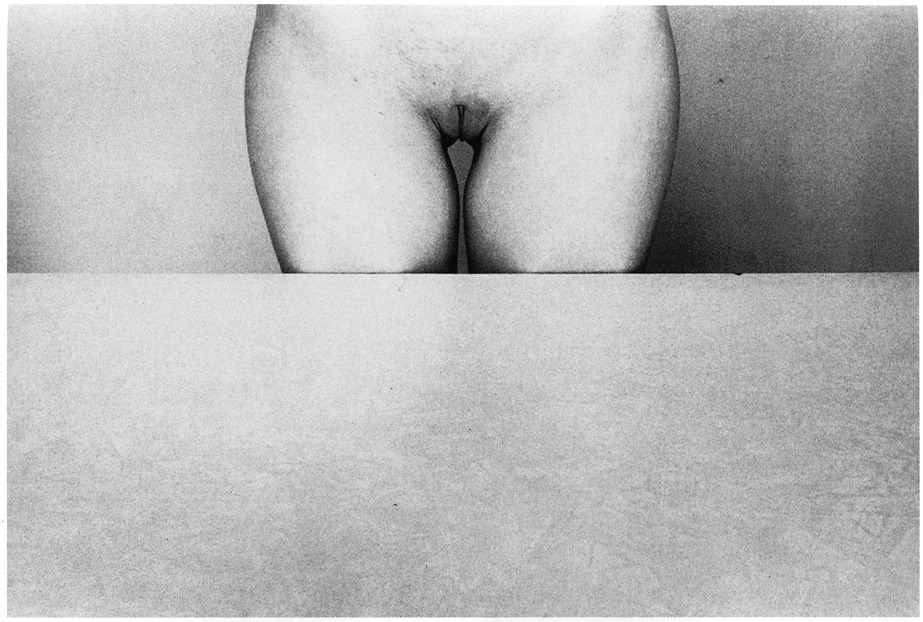
Duane Michals – Naked Nude (1982)

While the title is a riff on John Berger’s distinction between ‘naked’ (i.e. the natural state of the body) and ‘nude’ (i.e. the conventionally stylized art historical objectification of nakedness) in the seminal Ways of Seeing, I’m always suspicious when someone like Michals telegraphs that he’s aiming for the broadside of the barn.

Despite the simple elegance of the image, I feel like there’s an underlying middle finger being given to the notion that photography as an art is fundamentally more prone to essentialist objectification due the the inclusion/exclusion parameters of the frame edges.

Upon first seeing this I immediately flashed back to a college discussion on Piaget vs Vygotsky–specifically: the supposed necessity of object permanence in order for a child to learn language.

I never grasped the salient tenants of their disagreement but the general principle of object permanence applies here. At a certain point in our development–I believe Piaget would say it happened at one particular point, whereas Vygostsky insisted it was a recurring evolving process of increasingly sophisticated awareness–we learn that the toy our mom is hiding behind her back still exists even though we are unable to see it.

It seems Michals–who to my mind is a metaphysician first and a photographer second–is pointing out that we’ll allow that this woman’s legs continue below the table and even extend beyond the lower frame edge but politics insist we acknowledge that she is severed at the waist by the upper frame edge.

Using the table to create a frame-within-the-frame creates a tableau that it’s easy to dismiss as essentialist–reducing the female body to symbolic genitalia.

That this image doesn’t come off like that is a result of the clever composition, but I think contrary to Michals’ assertion–I’m pretty sure he’s a card carrying Cartesian–it’s the context of the image which dispels any trace of a sexist agenda. First, it is of an especially high quality, it’s self-consciously aware of the relationship between an out gay photographer, a nude model and an audience with the expectant male gaze default setting that will respond either salaciously, with disappointment or with critical censure.

The rightness or wrongness of thesis is irrelevant due to the masterful grasp of the totality of context.

FWIW: the self-portrait I submitted to this weeks ‘art’ themed nymphoninjas submission Sunday was accepted.

(Extra special thanks to sporeprint for not being at all bothered when I asked him about helping me edit less than 24 hours before I needed the finished product and managing to remain effortlessly patient with my damned demanding ass during the editing process.)

nymphoninjas:

Wonderlust Photoworks (Editing courtesy of Alveoli Photography) – Desolate Elements II (2014)

There’s a zen proverb that runs somewhere along the lines of comparing yourself to someone else is like sticking your head in a bucket of glue.

I constantly offer this advice to others; but rarely heed it myself.

The last two years have been very difficult for me. Trauma, loss and angst compounded by unemployment and persistent health problems. During this time, creativity—the only thing in my life that has presented consistent refuge—has been limited to thinking the work I’m trying to make doesn’t matter. I get stuck in this self-defeating-Orson-Welles-made-Citizen-Kane-at-26/Arundathi-Roy-wrote-The-God-of-Small-Things-at-28-what-have-I-done-of-any-consequence loop.

I’m always so focused on how precious little time humans have and as a result I focus on trying to make everything count to the fullest. It’s not a bad way to live so long as you give yourself permission to make mistakes. Mistakes are how you learn + grow emotionally, spiritually and artistically. I forget that so often…

The above is a frame from a video I shot several months ago. I don’t like shooting video—I’m an analog snob—but desperate times, desperate measures. The video itself was a disaster and I haven’t looked at it since I shot it. But when I saw that this weeks theme was ‘art’, I searched desperately for something to submit. Re-watching the awful video, this one frame jumped out at me so with the a little help from Alveoli Photography to clean it up I decided to share it as a reminder to myself and others that showing up is just as if not more important than having a devastating aesthetic sensibility.

Sometimes we have to create many things to get one thing we are happy with, and it this case it seems like you captured hundreds or thousands of frames for your video and found one frame you were happy with. I think in the end it was definitely worth it, and I’m glad you put in the time to find the right moment and thanks for sharing it with us. 

Allison Barnes –  [↑] July 30: Incision (2012); [←] July 23 (2012); [→] Bruised Vein from Neither For Me Honey Nor the Honey Bee (2014); [↓] July 24 (2012)

Little else drops me down a k-hole faster than stumbling upon a photographer whose work thoroughly engages me.

I spent a good part of yesterday pouring over Allison Barnes’ work. Given her proclivity for shooting analog large format almost exclusively, this shouldn’t be a surprise.

What surprised the fucking shit out of me was how far off base my initial impressions were.

For better or worse, I think everyone tends to start from what they know based on their experience. Barnes initially struck me as a photographer preoccupied with Francesca Woodman, Sally Mann and Ana Mendieta.

Following those markers leads down lush verdant path passing interesting scenic overlooks; but sooner or later each dead ends, leaving you to retrace your steps and then begin again from the beginning.

What’s strange is it almost feels like these false trails are supposed to be followed–as if in following them to their end the work is teaching the viewer how to see it, as if initial misunderstanding is somehow integral to any sort of eventual understanding…

It’s this that dismisses perfunctory correlations with Woodman and Mann–both being more caught up in aesthetic interrogations of the trilateral relationship between author, subject and audience, how that relationship manipulates objectivity.

The Mendieta trail does stretch further than the others but in the end Barnes veers away from carefully manicured feral confrontation for something not exactly patient or even contemplative so much as the expectant stillness of someone willing to wait for you to get the ever-so-clever joke in the otherwise grave conversation.

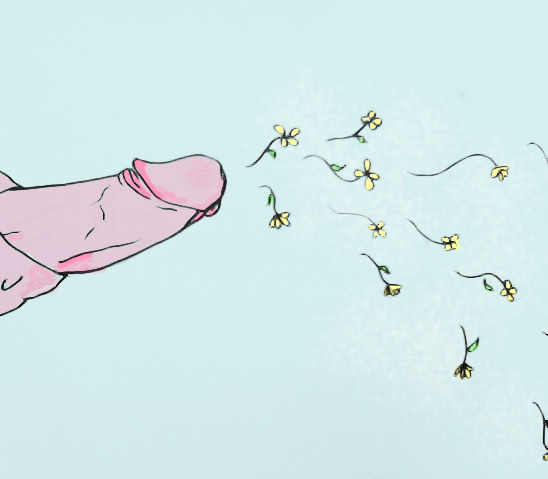
Source unknown – Title unknown (XXXX)

I like this v., very much.

Yes, I do have a fixation upon creative, non-sexist strategies for the visual depiction of ejaculation.

& yes, there’s def/ room for improvement as far as the line work here…

…but: the core idea–the physical act of seminal ejaculation as an event resulting in beauty–reads unambiguously as-is

& this is exactly the sort of work that if I ever had a space to truly claim as my own, I’d want this displayed prominently. I gives me very warm and fuzzy feels.

(Also, I’m borrowing knitphilia’s pretty masculinity and crafty cocks tag because they are v. apropos.)

Konstantin Antioukhin – The Pear (2010)

A Kievan considered by many to be the best living engraver, Antioukhin specializes in bookplates.

As with any engraver, there’s a great debt owed to Dürer. And while it’s not visible here, Antioukhin wears his influences on his sleeve borrowing Klimt’s icon-like compositions and excessively filigreed ornamentation; the latter of which are then filtered through Mœbius’ riffing on the florid superfluity of line in Ernst’s decalomania. There’s also usually some Giger thrown in as leavening.

It’s a heady mix and like Belgian beers, it’s difficult to question the excess of flavor since it serves the resulting quality. However, as with Belgian beer, I tend to prefer unapologetic directness, I don’t always want to be overwhelmed by profusion.

In this piece, the influences are still there to discover for the discerning eye; but in the unity between form and execution there’s a diminution of their obviousness. To me this suggests Antioukhin would be well served to trust his own vision instead of always announcing his footing on the shoulders of giants.