Igor Mukhin

Normal
0

false
false
false

EN-US
X-NONE
X-NONE

/* Style Definitions */
table.MsoNormalTable
{mso-style-name:”Table Normal”;
mso-tstyle-rowband-size:0;
mso-tstyle-colband-size:0;
mso-style-noshow:yes;
mso-style-priority:99;
mso-style-parent:””;
mso-padding-alt:0in 5.4pt 0in 5.4pt;
mso-para-margin-top:0in;
mso-para-margin-right:0in;
mso-para-margin-bottom:10.0pt;
mso-para-margin-left:0in;
line-height:115%;
mso-pagination:widow-orphan;
font-size:12.0pt;
mso-bidi-font-size:11.0pt;
font-family:”Garamond”,”serif”;}

If it moves, Igor Mukhin likely shoots it; if it doesn’t, he’ll still take aim.

With nearly 5000 images—split between B&W film scans and Leica AG M9 captures, amassed over 6.5 years—perusing his photostream is like mainlining a hyper-distilled, chaotic mélange of interesting, occasionally ingenious work.

My head doesn’t wrap around such profligate excess easily—limitation is too central a feature in my own process. (Read: I am poor.) But I can let that slide. What I fail to fathom is how Mukhin’s haphazard, throw-it-at-the-wall-to-see-what-sticks curatorial approach works at all, let alone results in such jaw-dropping examples of all that photography should embody.

(To avoid unnecessary disappointment, skip his staid personal website.)

Kim Eliot FungPhenomenon of Being 2006

Normal
0

false
false
false

EN-US
X-NONE
X-NONE

/* Style Definitions */
table.MsoNormalTable
{mso-style-name:”Table Normal”;
mso-tstyle-rowband-size:0;
mso-tstyle-colband-size:0;
mso-style-noshow:yes;
mso-style-priority:99;
mso-style-parent:””;
mso-padding-alt:0in 5.4pt 0in 5.4pt;
mso-para-margin-top:0in;
mso-para-margin-right:0in;
mso-para-margin-bottom:10.0pt;
mso-para-margin-left:0in;
line-height:115%;
mso-pagination:widow-orphan;
font-size:12.0pt;
mso-bidi-font-size:11.0pt;
font-family:”Garamond”,”serif”;}

It’s like returning to a location that filled the child-mind with its enormity only to find it suddenly shrunk, like music that once moved you, moving on now without you.

A rule to which there are precious few exceptions.

The disparity between perception and reality has to burn away over time, like morning fog. Perhaps this is what Baudelaire was about when he advised poets to burn anything written before the age of twenty-five if they wanted to be taken seriously.

If you take the idea of poetry literally: what of Rimbaud—who wrote everything he would ever write prior to turning twenty?

What if you define poetry as did Emily Dickinson—and I do—what does this mean for the photo poetry of Francesca Woodman?

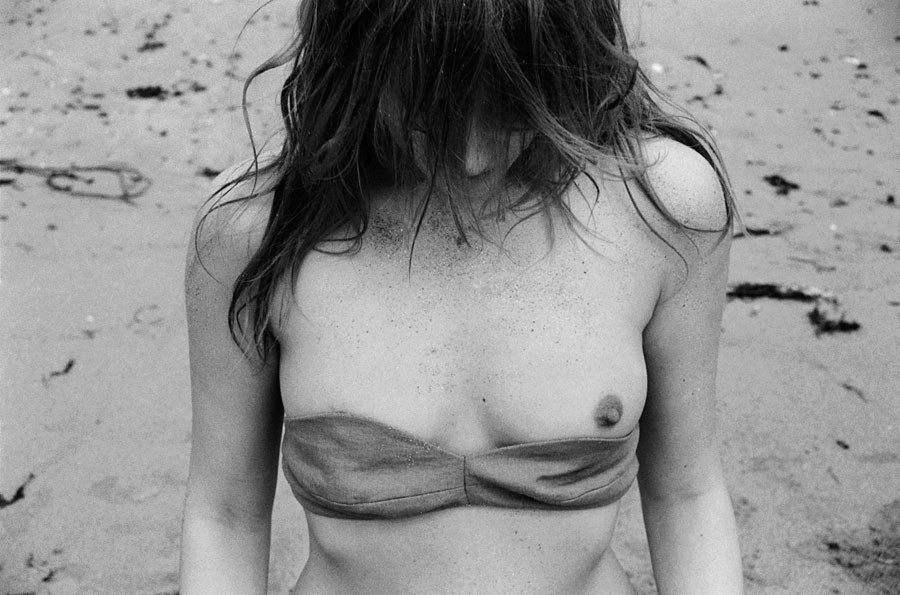
What about Kim Eliot Fung who was a teenager when she made this photograph?

I mean there are certainly criticisms that can be made here—adolescent angst, sentimentality. I might even add question with regard to why the model’s head is cut off—though I think the effort of the image has something to do with the spectators gaze and how an awareness of that implication inverts and skews notions of anonymity, gender perception/performance and the politics of visual representation of identity.

Criticisms that the work lacks refinement or is unaccomplished are completely off base. In other words, it suggests a precocious understanding of what maturity entails even if it has not yet fully reached maturation.

This is one of my favorite photographs. Unlike so many things that I return to in time, this does not seem smaller than my memory of it. If anything, the opposite is true: the image itself seems larger, richer and fuller when measured against my memory of it.

It’s my hope that Ms. Fung will return to photography at some point. Until then she makes aprons and curates the always impressive Editor’s Index.

The earliest instance seems to be this post; beyond that your guess is as good as mine.

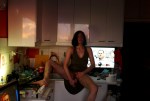
This image demonstrates at least a cursory concern for composition. The focal point of the image is not the center of the frame. There is a consistence in the angle and space allotted to the outside-edge-of-the-tub/floor and the inside-of-the-tub/tile wall. The model is watching what is happening in the frame not searching for approval from the viewer. She is presented nearly whole in the frame. Lastly, the flash is exposes the white fiberglass perfectly, stopping short of overexposure.

I love that this young woman is still wearing stockings and cute top. Along with the polish on her nails, the image retains color that levels out what would have otherwise been the tub being too white or her skin blanched.

There is clearly an urolagnia element to this scene. Yet it is– for me at least–mediated by the geyser-like appearance which although certainly urine echoes tropes surrounding female ejaculation.

In other words, some forethought and technical skill went into making this image. It’s gritty and transgressive but quality is not sacrificed just because its content features fetishistic elements.

toutdroitaller:

Irina Zadorozhnaja

Whether she is shooting street-travel hybrid images, landscapes or portraits, Ирина Задорожная demonstrates a precocious formal consistency.

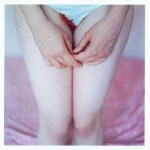
Her images feel symmetrical. Yet, upon closer inspection they instead employ an objects implicit extension beyond the frame edge to balance out an equal amount of negative space on the opposite side.

For example: the lower frame edge cuts awkwardly below the model’s wrist + mons pubis. Notice though how this is balanced by the negative space above the model’s head at the limit of the upper frame edge.

It’s a sophisticated, compelling tactic.

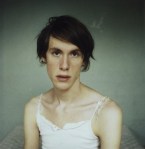
I really like this image. The expression in tandem with the pose is both aloof and fragile; the visible texture of the sweater expertly counters the otherwise problematic flatness. The light is probably too harsh but I can forgive that.

#skinnyframebullshit still needs to be called, however. It baffles me how the same artist responsible for this image showcasing how portrait orientation ought to be used, resorted to the typically knee-jerk, portrait-orientation-for-portraits in an otherwise nearly impeccable image.

Clips from the first part of this scene can be seen on XVideo.

***

My first instructor in film school was a regal woman of Indian sub-continental extraction. On the first day while I second guessed all the decisions that had brought me there, she went around the room, greeting everyone by name with a Namaste + a bow; she explained it meant the spark in me acknowledges the spark in you.

***

About a month ago, an acquaintance/friend was chatting with me. We had been talking about a number of superficial things when the topic suddenly shifted to childhood trauma. I had to figure out ways to deal with [the] darkness, and they were definitely not healthy, she said.

***

When I was eight I was preoccupied with black holes. They intrigued me because light could not escape them.

I wondered if one could focus darkness in the same manner as a flashlight focused light + and the respective beams were pointed directly into each other which would win out?

***

Why isn’t there a word for the darkness in me will not turn away from the darkness in you?

There is but it is not a word. I speak it with lips, with tongues + touch. And while I speak everything is dew wet—new and true.

***

This darkness in me stares into the darkness in you.

passius:

porn4ladies:            passius:

Olga Karasik404 2013

The use of the mirror here is goddamn inspired– obscuring both women’s faces within the frame. (See!! There’s no reason to decapitate yourself in your images to maintain your anonymity. A little creativity goes a long way and makes for better pictures.)

It’s obviously beholden to Francesca Woodman; but it wisely cribs a page from the rock and roll rule book for performing cover songs: make it better than or do it different.

Karasik filters Woodman’s concerns through her own aesthetic sensibility in a way that marks it as reinterpretation instead of a rearranging of elements in a template.

Sadly, it’s either some #skinnyframebullshit; or, :::shudders::: cropped. (I loathe a we’ll-just-fix-it-in-post attitude. Do it right the first time or go the fuck home. Post-production is a safety net in the unlikely chance it becomes necessary; the entire fucking point is not to need it.)

I guess at least evinces some thought went into the decision to opt for the skinny frame.

Excuse me while I throw this down, I’m old and cranky and tired of hearing the idiocy repeated by people who ought to know better.

Real women do not have curves. Real women do not look like just one thing.

Real women have curves, and not. They are tall, and not. They are brown-skinned, and olive-skinned, and not. They have small breasts, and big ones, and no breasts whatsoever.

Real women start their lives as baby girls. And as baby boys. And as babies of indeterminate biological sex whose bodies terrify their doctors and families into making all kinds of very sudden decisions.

Real women have big hands and small hands and long elegant fingers and short stubby fingers and manicures and broken nails with dirt under them.

Real women have armpit hair and leg hair and pubic hair and facial hair and chest hair and sexy moustaches and full, luxuriant beards. Real women have none of these things, spontaneously or as the result of intentional change. Real women are bald as eggs, by chance and by choice and by chemo. Real women have hair so long they can sit on it. Real women wear wigs and weaves and extensions and kufi and do-rags and hairnets and hijab and headscarves and hats and yarmulkes and textured rubber swim caps with the plastic flowers on the sides.

Real women wear high heels and skirts. Or not.

Real women are feminine and smell good and they are masculine and smell good and they are androgynous and smell good, except when they don’t smell so good, but that can be changed if desired because real women change stuff when they want to.

Real women have ovaries. Unless they don’t, and sometimes they don’t because they were born that way and sometimes they don’t because they had to have their ovaries removed. Real women have uteruses, unless they don’t, see above. Real women have vaginas and clitorises and XX sex chromosomes and high estrogen levels, they ovulate and menstruate and can get pregnant and have babies. Except sometimes not, for a rather spectacular array of reasons both spontaneous and induced.

Real women are fat. And thin. And both, and neither, and otherwise. Doesn’t make them any less real.

There is a phrase I wish I could engrave upon the hearts of every single person, everywhere in the world, and it is this sentence which comes from the genius lips of the grand and eloquent Mr. Glenn Marla: There is no wrong way to have a body.

I’m going to say it again because it’s important: There is no wrong way to have a body.

And if your moral compass points in any way, shape, or form to equality, you need to get this through your thick skull and stop with the “real women are like such-and-so” crap.

You are not the authority on what “real” human beings are, and who qualifies as “real” and on what basis. All human beings are real.

Yes, I know you’re tired of feeling disenfranchised. It is a tiresome and loathsome thing to be and to feel. But the tit-for-tat disenfranchisement of others is not going to solve that problem. Solidarity has to start somewhere and it might as well be with you and me.

Hanne Blank  (via mooncrumbs)

Goodness, yes.

(via feminesque)

thebodyasconduit:

‘And in this vision

the present is also revealed as a ruin.’

(Hal Foster)

*

by Traci Lynn Matlock

June 20th & July 9th, 2013

film

More often than not, articulating what’s going on in my head is like trying to fit an iceberg through the eye of a needle.

It’s like I see 300 images compressed into three seconds and I have to recall every bit of it with eidetic specificity. 

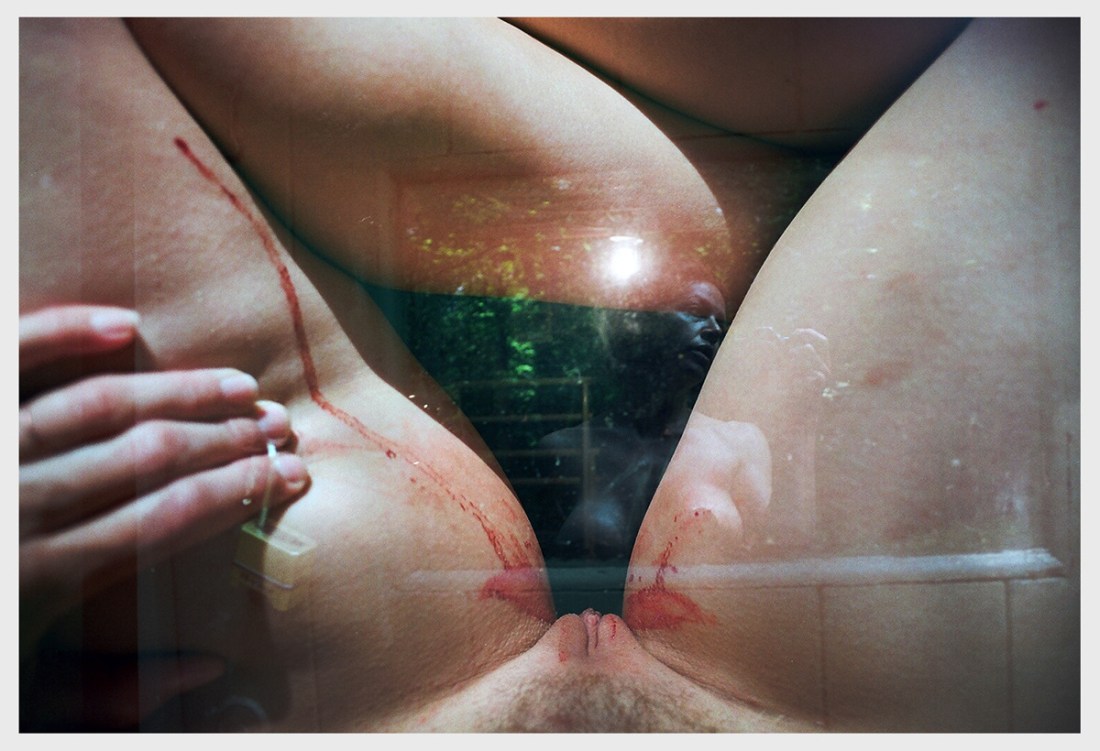
With this image what I can remember runs something like: ugh, multiple exposures; and, must Art always be goddamn sexist, there’s what, centuries worth of images featuring featuring women as essentialized, sexual objects but how many images can you think of where a female bodied individual is portrayed as a someone with a vital inner life independent of what a man thinks of her or the audacity to—clutch the pearls—depict menstruation; and, what would Szarkowski’s reductive Mirrors and Windows make of this?

The enormity of seeing the original thought surface, the marvel of its intricate perfection is all but lost.

My recall is sometimes astounding. I live for those moments.

During the remainder of the time, its like guessing at the original picture based on nothing more than a handful of puzzle pieces.

Occasionally, the pieces lead to more pieces. Given enough time, I can confidently point to an approximation of that first notion. Most of the time though, I can’t.

At which point I am left with the choice of giving up or trying to say something that manages to make sense of the pieces I have and hopefully points however glancing toward what I want to say.

Stories, I have learned, are a valuable tool in this process. Telling a story doesn’t always turn up more fragments. But it frequently triggers additional moments of astonishing clarity.

It doesn’t feel like there is a connection but I feel compelled to talk about how I discovered Matlock’s work.

Usually, I attribute my motivation to buy my first 35mm SLR to encountering her work. But that’s personal mythology; not the truth.

At the time, I was in film school studying cinematography. The summer between my junior and senior year was the first time I was not scheduled to shoot anything for anyone else and couldn’t afford to shoot anything of my own. So despite knowing nothing—less than nothing: fuck all—about still photography, I snagged a Nikon 8008s with a 50mm f1.4 lens. The salesman had to help me load the first roll of film.

The first handful of rolls turned out better than I had any right to expect. And after being prodded by my ‘adopted’ sister, I put some of my stuff up on Flickr. (This was back in the days of the simpler, more elegant interface and with it the now long gone pervasive sense of community.)

Part of me relished nominal attention my photos received. I likely would have bored of it, if it hadn’t been for the Explore feature.

After about six months of shooting, I hit my first plateau. The magic was far from gone but the process had begun to feel like work. It was that dead man’s land between Thanksgiving and Xmas and in combination with my frustration with my photographs, extremely loneliness and handful of other mitigating circumstances, created a perfect storm during which I stumbled onto Matlock and Ashley MacLean’s collaborative work under the moniker tetheredtothesun.

I remember distinctly that this was the first image I saw. Seeing it produced a feeling identical to the moment of surfacing, of mental clarity. Only, the three second time limit had been lifted. I could sit and stare; wonder at it all. Dwell there for a time.

I cannot understand how everything in my life since then has hinged on the flipping of that switch. I still don’t completely understand it. But it opened my eyes to the fact that the work I was making ran contrary to what I longed to create. Further, it lacked willingness to be vulnerable to others.

It’s not especially clear but the original thought I wanted to write about here was a bit of an extended metaphor. Something to do with the way parents track their child’s growth with pencil marks on a door frame. So much of my own creative development lines up in my mind with photographs Ms. Matlock has either helped to make or made herself. (I will write a goddamn dissertation of a post if I ever manage to track down her photo of Smashley titled something ‘a well-explored room’,.)

I don’t get her multiple exposure work. It doesn’t move me in the same way as her more candid images.

Matlock was recently interviewed by The Photographic Journal. Reading it I was reminded of how influential her work has been in my development as a photographer. It’s simultaneously thrilling and unnerving.