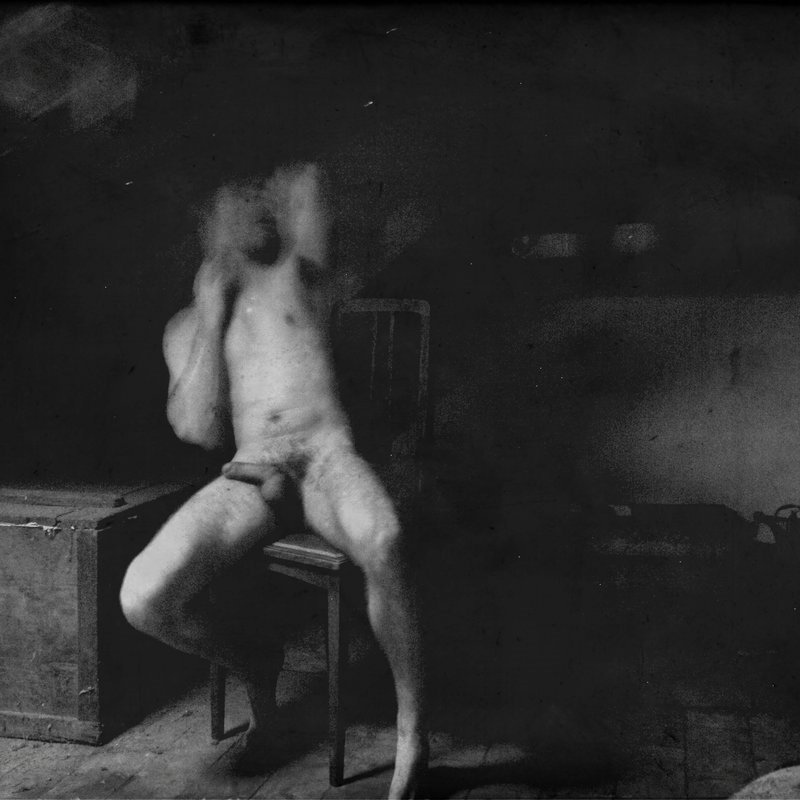
I have tried to source this but neither Google Image search or TinEye are coming up with anything conclusive.
This uncertainty exacerbates my polar reactions to it. Most of the time, the muddiness is reminiscent of Duane Michals early-ish work, particularlly a moment of perfection.
But there are also times–like writing this–where the position way his arms are positioned and his motion blurred face feel more like a horror film, a sort of E. Elias Merhige’s Begotten-esque haunted house where the ghost seduces then strangles the amorous.
I don’t know what to make of it. Not in an I don’t give fuck one about it, though. It’s so true what is said about the distance between what we love and hate is much less than the disparity separating love from apathy.
There something else rattling around in my head about the body as a house haunted by a soul, but language and I are having another one of our frequent sullen tiffs. Besides, any time it starts to feel like the only thing I have ever known, I start to forget how the stories go.
Meskhi’s website presents his as a photographer preoccupied with athletes, skateboarders and soldiers. Shooting predominately flat black and white, his inclusion of occasional, irreverent bursts of color do nex to nothing to lessen the work’s dour murk.
By contrast– and as suggested by the title– his When Earth Seems to Be Light series is full or warmth and whimsy.
It’s maybe not good but it is undeniably more accessible than the other work showcased.
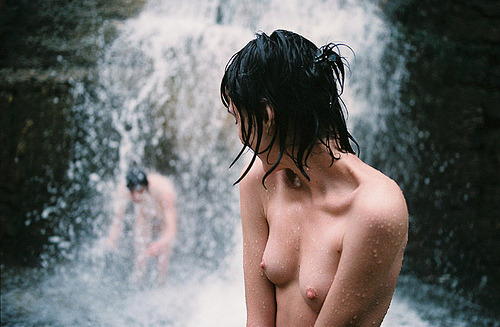
It is incomprehensible that this image does not appear on the site. Instead, another image of the same young woman–Anna, apparently is featured. The second image isn’t bad; it’s casual immediacy seems forced, as if it seeking to neuter the sentimental nostalgia.
And I see how someone could read the image I posted could as self-indulgently sentimental. It is a little; However, that’s not always a bad thing–arrive for the nostalgia, stay for the Art.
In this case, neither sentimentality or nostalgia pull me in. It’s the sheen of water droplets on her skin, the texture of her wet hair. And I absolutely love how she is turned away– it reminds me of the hypothesis posited by either Edward Snow or John Berger that the young woman in Vermeer’s Girl with the Pearl Earring is simultaneously turning toward and away from the viewer. (If you’ve got seven minutes to kill, check out: a physicist tackling this question.)
I confess that this image does cause me to lapse nostalgic. But that is due to the content more than anything pertaining to the execution. See although I am in my… er… well, further from my teens than I have ever been, I missed out on a lot of normal– at least for John Hughes movies–social rites of passage.
I played Spin the Bottle a handful of times but was always told that at least one of the people playing had promised my mom that they would make sure I didn’t play. I would beg and plead but there would always be a caveat that if the bottle landed on me, the most I could do would be choose two other people to kiss. (The stopped letting me play altogether when I began suggesting two boys or two girls should kiss.)
I also realized sometime last year that I have never been skinny dipping. And it’s not that the repressive environment I grew up in was so effective and getting kids to not be kids. It was more that I wasn’t invited to gatherings where those types of things happened.
One of my New Year’s resolutions was to go skinny dipping this year. But the truth is I have just as many people to go with then as I do now.
There are strong similarities between Troncoso’s work and art historical precedents. For example: Iluso smacks of Margritte, Real’s bad acid trip made flesh, borrows from a similar work– which escapes me at the moment but also used fragmented images attached to models’ bodies for unnerving effect–both owing a thing or fifty to Max Ernst.
But I can’t help thinking the references are little more than premeditated sleight of hand. The first clue is the image quality. There simply are not that many people around who can coax decent greyscales from digital equipment. Second, though his Flickr account is noteworthy, his personal website–despite its awkward and unwieldy layout– is incisively curated.
My Spanish is quite rusty but I ran Troncoso’s artist statement from the body of work in which this image features through a translation engine. What resulted was borderline nonsense. I tried to clean it up a bit–bear in mind my Spanish grammar is severely limited by my utter impoverishment when it comes to English grammar:
These images were performed over the course of five years and are chronologically arranged to portray a questioning evolution. A journey of visual interventions that came together in interpretations and symbols. Each photograph is a projection of my imagination, inspired by feelings involving me with this world. [A world where] reality and time intertwine with the infinite. The images seek to portray this connection.
Correlations with Margritte and Ernst shift to the background and I am left thinking of Yves Klein–specifically Saut dans le vide. Whether or not this is an astute response, there is something of Klein’s brash dynamism in Troncoso’s work.
Honestly, it matters less to me how they work than that they do–quite well, in fact.
People have such strange reactions to nakedness – and one of my least favorite is the concept that by revealing your body, you are somehow ‘giving too much away’ or ‘not leaving enough to the imagination’. Along with those phrases comes the implication that by letting others see…
It’s really a shame. For what it is– a staged photo of a boy with his fist circling his cock– I think this is classy.
The composition is nice. He’s presented entirely within the frame, not making eye contact with they camera. His body’s mid-line angles to his right, counter-balancing the framing which clips the vertical of the lamp base against the middle vertical of the metal bed frame/headboard.
With the lamp turned toward the wall, the light blows out into a white-hot super overexposed orb. In turn this allows the reflected light to illuminate the rest of the frame with appealing, dusky tones.
It’s an artful take on what could have easily been another uninteresting, disposable iteration of the same old thing.
Influence is crucial—sheer force of will and work ethic only goes so far. Hell, without inspiration, how many would have picked up a camera to begin with? Let alone kept on after all those rolls of ruined film, struggling through plateau after plateau in the work, etc.
So called fine art photography operates off the principle that imitation of your influences forms the most effective framework for becoming a photographer. Although seen through rose colored glasses, Arno Rafael Minkkinen presents the essential premise behind fine art photography with insight and aplomb in his renowned Helsinki Bus Station Theory.
While I disagree with the notion that gallery owners would so much give you the time of day let alone inquire as to your familiarity with X or Y artist and object to prejudicing the destination over the journey, Minkkinen’s theory does have special resonance for photographers with a vested interest in visual narrative or those—like Ms. Market—who count filmmakers among their foremost influences since the Helsinki bus station presents us a bit of a conundrum.
Even though I am not, let’s say—for the sake of argument— I am a enamored with Stanley Kubrick’s films. But for whatever reason, I prefer the medium of photographer so I arrive the Helsinki bus station and after looking around decide that to take a bus departing from the same platform as Diane Arbus. However, once on board I don’t even make it as far as the suburbs before realizing this isn’t for me. I go back and decide to follow the Walker Evans’ line—which departs from a platform on the opposite side of the station as the previous one. Maybe I make it a little further this time but quickly discover it’s still not for me. What then?
I go back and merely because I have no idea what else to do I wander onto the platform from whence Ansel Adams departed. This time the route choice sticks—but not due to being on a line the focuses on landscape photographer so much as finding a route pathologically preoccupied with the technical. (After all, what Kubrick lacked as a storyteller he more than compensated for with his exacting abilities as a technician and unparalleled production designer.)
Filmmaking and photography are sibling art forms and like siblings, you cannot approach them in an identical fashion. Those of us who come to photography by way of narrative/filmmaking share a frighteningly similar list of influences that, to stick with the metaphor, are dispersed all over the Finnish countryside. Most are contradictory. Mistakes are going to be made; routes will need to be abandoned and subsequently re-chosen as the line that works for each person is almost never the first choice.
But back to this image—I like it. And I like it because it is one of the few images where I do not feel the photographer is not leaning on something that has been said well before in order to add feeling, depth or relevance to her own ideas.
Flattery is the sincerest form of flattery. Brittany Market demonstrates she handle imitation flawlessly. My interest in her work is what she will produce when she finds herself on a line long enough to leave the Helsinki suburbs behind. This image suggests a great deal of potential that will hopefully be realized in her maturing work.
Browsing this kid’s work makes me think I’d be better off selling my gear, taking a vow of silence and dedicating whatever remains of my life to asceticism.
A year from now I will still almost certainly be reeling in response to his Different Ways.
How much is true and how much is personal mythology– I haven’t the foggiest notion, honestly. The answer doesn’t change fuck all, though– talent is talent is talent.
Technical concerns aside, the image’s awkwardness also works in its favor. It is, after all, an image belonging to a larger more-or-less sequential, implicitly narrative images. For example: before I researched this image, I was fairly sure that this young woman walked in on the young man in the tub, things escalated and she began to undress. (As far as I can tell, that is in fact, what happens.)
There is also the ripe implication of what will happen next: the scenario will proceed to intercourse. Thus, this single image contains all the information for the viewer to discern the entire narrative arc without seeing any other image.
The possibility of distilling a story to a single narrative image seed is an idea with which I am pathologically obsessed. And for all its faults, I actually prefer this to the arbitrary, narrative pretense of photographers like Gregory Crewdson, Sébastien Tixier and Reverend Bobby Anger. (If you disagree with this premise: attempt to envision what happened immediately prior and what will happen next. (Pro-tip: you can’t; despite all the gum flapping about narrative, when the work has more in common with the so-called ‘tone poem capturing the something of the weight in moments heavy with emotion.)
But, I would have posted this for nothing more than the way Cindy is standing over the boy in the tub, her expression which might actually be an unfeigned premonition of pleasure. Plus, I think it is so, so hot that she still has her top on.
Every 50th post here focuses on a relevant, under-reported current event.
I had started writing something on street harassment but changed my mind when I saw this post and the following piece by Gawker’s Rich Juzwiak about virulent anti-gay bigotry in Russia.
The following video, widely circulated on social media, shows a Russian teen being tortured by a Neo-Nazi gang that suspects him of being gay. It seems likely that the clip—like the photo above, taken at a St. Petersburg gay-rights rally in June—will become iconic for the same reasons the famous photographs of Emmett Till’s corpse did when they were published in Jet in 1955: It’s excruciating to endure and potentially galvanizing because of it. Says Spectrum Human Rights Alliance:
These self-proclaimed “crime fighters” perform their actions under the broad day light, often outside and clearly visible to general public that indifferently passes by or even commend them. Video recordings of bullying and tortures are freely distributed on the Internet in order to out LGBT teens to their respective schools, parents and friends. Many victims were driven to suicides, the rest are deeply traumatized. So far Russian police took no action against these “movements” even though Russian criminal code was clearly violated and despite numerous complaints from parents, victims and LGBT activists.
The video is symptomatic of the hostile anti-gay climate sweeping Russia, thanks in part to a series of laws limiting gay rights that have been enthusiastically passed by the Russian parliament and signed by President Vladimir Putin. Actor/playwright Harvey Fierstein’s op-ed column in last Sunday’s New York Times was a terrific primer on Russia’s mounting and pervasive homophobia. More is below.
President Vladimir Putin claims to care about “the rights of sexual minorities,” but speaks darkly about gay marriage with respect to what he calls Russia’s “demographic crisis.” He’s strongly influenced by the Russian Orthodox Church, whose Patriarch Kirill claims that recognizing same-sex unions is an “apocalyptic symptom.”
A Levada Center poll of Russians revealed earlier this year that 89 percent of responders said they had no homosexual friends or relatives. Half said gays and lesbians made them feel “irritated and disgusted.”
And how about from a legislative standpoint?
Putin recently signed a one-two punch of laws limiting the rights of homosexuals. They are:
A bill signed July 3 bans adoption for same-sex couples from countries where gay marriage is legalized. (It also bans adoption for single people and unmarried couples from said countries.) It’s a fuck-you to marriage equality and a bigger fuck-you to parentless kids. The Kremlin claims the move is intended to protect children from “complexes, emotional suffering and stress” that gay parenting inflicts, even though studies routinely suggest quite the contrary.
A bill signed on June 30 banning the “promotion” of “non-traditional sexual relations” toward children (also known as Russia’s anti-“gay propaganda” law). “Promotion” includes public displays of affection. Putin claims that the “Don’t Say Gay”-style law is not discrimination, but “about protecting children from such information.” Russian Foreign Minister Sergei Lavrov put it this way: “We’re not discriminating against anyone, we just don’t want reverse discrimination, when one group of citizens gets the right to aggressively impose their values, unsupported by most of the population, especially on children.” Duma, Russia’s lower house of Parliament, passed it almost unanimously, despite the European Union’s condemnation and fears of “[increased] discrimination and violence against LGBTI individuals.”
Practically speaking, the propaganda law means any Russian news outlet publishing an article or report that features a gay person must include a disclaimer, like this one RIA Novosti is running:
This article contains information not suitable for readers younger than 18 years of age, according to Russian legislation.
The law includes a provision that allows police to arrest and detain for up to 14 days gay or “pro-gay” foreigners. On Sunday, four Dutch activists were arrested at a human-rights seminar in Murmansk. One reportedly gave a lecture on gay rights, and the four of them planned to film a documentary about homosexuality in Russia. The filming reportedly included an interview with a 17-year-old, which is said to have precipitated the arrest. They were released from custody on Monday and reportedly fined 3,000 rubles ($92.80).
Arresting and detaining foreigners? Isn’t that going to make things dangerous for those attending the 2014 Winter Olympics are held in Sochi in February?
“The IOC has received assurances from the highest level of government in Russia that the legislation will not affect those attending or taking part in the Games,” according to the statement emailed to USA TODAY Sports.
So trust them, what’s the worst that could happen? Oh right, you could spend two weeks in jail when this assurance is conveniently forgotten.
Are you sure that Johnny Weir is going to be OK? He’s really flamboyant.
The fact that Russia is arresting my people, and openly hating a minority and violating Human Rights all over the place is heartbreaking and a travesty of international proportions, but I still will compete. There isn’t a police officer or a government that, should I qualify, could keep me from competing at the Olympics.
He also has dismissed calls to boycott the Games:
To have a boycott would not only negate the career of some athletes who have only one chance at competing at the Games, but also the over-time shifts an exhausted father takes to make ends meet, or the social acclimatization of a brother who can’t go on spring break because his brother needed another costume, or the mother who works part-time at a job far beneath her, just so she can afford to watch her first born perform for the world. The Olympics are not a political statement, they are a place to let the world shine in peace and let them marvel at their youthful talents.
OK, so I won’t boycott the Olympics, but I want to boycott something. Help.
Earlier this week, Dan Savage announced he was boycotting Russian vodka in a #DUMPRUSSIANVODKA/#DUMPSTOLI campaign that comes with a 2-sided PDF flyer and everything. In an open letter, Stoli said that it opposes Russia’s recent anti-gay measures and affirmed its status as an ally to the gay community (“We also thank the community for having adopted Stoli as their vodka of preference,” it reads, but that sounds presumptuous to me—I wanna see the receipts). Savage shot down Stoli’s but-I-have-gay-friends laundry list. His response read in part:
While it’s nice that SPI is willing to market to homos who are lucky enough to live in Austria, the US, and South Africa, what has SPI done in Russia? The group has sponsored gay pride events in Vienna and Miami. That’s nice. But have they sponsored gay pride events in Moscow or St. Petersburg? Val says that Stoli is upset and angry. That’s nice. So has Stoli said anything to the Russian authorities? Has [Stoli owner] Yuri Scheffler expressed his anger in an open letter to Vladimir Putin?
Russian LGBT activist Nikolai Alekseev said that he doesn’t see the point of the protest, adding, “The producers, even if they become bankrupt because of the boycott (which is unlikely) will not be able to influence Russian politics and President Putin as well as the decisions of the State Duma.”
Savage mentioned pride events. How’s all that been going in Russia?
Terribly! A rally on June 29 resulted in dozens of arrests of gay-rights activists and anti-gay nationalists alike. About 40 of the former showed up, and 200 of the latter. The bigger group threw eggs and rocks at the activists.
As the New York marchers start making their way down Fifth Avenue at noon Sunday, their counterparts in Moscow will take virtual steps toward Red Square along a route marked with supportive tweets tagged #virtualpride.
That’s… something. Admittedly, it’s hard to do much when even expressing your opinion is considered propaganda and grounds for your arrest.
What can we do?
Alekseev is encouraging those with an unthreatened voice to contact their governments to make life more difficult for the Russian lawmakers responsible for the anti-gay restrictions. He says:
Just three or four persons on the visa ban list of the EU, USA, UK and several other countries will dissuade other Russian politicians to follow this path. This is the only thing which can effectively work. Pressure your governments to put the authors of those laws on the black lists for the entrance visas. They will suffer and others will think twice. Nothing else will work!
The biggest thing you can do is make sure you put no money toward Russia at all. Check and see what Russian products are and refuse to [buy them]. Write up on your social media — copy the story about the young man that was killed, copy the story about the [four Dutch tourists] arrested, copy the stories about the adoptions and these poor people whose hearts have been ripped open by the stupid laws that [Putin is] passing. Copy anything and just make sure that people know. Then write to your representative and say, “I don’t want you whitewashing this shit. I want a condemnation of Russia. I don’t want any of my tax money going to Russia.” You’ve got to write to the Olympic Committee and say, “I think we should boycott.” People in our industry should write to our unions. We have a TV union, there are lots and lots of unions that will be involved in the Olympics and our unions should refuse to let our union members go. That’s the only way to stop this, is to starve the rat. I’m telling you.
…By circulating the video without protecting the anonymity of the victim, these distributors have become unwitting accomplices in the harassment. They are carrying out the crime that the abusers unleashed, outing a 15-year-old to more than a half-million viewers around the world. What will this mean for the boy, whose face is not only recognizable throughout Russia, but throughout the world?
“They look at each other, each waiting for the other to offer to do that which both desire but neither wishes to do." –Literal translation of a seven syllable Fuegian sentence-word mentioned by Martin Buber’s in I and Thou.






 Acetylene Eyes