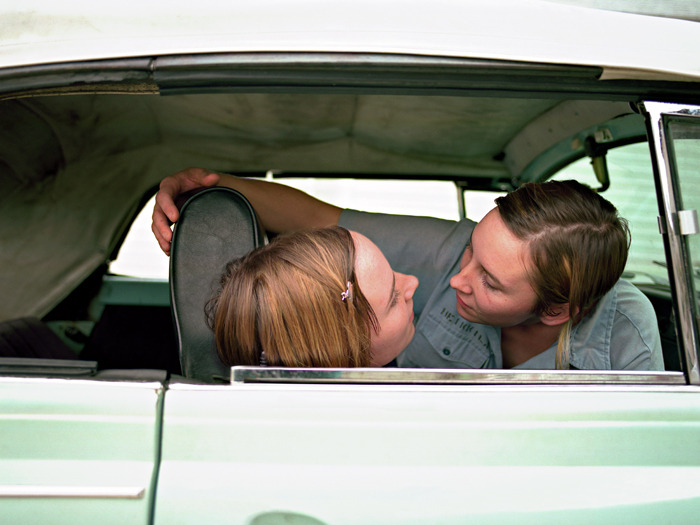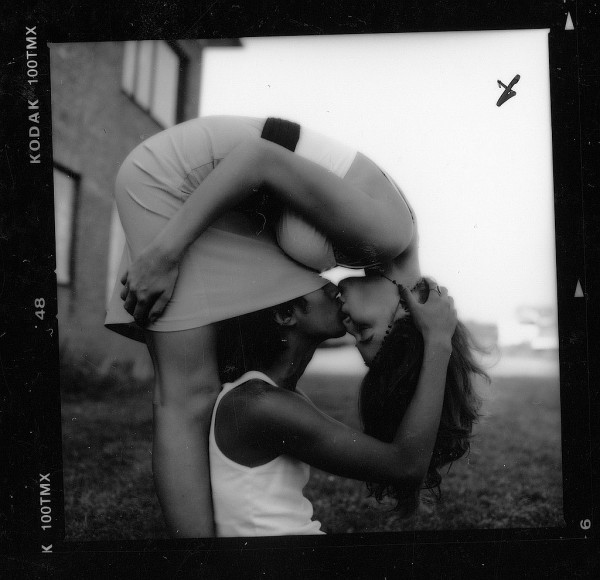
Kelli Connell – Convertible Kiss (2002)

Honestly, I am too profoundly moved by this body of work to offer any sort of worthwhile commentary–it’s just effing exquisitely devastating.

So beyond begging you to spend some time with this work, I’m going to let the artist speak in her own words:

These images were created from scanning and manipulating
two or more negatives in Adobe Photoshop.  Using the computer as a tool
to create a “believable” situation is not that different from accepting
any photograph as an object of truth, or by creating a story about two
people seen laughing, making-out, or quarreling in a restaurant. These
photographs reconstruct the private relationships that I have
experienced personally, witnessed in public, or watched on television.  
The events portrayed in these photographs look believable, yet have
never occurred.  By digitally creating a photograph that is a composite
of multiple negatives of the same model in one setting, the self is
exposed as not a solidified being in reality, but as a representation of
social and interior investigations that happen within the mind.

This work represents an autobiographical questioning of sexuality and
gender roles that shape the identity of  the self in intimate
relationships. Polarities of identity such as the masculine and feminine
psyche, the irrational and rational self, the exterior and interior
self, the motivated and resigned self are portrayed.  By combining
multiple photographic negatives of the same model in each image, the
dualities of the self are defined by body language and clothing worn.
This work is an honest representation of the duality or multiplicity of
the self in regards to decisions about intimate relationships, family,
belief systems and lifestyle options.

The importance of these images lies in the representation of interior
dilemmas portrayed as an external object – a photograph.  Through these
images the audience is presented with “constructed realities”.  I am
interested in not only what the subject matter says about myself, but
also what the viewers response to these images says about their own
identities and social constructs.

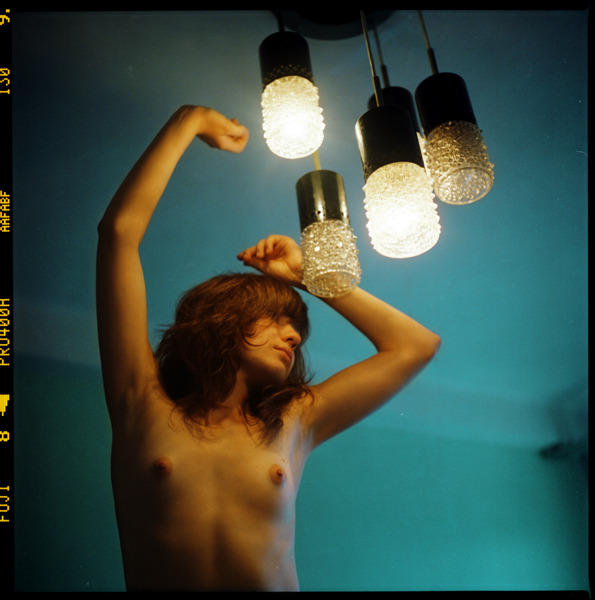
Furka Ishchuk-PaltsevaHen Party (2009)

If you’ve followed this project for a while, you’ll be well versed in my own personal bias against digital in favor of good, old-fashioned film.

I’m not a Luddite–hell, my day job is as Systems Admin. It’s not that I’m incapable of working digitally–I have digital gear and I possess a general mastery of working with it.

Why do I prefer analog? Well, there’s the obvious reasons: film’s vastly superior resolution coupled with the feel that an organic grain structure contributes the image. It is those things but it’s also about process.

One of the first things you learn when you begin to study cinematography is that not all light is created equal. By ‘equal’, I mean that the temperature at which a source of illumination burns determines the color of the light.

For example: although we think of the sun as yellow, we think of sunlight as white when, in fact, daylight is blue in color and burn at approximately 5600K. (Interesting note: daylight is bluer in winter, more yellow in summer.) A standard incandescent bulb–not these new-fangled CFL bulbs which you can buy in any number of color temperatures but always seem to make everything look like a pile of shit under restaurant heating lamps–or tungsten illumination burns at about 3200K.

Thus when you are shooting something you have to consider in advance what your light sources will be. Are you shooting in Midtown Manhattan at high noon? Well, then you’re probably going to want Daylight balanced stock. Shooting a family dinner scene that happens at night? Tungsten balanced stock is probably gonna be the way to fly. (Of course, you can shoot whatever stock and either adjust your lighting to match it or slap a filter on the lens to correct. The last time I shot 16mm stock, I shot everything on daylight balanced stock and made sure to shoot color bars at the head of each reel and then had the lab color correct the telecine.)

From a process standpoint, I prefer having the decision about color balance made in advance. It’s one less thing to measure. (And really that’s probably the thing I hate most about digital. The workflow is fussier to me than analog where I find my frame and the camera becomes a reference instead of a distraction. With digital, I have to white balance. I have to judge exposure using the histogram. (Honestly, fuck histograms. Give me a Sekonic L-398A any day of the week and twice on Sunday. That way I’m interacting with the scene instead of evaluating it on some shitty, small ass LED camera back or worse a $10K HDMI monitor.)

With digital, I am intensely suspicious of the instant gratification. You snap a shot, you record the scene and you can playback everything immediately. It foments this WYSIWYG approach to art-making that strikes me as repugnant.

It’s like the Stanford marshmallow experiment, wherein researchers offered children one marshmallow now or two later on. There’s no way around it, digital is the child who insists on instant gratification.

That’s what I love about this image. Fuji Pro 400H is a daylight balanced color negative stock. But the primary source of illumination comes from Tungsten bulbs in the overhead fixtures. This pushes the daylight on the ceiling and wall blue-green, while tinging the young woman’s skin orange.

In fact, it’s the color that ‘sells’ this image. The composition is interesting but not really inspired. The languid lazy dancing would seem contrived if not for the way the color functions to separate the body from the background.

Ultimately, that’s what I appreciate most about this image. Triggering the shutter on a scene like this is always a risk–no matter your degree of expertise. You can only intuit that it’ll turn out readable.

Yes, the more you do it the better your instincts become… but there’s always an leap of faith required on the part of the camera operator. You can’t just check the LED screen to make sure you’ve got it.

And that’s what I love this so much because I know what it’s like to re-experience the wonder that drove you to memorialize the image in the first place–without knowing whether or not it would turn out. And the extreme wonder when it does and the moment you see on the film is like a glinting spark in amber, that when it hits the light just right, puts you nearly out-of-body back into the feeling you wanted to hold onto so you clicked the shutter and prayed it would work out.

That ability is the reason I bother with this photography thing.

thebodyasconduit [Traci Matlock‘s Tumblr] – Ruby Slipper (2015)

As much as I carry on about composition as a facet of qualitatively ‘good’ photography and image making, truth told: I always favor work which presents the singular immediacy of The Moment.

For example: this depiction of a threesome is indelibly imprinted on my psyche. Is it a qualitatively good image? I’d argue it’s no more and no less important than a broad swatch of Nan Goldin’s photos. The difference is the former is fixated on the immediacy of documenting a moment, whereas Goldin is more interested in photography as an act of memorializing.

Admittedly, both are two shadows cast by the same motivation; but, in Goldin’s case there’s an implicit questioning of how perception works. Given that it’s a hop skip and a jump to an assumption that the work must function as some sort of implicit eye training–exists at least in some part as a means of instruction in or illumination of How We See ™.

And to bring it back to the actual image I’m posting: Traci has been posting a lot of work she made last month with Ruby Slipper. Really, their recent collaboration is just the cat’s fucking meow–you really should check it out.

In looking at this work, I am starting to notice the ways Matlock has matured as a photographer. As long as I’ve known of her work, she’s been better than just about anyone at tapping into the objectless transcendence of The Moment. Her compositions have similarly always been on point. Yet, what is emerging in her work is a sort of hybrid between Stephen Shore’s ability to compose a perfectly balanced frame that appears as if he snapped it off hand as a casual afterthought; or, Garry Winogrand‘s seeming accidental–but in truth, anything but–perspectives.

The work also has something to say about the role color should play in photography. I think I’ve always seen Matlock as a follower of Eggleston; this making it even more clear–afterall, Eggleston pretty much single-handedly legitimated the Art value of color.

But seeing that it makes me question such an assumption. There’s really something here interrogating the boundaries between pigment on canvas and painting with light itself. The above image reminds me of a painting–which, of course, since I’m hung over as the queen in Maida Vale, I can’t recall the painter but it’s like van Gogh and Klimt collaborated.

I’ve put this all badly but my point is simply this: good work shows you something new; great work shows you something you’ve already seen in a new and different light.

Given that metric: Matlock’s work is probably whatever comes after good merges with great.

Igor Mukhinimg167 (2009)

I’ve been looking at a metric fuck ton of Mark Steinmetz’s photos lately. And the reason I mention him is because of the fact that although I adore his use of space, he compositions don’t adhere to any ideal with which I am familiar.

With Mukhin, I can always draw a diagram. For example in the above image the staging from left to right of the nude male (standing in a modified contrapposto stance), the woman (whose semi-striding pose wouldn’t be out of place in one of those infamous Soviet war memorials) and the towel/purse hanging from the sapling form a triad that is not only easy to scan but also suggests a downhill slope from right to left toward the stream.

There’s also the little details: the darkest points in the frame are the purse and her inseam. This pulls the eye back to the man’s carefully man-scaped, uncircumcised member. (I enjoy the contradiction in his more modest post and the way she seems to be standing to block him from view slightly even though clearly whatever led up to this scene didn’t involve any sort of concern for modesty).

In fact, that’s what I think I dig most about Mukhin’s work: even aside from the fact that he tends to release images in groups inclusive of a particular happening, removed from the grouping there’s still very much a feeling of the image as rooted firmly in a very particular milieu. The virtue of what is included is that it points strongly towards what was excluded.

(In a value-neutral judgment, Steinmetz’s photos are dislocated, free floating, timeless. Thus his tendency to name images with their location.)

And I’m not sure if it’s because the first thing I encountered of Mukhin’s was his more erotic imagery but to me the specter of permissive sexuality seems to always resonate with his work. Such as here, where I can’t help wondering if what I think might have led to the need to brush one’s teeth is why the woman is brushing her teeth.

This photograph verges on being narrative because I want to know the nature of the events that led up to this moment. And the thing that Mukhin is so talented at doing is presented as a story something that he as the image maker stands in the same position as the viewer with regards to curiosity as far as origination.

Lynn KasztanovicsTitle Unknown (200X)

On the infrequent occasion I’ll publicly admit to ‘being a photographer’ and because I live in NYC where everyone seems to know something about art, the question arises: which photographers influence your work?

I never know how to respond. I mean Francesca Woodman and I are involved. But who doesn’t like her? She was that rare and singular wunderkind, we term a ‘prodigy’. I’m nearing the 10,000 hour point when it comes to studying Sally Mann’s work. I adore Jeff Wall for both his technical skill and the narrative angle in his work. I’ve yet to encounter a Stephen Shore frame wherein the composition fails to exemplify perfection. (Plus, he’s damn hilarious… if you don’t leave his work feeling like you’ve spent time with the subversive uncle at the family reunion who convinces the little one’s that the moon is made of green cheese and that you have to hold your breath when driving through tunnels because the air is poisonous and then leaves the kids’ parents to deal with the fallout…then you haven’t really engaged with the work properly.) Recently, I’ve been finding myself flat out hypnotized by Mark Steinmetz’s heavenly eye and the way it locates transcendent beauty in mundane exigencies.

Despite incredible talent, your average Jane on the street isn’t going to know Allison Barnes or Prue Stent or Igor Mukhin. (I’ve mentioned Traci Matlock and Ashley MacLean and increasingly folks have some idea of who they are/were.)

The truth is–and probably also the reason my work will never be deemed ‘important’–in my heart of hearts, Lynn Kasztanovics is the most important photographer in the history of photography.

As with most things I feel so completely through and through, I have a hard time knowing how to explain this preposterous insistence except to say her work is the appositive of the seven syllable Fuegian sentence word Martin Buber mentions in his astounding I and Thou:

They look at each other, each waiting for the other to offer to do that which both desire but neither wishes to do.

Sans all the abstraction: her work is like seeing something beautiful and in the moment of realizing you want to touch it, it reaches out to you and tucks a stray strand of hair behind your ear then smiles before looking away shyly.

wonderlust photoworksMx Inchoate (2014)

I always thought that if I could just figure it all out then they saying would take care of itself.

…except when understanding dawned, fitting the unexpected truth of knowing to words proved more impossible than I could have imagined.

But, maybe if I can’t say it, I can show you.

I’m still failing and it’s not really any easier than finding the right words but despite it sometimes the feeling, the tone and the scope of a moment bleeds through from around the edges of my desolation and stuborn idiocy.

It hurt to shoot this. It hurts to look at it. But I have to look.

If I could just show you, if I could offer but a flickering glimpse…

Allison Barnes –  [↑] July 30: Incision (2012); [←] July 23 (2012); [→] Bruised Vein from Neither For Me Honey Nor the Honey Bee (2014); [↓] July 24 (2012)

Little else drops me down a k-hole faster than stumbling upon a photographer whose work thoroughly engages me.

I spent a good part of yesterday pouring over Allison Barnes’ work. Given her proclivity for shooting analog large format almost exclusively, this shouldn’t be a surprise.

What surprised the fucking shit out of me was how far off base my initial impressions were.

For better or worse, I think everyone tends to start from what they know based on their experience. Barnes initially struck me as a photographer preoccupied with Francesca Woodman, Sally Mann and Ana Mendieta.

Following those markers leads down lush verdant path passing interesting scenic overlooks; but sooner or later each dead ends, leaving you to retrace your steps and then begin again from the beginning.

What’s strange is it almost feels like these false trails are supposed to be followed–as if in following them to their end the work is teaching the viewer how to see it, as if initial misunderstanding is somehow integral to any sort of eventual understanding…

It’s this that dismisses perfunctory correlations with Woodman and Mann–both being more caught up in aesthetic interrogations of the trilateral relationship between author, subject and audience, how that relationship manipulates objectivity.

The Mendieta trail does stretch further than the others but in the end Barnes veers away from carefully manicured feral confrontation for something not exactly patient or even contemplative so much as the expectant stillness of someone willing to wait for you to get the ever-so-clever joke in the otherwise grave conversation.

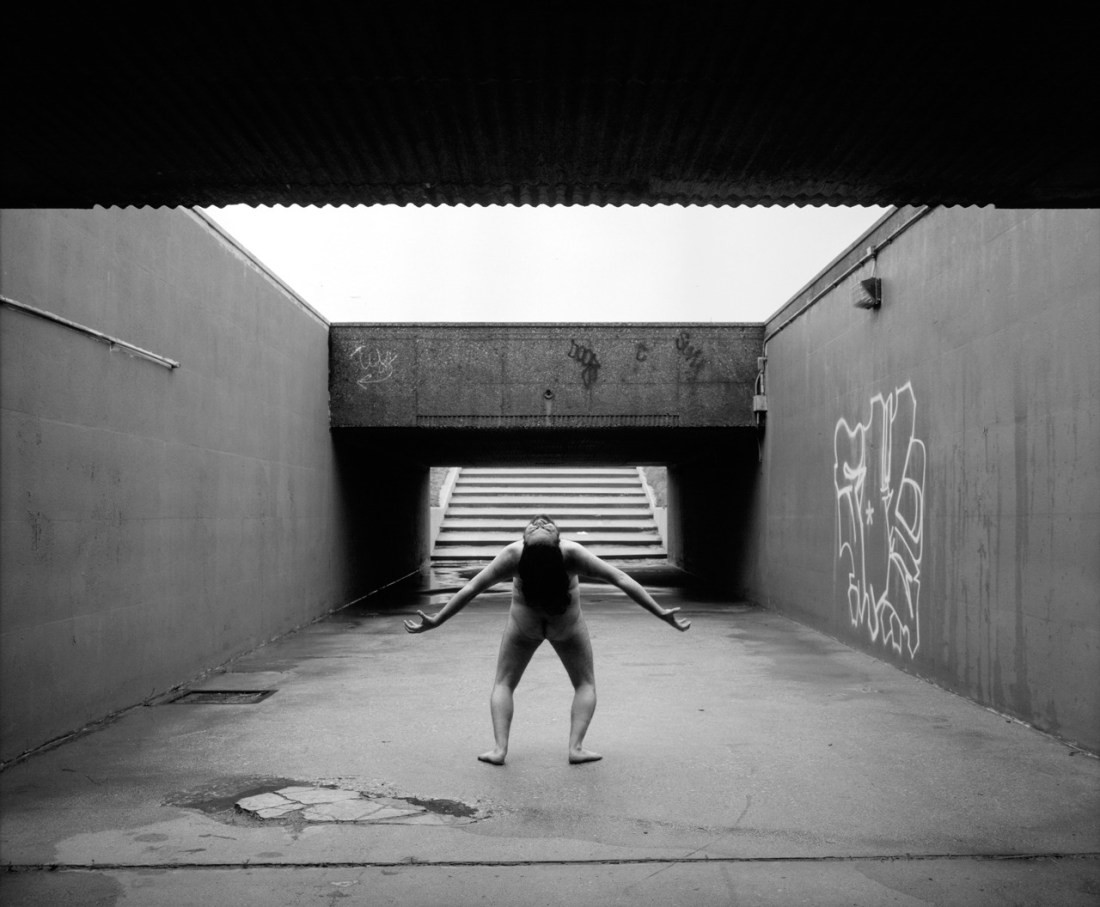
Ryan Muirheadyour picture out of time/left aching in my mind/shadows kept alive (201X)

I’ve heard that you can recognize a photographer
by how they continually compose the edges of their frames,

that each quarter-second decision to exclude, to define a boundary,
to say what will not be in the photograph

is as explicit as a thumbprint.

–Traci Matlock

I find this metaphor appealing for dozens of reasons.

From police commish to your average Jane on the street, the police procedural and its popularity have instilled a near universal awareness of the distinctive singularity of the human finger print.

Recently, I learned a bit about the methodology underlying dermatoglyphics; namely, a fingerprint consist of one of three patterns: whorls, loops or arch.

5% of all fingerprints are arches.

Every fingerprint is–in theory unique–but arched prints are, in effect, doubly unique.

I feel this contributes a certain added elegance to the metaphor. Yes, image composition is as explicit as a thumbprint; but, there are certain image makers whose composition is so distinctively singular, that they stand out at forty yards under bad light as belong to a particular artist.

Ryan Muirhead work is a good exemplar.

He prefers vertical frame orientation. And not to disappoint long time followers but I am not at all inclined to dive for my customary #skinnyframebullshit accusation.

Why? Well, there may be grounds for questioning where stylistic affectation ends and compositional logic begins—Muirhead’s wide framed images are more compelling (at least to my eye). ultimately though I can’t fault his skinny frames–they routinely contribute a preternatural dynamism, cleverly accentuate shape and form (rightmost image), ground portraits in a specific context, all while exploring a diverse range of technical nuance to precocious effect.

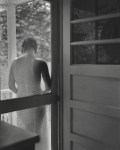
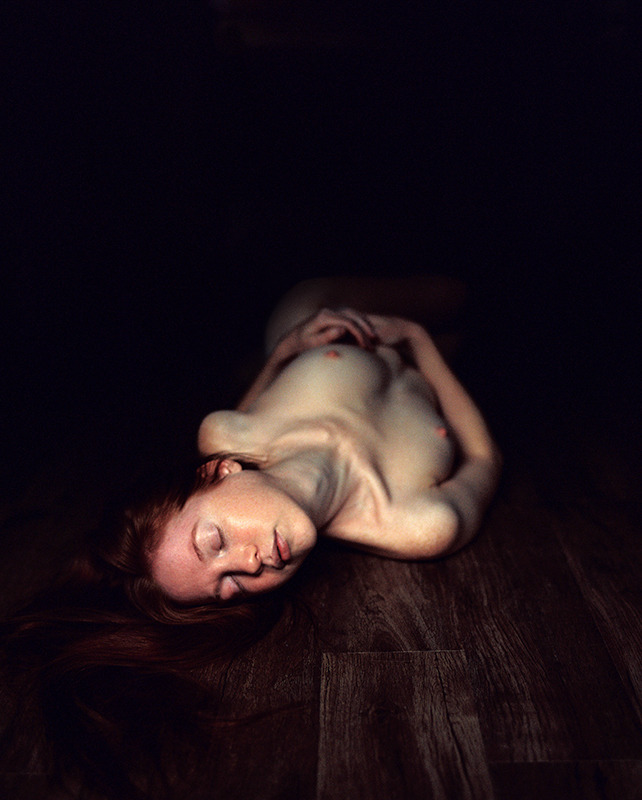
Given all that, I’m not entirely sure vertical orientation adds anything to this image. Don’t get me wrong–it’s one of the best conceived and executed nudes I’ve encountered in months, completely unlike anything I’ve ever seen. I am enamored by the way it finds a way for stillness and restlessness to coexist in the same space in time. The only word I can attribute to nature of the gaze is respectful.

Unlike many photographers whose work impresses me at first blush, researching Muirhead further did little to diminish my interest. In fact, this beyond on point interview over at This Is Imperfect honestly impressed the shit out of me.

Merel WessingTitle Unknown (200X)

I’m not 100% as far as the attribution on this.

Google Image search best guesses as Belgian model Merel Wessing.

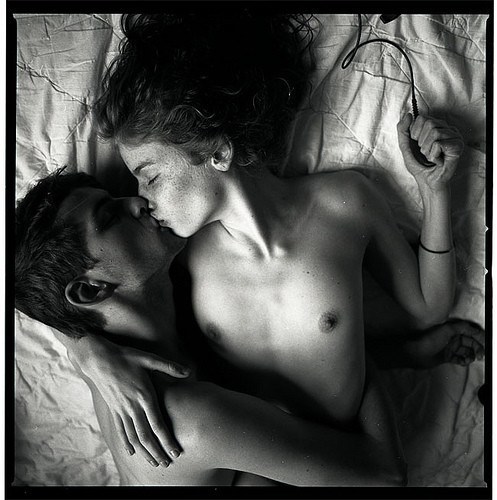
With the galaxies of freckles on her forehead and around her eyes, this is almost certainly the same young woman.

It seems she’s a photographer too. Or was, at least–there’s a Flickr account bearing her name and the The Way Back Machine shows updates between 2007 and 2011.

Unfortunately, none of those images are cached. Anywhere as far as I can tell.

Excepting the above, another photo from this same ‘shoot’ and this, her work has been scrubbed from the Internet.

Although there’s no way to qualitatively assess her abilities based on three photographs, the images–especially this one–justifying a strong curiosity with regard to the rest of her work.

I have an itching suspicion she was/is very good, if not flat out phenomenal.